I agree that this is a strange name for a restaurant – Shopping Shrimp Restaurant – but I was told it is the transliteration from Chinese into English. Anyway, the three of us, Jim, Steve and myself, we were really looking forward to check out this place.
Jim had been there before and was raving about the pepper shrimps, the best in the world. In fact the “shrimps” turned out to be Thai prawns. Why did I have to come from Bangkok to sample Thai prawns here on the beautiful island of Formosa?
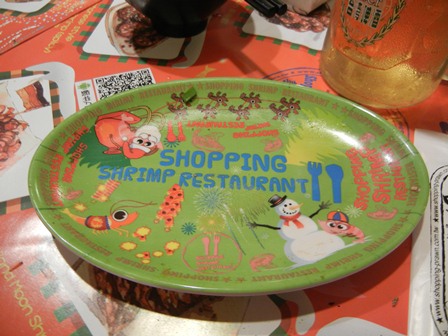
Tacky plastic plates at Shopping Shrimp
The deal was that you could eat as much as you wanted for 499 NT $ including four mugs of 0.4 litres of beer. Who can refuse such an offer?
From the International Center for Land Policy Studies and Training (國際土地政策研究訓練中心), where the three of us were teaching, we jumped on the bus to Bade and reached the restaurant in no time.
The inside of Shopping Shrimp Restaurant
We were early and the place was still rather empty. Later it should fill up quickly. The friendly staff selected among themselves the one who spoke some English and off we went and ordered our food.
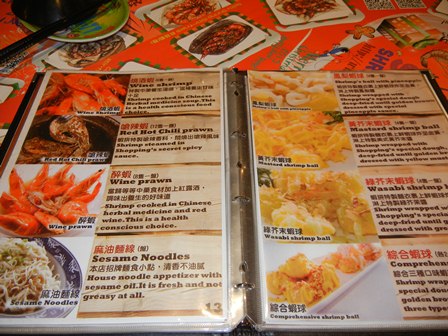
The menu
The menu was in English and Chinese with big colour photos so that one would know what was ordered. We selected a few dishes, and anxiously awaited what was to come.
Pepper shrimps in a clay pot
It did not take long and the first clay pot of pepper shrimps arrived at our table. More followed soon. the waiter brought us the menu for more orders and we sampled the various types of prawns in all flavours and shapes.
Garlic shrimps
More shrimps
Shrimps wrapped in a leave
Shrimps on rice
Needless to say that the food was super delicious. We ordered more and more, even another pepper shrimp clay pot. We did not need carbs that night.
Taiwan draft beer
Needless to say, we washed the food down with fresh Taiwan draft beer. The three of us, we had a jolly good time. Shopping Shrimp Restaurant is a cool and groovy place.
Remark: Steve and Jim are from San Diego, they taught me Californian slang over dinner.
I am in Hong Kong right now and very busy with my day job, which keeps me busy at night as well. So no time to write anything meaningful. Yesterdays local newspaper, the South China Morning Post, carried an interesting article about wine consumption in the territory. Moreover, two additional sections of the paper were devoted to food and wine and the up-coming wine and spirits fair.
Unfortunately, I will leave early tomorrow morning and therefore will miss the wine and spirits fair when it is open to the public on Saturday. If I would have known beforehand. The event must be an exciting one. There are 950 exhibitors from 36 countries, among them also the World’s Best Winemaker, Australia’s McGuigan Winery.
The import data on wine are impressive. Especially new world wine imports increased last year in Hong Kong. The sharpest increase was reported for wines from South Africa where sales were up by 52 % by value and 47% by volume. Imports from Chile increased by 36% and 33% respectively.
The bad news is that total wine imports dropped by 18% in value over the last year. Wines from France are still the most popular in Hong Kong. On the plane tomorrow morning, i will study the trade magazine and learn more about the fascinating world of wine consumption in Hong Kong.
My readers know that I adore Riesling wines. Here is another one which we had with a delicious pasta (see photo above) the other day. The intensity of the tomatoe sauce was matched by the vivid citrus aromas, the fine balance of the acids and the mineral character of the Riesling from the Rheingau, Germany.
The ‘2011 Steinberger Riesling trocken (dry)’ by the famous estate of Kloster Eberbach is a great drop for every day consumption. It is their basic wine, and at the cost of 8.90 Euro it is quite affordable. The wine has all what it takes to be an excellent Riesling.
Enjoy.
As the name “Steinberger” suggests, the vineyard is a kind of “stone hill” and just located nearby the monastry. For centuries fine wines were produced from this terroir. The short video below gives you an idea about it.
As you know, I like to eat game of all kind. The best wild boar I have eaten in a long time was served to me by my good old friend Ulrich Hillejan and his wife Elfriede when we visited them this summer near Muenster. The so called Muensterland is a very picturesque agricultural region right north of the former industrial heartland of the Ruhr.
Ulrich comes from a tranditional farming family which goes back a couple of hundred years (he keeps very impressive records). He inherited one of the traditional farm houses away from the manor house, just outside the nearby village.
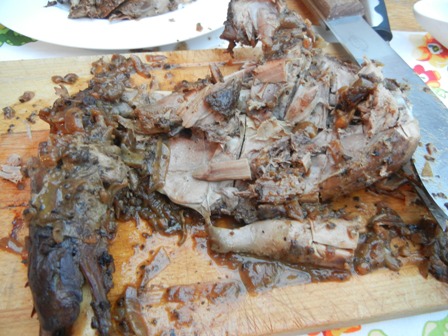
His mother (I call her aunty Doris) prepared for us the leg of a young wild boar, shot by Ulrich’s younger brother Georg. Let me say from the outset that this was the best piece of game I have ever eaten. I asked her to tell me the secret of this delicacy. Her instructions were rather sketchy. I figured that mustard plays a central role. The meat needs to be rubbed carefully with a mustard-pepper-salt potion.
The following photos show what we had for dinner. Of course the side dish with the carbs consisted of good German potatoes.
The potatoes
The young wild boar’s leg
On the plate
And after….
Needless to say that we had various kinds of delicious wines with our meal. We started the extensive tasting with a white wine, a fresh Gruener Veltliner from Weingut Setzer, Austria. The Setzer winery was decoreated with the “winery of the year 2013” award.
The estate has about 30 ha under vines and produces a wide variety of wines. Main grape variety are Gruener Veltliner, and red Veltliner. Recently, Hans Setzer, owner-operater of the estate, was awarded with the “Vinter of the year award” for 2013. With its low (11%) alcohol content, this wine is wonderful for warm summer days. It is refreshing and shows great temperament.
Gruener Veltliner Vesper, Austria
Knipser Riesling, Pfalz
We followed up with a German dry Riesling by the well-known Knipser Estate in Laumersheim, Pfalz.In 2009 the winery was awarded the “vintner-of-the-year” award by Gault Millau.
The ‘2001 Laumersheimer Kapellenberg Riesling Kabinett Trocken’ was just the right wine to complement the meal. I like the minerally note and the tropical fruit aromas.
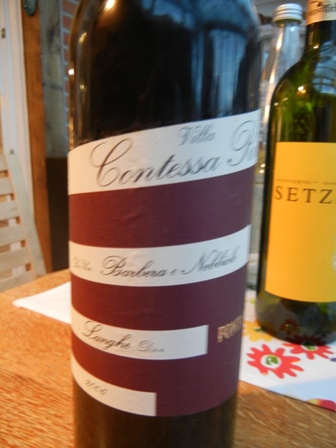
Barbera and Nebbiolo blend by Villa Contessa Rosa
Mid-term through the meal, we changed colour and switched to a red wine from Italy. Villa Contessa Rosa has currently about 70 ha under vines. The blend of Barbera and Nebbiolo, produced in the wine region Langhe, was also a good accompliment to the wild boar.
The meat from the forest animal and the red and Forest berry aromas from the wine went well together. Below you see the colour of the drop from heaven.
From here on I lost track of the wines we sampled in the course of the evening. There were a few more red wines, but honestly I cannot recall what they were and where they came from.
The generosity of our hosts knew no bounds, I might say (thank you again Ulrich and Elfriede). It was a terrific evening of reminiscing about the past and making plans for the future.
As you know there is not really a summer in the tropics. We have different seasons than temperate climates. However, when the rainy season has come to an end, days are getting hotter, and the meal I am going to describe is exactly for such days.
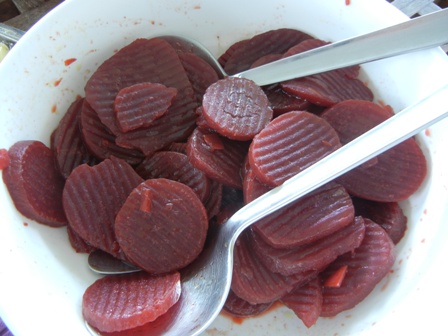
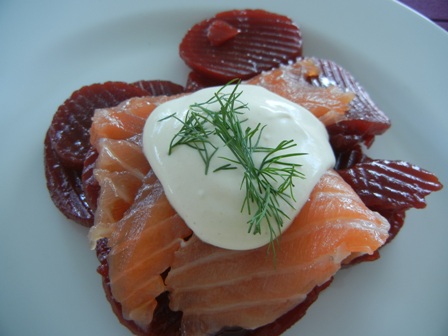
We had a beetroot salad with some cured salmon and a self-made sauce based on yoghurt. For carbs, we offered a selection of bagels. Look at the photos below. Doesn’t the food look delicious?
Beetroot salad
Salmon
And here the ensemble on the plate
Bagels from the supermarket
I would agree that bagels from a proper bakery would be superior to the ones shown above. But hold it. Remember we live in Bangkok!
Since it was a weekday, no special wine was pulled from my wine fridge. Instead I opened a bottle of a mass produced Sauvignon Blanc by Tahuna from the Marlborough wine region in New Zealand.
I was a bit worried at first, since the vintage was 2009 but the wine was in a perfect condition. It showed all the characteristics of a solid but inexpensive Sauvignon Blanc, and satisfied our needs for a glass of wine with our light lunch on a perfect summers’ day. Cheers
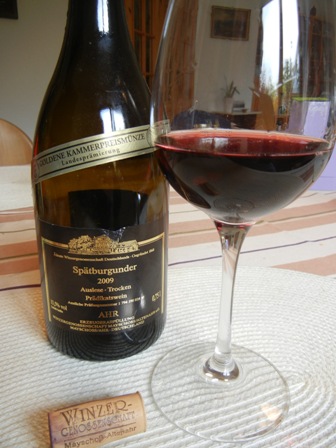
The Ahr wine region is well known for producing outstanding Pinot Noir wines in Germany. During a visit this summer we bought a bottle of ‘2009 Spaetburgunder Auslese dry’ from the Mayschoss Vintner Co-operative.
The co-operative is the oldest in Germany. In 2012 one of it’s wines was awarded the best “Blanc de Noir of Germany” title by the food magazine „Der Feinschmecker“ (5/2012 edition). We visited the cellar door in August and had a guided tour which was very lovely.
Recently I tasted the Mayschoss Pinot Noir together with my friend Juergen. The wine has a beautiful dark red colour. The black fruit aromas with a tiny hint of peach are lovely. The wine is medium-bodied, smooth and shows a fine balance. We drank it on a Sunday morning, just like that without food, what we call in Germany a “Fruehschoppen”, a drink (glass of wine or beer) taken after church, and before going home for lunch.
Thanks Juergen and Elisabeth for the excellent company.
I love the recipes from Jamie Oliver. In his book: “Jamie does…”, the Aegean Kakavia, a Greek fish stew, is presented.
These days, as you know, there is some kind of weariness between Greek and German people because of the currency and bailout issues. So a Greek dish with a German wine seemed the right pairing; hinting at some kind of reconciliation or just because fish and Riesling harmonize so well?
I don’t know.
The recipe is dead simple. The beauty is that any fish will do. We had flounder and prawns. Chop some onions, tomatoes, garlic, celery and potatoes and cook it in some vegetable stock, with olive oil, lemon juice, salt and pepper. At the end add some fresh parsley and dill, and voilà, here we are.
2010 dry Riesling by Emrich-Schoenleber
I love Riesling and hold the wines made by Emrich-Schoenleber Estate in Monzingen, Nahe in high esteem. They remind me of my childhood and the time I spent with my maternal grandfather in Martinstein, just a couple of kilometres to the West.
This low alcohol (11.5%), bone dry Riesling is a fine specimen of what the Nahe wine region can produce. The wine is fresh and zesty, with intense lemon aromas, well balanced acidity and a long finish. I could have a bottle every day…but since I live in Bangkok, this is hardly possible. The more I treasure this fine Riesling wine.
If you happen to pass by the Nahe, visit the winery of the father and son vintner duo and enjoy a 250-year tradition of grape-growing and wine-making. The cellar door of the Emrich-Schoenleber family is a beautiful place to taste fine wines. You will not regret it.
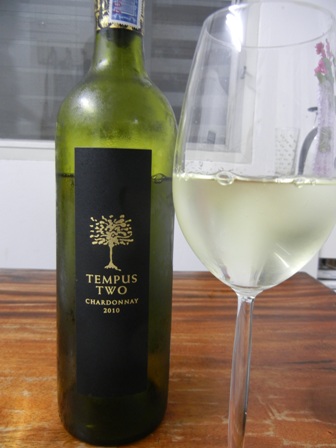
The grapes for this wine are actually not coming from the Hunter valley but from the cool climate Adelaide Hills wine region. The wine is a modern product, harvested by machine, made in steel tanks and briefly kept in French oak barrels in order to get the spicy vanilla character.
The Tempus Two winery, founded by Lisa McGuigan, a member of the fourth generation dynasty of celebrated vintners, the McGuigans, is situated in the Hunter valley.
The cellar door, an ultra-modern building, is just outside Pokolbin in the Hunter Valley, New South Wales in the foothills of the Brokenback Ranges (a region with freezing cold winters). Fruit for the Tempus Two wines comes from many different vineyards wine regions all over Australia. The band was established in 1998 only.
Back label explaining what you taste
This mass produced wine, is something for easy, every-day drinking. Apart from the Chardonnay, the Varietal Range includes a Blanc de blanc, a Verdelho, a Semillon Sauvignon Blanc, a Merlot, a Cabernet Merlot and a Shiraz.
The two premium brands are called the Pewter Range, which comes in distinctive bottle shapes, and the Copper Range, with more modern-style wines.
Since we were on a modified Dukan diet ( we made concessions for the alcohol), we had it with fish, a mackerel, which is a strongly-flavoured and oily fish. The wine coped well with the strong fishy taste. The citrus flavours and the high acidity were a great complement to the food.
Mackerel
I would have eaten another portion of the fish, and certainly could have had a second bottle of wine. My verdict: highly recommended.
PS: In Thailand, Siam Winery is the agent of Tempus Two.
In the last week of September three of my favourite German wineries were honoured by the Wine & Spirits Magazine, and included in the top 100 list of the best wineries of the world in 2012.
The three wineries are the following:
1. Dr. Loosen, Bernkastel, Mosel
The winery has been in the Loosen family for more than 200 years. Ernst Loosen took over in 1988, and, as they say, the rest is history. Dr. Loosen is maybe one of the best known German vintners in the international wine scene. I was so happy when Barrique, my local wine shop in Healesville, Victoria was carrying Dr. Loosen wines.
Address: Winery Dr. Loosen,
St. Johannishof
54470 Bernkastel, Mosel
Tel.: +49-6531-3426
info@drloosen.com www.drloosen.com
2. C. von Schubert, Mertesdorf, Ruwer, Mosel
This winery has also a long tradition. The “Grünhaus”, as the estate is also known, was already mentioned in ancient documents in 966 when it belonged to the Benedictine monastery of Saint Maximin in Trier.
Carl von Schubert, the current owner-operator, belongs to the fifth generation of the von Schubert family. The estate produces outstanding wines and was awarded many national and international prices. I tasted some of the Maximin Grünhäuser 2011 vintage dry Riesling wines during our summer vacation
Address: Dr. Carl von Schubert
Hauptstr. 1
54318 Mertesdorf
Tel.:+49-651-5111
Fax: +49-651-52122
info@vonschubert.de www.vonschubert.com
3. Robert Weil, Kiedrich, Rheingau
The winery was set-up in 1875. The founder was the university professor Robert Weil who taught German at the Sorbonne in Paris. The Franco-Prussian war of 1870/71 forced him to return to his native Germany. He settled down in Kiedrich, Rheingau and extended his vineyards and laid the foundation for today’s estate. In 2010 I found some bottles of the Robert Weil 2008 vintage in a Bangkok wine shop. Delicious.
Address: Winery Robert Weil
Mühlberg 5
65399 Kiedrich, Rheingau
Tel.: +49-6123 2308
Fax: +49-6123 1546
info(at)weingut-robert-weil.com www.weingut-robert-weil.com
When a little boy, my Australian nephew Nick, had written in a guest book “great place, crap food”. I was reminded of this great line the other day when we tried to enjoy a wonderful Jamie Oliver seafood dish with a mass produced, cheap industrial wine. We adapted this seafood soup from Los Angeles to accommodate Thai conditions.
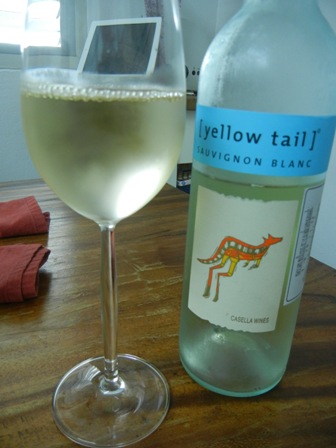
Yellow tail SB from Australia and New Zealand
We knew what we were in for. I was not surprised that this wine by yellow tail was of low quality. The Shiraz from the same series, I would call “very drinkable”. The Sauvignon Blanc is also “drinkable”, however, I would omit the word “very”. Anyway.
But a good thing happened nonetheless, and that was the big surprise for me. Because of the high quality of the food, the wine was, shall I say “augmented” beyond belief. It became quite drinkable.
Yellow tail Sauvignon Blanc
The bottle does not carry a production or vintage year. The blend is an Australian & New Zealand one, with grapes coming from both places. I do not know if the producer is doing himself a favour with this kind of wine. The fact that it is on the market is proof that there is demand, and therefore there should be supply.
After all, it was my choice to have this wine with the seafood soup.




 Posted by themanfrommoselriver
















 The Man from Mosel River