One of the privileges of a frequent traveller, even if exclusively travelling on economy class, is the use of the lounge. As a “wino” this is great territory to sense and experience some of the global trends in the wine industry and/or the airline service providers.
One such trend seems to be the use of paper cups instead of proper glasses. That’s at least what my recent experience in the business class lounge (star alliance) at Shanghai Pudong International Airport suggests.
I found the “wine ensemble” below. Isn’t it cute?
Wine at your service
I could not resist a tasting of the two wines on offer, a white from China and a red wine from France. Unfortunately I could not find any trace of the French wine in the internet. I had noted down “Tour Gouvercin” as the name of the wine (a Cabernet Sauvignon) which was quite pleasant to drink, fruity with body and structure.
The second wine, a ‘Clos des Chenes, dry white wine’ by Imperial Court, a brand re-designed and re-established by Shenma Winery. The wine was a bit “thin” but since the cooler (as seen in the picture above) guaranteed a pleasant temperature, I found it not so bad, light but technically well made.
My wine tasting at Shanghai Airport
China is not only an emerging world power but also a booming market for oversees wines. Chinese grape wine consumption increased from 554 million bottles in 2004 to 899 million bottles in 2008. However, per capita consumption is still very low, about 0.4 litres per person per year.
That’s all good news for wine producers and distributors. Also that imported wines account doe only about 11.8 % (2008) of total domestic consumption is “music in the ears” of the non-Chinese wine industry.
Wine educators have their tasks outlined for them as well. Chinese consumers do not like tannins and acids, often perceive grape wines as “sour” only. This is why the mixing of red Bordeaux wines with coke and spite is quite common consumption habit. This needs to be changes, I guess. Since Chinese people have very complex taste buds, it should not be too difficult to make them appreciate the wonders of fine wines.
A couple of weeks ago, we drank a very special type of wine, a white Rioja, vintage 1987, called Viña Tondonia White Reserva! Our wine-making friend, Timo Mayer from the Yarra Valley had brought the bottle all the way from Europe to Bangkok.
The winery is owned and managed by the third generation of the López de Heredia family. For a hundred and thirty one years this enterprise is producing exceptional and unique wines. The founder of the company, Rafael López de Heredia y Landeta, defined in the late nineteenth century what a “Supreme Rioja” wine could be. Viña Tondonia White Reserva 1987 bears witness to this philosophy.
Timo Mayer opening the bottle in our kitchen
The wine is made from Viura (about 70%, also called Macabeu in France) and Malvasia grapes. It was kept for 10 years on the yeast in old, large oak barrels and for 13 years in the bottle before the wine is finally released.
1987 is the current vintage! Who can afford to leave wine for 23 years in the cellar?
The wine is a unique experience. It is completely dry, has a fine bouquet with a hint of dried fruit. First, we did not know what to make of it but with each sip it dawned on us that we held something very special in our glasses. Awesome stuff, indeed. One can taste the passion which went into this wine.
Cheers mate
The wine can be bought in Germany from “Weinhalle“. It is not cheap but worth to be explored if you long for a unique and amazing wine experience.
To have an experienced wine-maker staying over at ones home is a blessing. I always learn so much about different wine styles and different wines. When Timo Mayer, owner and wine maker of The Mayer Vineyard in the Yarra Valley, visited us in Bangkok recently, we had the chance to catch up with the world of wine-making.
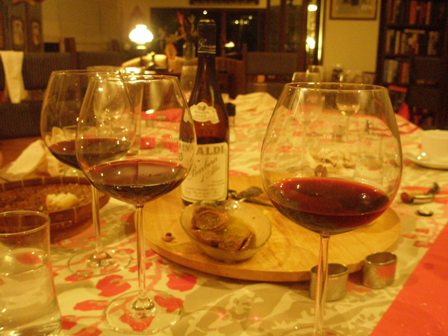
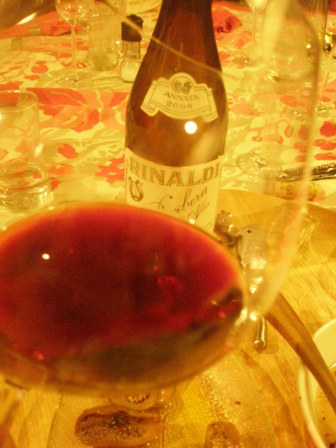
He brought a bottle of ‘2008 Barbera d’Asti’ of Giuseppe Rinaldi from Piemont, Italy. He had visited the winery on a study tour to Italy and wanted to share this treasure with us. Rinaldi makes his wines “the good old way”, using no barriques, no destemming, no filtration etc. He is one of only about a handful of wine-makers left who are not producing heavy (oaked) wines for the American market.
One bottle is just the beginning
The results of this traditional style wine-making are wonderful. The wine is fruity with a good structure, the acids are remarkable, the tannins are fine and delicate. You taste the earth the grapes were grown on and not the oak they were exposed to. This is Barbera d’Asti of the best. If you have a chance to indulge in it, my suggestions: do it.
Address: Rinaldi Giuseppe Az. Agr.
Via Monforte, 3
12060 Barolo (Cn)
Tel.: +39-173-56156
Fax: +39-173-56156
Year founded: 1890
Owner: Rinaldi Giuseppe
I am afraid some of you might not like this post and the pictures which I present today. But meat comes from animals and they have to die so that we can enjoy the meals we make from it. Wild pigs are a real pest in Germany theses days, and very difficult to hunt and kill. My friend Heinz shot the little boar in Schoden, Saar.
My mother prepared a wonderful Sunday lunch with the best parts of the meat. We enjoyed it together with a bottle of our Merlot (2004 Two Hills Merlot), and I tell you that was just heaven on a stick, as we say in Australia.
Recently, I finished reading the above book by George W. Taber. It is an excellent work. I was amazaed that one could write so much about the different aspects of this little think: the stopper in a bottle. Nowadays, quite a few different materials and techniques are available and every poor vintner needs to make up his mind what to chose.
At Two Hills Vineyard we went for the DIAM solution (technical cork) for our Merlot wines. Our German customers want a cork to pull and DIAM has never let us down. We have experimented with other corks but found that DIAM suits us best.
Moreover, I hate plastic. It does not do the job. I love glass. It is elegant and suggests superior quality of the wine because of its high price. In Australia screw caps are very widespreach. Almost 100% of white wines and maybe 80 % of all bottles are now under screw caps.
I learned from “To cork or not to cork”, that the last word is not yet spoken. It will be interesting to see how wine ages under screw cap and glass stoppers. If we make white wine again, I would chose screw caps for our Sauvignon Blanc, but maybe DIAM for Chardonnay. Our Merlot will definetely stay under DIAM. For Pinot Noir I would remain undecided. Hmm, I wonder what would be the best solution?
This is how a song line from South Africa goes. Paul Simon and Ladysmith Black Mambazo made it famous in my circles. Now the drought in Victoria seems to have come to an end (after 13 years or so). It rains and rains in northern and central Victoria.
Of cause rain brings also destruction, landslides at Mount Buller for instance, flash floods, rivers rising, people had to be evacuated, in short chaos across the state of Victoria. In some places they had 150 millimetres.
But our dams at Two Hills Vineyard are full now. That’s the good news. I have not seen our big dam as full as now. ‘Brownies landing” is floating for the first time in years.
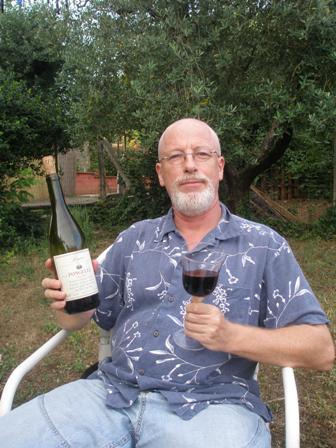
I have written about a wine from Villa Bucci some time ago (it’s Verdicchio). When I bought wines from Il Grappolo Divino and Alessandro Mauceri in Frascati, I also choose a red wine from Villa Bucci, the ‘2007 Pongelli’. This wine is a blend of 50/50 Montepulciano and Sangiovese grapes with 13.5% alcohol.
I served it slightly cooler than normal. Well, it was one of these hot days in Rome where you come out only in the evening. We had it without food, just like that, while sitting under the olive trees. It was a great experience to taste it.
The colour is a strong ruby red. Raspberry aromas were there with some hints of vanilla and leather. The tannins are soft and mellow. The wine has a good structure, is full bodied and has a strong finish. The Parker-point-fans give him 86-88 of 100. My verdict: if I only could get my hands on some bottles of this wine here in Bangkok.
If you are in Rome you are in a better position. Just go and visit the Castelli Romani; stop by in Frascati and see Alessandro Mauceri and his new wine shop: Il Grappolo Divino. There you can also buy the ‘Pongelli’ (among many other treasures).
Address: Il Grappolo Divino
Via dell’Olmo, 37
00044 Frascati
Italy
Tel.: +39-6-89026061
From Alessandro Mauceri and Il Grappolo Divino (Frascati) I acquired two bottles of wine from Villa Bucci, a red and a white one. Villa Bucci is located in Montecarotto (Pongelli), in the Le Marche region. The wines from this region are little known by the mainstream but definitely worth to be explored further.
Villa Bucci Verdicchio
Villa Bucci is a jewel of a winery from the Le Marche region. I was so happy with this discovery. Their Verdicchio wines are all made from their own grapes, grown on 21 ha at Castelli di Jesi.
Italy is maybe the place with the highest number of native vine varieties. Verdicchio, mainly grown in Le Marche, is one of them. High in acidity, the grape makes excellent white wines, fruity and nutty (almonds) with a capacity for aging gracefully.
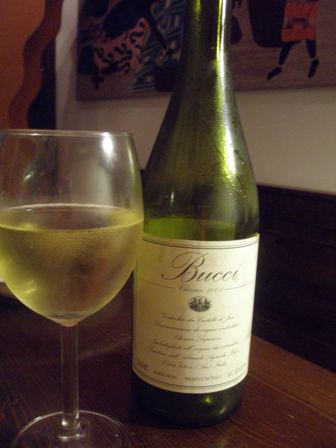
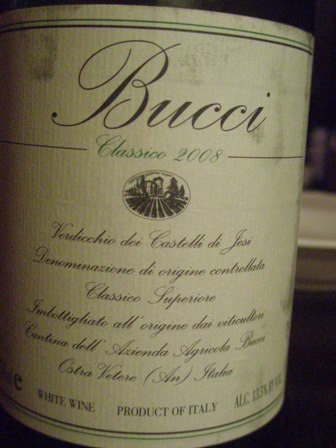
Back label of 2008 Bucci Verdicchio
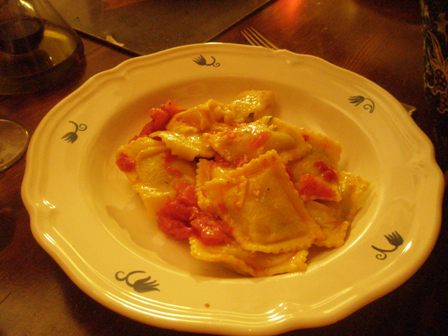
My bottle from 2008 had no time for that. We consumed it on a beautiful summers night with a delicious pasta. It is a young but elegant wine, with a golden greenish colour, fruity and fresh with a light almond aroma.
Thanks Alessandro for this selection. I highly recommend to everyone to try the wines from Villa Bucci in particular and Le Marche in general. Great learning.
I just love to eat fish, all kinds of fish. And there is good fish on offer in the markets of Bangkok. Often we do not have carbohydrates with it. But veggies are a must. They are a great complement for the protein.
What you need in addition is, if possible: a superb wine, preferably white.
A plate of fish and veg
Very delicious veggies
I admit that sometimes I drink red wine with fish but most of the time I select a white. Since I love to drink Riesling wines, that’s often my preferred choice. Another option I like is Sauvignon Blanc. But it needs to be a really good one. I like Sancerre style wines and the ‘2007 Mount Nelson Sauvignon Blanc’, from the Marlborough wine region of New Zealand seemed to be the right stuff.
But I did not buy the bottle because SB wines from New Zealand are in fashion right now. I bought it because the Mount Nelson brand is a project of a famous Italian wine dynasty, the Antinori’s from Tuscany.
Piero and Lodovico Antinori are the 26th generation of Italy’s most famous wine family. I wanted to know how their interpretation of New Zealand SB fruit would turn out. I should not be disappointed as it turned out later.
2007 Mount Nelson Sauvignon Blanc
In 2004 the Antinori brothers bought for US$ 1.8 million a 32 acres vineyard on the banks of the Taylor River near the mouth of Cloudy Bay not far from the Wither Hill Vineyard. To make the Mount Nelson SB additional fruit (about 40%) is purchased from the adjoining Meadowbank vineyard.
The 2007 vintage is just the best ever. This is the unanimous verdict of the wine critics (91 Parker points). I can only confirm this. My recommendation: buy buy buy.
The wine has zest, is fragrant with lime and lemon flavours and some mineral notes. The colour is beautiful straw-like. The finish is lasting. I forgot the alcohol content and the price. But rest assured if I see it in my local market again, I will buy all the bottles on the shelve.
Beautiful colour in the glass
In early July, we will be in Italy. There I will taste some more of the Antinori wines. This time Italian wines.
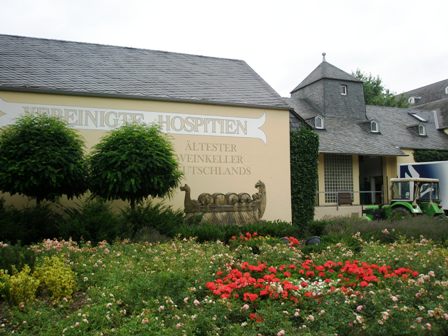
I grew up just next to the convent of St. Irminen at Irminenfreihof No. 5 in Trier, Mosel. The convent belongs to Vereinigte Hopitien, a foundation which also ownes a well known winery with the same name. Their English name is “United Hopices Wine Cellars“. The patron saint of United Hospices is St Jacob, an image of which is also used on the wineries labels.
As a kid I played in the cellars and warehouses of the convent. I also remember them sending their vats and barrels for controlling purposes to the Eichamt, the local Weights and Measures Office, which my father was heading. We played around the barrels and I vividly remember the smell emitted by the oak and the moist wood.
The winery
United Hospices owns vineyards along the Mosel (locations: Piesporter Goldtroepfchen and Triere Augenscheiner) and the Saar (locations in Wiltingen, for instance Hoelle, Scharzhofberg and Kupp, Kanzem and Serrig). Most of the vineyard originally belonged to monastries and convents. Today about 25 ha are under vines, 90% of which are planted with Riesling grapes (my favourite grape variety), the rest consists of Pinot Gris, Blanc and Noir.
As many of the wineries in Trier, also United Hospices has a large traditional wine cellar (some parts of it dating from the 3. century) which you should have a look at. Wine tasting in ths historic atmoshere are unforgettable events. United Hospices top wines are the dry and sweet (Trockenbeerenauslese) Scharzhofberger Riesling wines from the Saar some of which sell for up to 100 Euro/bottle. The ordinary Riesling wines cost about 6.20 Euro/1 l. bottle.
I hope you are going to visit Trier this summer and drop in for a wine tasting. Cheers
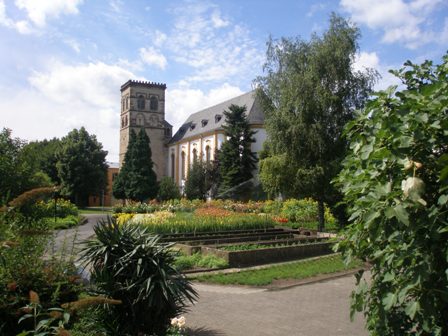
The main hospice building along the Mosel
Church St Irminen
Address: Vereinigte Hospitien
Krahnenufer 19
54290 Trier
Tel.: +49-651/945-1210 o. 0651/945-1211
Fax: +49-651/945-2060
Opening hours: Mo. – Thu. 08-12:30 and 13:30 to 17h; Friday closing at 16h, Saturday 10-14h


 Posted by themanfrommoselriver










 The Man from Mosel River