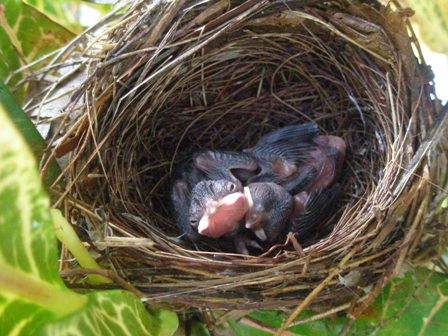
My two little Merbah Kapur – Yellow-vented Bulbuls have grown a little. The parents are very busy collecting insects to fee the two hungry beaks. They have also grown some feathers.

My two little Merbah Kapur – Yellow-vented Bulbuls have grown a little. The parents are very busy collecting insects to fee the two hungry beaks. They have also grown some feathers.
 Leave a Comment » |
  general | Tagged: Bangkok, birds, Merbah Kapur, Thailand, tropics, Yellow-vented Bulbul |
  Permalink
 Posted by themanfrommoselriver

Two eggs only
Today I discovered that the little Yellow-vented Bulbul (Pycnonotus goiavier) or Merbah Kapur as we call them in Malay, which had built an elaborate nest in on of the bushes just next to the table on our terrace, and which had laid two eggs some time ago, has had young ones. Our terrace is about 80 sq. meters and we planted a lot of different pot plants. I found the two hungry birds today. Welcome to Bangkok.
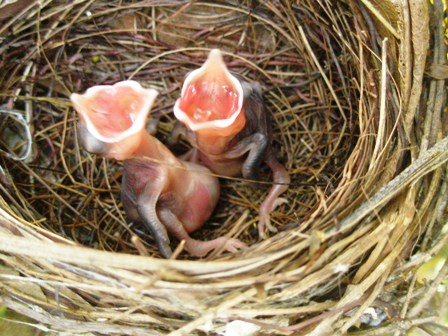
Eggs become chicks
Leave a Comment » | general | Tagged: Bangkok, birds, Merbah Kapur, Thailand, tropics, Yellow-vented Bulbul | Permalink
Posted by themanfrommoselriver
When I read in the Age that Melbourne is planning to take 10 billion litres (which covers the city consumption for about 10 days only) from the Thompson River to make up for the shortfall which cannot be covered from the Yarra River, I was not impressed. The Labour government is desperate.
The interview of Tim Holding, the Victorian Water Minister, which Plug the Pipe has on its website is revealing. The North-South pipeline is completed ahead of schedule but there is no water. The conclusion I draw from it is, the Minister should change jobs before it is too late. The state’s water policy is a mess.
The cartoon below (from Plug the Pipe) summarises the situation. Whereever Melbourne turns to these days for water: there is none. There is hope though: elections are around the corner (2010).

Leave a Comment » | general | Tagged: Goulburn River, Melbourne, North-South Pipeline, Plug the Pipe, Tim Holding, water, Yarra River | Permalink
Posted by themanfrommoselriver
The day I received the results from the 2009 Decanter World Wine Awards, I also received an e-mail from Karl Storchmann from the American Association of Wine Economists announcing the newest publication of the Journal of Wine Economics (Vol 4, No 1).
The lead article in this issue of the journal is about the wine judges and their reliability in judging wines. This was the perfect contrast reading to the long list of award winners from Decanter. Again Robert T. Hodgson has summarized some more research about the topic in question.
The title of the article is “An Analysis of the Concordance among 13 U.S. Wine Competitions”. Hodgson followed over 4,000 wines entered in these competitions of which 2,440 wines were entered in more than three competitions. 47% of these wines received gold medals in one show but 84% of these same wines received no medals at all in the subsequent shows. These results indicate that winning a Gold medal is greatly influenced by chance alone. Or to put it another way: Wines which were deemed of an extraordinary quality by some wine judges were assessed as very ordinary by others.
In come the Decanter World Wine Awards 2009 results. What does the study say about these awards. Nothing, of course. My skepticism about wine shows, however, is rather stronger then before.
One may ask the question are the Hodgson findings about wine shows in the U.S. applicable to shows such as Decanter? Can we safely conclude that some of the Decanter award winners would be seen as ordinary by other wine judges at other shows, and that some of non-winners could easily win a Gold somewhere else. Or could the Decanter wine judges replicate the tasting with the exact identical findings? Or what would their “margin of error” or inconsistency be?
What Hodgson’s study also tells us is, that wine judges are just human beings who are inconsistent and unpredictable. But we might rightly assume that they are trying to do the right thing but fail in this from time to time. The judges at the wine competitions surveyed, though, seem to have a shared idea about the wines they do not like and therefore win no awards at all. That’s at least something.
A few wine blogs have taken up the issue as well. Alder Yarrow for instance writes on Vinography about the AAWE paper and calls for a stop of the proliferating state wine shows. He admits, however, that the shows surveyed where, and I quote, “essentially the largest and most prestigious wine competitions in America”.
What does this tell us wine consumers? Well, wine quality and medals won at wine shows are not “orthogonal”, the presence of one doesn’t imply the presence of the other. Therefore, trust your own taste and buy what you like, possibly after tasting and let the wine shows be wine shows.
How about the vintner? Well, it is very nice for any wine producer to be recognized for outstanding quality and performance. So it is nice to win a medal at a wine show or getting a five star winery rating from James Halliday for instance. But it is not the end if this is not coming along. Most important is that ordinary people like to drink and buy your wine; the rest takes care of itself.

Cheers folks, trust your own judgment and taste as many wines as you can.
1 Comment | culture, general, wine | Tagged: Alder Yarrow, American Association of Wine Economists, Decanter, Decanter World Wine Awards 2009, Karl Storchmann, Robert T. Hodgson, Vinography, wine bloggers, wine blogs, wine judges, wine shows | Permalink
Posted by themanfrommoselriver
During our family vacation, we were also looking for a new tractor. Our old FIAT tractor had broken down some time ago. We were searching the internet for a while for a used tractor but we were either too late or the right machine did not come up.
Therefore, we looked for new equipment. First we had our eyes on a Kubota from Japan but then fellow vintners suggested to have a look at a Korean brand: Daedong. I had never heard of Daedong before. At Rees Miller Estate we had the opportunity to inspect a one-year old 55 hp Daedong cabin tractor with a frontloader.
We asked for a couple of quotation, and to cut a long story short, decided to go with the Korean Daedong. The photos below show the vineyard tractor with 55 hp plus frontloader.


Until it is beeing delivered, we have to sort out the finances but I am confident that we will get our Daedong tractor so that I can work with it during our next visit.
1 Comment | general, vineyards | Tagged: Australia, Two Hills Vineyard, Victoria | Permalink
Posted by themanfrommoselriver

The conference banner outside the BICC
Another week without a blog entry from me. There is a simple explanation for it. I attended an international conference in Beijing, China, which was a great success also for the host, the Chinese Academy of Agricultural Science (CAAS).
But whereas blogging from rural Australia was just an infrastructural challenge, this time the great firewall of China prevented me from communicating and reaching my blogging platform: wordpress.com.
It prevented me also from accessing my facebook and twitter accounts and various other sites of interest, for instance the Open Wine Consortium (which uses a NING platform format). Needless to say that youtube was also down.
I am not a political blogger, just a wine and food enthusiast, and by training an agricultural economist which was the main reason why I attended the 27th International Conference of the Association of Agricultural Economists (16-22 August 2009) titled: “The new landscape of global agriculture”.
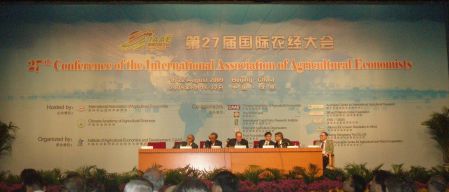
Experts on the dais
To say it from the outset, the conference was a full success. It was just great. I cannot but praise our Chinese host and the organizing committee as well as the Chinese agricultural organizations involved in its preparation and conduct.
The highest level of the Chinese government gave full support to the event and thereby to a field in public policy which had been largely neglected by the global financial institutions and many national governments alike during the last two decades. Vice premier Hui Lianyu, a native of Jilin province and a Chinese Muslim (Hui nationality), officially opened the event.
The great firewall of China, however, prevented me from publicly heaping praise on the Chinese government and the organizers, because I could not access the internet. Well, to be precise I could access some sites of the internet. We also had wlan-wifi connections during the duration of the event but the censorship exercised by the Chinese government did not allow for life reporting. A shame, good things could not enter the bloggosshere. There is a cost to such kind of censorship policy. China misses a chance to improve its public image.
Moreover, I wonder how many of the world’s top creative people would bother coming to a place where they are cut off from the world, their creative batteries, their inspiration and their audience for so long and from where the results of creative processes could not immediately find their way into the world wide web. This is another part of the costs incurred by the censorship policy.
We all know that the control of the internet by governments is a rat’s race. The whiz-kids, digital natives and techno freaks of this world, the Davids, to speak in biblical terms, are magically drawn to places like China in order to show and test their skills in beating Goliath: the Communist government. And therefore it is no surprise that there is ample support out there for trapped bloggers and others to circumvent the censors and jump over the great firewall of China by using proxy servers, and software designed to avert control. Alas, we are not alone in this tech-world of the 21st century.
Congratulations again to our Chinese partners for hosting such an important international event. May your government realize that it has more to gain than to fear from co-operation, sharing and the reciprocity through the inter connectivity of the world community and finally give up the censorship of the internet.
And then there is the saying of Mahatma Gandhi:
“When I despair, I remember that all through history the way of truth and love has always triumphed. There have been tyrants and autocrats, and for a time they seem to be invincible but in the end they always fail.”
It’s better to change when there is time for it. The communist party of China has shown wisdom in the past when it came to points of no return, for instance when they tolerated that farmers dissolved communes on their own accord and without prior sanctioning of the party. Let us hope they can draw on this wisdom also when considering the censorship policy.
Leave a Comment » | general | Tagged: blog, bloggers, blogging, China, International Association of Agricultural Economists, Open Wine Consortium | Permalink
Posted by themanfrommoselriver
To say it from the outset, blogging from rural Australia was no fun. We had bought only a small package with limited capacity (which we forgot, our own fault). That turned out to be a desaster. The package was not cheap and the penalty rates immorally exorbitant!
Because the four of us used the internet as we are used to in Bangkok, Thailand where we have excellent facilities, enjoy fast access to a reasonable price, we went far above the contracted amount and were heavily punished. Telstra imposed a huge penalty on us which swallowed a big part of our holiday budget.
After that I had lost all interest in blogging. It was our own fault, yes I know. I can only blame myself. However, the Man from Mosel River went silent for almost two weeks. Instead I kept myself busy working on the vineyard. I was in the fresh winter air at Two Hills Vineyard and enjoyed myself.
After my return to Bangkok I was busy with catching up with my work. Now I have recovered somehow from the shock. But do not worry I will start blogging again, I promise. I have collected so many stories, tasted so many good wines, talked to so many interesting artisan winemakers and vignerons that I cannot keep quiet. Thats the good news.
Australia has to do a lot more to get the rural hinterland connected at affordable rates. What is certainly also needed is some more competition among service providers to increase choice and reduce the costs of being linked to cyberspace and to the outside world.
2 Comments | general | Tagged: Australia, blogging, Two Hills Vineyard | Permalink
Posted by themanfrommoselriver
I left the vineyard last Sunday, a beautiful sunny winter’s day. It was a sad moment; in fact it always is. We drove down Two Hills road; Margit, Lucy, Charlotte and me. I drove our old pick-up truck. We were all able to control our emotions somehow. it was just such a good time we had together. They dropped me, a quick hug, a kiss, and they were gone.
At Melbourne airport I checked the wine section. Everywhere was the campaign “Put Victoria on your table”. In the wine from Victoria section I even found some wines from our region, the Upper Goulburn Wine Region. But most wines cam from the Yarra Valley.
While browsing through the bookshop, I picked up a copy of the biography of Led Zeppelin (by Mick Wall, titled “When giants walked the earth”), a genre of books which I usually do not buy. I felt a bit nostalgic, I guess and I bought it: reading material for the nine hours flight back to Bangkok and already “Stairways to heaven” in my mind.
The tune of “Stairways to heaven” was in my mind. I had just left heaven (we Adams are used to leave paradise). There is nothing better in life than fond memories and a good tune.
And ever since I have not produced a singel blog entry. Until today. I must have arrived somewhere.
Comments Off on In the air again | general | Tagged: "Put Victoria on your table", Australian wine, Led Zeppelin, Two Hills, Upper Goulburn Wine region, Victoria, Yarra Valley | Permalink
Posted by themanfrommoselriver
On the blog of Geoff Bilbrough I found a most useful tool: the Australian Wine Region Map. If you are planning a trip to Australian and you want to visit some wine country, this map is exactly what you always wanted.
On Geoff’s link, the “Wine Wine Wine” (which by the way is a wonderful informative site) the map looks like the sketch below in the left corner:

I played a little around with the Google based map, and found it amazing, especially the Yarra Valley part. Unfortunately, our wine region, the Upper Goulburn Wine Region is not (yet) on the list of Australian wine regions.

The interactive map allows you to select a wine region and/or a winery so that you can plan your winery tour. It prints out the map as well, if you like. Precondition is of course that the wine region and the vineyard/winery you intend to visit are somehow included in the system.
I will try to use the tool soon when we all go to Australian for the winter break. I’ll report back to you.
1 Comment | general | Tagged: Australian wine, Australian wine region map, Australian wine regions, Upper Goulburn Wine region, Upper Goulburn Winegrowers Association, wineries, Yarra Valley | Permalink
Posted by themanfrommoselriver
I have written about the stupidity of the Brumby governments water policy in Victoria on this blog before. Surfing the net today I found a wonderful video on Plug the Pipe by a young man who summarised and assessed the Victorian Labour governments blunder. Great job I find. We farmers will pay the price and so will the Victorian taxpayer.
Watch this, it’s a great video. Congratulations. Similar things happen all over the globe when urban policy makers screw country folks.
Leave a Comment » | general | Tagged: Plug the Pipe, Victoria | Permalink
Posted by themanfrommoselriver
You are currently browsing the archives for the general category.
 The Man from Mosel River
 The Man from Mosel River