German wine regions: the Nahe

September 17, 2009

Nahe2

The Nahe wine region has a great significance for me and my family. It was here that I got first into contact with vine cultivation and wine appreciation at a rather tender age.

Why you might ask? Were you not from Trier, Mosel?
Well, my maternal grandfather, Hans Heinrich Schüssler, a native of Reichenberg, a village near Würzburg, used to live in Martinstein. Being from Franconia, another famous German wine region, he was the only wine drinker in the immediate family (my father preferred beer). He used to be the station master in Martinstein (today 322 inhabitants), a hamlet along the left bank of the Nahe river. The village was founded in the middle ages at a ford crossing the Nahe river. In 1340 it got a castle and even market (city) rights.

My brother and I, we used to spend the long summer holidays (and many other holidays) at my grandparents house in Martinstein. My grandfather used to take us on long walks in the forest and villages nearby. During these walks we always found a country inn where we could refresh ourselves, enjoy a drink or a “Brotzeit” (a typical German snack). He would drink a “Schoppen” (0.25 litre glass) of the local Nahe wine. He loved dry white wines. We would have a lemonade.

He was associated with a “hiking brotherhood” (called “Hunsrückhöhenverein”) whose members would walk in large groups on weekends to various destinations. Usually a country inn was the designated object of the hikers. Here the group converged for a hearty meal and some drinks. Shortly after vintage, “Federweisser” (freshly made but still half-fermented wine) was a popular drink.

But boys being boys, we would sip at his glass from time to time. He being deeply involved in conversation with fellow hikers, did not notice. Neither did we. The sweetness of the fresh wine veiled its dangers. To cut a long story short, we had the experience of a first inebriation of our young lives and could hardly walk strait on our long way home.

After my grandfathers retirement he moved out of the train station into a newly built home right in the middle of vineyards at the outskirts of the village towards the east. Vineyards stretched right to the door. Just a short walk up the hill and endless vineyards lay at your footsteps. Occasionally we would help during vintage time (more play than serious helping). But we would often taste fully ripened grapes and enjoy the fruit. I treasure these wonderful memories of my youth at my grandfathers house in Martinstein.

Map Nahe wine region

The Nahe wine region (photo source: wikipedia)

As you can see from the above map, the Nahe wine region stretches from Martinstein to the West along the river eastward, later north towards the estuary at Bingen where it flows into the Rhine river. The largest city in the region is Bad Kreuznach, a small town of about 45,000 inhabitants.

Nahe1

With about 4,200 ha under vines, the Nahe region is one of the smaller wine growing areas in Germany. It is still larger than, for instance the Yarra Valley in Victoria (with about 3,800 ha, about 2% of Australia’s total). The Nahe region is dominated by white grape varieties (about 74% of the total area under vines). The main variety is Riesling (26%) followed by Mueller-Thurgau (14%) and Dornfelder (13%).

Fifty years ago the variety distribution was very different. Silvaner used to be the most planted variety with about 50% of the total area but has ever since been replaced by the Burgundy varieties (Pinot White, Gris and Noir) as well as by Riesling, Dornfelder, Blauer Portugieser and Müller-Thurgau plantings.

The Nahe is divided into seven collective sites (Grosslagen) and 328 individual sites (Einzellagen). Due to its volcanic origins, the soils of the nahe show a great diversity. The wines reflect this. Only in 1971, the German wine law defined the nahe region. before that time, its wines were sold as “Rhine wines”. However, some of the best Riesling wines of germany originate from the Nahe and today Nahe wine can rival the best from Mosel and Rheingau or any other German wine region.
Nahe3

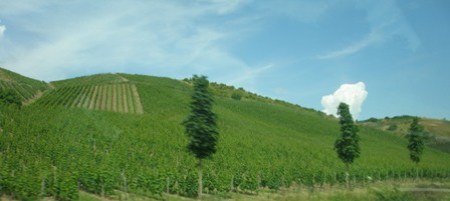
The Nahe can be divided into the upper (west) and lower (north-east) Nahe and the region around Bad Kreuznach. In Martinstein and the neighbouring village of Monzingen (first mentioned in 778) the oldest vineyards of the Upper Nahe are to be found. The soils of the Nahe range from sandstone to quartzite and slate. The region shows a temperate climate and some of the southern slopes enjoy a micro climate comparable to the Mediterranean. Elevations range from 100 to 300 meters altitude.

Nahe4

Who are the top producers of the Nahe wine region?

Well, the name Herrmann Doenhoff comes to mind. He is the leading vintner of the Nahe and his wines are ranked among the top Rieslings in Germany. Herrmann Dönnhoff has about 20 ha under vines and produces about 140,000 bottles a year. His winery is located in Oberhausen/Nahe. The 2007 vintage produced outstanding wines; the 2008 Riesling wines did not quite reach that quality level during recent tastings. But his ‘2008 Niederhäuser Hermannshöhle Riesling Gran Cru’ earned 93 Parker points.

Other top producers are Emrich-Schönleber in Monzingen (about 15 ha under vines, yearly production about 110,000 bottles), Schlossgut Diel (17.5 ha and 120,000 bottles) in Rümmelsheim and Schäfer-Fröhlich (14 ha under vines and 75,000 bottles annually) in Bockenau.

Wines and vintners I like very much are Sascha Montigny in Laubenheim and Weingut Edelberg at Gonratherhof 3 in Weiler just on the other side of Martinstein. The former I like because of the high quality of his red wines, especially the 2006 vintage; the latter produces solid country wines which remind me of my youth in Martinstein and the long hikes with my grandfather. The country inn at Gonratherhof was often our destination when the three of us set out from our little house in the vineyards.


The other Mosel: The wines of Luxembourg

September 2, 2009

Lux0

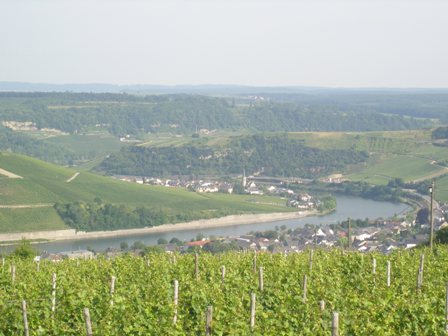
Luxembourg vineyards along the Mosel seen from the German side in Wellen

Having grown up in Trier, Mosel the Grand Duchy of Luxembourg is no stranger. As a teenager we used to drive to Luxembourg City to enjoy its night-life visiting the famous discotheque “Blow up” and thereby expose ourselves in a kind of pan-European experience, populating the dance floor amid dancers from Belgium, Holland, France, Germany and Luxembourg.

Lux1

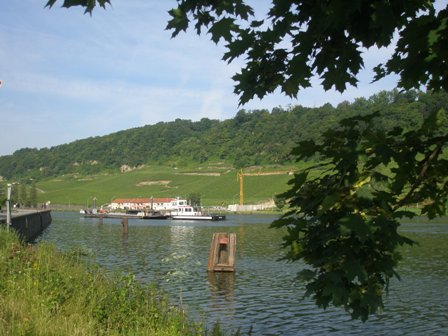
Mosel river with Nittel in the foreground (German side) and Machtum (Luxembourg side)
The above photo shows the Mosel valley, in the foreground the wine village of Nittel on the German side, and in the background the Luxembourg village of Machtum/Miechtem along the “Route du Vin”, the road which leads the visitor through the picturesque vineyards and wine villages of Luxembourg. I took these photos during my last visit to Trier at the end of June when I cruised along the river visiting both Grevenmacher and Nittel.
One of the best kept secrets as regards European wines are the fine wines of Luxembourg. Total production is about 12.4 million litres of which more than half is exported (mostly to Belgium and Germany). The total area under vines is about 1300 ha only which is about a third of the Yarra Valley. Luxembourg is a kind of artisan wine producer, where the winery sector is dominated by small family-enterprises, whereas large, corporate-wine industrialists shine through their almost complete absence. Of the odd 430 grape producers only about 60 have their own wineries. Most vignerons are members of a wine co-operatives at the village level.

Luxembourg is mainly a producer of dry, varietal white and sparkling wines (about 15% of total production). This is a stark contrast to the German side of the Mosel which has a strong tradition in semi-dry and sweet wine production.

Of the 15 approved wine varieties, Müller-Thurgau (Rivaner) accounts for about 29% of the area under vines followed by the Burgundy varietals (together almost 40%). Auxerrois (14%), Pinot Blanc (12%) and Pinot Gris (13%). Riesling covers only about 13% of the area in Luxembourg whereas it is the dominant grape variety on the German side of the Mosel. Luxembourg also has about 10% of the area under Elbling, the oldest wine variety in middle Europe, characterized by its high acidity which makes it ideal for the production of sparkling wines. Chardonnay and Gewürztraminer are other white varieties grown. Pinot Noir (about 7% of the area) is the most common red variety of Luxembourg.

Lux2

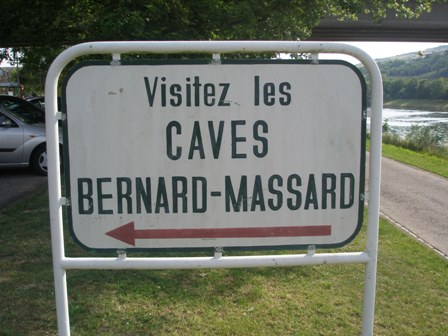
Parent house of Bernard Massard in Grevenmacher

On of the largest producers of still wines and crémants (bubbly/sparkling for my Australian readers) is Bernard Massard. Bernard Massard is also well known in Trier where the company has a large office and wine cellars in the middle of the town centre (Jakobstrasse), but Bernard Massard owns and operates vineyards also along the Loire river in France. The parent house of the company is located in Grevenmacher. More than 30,000 visitors come to see the extensive wine cellars
Lux3

Bernard Massard owns two vineyards along the Mosel: Domaine ‘Thill’ in Schengen (12 ha under vines) and Domaine ‘Clos des Rochers’ in Grevenmacher and Wormeldange (18 ha) with a combined production of about 120,000 bottles (or 10,000 cases) per year. Through the sparkling production in Trier about 3 million bottles of crémants and other sparling wines are sold. The French vineyards (Caves Monmousseau at Montrichard and La Petite Cave at Ronchamp) along the Loire river produce mainly crémants (Crémants de Loire and Touraine sparkling wines) and a variety of local wines.
Lux4

Domaine ‘Clos des Rochers’ in Grevenmacher

Lux5

Vineyards near Mertert/Wasserbillig

The bulk of Luxembourg’s family vineyards and wineries is much smaller than Bernard Massard. Because of the long tradition of viticulture in the villages and hamlets along the Mosel, many vintners come from families who have a strong family tradition in grape growing and wine making. Many families are related through intermarriage and therefore many wineries have combined family names most of which you will have never heard of.

Representing these strong traditions I would like to mention only three smaller wineries. I apologise to all the others; I know many of you deserve a full portrait.

Caves René Bentz, Wellenstein (5.2 ha)
The vineyards are located in Wellenstein, Remich, Wintringen and Bech-Kleinmacher. Main variety is Müller- Thurgau, however the most important varieties are Riesling, Pinot Gris, Pinot Blanc and Auxerrois. The Riesling wines of the Gottesgôf selection are worth trying, and so is the 2007 Pinot Gris Côteau Wellenstein.

Domaine Viticole Charles Decker, Remerschen (4 ha)
Charles Decker has a clear vision of his wines. He is one of the few who cultivates Muscat Ottonel grapes and experiments with German new varietals such as Siegerrebe, an aromatic grape. He specialises in sweet wines. Try his Muscat Ottonel wines but also the Chardonnay and the Pinot Gris are commendable.

Caves Kayl-Noesen Nic et fils, Remerschen (6 ha)
This is a very young undertaking, with the winery established only about 5 years ago. Before that the family produced grapes and sold the fruit to other wineries. The young vintner who studied oenology in Germany, manages the estate with his father. The classic varieties of Luxembourg are the wines you should try. Their Auxerrois, Pinot Blanc and Pinot Gris are ideal wines consumed with fine cuisine.

Lux6

The mouth of the Sauer river at Wasserbilligerbrück meeting the Mosel

It is worth visiting Luxembourg and its vineyards and wineries. Stop at any nice café or wine bar and try the local Elbling or go for the more elaborate cool climate Auxerrois, Pinot and Riesling wines.

Information about Luxembourg and its wines:

I found the following book very useful (in German): “Weine und Crémants aus Luxemburg”, Einkaufsführer 2009, Meininger Verlag (www.meininger.de), Neustadt, Weinstrasse.

A very informative article about Luxembourg can be found on http://www.wine-pages.com/features/luxembourg-wine.htm
.

But also the Wikipedia write-up gives the newcomer a very good overview.

The fourth source of useful information comes from http://www.vins-cremants.lu/en/winegrowers/alphabetical_listing.html


German wines: delight in red and white

July 4, 2009

Traveling in Germany I had the opportunity to taste some marvelous wines with some of my friends. Two of these I would like to briefly present to you, one red, one white wine, one from the Pfalz and one from my native land, the Mosel or to be precise the Saar.

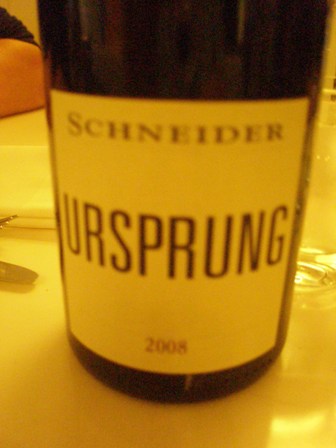
Over a dinner at “Schneeweiss”, a fashionable restaurant in the eastern part of Berlin offering “cuisine from the Alp mountain lands”, we had a bottle of ‘2008 Schneider Ursprung’, a cuveé made of Cabernet Sauvignon, Merlot and Portugieser by Markus Schneider.

Markus Schneider is one of the young but accomplished vintners who earned the highest praise from wine critics and experts from the wine and hospitality industry. This cuveé is made from grapes grown on a rather warm location at the “Feuerberg”, a terroir known for its capacity of heat retention by the local gravel stones which allows the grapes to fully ripen.

The wine is of a deep purple colour. It displays flavours of a lot of fruit, plum, some mint, chocolate and shows some peppery notes. The wine is very round and extremely smooth, for me just a bit too perfect in the mouth, I must say. It went extremely well with the food that I had ordered (Italian pasta filled with mushrooms). The wine is perfect and was a good choice. It retails for about 8 to 11 EURO but is worth the money.

Schneider Ursprung

A very simple label on the bottle: “Schneider Ursprung”

Schneider ursprung2

What a beautiful deep purple colour

Later the same evening, we tasted a dessert wine from my native lands, the Mosel, actually from the Saar river. It was a ‘1992 Ockfener Bockstein Riesling Spaetlese’ from “Staatliche Weinbaudomaene Trier”.

OckBockRiesAus

What a delight this wine was, a drop from heaven. It had aged well, was fresh and round. Although low in alcohol (only 8%), the acids were vibrant so that the wine was extremely well balanced, honey sweet, just wonderful. Only my friend Gerhard can wait for a wine like this to ripen in the cellar and patiently await the right moment to open a treasure like this.

I know the terroir quite well, Ockfener Bockstein, just a couple of meters away from the boundaries of the hunting grounds of my friend Heinz in Schoden, Saar which borders on Ockfen. The vineyards here are extremely steep and all work in manual. The 1992 vintage of this Riesling Auslese is just wonderful. I have no words to describe this nectar and do justice to the wine.

Address:
Schneeweiss
Kern Ranogajec GbR
Simplonstraße 16
10245 Berlin
Proprietors: Denis Ranogajec and Ralf Kern
Tel.: +49-30/29 04 97 04
Fax: +49-30/29 04 97 05

Weingut Markus Schneider
Am Hohen Weg 1
67158 Ellerstadt
(near Wachenheim, Pfalz)
Tel.: +49 (0)62…
Fax.: +49 (0)6237 – 977230

Administration:
Georg-Fitz-Straße 12
67158 Ellerstadt
info@black-print.net
http://www.black-print.net

Staatliche Weinbaudomänen Trier
Deworastr. 3
54290 Trier, Germany
+49 651 97598-0
www.staats
weingueter.rlp.de


Heaven on a stick

June 14, 2009

As you all know life in the tropics is sweet, and can therefore be described as “heaven on a stick”, as we say in Australia. This is even more so since (finally) the best beer of the world arrived in our local neighbourhood super market, the Villa Market in Thonglor, Bangkok.

There are of course many “best” beers in the world depending on ones taste, upbringing, and the general circumstances. But since I come from the Mosel river, my favourite beer is Bitburger Pilsener, brewed in the small town of Bitburg about 30 km north of my home town Trier.

BitteeinBit

Bitburger Pilsener

After patronizing this supermarket for about nine month and browsing the beer section consisting mostly of Japanese, Thai and Bavarian beers, you cannot imagine my joy to find a few bottles of Bitburger beer.

Apart from a good beer, a glass of wine and a good meal, the tropical pleasures are simple: enjoy the fragrance of a Frangipani flower (Plumeria), a dash in the pool, and company of family and friends.

Franjipani

A potted Frangipani tree on my terrace in Bangkok

Pool

It’s just too hot these days

Hope you all have a good weekend. Cheers.


Spring in Schoden, Saar

May 25, 2009

Spring was in full force when I visited Germany recently. The sky was blue and everything was fresh, a young green covered the land. As always I accompanied my friend Heinz on the hunt in Schoden, Saar. We took a tour around the 500 ha of hunting ground rented from the local land owners association (“Gehoeferschaft).

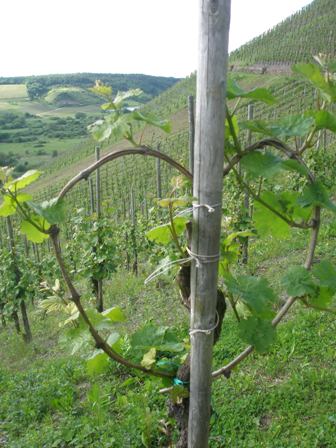
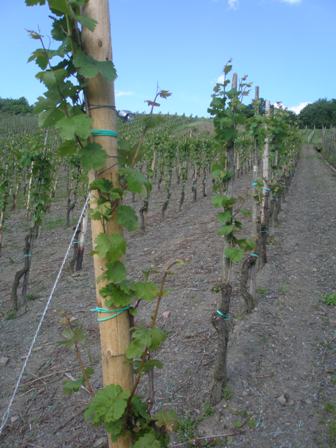
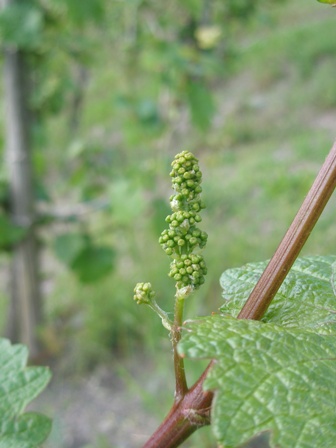
I took photos of the vines at “Herrenberg” one of the best terroirs at the steep hillside overlooking the Saar valley.

Sch1

The canes are bent down and arranged in a circle

Sch2

The Herrenberg vineyards are very steep

Sch3

The view downwards

Sch4

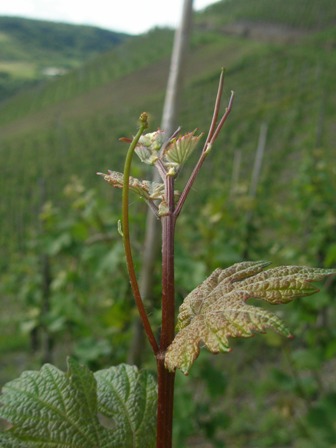
New shoots

Sch5

The flowers are almost ready

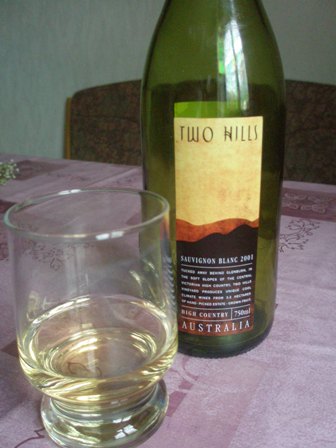
And guess what I found in my mothers cellar? A rare bottle of ‘2001 Two Hills Vineyard Sauvignon Blanc’.
The colour of the wine was still a splendid light straw, and it was drinkable. Of course it had lost its zest, almost no finish but it was still OK with my meal, I must say. A clean white wine.

Schx


On the road again

May 21, 2009

Huns2

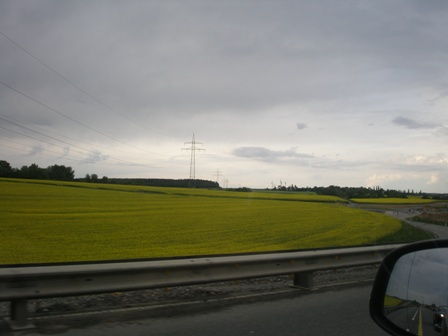
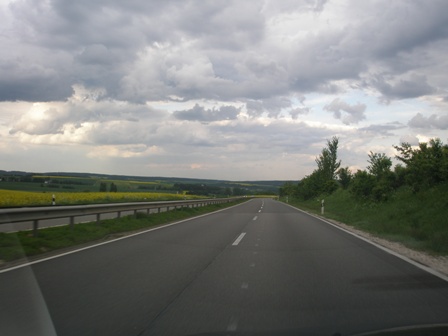
It was a gorgeous day when I drove from my home town Trier at the Mosel to the airport in Frankfurt. I passed through the hilly country called the “Hunsrueck”, a large plateau with deep forests and not-to-infertile plains where grains, maize and rape seed are grown. After a couple of kilometres clouds appeared and it started to rain.

Huns3

The yellow of the rape seed fields contrasted beautifully with the surrounding green of the grains, the grass and the trees. From the moving car I took a couple of shots to capture the contrast. Reality is almost always more beautiful than those quick digital camera shots.

Huns1

I had about two hours for contemplating about life, death and the universe. I love these rare occasions of introspection. I love the short life between the worlds, leaving Germany for the tropics of Thailand. Having left a world behind but not reached the desired destination, leaves me in a kind of vacuum, an emptiness full with feelings.

Huns4

The last leg of my journey led me through parts of the Nahe and the Rheingau wine regions. At this time of the year the vines appear tender and soft, near the flowering stage maybe, but the green of the leaves is still a light green.

The rainy season would wait for me on the other side of the world. Only the long hours in the narrow plane would be between “me in Germany” and “me in Thailand”, the past and the future, the wines of Germany and the wines of Australia and Thailand of course.


Saar Riesling: Ayler Kupp

April 19, 2009

ayl1

Spaghetti alle Vongole

Spaghetti alle Vongole was the right pasta to be enjoyed with one of my “treasure” Riesling wines. From my last trip to Germany I had brought two bottles of Riesling back to Thailand.

ayl3

One of them was a ‘2007 Ayler Kupp Riesling Kabinett’ (dry), Saar from Bischoefliches Konvikt Trier. Nothing special, you might say, but a very decent Saar Riesling for sure (price: about 10 Euro/bottle). The terroir “Ayler Kupp” is world famous for producing excellent Riesling wines.

ayl4

The wine is a typical young Saar Riesling. Actually the wine region’s official name is Mosel, but I stick to Saar, Saar being the river where the grapes for this wine are grown in a small hamlet with the name of Ayl.

ayl2

We poured the wine, which had a light straw colour and is low in alcohol (11%), so that I could take a picture. I love the Saar Rieslings, they are wines to die for. They are well balanced, acidity, sugar and alcohol in a perfect combination. They have character, texture and structure. Aromas of melon, citrus, passion fruit, peach and/or floral notes are to be found.

The match of the food with the wine was perfect. The slight spiciness of the seafood pasta and the basil went very well with the citrus aromas of the young, slightly bubbly Riesling. The wine was very fruity, a citrus bomb, so to say, marvellous. If you have a chance to visit the Saar region, please take your time and taste some of the local wines.

PS: After the extensive lunch, by the way, we had some chocolate, espresso and port of course. I smoked a big Cuban cigar. The tropical heat made us feel mellow; what a joyful day.


Back in Bangkok, homesick and nostalgia

March 26, 2009

Being back in the warmth of Bangkok and reunited with the family is not bad after all. And I brought back a bottle of Mosel Riesling. To be correct, a bottle of ‘2007 Ayler Kupp Riesling Bischoefliches Konvikt’ from the Saar. (It’s a pity that wine bottles are so heavy).

But I still feel torn somehow. The short visit to my mum in Trier was lovely as always. My heart is in at least three different places: Bangkok, Trier and Glenburn.

I apologize to my non-German speaking visitors and put here a short video by Helmut Leiendecker from the band Leiendecker Bloas, a local music group from Trier.

The topic is “zobben” and even people who do not understand our local vernacular will get an idea what Helmut Leidendecker is talking about in this beautiful poem.


Restaurant Review: Libertine in Melbourne

January 22, 2009

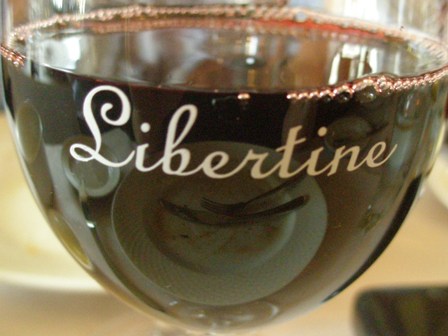
libertine

During the four weeks in Glenburn, Victoria I made it to the big city (= Melbourne) only once. My friend Tony Arthur had organised a lunch with Joe and Helen and myself at “Libertine”, a French restaurant in North Melbourne.

When Tony mentioned the name of the place we were supposed to meet in town over the phone, I was already enthralled. For a liberal like me, “libertine” augured well, promising freedom of French provenance.

libertine1

The restaurant is tucked away between various other entrances and not easily glimpsed. I came in my pick-up truck from the countryside and had to circle the place.

The dining area downstairs is rather small but I understand they have more facilities upstairs. When I arrived at 12:30 sharp, my friends had already assembled. Most tables were still empty but that would change very quickly. The place was packed just a little later.

Tony, Helen and Joe had been travelling together in France. As a native of Trier, Mosel, just a few kilometres from France I am not exactly a stranger to French culture and cuisine and consider myself a “francophile”.

We started with aperitifs. I was introduced to a Floc de Gascogne. Based on a XVI century local recipe, this is a fortified sweet wine, a blend so to say, between fresh grape juice (2/3) and Armagnac (1/3). It is kept for about 10 months in the cellar. The aromas it displays are almond, jasmine, roses and honey. The alcohol content of the drink varies between 16 and 18%.

Also the second aperitif, a Pommeau de Normandie was a “mistelle”, in this case a mixture of apple juice with Calvados. It’s usually aged in oak barrels for about 30 months and contains 17% alcohol. The drink displays aromas of vanilla, caramel and butterscotch flavours.

libertine2

The Pommeau de Normandie

libertine3

The Floc de Gascogne

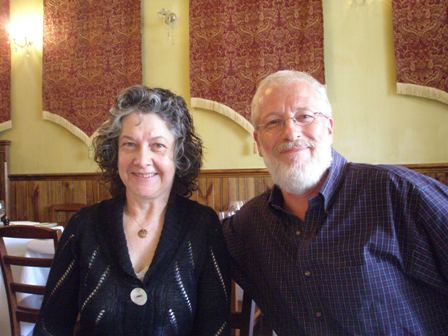
The next two photos introduce the diners. A happy lot they were. We had not met for more than a year. It was easy to lure me down to town from my farm upcountry in the Upper Goulburn to meet up and dwell on the happenings of the past months.

libertine5

Tony and Joe

libertine41

Helen and me

libertine6

My steak

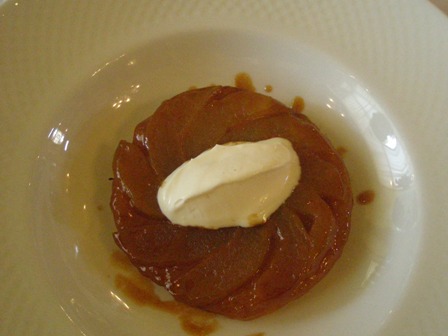
We all ordered the set menue were you have a couple of choices. I opted for the fresh onion soup, followed by a steak. The dessert I choose was a “tarte de pomme”, all very delicious. The service was relaxed but very attentive; the food of an excellent quality and taste for a very reasonable price.

We were also advised on the wines. We went with the house wine, all from bottles, a Roundstone Cabernet Merlot from the Yarra Valley. Helen had a Lis Neris Bianco from Italy. The blokes followed up with a glass of Tempranillo but by that time we were beyond producers and other wine information. I just did not record any of it any more because we were deep in philosophical conversation about love, life and the universe.

libertine7

The dessert

We had a coffee at the end, bid each other farewell and scattered in all direction with the sincere promise to repeat this as soon as possible but latest at our next visit in Australia.

The Libertine is a great restaurant. If you visit Melbourne you should schedule a meal either lunch or dinner with your friends in this atmospheric little place.

Address:
Libertine
500 Victoria Stret
North Melbourne 3051
Melbourne, Victoria
Australia
Tel.:+61-3-93295228
http://www.libertinedining.com.au


The Christmas Market in Trier

December 15, 2008

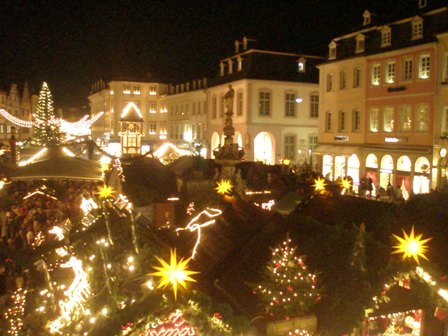
weihtrier0

The main market square – Hauptmarkt in Trier

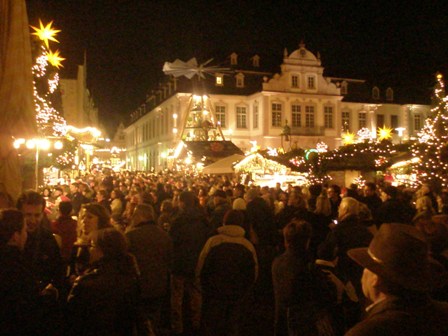
I had only about 24 hours for a family visit in Trier, my beloved home town. This is not much time and I needed to buy urgently some supplies. I was in a hurry which is not good when you end up in a Christmas market. Gee it was crowded. I had not expected so many people. After all the media lamented the economic crisis, the downturn, the loss of jobs and income in short a dark and insecure future. Nothing of that could be felt at the Christmas market in Trier. It was packed with people. I was pushed through the masses. One could hear many languages, French, English, Dutch, Luxembourgian and various German dialects.

weihtrier1

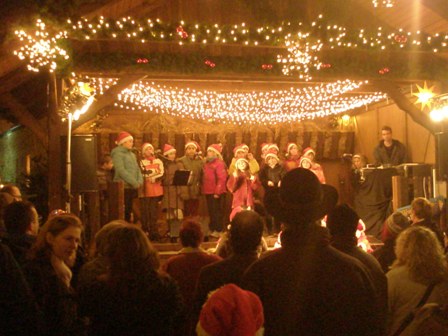
Children sing Christmas carols

We have learned from other economic crises that people try to forget the dire circumstances by celebrating even more and more intensely than in “normal’ times. Well, that must have been the case in Trier as well. Everywhere people were drinking mulled wine which is good against the cold but also beer and “normal” wines were on offer. It was a cheerful mood; joyous and happy faces wherever I looked. The pictures above and below give you an idea.

weih-trier2

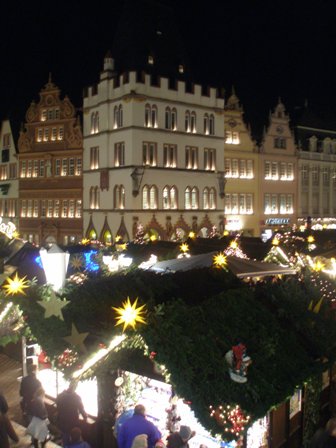
Main market square towards Porta Nigra

weih-trier3

Steipe – the old town hall

weih-trier4

The St. Peter fountain

St. Peter must have been happy too with all these many cheerful Christmas shoppers. After a bath in the crowd I sought refuge in a quiet place and escaped to one of my favourite watering wholes, the wine bar Kesselstatt. I ordered a ‘2007 Kaseler Nies’chen Riesling’ from the Ruwer river, a tributary of the Mosel and listened to the conversations of my neighbours.

It’s good to be home and Christmas is an auspicious time. I let myself be taken in and my mind flowed through the narrow lanes and back streets of the old Roman town. I could smell the smells of my youth and saw faces of people long gone. I dreamt myself away for a while before strolling home. It’s s pity that 24 hours have only 1440 minutes.