Along the Mosel river – impressions from a train ride

October 6, 2011

Taking pictures from a train usuallay did not work for me in the past. However, the other day when I visited the Mosel river and my home town Trier, I tried it again with my new digital camera.

The outcome is not too bad, I think. And this is why I want to share it with you here on my blog. Unfortunately, I did not catch famous terroir, single vineyard locations and/or famous wine villages and towns, just some no-name impressions.

In any case, this is maybe the best view one can get of the Mosel: exploring the region on a train.

I suggest to any tourist and casual visitor to this part of Germany to take the train from Koblenz to Trier and enjoy from the regional express train the sometimes spectacular views of the Mosel valley and its vineyards.

You can feel the speed of the train – above the ‘Autobahn’ bridge at Winningen

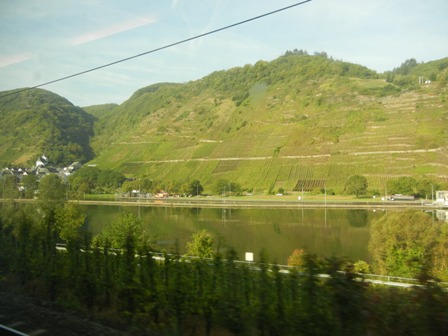
Most ‘grand cru’ locations are to be found on the steep slopes (right) but there are also flat parts with vineyards (left)

Train station in Bullay with the view of two Mosel bridges

Vineyards on steep slopes

An autumn feeling

Blue slate on the roofs of the houses along the Mosel

The river bed, train tracks, and a country raod, all three have to find a space in the narrow Mosel river valley. That the vineyards are located on the steep slopes is not an accident. This is where the slate underground reflects the sunlight and keeps the vines warm for the optimal ripening of mainly Riesling grapes. The steep slopes are hard work for the vintners.

I love the Mosel. I find it extremely relaxing to sit on the train and watch the landscape along the winding valley.

Alternatively one can also visit the Mosel by pushbike or car. Every way of transport, every way of movement will bring new insights and offer other aspects of this magificent river landscape.


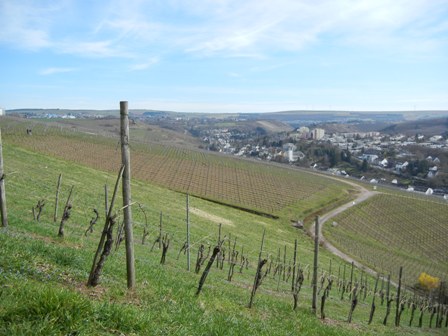
The first signs of spring in the vineyards of Olewig, Trier

March 31, 2011

This is just a photo blog entry. One could sense spring when I visited my hometown Trier in March. I deliberately went to the hight at “Perisberg” and have a good look around the vineyards and the city. I love Olewig and its wine festival. Come to Trier, the oldest city in Germany, it’s worth a visit.

The village of Olewig

Steep slope vineyards

The vines are pruned and ready for another season

The main cathedral in Trier


Grand Cru from the Mosel: 2009 Dhron Hofberg Riesling GG by Grans-Fassian

January 30, 2011

Beautiful fish

Pomfret, or Bawal Putih, as we call it in Indonesia, is a wonderful fish; in fact it is one of my favourites. I also love “fish-Sundays” which always lends itself to a beautiful white wine. Mind you, I also drink red wine with fish, but if I have some Riesling in my fridge….

Pomfret

With the chilli-garlic-ginger sauce, the pomfret was just wonderful.

From the outset, I was clear about the wine. Well, actually our wine fridge is quite empty. But from my last trip to Germany in November last year, I brought with me two bottles of precious liquid: Riesling wines from my beloved Mosel river.

You might guess it, yes. I opened a bottle of ‘2009 Dhron Hofberg GG Riesling’ by Grans-Fassian Estate in Leiwen, Mosel. This grand cru (or Grosses Gewaechs as the German call it) is just wonderful.

2009 Dhroner Hofberg Riesling GG by Grans-Fassian Estate

Wine tastings last year by Weinwelt, a German wine magazine, awarded it with 95 Parker points. The wine is luscious and complex, with beautiful peach and citrus aromas. It has the minerality of the Mosel Riesling. The fine acids and the balance of the wine are just mind blowing.

Wine prices in Bangkok are astronomical. For a 5 EURO wine in Germany one has to fork out about 20-30 EURO here. You can have the Dhron Hofberg Riesling for a price below 20 EURO from the cellar door. The trip is worth it. Leiwen is a treasure trove for wine lovers and Riesling geeks.

I wrote about the Grans-Fassian Estate in an earlier blog entry. The winery is also member in the prestigious VDP (the Association of German Quality Wine Estates).

Cheers and “zum Wohl”

Address:
Weingut Grans-Fassian
Römerstraße 28
54340 Leiwen, Mosel
Tel.: +49-6507-3170
Fax: +49-6507-8167
E-Mail: weingut@grans-fassian.de
Openng hours: Mon. to Fri.
8.00-12.00 und 13.30-16.30 h
www.grans-fassian.de


Grans-Fassian Estate in Leiwen, Mosel

January 22, 2011

Grans-Fassian Estate in Leiwen

When I drove along the Mosel on a grey Saturday morning last November, I was heading to Leiwen to buy some good Riesling wines.

There were three reasons for this trip. It all started at Frankfurt airport when I bought the December issue of “Weinwelt” (World of Wine), the German wine magazine.

1. I had looked at the results of a wine tasting of grand cru (GG = Grosses Gewaechs) Rieslings: two of the top wines from the Mosel came from Leiwen; one of them was a ‘2009 Dhroner Hofberg’ by Grans-Fassian Estate.

2. Leiwen is just a 30 minutes drive from my mothers home in Trier at one of the most beautiful bights of my beloved Mosel.

3. I love German Riesling especially if it comes from the Mosel river and I wanted to know what a 95 point wine would taste like.

The original Grans-Fassian Estate manor house with the cellar door

So off I went by car and cruised along down the Mosel. I was lucky, the cellar door was open. Here I met Catherina, one of the two daughters of the owner, Gerhard Grans who had taken over the estate from his father Matthias in 1982.

We had a bit of a chat about wine, life and the universe. Catherina is a charming young lady. She is going to be an oenology student at Geisenheim soon.

Catherina Grans showing me the top wines

I tasted two of the wines (the ones mentioned in the magazine): the ‘2009 Riesling Dhroner Hofberg’ (95 points) and the ‘2009 Riesling Leiwener Laurentiuslay’ (92 points). I tell you these are Rieslings how I like them. Wonderful wines indeed. Tropical fruit the first wine, and a kind of a citrus bomb the second. Both with a good structure, young, minerally, powerful with a long finish.

The treasure box with Grans-Fassian wines

Furthermore, I learned that the estate has about 10 ha under vines. Some of the vineyards are lokated in the best terroir of the region, for instance Dhroner Hofberg, Leiwener Laurentiuslay, Piesporter Goldtroepfchen, and Trittenheimer Apotheke.

About 88% of the vines are Riesling, 10% Pinot Blanc and 2% Pinot Gris. The brochure shows the steep slopes of some of the vineyards, most of them with a southern or western aspect. The micro climate is ideal for Riesling. The soils consisting of red, grey and blue slate.

I bought a couple of the two wines I had tasted. By the way for someone like me who pays obscene prices for wine in Bangkok, these top wines were very reasonably priced, in fact they were a true bargain. It’s a pity that wine bottles are so heavy. I knew that I could only take one, maximum two of them with me on my long journey back to Thailand. What a pity, I thought.

The wine bloggers delight

Here is another hot “secret” for your next trip to the Mosel river: Grans-Fassian Estate in Leiwen should be your destination. Trust me, you will not regret it.


November at the Mosel river

January 21, 2011

It’s beautiful to drive along the Mosel river, even in the month of November. I had this opportunity last year and thoroughly enjoyed it.

The Mosel wine route (Mosel Weinstrasse) is a fine example of a scenic drive along the vineyards and wine villages in this part of Germany which I still call home.

The winding Mosel with the slopes covered in vineyards

Steep slopes promise hard work and exquisite wines

Vines on blue slate soils

Blue slate ideal for Riesling grapes

Every individual vine got one stake

Low lying vineyards at the river bank

As many as you like

Famous terroir: Poelicher Held

Famous terroir: Kluesserather Bruderschaft

The Roman wine route

The country I come from is just beautiful. Visit the Mosel and remember the Romans did this too about 2000 years ago. Spring (and Mosel Riesling) is waiting for you.


Crazy bridges – how to destroy the Mosel

May 15, 2010

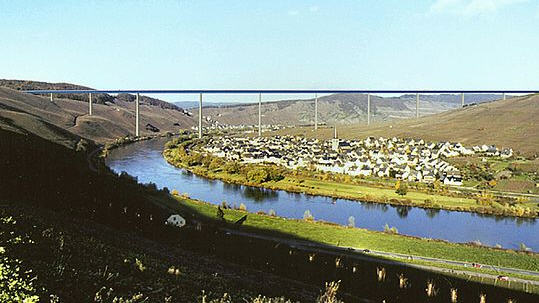
Planned bridge near Uerzig, Mosel

Two days ago the deadline for the petition ended. I confess that I did not make it in time. But I have joined the facebook group called “Stop the new B 50 and save the Mosel vineyards from devastating damage” opposing the building of this bridge.

The planned bridge is massive. It is about 160 meters high and 1.7 km long. It will probably cost about 270 million EURO which is equivalent to about US $ 400 million. On the facebook site above you can find more photos and animations showing you what the bridge will do to the Mosel valley.

The issue made it even into the New York Times which carried an article about it contrasting pro and contra views. Because the cost and benefits of such a massive undertaking are not clear cut. If you asked me to which camp I would belong, well, I asked myself two simple question: 1. would I give up my vineyard land for the venture? and 2. Would I like to look at this bridge from my window when I wake up in the morning?

My recent Australian experience with the North-South pipeline suggests that there is very little hope that such mega projects can be stopped by citizens protest. The Plug the Pipe campaign could not stop the project but it surely raised the political costs to Victorian the labour government. And election time is near.

Topher analyses the political economy of the North-South Pipeline. Unfortunately, there are no elections in my home state of Rheinland-Pfalz this year. So we are less lucky than the Victorians. The only thing which might save us is the empty state coffers.


The other Mosel: The wines of Luxembourg

September 2, 2009

Lux0

Luxembourg vineyards along the Mosel seen from the German side in Wellen

Having grown up in Trier, Mosel the Grand Duchy of Luxembourg is no stranger. As a teenager we used to drive to Luxembourg City to enjoy its night-life visiting the famous discotheque “Blow up” and thereby expose ourselves in a kind of pan-European experience, populating the dance floor amid dancers from Belgium, Holland, France, Germany and Luxembourg.
Lux1

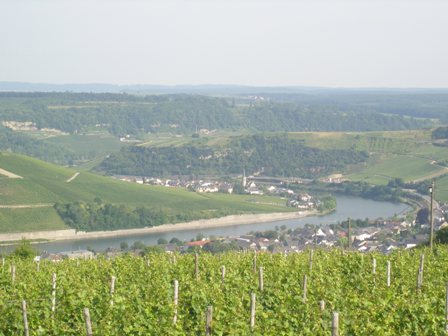
Mosel river with Nittel in the foreground (German side) and Machtum (Luxembourg side)

The above photo shows the Mosel valley, in the foreground the wine village of Nittel on the German side, and in the background the Luxembourg village of Machtum/Miechtem along the “Route du Vin”, the road which leads the visitor through the picturesque vineyards and wine villages of Luxembourg. I took these photos during my last visit to Trier at the end of June when I cruised along the river visiting both Grevenmacher and Nittel.

One of the best kept secrets as regards European wines are the fine wines of Luxembourg. Total production is about 12.4 million litres of which more than half is exported (mostly to Belgium and Germany). The total area under vines is about 1300 ha only which is about a third of the Yarra Valley. Luxembourg is a kind of artisan wine producer, where the winery sector is dominated by small family-enterprises, whereas large, corporate-wine industrialists shine through their almost complete absence. Of the odd 430 grape producers only about 60 have their own wineries. Most vignerons are members of a wine co-operatives at the village level.

Luxembourg is mainly a producer of dry, varietal white and sparkling wines (about 15% of total production). This is a stark contrast to the German side of the Mosel which has a strong tradition in semi-dry and sweet wine production.

Of the 15 approved wine varieties, Müller-Thurgau (Rivaner) accounts for about 29% of the area under vines followed by the Burgundy varietals (together almost 40%). Auxerrois (14%), Pinot Blanc (12%) and Pinot Gris (13%). Riesling covers only about 13% of the area in Luxembourg whereas it is the dominant grape variety on the German side of the Mosel. Luxembourg also has about 10% of the area under Elbling, the oldest wine variety in middle Europe, characterized by its high acidity which makes it ideal for the production of sparkling wines. Chardonnay and Gewürztraminer are other white varieties grown. Pinot Noir (about 7% of the area) is the most common red variety of Luxembourg.
Lux2

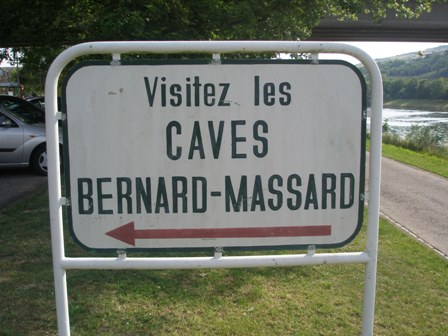
Parent house of Bernard Massard in Grevenmacher

On of the largest producers of still wines and crémants (bubbly/sparkling for my Australian readers) is Bernard Massard. Bernard Massard is also well known in Trier where the company has a large office and wine cellars in the middle of the town centre (Jakobstrasse), but Bernard Massard owns and operates vineyards also along the Loire river in France. The parent house of the company is located in Grevenmacher. More than 30,000 visitors come to see the extensive wine cellars

Lux3

Bernard Massard owns two vineyards along the Mosel: Domaine ‘Thill’ in Schengen (12 ha under vines) and Domaine ‘Clos des Rochers’ in Grevenmacher and Wormeldange (18 ha) with a combined production of about 120,000 bottles (or 10,000 cases) per year. Through the sparkling production in Trier about 3 million bottles of crémants and other sparling wines are sold. The French vineyards (Caves Monmousseau at Montrichard and La Petite Cave at Ronchamp) along the Loire river produce mainly crémants (Crémants de Loire and Touraine sparkling wines) and a variety of local wines.

Lux4

Domaine ‘Clos des Rochers’ in Grevenmacher

Lux5

Vineyards near Mertert/Wasserbillig

The bulk of Luxembourg’s family vineyards and wineries is much smaller than Bernard Massard. Because of the long tradition of viticulture in the villages and hamlets along the Mosel, many vintners come from families who have a strong family tradition in grape growing and wine making. Many families are related through intermarriage and therefore many wineries have combined family names most of which you will have never heard of.

Representing these strong traditions I would like to mention only three smaller wineries. I apologise to all the others; I know many of you deserve a full portrait.

Caves René Bentz, Wellenstein (5.2 ha)
The vineyards are located in Wellenstein, Remich, Wintringen and Bech-Kleinmacher. Main variety is Müller- Thurgau, however the most important varieties are Riesling, Pinot Gris, Pinot Blanc and Auxerrois. The Riesling wines of the Gottesgôf selection are worth trying, and so is the 2007 Pinot Gris Côteau Wellenstein.

Domaine Viticole Charles Decker, Remerschen (4 ha)
Charles Decker has a clear vision of his wines. He is one of the few who cultivates Muscat Ottonel grapes and experiments with German new varietals such as Siegerrebe, an aromatic grape. He specialises in sweet wines. Try his Muscat Ottonel wines but also the Chardonnay and the Pinot Gris are commendable.

Caves Kayl-Noesen Nic et fils, Remerschen (6 ha)
This is a very young undertaking, with the winery established only about 5 years ago. Before that the family produced grapes and sold the fruit to other wineries. The young vintner who studied oenology in Germany, manages the estate with his father. The classic varieties of Luxembourg are the wines you should try. Their Auxerrois, Pinot Blanc and Pinot Gris are ideal wines consumed with fine cuisine.

Lux6

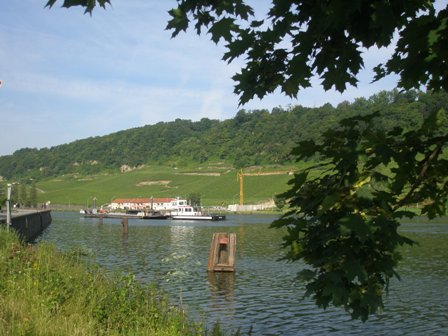
The mouth of the Sauer river at Wasserbilligerbrück meeting the Mosel

It is worth visiting Luxembourg and its vineyards and wineries. Stop at any nice café or wine bar and try the local Elbling or go for the more elaborate cool climate Auxerrois, Pinot and Riesling wines.

Information about Luxembourg and its wines:

I found the following book very useful (in German): “Weine und Crémants aus Luxemburg”, Einkaufsführer 2009, Meininger Verlag (www.meininger.de), Neustadt, Weinstrasse.

A very informative article about Luxembourg can be found on http://www.wine-pages.com/features/luxembourg-wine.htm
.

But also the Wikipedia write-up gives the newcomer a very good overview.

The fourth source of useful information comes from http://www.vins-cremants.lu/en/winegrowers/alphabetical_listing.html


Heaven on a stick

June 14, 2009

As you all know life in the tropics is sweet, and can therefore be described as “heaven on a stick”, as we say in Australia. This is even more so since (finally) the best beer of the world arrived in our local neighbourhood super market, the Villa Market in Thonglor, Bangkok.

There are of course many “best” beers in the world depending on ones taste, upbringing, and the general circumstances. But since I come from the Mosel river, my favourite beer is Bitburger Pilsener, brewed in the small town of Bitburg about 30 km north of my home town Trier.

BitteeinBit

Bitburger Pilsener

After patronizing this supermarket for about nine month and browsing the beer section consisting mostly of Japanese, Thai and Bavarian beers, you cannot imagine my joy to find a few bottles of Bitburger beer.

Apart from a good beer, a glass of wine and a good meal, the tropical pleasures are simple: enjoy the fragrance of a Frangipani flower (Plumeria), a dash in the pool, and company of family and friends.

Franjipani

A potted Frangipani tree on my terrace in Bangkok

Pool

It’s just too hot these days

Hope you all have a good weekend. Cheers.


Along the Mosel River

September 12, 2007

I have often traveled along the Mosel River by train. Last weekend I decided to abolish the train and drive by car from Kobern-Gondorf to Trier. Unfortunately, the sun did not shine. But despite this handicap it was one of the most marvelous trips I have recently made.

The Mosel River valley was buzzing with visitors and tourists. Groups of cyclists, tour buses, camper vans as well as people on foot, motorcyclists and others were cruising along the river and swarming the small towns and villages. Almost every settlement advertised its ongoing or imminent wine festival and vintners’ fair. Everywhere one could buy wines, have a meal or stay overnight. Vintage was in full swing in many places and the young fermented grape juice, in German called “Federweisser” was everywhere on offer.

rivermosel.jpg

Barges and a ferry on the river and a castle in the background

moselriver2.jpg

Steep slopes and a narrow valley, vines on “Graywacke” slate plates

The appelation of the wine region “Mosel-Saar-Ruwer” is the result of the Wine Act of 1909. From 1936 onwards wine labels could show this designation. In 2006 the German Parliament passed a new law abolishing “Mosel-Saar-Ruwer” and simply replacing it with “Mosel” and since August 1st, 2007 the region is officially called “Mosel” only.

The region consists of six sub-regions with 19 locations (Grosslagen) and 524 individual locations (Einzellagen). 5,500 wineries and vineyards are spread over 125 settlements, villages and towns. The total area under vines is about 9,000 ha, which produce annually about 850,000 hectoliters of wine (including 75,000 hectoliters of red wine). The largest wine producing acreages can be found in the settlements of Piesport, Zell (Mosel), Leiwen, Konz, Neumagen-Drohn, Mehring, Bernkastel-Kues and Trittenheim. I passed through some very famous vineyard locations such as “Bremmer Calmont”, “Wehlener Sonnenuhr”, “Erdener Treppchen”, “Ürziger Würzgarten”, “Piesporter Goldtröpfchen”, “Bernkasteler Doctor” and many others.

steepslopes1.jpg

The elevator “sledge”

steepslopes2.jpg

The “rail” for the “elevator”

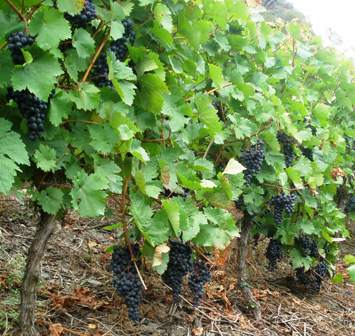
The region has the largest extent of vineyards on steep slopes (inclinations range from 30% till 60%) in Germany. The Mosel region is also the biggest Riesling producer in the world (with about 5.000 ha acreage). Recently some of the more extreme locations have fallen fallow. Traditionally vines were planted on the steep slopes using single posts. In recent times they have been gradually replaced by modern trellis systems. For transport purposes, elevator systems were installed in some locations, as shown on the photos below. I was very surprised to find a lot of red grapes planted in the flat lands near the river. Most of them are Pinot Noir and Dornfelder grapes. There is an increasing trend to extend the acreage for red varieties and the Mosel has once again become a superb producer of red wines, especially Pinot Noir.

redgrapes1.jpg


Obituary to a name: Mosel-Saar-Ruwer

July 5, 2007

Decisions have been made to rename the wine region where I come from. Soon it will not be called any more by the familiar name of Mosel-Saar-Ruwer but only Mosel. The two tributaries, Saar and Ruwer, where some of the best Rieslings of the world are grown, will not feature any more in the name of the wine region. Personally I find this a pity. I love the two tiny wine producing areas with their distinct character. They are the most charming and lovely destinations for wine lovers and other tourists alike.

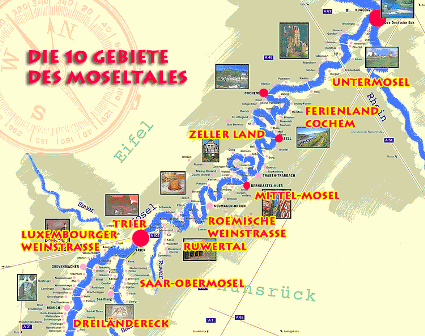
The Mosel-Saar-Ruwer wine region

gebiete-moselbauweb.png

Source: http://www.die-mosel.de