The vintners knife II

July 11, 2007

You might remember that I introduced a while ago to you the brothers Consigli from Scarperia, Italy (www.conaz.com) and their knife-making art.

When I browsed trough the many photos I have on my PC the other day, I found two copies of vintners knives from Roman times unearthed in the Mosel River valley.

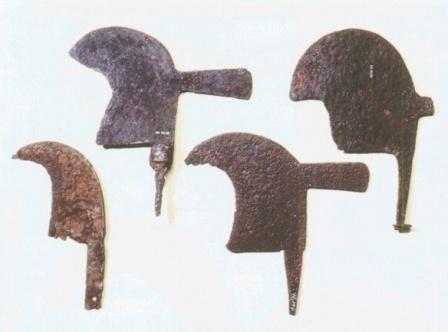
In the “Bacchus and Sucellus” book of Karl-Josef Gilles (Rhein-Mosel Verlag, Briedel, 1999, pages 61 and 62), two forms of vintners knives of the Roman times are shown.

The first type is for pruning, it is massive with a broad blade and a small pruning chisel on the backside. The second type was for harvesting grapes and looks like a sickle. It is slighter and finer. Also a knife which was slid over a finger was found and used for the same purpose.

rebmesserb.jpg

The Roman knives for pruning (Brauneberg, Leiwen)

rebmessera.jpg

The Roman knives for harvesting (Piesport, Wittlich, Trier)

Most likely from tomorrow onwards I will be pruning vines in my own vineyard in Glenburn, Victoria. I will be back in August. Have a good time and drink some bottles of fine wine, somewhere with someone you like (should not be that difficult).

Postscript: I was made aware by Bob Burgess that the back of the pruning knife consists of a small pruning chisel and not a hammer knob as I have mistakenly believed. Thanks Bob for the correction of this error. Please visit also Bob’s very interesting webpage (www.billhooks.co.uk) on early edge tools.


Sauvignon Blanc

July 10, 2007

My morning newspaper, the International Herald Tribune, carried the other day an article summarising the tasting of 25 Sauvignon Blanc wines from New Zealand. Sauvignon Blanc is one of my most favourite white wines. The results were interesting. Only about 10 of the 25 wines found the approval of the tasting panel (it was a New York Times event of the dining section). For the judges, the tasting was a disappointment. They were looking for the bold, pungent refreshing SB but found that too many wines were dull, too sweet or simply wishy-washy or as Eric Asimov put it “commercially inoffensive”. My favourite SB from New Zealand, Cloudy Bay came up third (behind “Villa Maria” in number one position), described as “quieter than the top wines” but still “bold, zesty and delicious”. In my bottle shop in Jakarta it retailed for 40 US$ the bottle last week. Gone are the days when I had to pay only 18 US$ for this most delicious white.

Mr. Asimov is of the opinion that many producers have decided to push quantity at the expense of quality and that they are over cropping (too high yields per acre). I learned something else from the article: that in New Zealand wine producers are allowed to add sugar or acid to make up for “green” (not fully ripened) grapes, as we say. In Australia, we are not allowed to engage in this technique or should I say “manipulation”. Next time in the bottle shop it will be much easier for me to walk away from the dear SB from Marlborough and turn to some cool climate Sauvignon Blanc of Australian provenance. I might be enticed to make some Two Hills Sauvignon Blanc again in 2008. Kinloch Wines (www.kinlochwines.com.au) Sauvignon Blanc of 2006 is sold out, as I learn from their website. Guess who provided some of the fruit for this most delicious wine from the Upper Goulburn River (www.uppergoulburnwine.org.au)?


Like wine: Vintage Chocolate

July 9, 2007

Vintage wine, vintage cars and vintage cigars may be in vogue right now but also other products are coming in a vintage fashion nowadays. When earlier this year my friend Jim Riddel from Minnesota visited Jakarta he brought with him a whole stack of chocolate bars from his favourite producer, Michel Cluizel and his vintage chocolate produced on small farms under controlled conditions. It’s a chocolate for adults with a fantastic unadulterated taste, many of the younger generation, used to industrially produced chocolate, does not yet appeal. Michel Cluizel (www.cluizel.com) is an artisan chocolate producer since 1948. His mission is to produce the best chocolate by vigorously selecting the best cocoa beans to produce the finest chocolate of exceptional quality. He and his four children work in the family enterprise.

In 1997 he created the single plantation chocolate series -1ers Crue de Plantation – which sounds like the denomination of any fine wine from France. In fact the concept for this product includes to find the best cocoa beans and to establish fair and long term relations with the planters. The chocolates are to be enjoyed and compared like fine wines.

We tasted the two single plantation chocolates below, the Los Ancones from Santo Domingo and the Maralumi from Papua New Guinea. From Michel Cluizel’s website I got the following descriptions of the plantation and the tasting notes:

Los Ancones – Dark Chocolate 67% cocoa

“I discovered this plantation in a splendid environment to the north east of the island of Santo Domingo, at the heart of the Caribbean where the family Rizek has produced, since 1903, exquisite cocoa beans.”

“Lengthily worked, the beans release in this chocolate their aromas of liquorice wood, then red berries and green olives with a lingering flavour of currants and apricots.”

Maralumi – Dark Chocolate 64% cocoa

“The island of Papua – New Guinea, off the coast of Australia, is an unusual origin for cocoa. A superb Maralumi plantation lies close to the East coast producing refined beans that greatly appealed to me.”

“The beans give this mellow chocolate slightly roasted and spicy flavours, fresh notes of green bananas and acidulates flavours of red currants prolonged by charming aromas of Havana tobacco leaves.”

2-chocolatesweb.jpg

Cocoa, the fatty seeds from the cocoa tree (Carolus Linnaeus), is the base of which chocolate is made. Cocoa trees are very “individual” which means that they are not suitable for large scale plantations but rather small tree gardens tended to by individual farmers. The trees are usually grown together with other useful trees, either for fruit or firewood. The tree is a native to Latin America but Indonesia is one of the major producers (third after Ivory Coast and Ghana) and blending centres for chocolate. Production worldwide has increased steeply in the last couple of years. Leading consumer of chocolate is Belgium, leading processor is The Netherlands. Chocolate tasting is organised similarly to wine tasting. After a beautiful meal I usually drink a strong espresso and relax with a piece of chocolate, if possible from Michel Cluizel.


Obituary to a name: Mosel-Saar-Ruwer

July 5, 2007

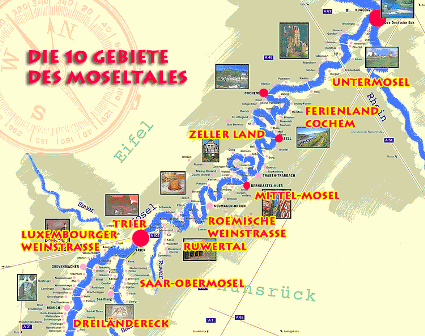
Decisions have been made to rename the wine region where I come from. Soon it will not be called any more by the familiar name of Mosel-Saar-Ruwer but only Mosel. The two tributaries, Saar and Ruwer, where some of the best Rieslings of the world are grown, will not feature any more in the name of the wine region. Personally I find this a pity. I love the two tiny wine producing areas with their distinct character. They are the most charming and lovely destinations for wine lovers and other tourists alike.

The Mosel-Saar-Ruwer wine region

gebiete-moselbauweb.png

Source: http://www.die-mosel.de


Merlot Night

July 2, 2007

Looking at the calendar, we were alarmed that quasi “half of the year is already over”. Time flies, it seems. What have we been doing? How could it go so fast? Consequently, we spontaneously decided to celebrate this event with a wine tasting on the last evening inJune.

Merlot was our choice of the day. Our wine cellar had only two brands left:

● a 2003 Hungerford Hill, Orange Merlot from the Hunter Valley and

● a 2004 Two Hills Merlot from the Upper Goulburn Wine Region.

The Hunter Valley (www.hunterweb.com.au) is one of the oldest wine regions in Australia. Its flagship wines are Semillion and Shiraz but it has also pockets of cool climate sites. The Upper Goulburn Wine Region (www.uppergoulburnwine.org.au) is a significant cool climate grape growing area in Victoria with quite remarkable diversity of varieties and wine styles.

We had the two wines after dinner with a most delicious cheese, a Brie “au lait entier”, processed according to traditional methods by “Paysan Breton” and fresh baguette.

Both wines come from cool climate regions. Hungerford Hills Merlot belongs to the regional series of the brand (www.hungerfordhill.com.au). It is produced in Orange in New South Wales, a rather new location on the Australian wine map (established in 1983). Formerly it was know as the Central Highlands centred on the slopes of Mount Canobolas which is an important fruit producing area (apples, pears, cherries). The first commercially planted vineyards were established in the 1980s. The location of some of the vineyards for this regional wine is above 600 m altitude.

The 2003 vintage is under cork whereas the Orange Merlot 2004 is already under metal capsules. Both are available at duty free bottle shops in Jakarta, retailing for about 23 to 26 US$ per bottle. The internet order form of the winery shows 28 A$ per bottle for the Merlot (22.40 A$ for wine-club members). Whereas the 2003 bottle does not show wine awards stickers, the 2004 shows a gold medal and other distinctions at the 2006 Sydney International Wine Competition. The winemaker is Philip John.

As you probably know, Two Hills Vineyard also produces cool climate wines. The Geographical Indication (GI) for the Upper Goulburn Wine Region was only recently identified (formerly also called Central Victorian High Country) but grapes have been grown there since more then 30 years. The vineyard is a single site on a slight northerly slope. The 2004 vintage is under a DIAM cork closure. The wine is made by Alan Johns, the owner-winemaker cum viticulturist of Yering Farm Wines in the Yarra Valley (www.yeringfarm.com.au). Retail price at the Old England Hotel (www.oldenglandhotel.com.au) in Heidelberg, Melbourne should be around 15-17 A$/bottle. It can also be obtained at the upcoming Upper Goulburn Wine and Food Expo (Saturday, 11th August, in Alexandra Town Hall).

picture-076webmerlot.jpg

Tasting notes
Both wines show excellent dark crimson red colours. The nose of the Hungerford Merlot shows complex aromas of wild berry fruit with a slight nose of liquorice and nutty French oak. The wine is a blend from different vineyards in Orange. It is medium bodied, has a soft finish and displays balanced tannins.

All wines at Two Hills Vineyards are hand crafted. The grapes for Two Hills Merlot are coming from a single site, the vines are hand pruned and the grapes are hand harvested. The ‘2004 Two Hills Merlot’ also displays ripe wild berry fruit but not the liquorice and nuts flavours. The wine is very subtle, elegant with great finesse. It is medium bodied, dry, with good acidity, and a long finish. Its tannins are firm and give the wine a fine balance.

Hungerford Hill, Orange Merlot 2003
14% alcohol, matured in 60% new and 40% old French oak for about 15 months

Two Hills Merlot 2004
13.5 % alcohol, matured in 90% old and 10% new French oak for about 18 months

The Many Wines

June 28, 2007

One of my favourite poets is Rumi, also know under his full name of Mawlānā Jalāl-ad-Dīn Muhammad Rūmī (Persian: مولانا جلال الدین محمد رومی, Turkish: Mevlânâ Celâleddin Mehmed Rumi, Arabic: جلال الدين الرومي, shortened to إبن الرومي). a 13th century Muslim jurist and theologian from Persia.

200px-mawlana_rumi.jpg

Rumi (from wikipedia)

For us modern, 21st century vintners and wine lovers the following excerpts from one of his poems on wine are of interest:

The Many Wines

God has given us a dark wine so potent that,
drinking it, we leave the two worlds.

There are thousands of wines
That can take over your minds.

Be a connoisseur,
And taste with caution.

Any wine will get you high.
Judge like a king, and choose the purest,

The ones unadulterated with fear,
or some urgency about “what’s needed”.

Drink the wine that moves you
as a camel moves when it’s been untied,
and is just ambling about.

(Source: cited from: “The Essential Rumi”, translated by Coleman Barks, with John Moyne, A.J. Arberry and Reynold Nicholson, Castle Books, 1997, page 6 and 7)


Boutique Vineyards

June 27, 2007

Where Two Hills Vineyard is located, among the beautiful rolling hills between Yarra Glen and Yea at the Southern edge of what is commonly known as the Upper Goulburn Wine Region (www.uppergoulburnwine.org.au), there are many more small and very small vineyards and wineries out there.

Definitions of what a boutique vineyard and/or winery are vary. Some think the total tonnage for the wine label should be below a certain limit (for instance a maximum of 250 tonnes crushed per year). Others see the limitation of yields as crucial (for instance less than 3-4 tonnes per acre). Specialised organisations of producers and wine merchants support the Boutique vineyard sector (for instance www.boutiquewineries.com.au) and cater to their needs. The size differential is usually compensated by outstanding product quality. Hand crafted, artisan wines from Boutique vineyards and wineries can certainly compete with mass-produced, industrial products.

thv-03-valley2web.jpg

Two Hills Vineyard in Glenburn

What they all have in common is the limitation of overall quantity for the sake of quality.This is exactly what we at Two Hills are attempting to do. Less is more for us. Our philosophy is that only excellence is worth being produced. This is also our economic niche which hopefully allows us to survive in this very competitive market. Fortunately, wine drinkers always want to try something new, they want to explore new opportunities, find new challenges. We attempt to serve this urge. And since every year’s grapes are different also the wines we make out of these grapes are different. We only use high quality fruit. In order to get to the 3 tonnes yield per acre we have to drop a lot of fruit in order to ripen the remaining one to the highest standard. Steve Sadlier of Vineadvice, our viticulturist, makes sure that the standards are high and consistently maintained.

Another aspect of Two Hills Vineyard is that it is a single site (in German: Lagenwein). Therefore the “terroir” matters to us more than to others. Our wines are made in the vineyard. There is no blending going on. What we get at harvest time, is what we process. We do not buy grapes from other locations. This is why we devote all our times and effort to the production of clean and healthy, top quality fruit. The wines we produce are witness to this philosophy. Alan Johns, our winemaker at Yering Farm (www.yeringfarm.com.au), has the passion and devotion to producing top wines. The Merlot 2006 which we are going to release soon will prove this. Unfortunately we have only a couple of thousand bottles of this treasure.


Freedom from protectionism – the EU wine market in the 21st century

June 22, 2007

It sounds strange to the ears of an Australian vintner that the wine industry (because of its complexities) would need the protection of the government. I think we in the Australian wine industry enjoy a maximum of freedom from government intervention. European vintners are not that lucky. But is seems that finally they might be getting some more freedom, if the European Commission carries through with its proposal to reform the heavily subsidised and regulated wine market.

However, if one expected a hearty welcome and praise for this effort, one would be utterly mistaken. There is some fierce criticism from some of the EU member countries which object to this “too much” of freedom. Doomsday scenarios are then usually invoked to scare reform minded policy makers. “The end is near”, “our culture and traditions are dying” and other similar slogans are shouted out by lobbyist of various persuasion. Of course consumers would ultimately benefit from deregulation and liberalisation. In the non-wine producing countries, there seems to be no problems but in the wine belts of the EU a storm is being stirred.

According to the Economist of June 16th, 2007, the EU wine budget amounts to € 1.3 billion a year. Some wine is produced more or less exclusively for destruction. The reform plan includes the pulling of about 200,000 ha of vines (about 6% of the total area) and transfer payments to vintners who cannot sell their produce so that they can leave the sector and find some new employment. The restrictions on new planting are scheduled to be lifted from 2014 onwards so that successful wineries can expand. Especially French and Luxembourgian officials oppose these moves and invoke the fears of inundation by cheap, mass-produced, “industrial technique” dominated wines from the new world. Both countries are rather successful in making money from wine production. Their vintners earn more than others in Europe, says the Economist. Ever since the debate of the Corn Laws in Britain in the House of Commons in 1813 and the enactment of the importation act in 1815, mercantilism has raised its ugly head from time to time, always with the ever same line of argumentation (foreign grown products would be dangerous to rely on, prices and wages would be diminished and producers and manufacturers would lose out). Empirical evidence is overwhelmingly just to the contrary. Europe would not be that prosperous without free trade and the healthy competition it bring with it.

On a more personal note, I believe there is another aspect usually overlooked: the dignity of a producer who can survive in the market without government handouts. Isn’t it a beautiful feeling if your wine flies out of the farm into shelves of supermarkets and grocery stores, and you don’t have to beg government officials for charity? I hardly make any money with Two Hills Vineyard at the moment, but so far I survived as a free but responsible man. If I should be forced to pack up and sell, I can say that I at least tried. No government to blame, I have only myself to blame which is neat.

I wish my European colleagues well in their efforts to become more independent and sucessful.


The vintners knife

June 18, 2007

Some years ago my wife surprised me with the most marvellous birthday gift: a vintners knife which she had ordered from Italy. She kept all the transactions secret from me. I only notices some e-mail going back and forth from our PC in Jakarta to Italy in Italian. But I did not look at them thinking it must be old acquaintances from the good old days when we were living in Rome. I was really chuffed. It is a traditional Italian knife used by vintners even for pruning of vines which I carry with me every day when on the farm.

The producers are two Italian brothers, Luigi and Enrico Consigli who opened their forge about 50 years ago in Scarperia a small town in Tuscany. The settlement traces its roots back to 1306 when it was created at the foot of the Giogo Pass linking Florence to Bologna. The city of Florence soon established a castle (Castel San Barnaba) their in order to control the most important road crossing Italy. “Scarpa” means “shoe” in Italian and “ria” (in Tuscan) means “steep”, the two words were combined and so the name Scarperia was born. The town has since the 1980s a very interesting “cutting irons” museum and till today, it is a world renown centre for the ancient art of knife making.

Back to the two Consigli brothers. Today, Luigi is retired and the family business is carried on by Enrico and his children Elena and Pietro. It is a typical Italian business venture moulding tradition. Modern tecyhnique with elegance and refinement. The company does not only produce traditional workmen’s knives (for vintners, fishermen, shepherds, olive growers, etc.) but also kitchen cutlery. The family business website (www.conaz.com) is also in English. It introduces the visitor to the history of the region, the company, the trade (how a knife is made) and provides a wonderful catalogue with various regional, and historic knives as well as table and kitchen cutlery.

Below, a photo of my traditional “vintners knife”. A couple of years ago it was still produced in different sizes. When I screened the catalogue on the website, however, I could not find it any more. It must be out of production. The more I am happy to own such a treasure which is of great help in my little vineyard at Two Hills near Glenburn in the New World, far away from Italy and its traditions. But when I cut away at my vines, Italy is on my mind, and the forge of the Consigli brothers who made all this pleasure possible. While browsing the catalogue I had already singled out some very elegant models for future birthdays.

nive2web.jpg

My vintners knife, Consigli brothers, Scarperia


The top 100 Wineries in Germany

June 14, 2007

Today, I visited the website of the winery Adolf Schick (Jugenheim/Rheinhessen) which I had visited with a group of Indonesian politicians some years ago. The visit and the tasting was a great adventure, because Mr. Schick was so enthusiastic about his wines and his family business with a tradition of winemaking going back to 1590!

Our Indonesian guests were very impressed and so was I. Well, as an Australian boutique vineyard vintner I find a family business going back to 1590 very remarkable. At that time kangaroos were hopping through the forests where today, Two Hills Vineyard is located, I guess.

w_gut.jpg

Weingut Adolf Schick in the heart of Jugenheim

The winery is located in the village of Jugenheim, a very charming place, which I know from own experience. The family does not only produce high quality wines, it also owns the Hotel Weedenhof. The hotel’s restaurant is very good too. We had lunch there. The vineyard consists of 9.8 ha planted with the Burgundy varieties, Chardonnay, Rieling, Kerner, Portugieser and Dornfelder. Needless to mention that the wines won many local and national awards. The wines are very reasonably priced and you will find a wide range of different products including grape juice. All my Indonesian friends all bought some bottles of it.

As in previous years, the Weingut Adolf Schick (www.weingutschickjugenheim.de) was also in 2006 ranked (by the DLG, the German Agricultural Society) among the 100 best wineries in Germany (rank 47). Only 12 wineries from Rheinhessen can be found in the top 100. From my home region, the Mosel, 11 wineries made it into the list (www.wein.de), and only one of them came from Trier (Weingut Deutschherrenhof). I loaded down the list to plan my next excursion to German wineries when I will be visiting again in September. Happy tastings ahead of me, I guess.