Mosel and Rhine, rivers and wine

September 6, 2007

I just have arrived in Germany and I am sitting in the train from Mainz to Koblenz. Its 7:00 in the morning on a Saturday and it’s raining. September weather, Germans would say. The Rhine valley is so beautiful. We just passed Bingen and some beautiful old castles, forests and barges on the river. Some small vineyards are nestled in pockets on steep slopes. Within a couple of minutes the train passes through three wine regions, the ‘Rheingau, Rheinhessen’ and then follows the ‘Mittelrhein’ for a while.

350px-mittelrhein_burg_katz.jpg

(Source wikipedia: St. Goarshausen, castle Katz with Loreley rock)

The vegetation is still very green, only slight hints of autumn are to be seen here and there. Another spectacular castle rises on the next hill. I cannot provide you with all the names of these magnificent structures from ancient times. There are so many of them. Villages in white sit on the hilltops. How can they grow the vines on these steep slopes, on these slate plates? The ground consists of slate on top of greywacke, a kind of sandstone generally characterised by its hardness and dark colour. It is a texturally immature sedimentary rock found in Palaeozoic strata. ‘Greywacke’ is the typical ground of the Rhine-Mosel-Nahe river valleys and the adjacent hills.

260px-vineyard_zell_germany.jpg

(Source wikipedia: Vines on steep slopes on slate)

Lots of water flows in the river. My train is on the right side of the river northward bound. During my previous visits I always travelled on the left side of the river. Today I have the opportunity to look over from the other side, which offers quite an amazing new perspective. Another medieval settlement with castle and church: Bacharach, a famous terroir, very picturesque. The part of the Rhine river we are passing is called the Middle Rhine and starts in Bingen and ends in Bonn. From the train I can see the settlements of Oberwesel, Sankt Goar and Boppard; then we reach Koblenz, an old roman garrison town where the Mosel flows into the Rhine river.

More than 2000 years ago the Romans occupied this territory. Garrison cities such as Koblenz secured the area and kept the German tribes people at bay. The Romans used the Rhine and the Mosel rivers to transport goods and troops. Ever since that time, vines have been grown along the rivers Rhine and Mosel. Many of the parcels are quite small. Usually we find vineyards on the southern slopes. The vines are un-irrigated. In some locations elevators are installed to transport materials, equipment and the fruit. About 75% of the area is planted with Riesling on steep slopes (25 to 30˚). Other varieties are Elbling and Mueller-Thurgau. The climate allows the grapes to get sufficient sun and heat. Because the slate soils act as heat storage, releasing the stored heat slowly during the night; temperature fluctuations are kept to a minimum and the ripening seasons is prolonged. Cold air, however, is ‘drained’ from the land by the steep slopes.

The Middle Rhine is one of the certified wine regions of Germany. The area under wines has continually dropped over the last years because of the small farm size and the low profitability of wine production. In 2006 the total area under vines was only 380 ha. However, for many families income from wine production and sales is still an important component of their total family receipts.

In Koblenz I had to switch trains and therefore boarded a slow local carriage which would bring me to my hometown Trier. For me this is the most enjoyable part of the journey. Homecoming involves such strong emotions, almost like tasting a Riesling or any other fine wine. Most of the train route is along the Mosel river and the views from the train are stunning. The rain stopped and here and there light rays of sun broke through the clouds. The green of the vines and the trees is so intensive. Some of the vineyards were already covered with nets indicating that vintage time was near. This year, due to a mild winter and a very sunny spring, many parts of Europe have seen the advent of vintage time earlier than usual. Vintners in the Champagne, in northern France for instance, started to pick their fruit on 23 August already, about two to three weeks earlier than usual (and the earliest time on record since the 19th century).

288px-wolf_mosel.jpg

(Source wikipedia: The Mosel near Wolf)

We passed the settlements of Winningen, Kobern-Gondorf and Bullay. The same picturesque scenes as a couple of hours ago at the Rhine were to be enjoyed: vineyards on steep slopes, nestled high just below the hill tops which are covered with forests. A little later the train left the valley behind and entered the hills of the Eifel region. I said good bye to all the vines and vineyards knowing that I would soon meet them again near Trier and that I would soon hold a glass of Riesling in my hand and would taste the reward of extremely hard work on the steep slopes of the Mosel, the Ruwer or the Saar. For me nothing beats Mosel Riesling. I just love its minerality, its crispness, the low alcohol but high acidity, its freshness, the intense floral and citrus fruit characters. Zum Wohl. Auf ihre Gesundheit.


Vineyard profile: The Mayer Vineyard

September 6, 2007

The “Mayer Vineyard” is located in the Yarra Valley, about halfway between Healesville and Yarra Junction on a steep slope overlooking the surrounding valley. The vineyard belongs to the Mayer family, Timo and his wife Rhonda. They and their three children (Rivar, Ruby and Ivy) live in a beautiful, rammed earth house on the top of the hill.

mayerfamily.jpg

The Mayer and the Adam families (Rivar missing from the picture)

Timo is the winemaker cum viticulturist at Gembrook Hill, a well-known boutique vineyard at the far southern and cooler end of the Yarra Valley. He is famous for his fine palate and a much sought-after wine consultant.

His own vineyard covers about 6 acres (VSP trellising, cane pruned, row spacing 2.5 m, vine spacing 1.5 and 0.75 m) and his wine label is called “Bloody Hill” which is also “written” or should I better say “slashed” (by a tractor slasher) into the remaining paddock in between the two vineyard blocks. Timo produces a “Bloody Hill” Chardonnay, a Pinot Noir and a “Big Betty” Shriaz. The wines can be obtained from various retail outlets (for instance the Wine Hub at the Yarra Valley Dairy or the Winehouse at Southbank in Melbourne) and by mail order. Timo makes also a very delicious Rosé. The total yearly production is about 12 tonnes of fruit which is ‘transformed’ into about 700 cases of wine.

mayervineyard.jpg

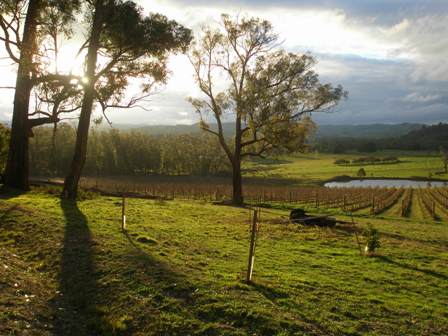
One part of Bloody Hill, the Mayer Vineyard

We were lucky to have had Timo make our 2002 award winning Sauvignon Blanc. However, we have more in common than a love for wine. Timo is also of German origin. He is the son of a farmer from the beautiful lands of the Suebians (Schwaben), home to a German tribe in the South and he cherishes many old local traditions. During a recent birthday celebration we were involved in a breathtaking collective “move the table” ritual, nothing spiritual of course but rather a rustic rural drinking game (with all the glasses and the crockery standing on it), where we physically lifted the table to above our heads chanting merryily, entirely in the Suebian language. All this went very well in the Australian setting of multiculturalism.

My suggestion: Check out the wines now and fill your wine cellar to capacity before they become a cult wine and very, very expensive.


Hanging Rock Winery

September 4, 2007

hangingrock.jpg

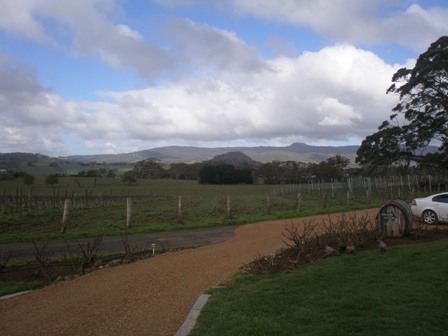
During our recent holiday in Australia we once strayed from our home turf. We went west towards Bendigo. On our way back from a visit in Castlemaine, we came through the Macedon Ranges wine region where we had never been before. This was a perfect opportunity to get to know some of the wines there. I had always dreamt of visiting the famous Hanging Rock Winery (www.hangingrock.com.au) whose webpage I had visited before. Visiting ‘virtually’ is one thing, but nothing beats the real thing. So we pulled up for a tasting. The winery is situated near the small settlement of Woodend. From the cellar door one has a wonderful view of the famous Hanging Rock, a major tourist attraction of the region.

hangingrock3.jpg

The Hanging Rock seen from Hanging Rock Winery

It was a grisly day and we were cold when we entered the cosy tasting room. Andrew showed us some of the outstanding wines produced at the Jim Jim Vineyard . The Macedon Ranges is a cool climate region, producing some of the finest sparklings in Australia. We also tasted wines made from grapes from the Heathcote area, another well known wine region of Victoria. In sharp contrast to the Macedon Ranges, Heathcote is hot and therefore ideal for red varieties such as Shiraz.

We talked about all kinds of things; among others the challenges of the Asian, especially the Chinese, wine markets. We had a great time and bought a few wines, from the Rock range, the premium range (yellow label) and the super premium range (black label). Some days later, together with friends, we decided to sample the 2003 Heathcote Cambrian Rise (which won a gold medal at the 2007 Korea Wine show). It is indeed a very impressive wine.

From a brochure called milestones, I learned many interesting facts about the winery and its owner, John Ellis, and his family and friends. 2007 is a special year for the Ellis family and Hanging Rock. It marks the 25th anniversary of the winery and the 40th year of John Ellis in the wine industry. There are more causes for jubilation among them the 21st vintage at Jim Jim Vineyard and the 20th for the Heathcote Shiraz. In 2007 John Ellis was also elected the Chairman of the Small Winemakers Committee of the Winemakers federation of Australia.

hangingrock2.jpg

Lucy, Charlotte and Margit with a case of treasures from Hanging Rock

We did not try the sparkling (we were in red wine mood, I reckon) but the Rock Macedon Cuvée XI and the Macedon LD Cuvée VI were rated by James Halliday’s 2007 Wine Companion at the top of his “Best of the best” rankings. Congratulations. The winery is certainly worth a visit. Its not far from Melbourne. Have a great time there and say hello to Andrew.


The Wine Hub

September 3, 2007

Due to an alternator breakdown, we were grounded for three days at my brother-in-law’s house in Healesville. We used the spare time to visit interesting places in the vicinity; one of them was the Yarra Valley Dairy where we had lunch one day. The dairy also houses the Yarra Valley Wine Hub (www.yarravalleywinehub.com.au),in a section of the rustic Dairy shed that is managed by Brook and Stephen Powell ,where they sell local wines usually from small vineyards and wineries. The Wine Hub specialises in single-vineyard wines. It’s a great place. Margit talked with Brook about wine in general and Merlot in particular and within a short time they agreed to conduct a tasting of our 2001 and the 2004 Merlot vintages. Brooke liked them both and ordered a couple of cases. And ever since, Two Hills wines can be bought at the Yarra Valley Wine Hub in the Yarra Dairy near Yarra Glen. Check them out when you pass by next time.

winehub2.jpg


Vineyard profile: Nenagh Park

August 28, 2007

The most important person to our small vineyard was and is Steve Sadlier from Yarra Glen who convinced us many years ago to plant the first grapes on Two Hills Road in Glenburn. Ever since, he has been our viticulturist consultant. But Steve Sadlier has not only a consultancy business, called “vineadvice”, but also a vineyard of his own. Its name is Nenagh Park. He choose the name in commemoration of his great-grandfather, also called Stephen Sadlier, who came from Ireland to Australia in the mid 19th century from the town of Nenagh in the county of Tipperary.

steve2.jpg

Steve Sadlier

The Sadlier family moved to Yarra Glen more than 100 years ago. The original homestead burned down in the bushfire of 1939. Steve and his family of six (wife Meagan and the children Bronte, Lou-Allan, Millicet and Heidi) live in the little house which was erected as replacement for the lost homestead. Of the original family land, Steve farms about 60 acres of which 21.5 acres are under vines. The vines are between 10 and 17 years old. Before 1997 Steve was the chief viticulturist at Yarra Ridge which is just across the road from his own vineyard and the Sadlier property.

The Yarra Valley is one of the most famous wine regions in Victoria. Outstanding cool climate wines are made here, especially Chardonnay and Pinot Noir. In the last couple of years late frosts destroyed most of Steve’s fruit. In 2002 only two tonnes of fruit were harvested from 21 acres; in 2006 the harvested volume was 32 tonnes which compares to a normal year of 75 tonnes. Severe frosts usually do not only have a negative impact on the fruit in the year the frost occurs but also the subsequent year. Usually, volumes are down until the vines recovered.

steves-chardy2.jpg

The Chardonnay block

Steve grows Chardonnay (about 9 acres), Pinot Noir (7.5 acres), and to a lesser extent Merlot (0.75 acres), Cabernet (2.5 acres) and Sauvignon Blanc (1.3 acres). Some of his fruit is contracted on a long term basis by one of the oldest wineries in the Yarra Valley, Yering Station. Steve sells mainly the fruit but in some years produces up to 250 cases of his own wine, usually made by Alan Johns of Yering Farm who makes also our wines. He sells his own wine as “clean skins” but plans are underway to develop a label and for the more distant future the vision is to develop the old house into a cellar door-cum-bed and breakfast.


Single-vineyard wines

August 26, 2007

According to an article in The Age (18.08. titled “The singles scene”), Steve Flamsteed, the winemaker of Giant Steps in Healesville in the Yarra Valley allegedly said that “the future is in single-vineyard wines”. In fact one of his own single-vineyard wines, a 2005 Sexton Chardonnay, only recently won a gold medal at the Royal Melbourne Wine Show. And his second single-vineyard wine, a 2005 Terraford Chardonnay, won a silver medal at the same event.

It is easy to be a supporter of single-vineyard wines when you have only a single vineyard, like me (Two Hills Vineyard has only one site). However, where I come from, the Mosel River valley, single vineyard wines are very common, rather the rule than the exception. It comes as no suprise to me that if you have selected the perfect site and planted the right grape variety, your fruit and with it your wine must be exceptionally good. The proliferation of the industry and also the expansion to second grade locations must have a negative effect on quality, which will show somewhere.

Well, the vintners at the Mosel had about 2000 years to select the right sites and the right varieties. We in Australia are not as fortunate as far as the time frame is concerned. But our entrepreneurial spirit, our love for quality and the beauty of the land allow for exceptional finds and with it for exceptional wines. Its great to contribute to this, especially if you are only a miniscule vintner with a very small and rather new vineyard in the Upper Goulburn Wine Region. Let’s move it.


Wine Tasting at the Alexandra Food & Wine Expo

August 23, 2007

expotasting1.jpg

The tasting chamber

During the recent wine expo of the Upper Goulburn Winegrowers Association (UGWA, www.uppergoulbournwine.org.au ), three wine tastings were offered to the visitors. The tasting took place in the meeting chamber of the Alexandra Shire Council where the mayor and the council members convene their meetings. Because Margit and I (Two Hills Vineyard) participated for the first time in an event of the Association, we took the opportunity to learn more about the wines from the region and our fellow members. Margit participated in the first tasting conducted by Les Oates, from Growlers Gully (www.growlersgully.com.au) and chairman of the UGWA. She thoroughly enjoyed herself. I was scheduled for the second one with David Miller, winemaker and partner from Rees Miller Estate (www.reesmiller.com), is one of a few certified biodynamic wineries in the region (the other one I know of is Will de Castella and his Jean Pauls Vineyard near Yea (www.jeanpaulsvineyard.com.au).

expotasting2.jpg

David Miller, winemaker at Rees Miller Estate

David conducted the tasting with great passion. We tasted four wines, two reds and two whites. The first white was a 2003 Kinloch Chardonnay (www.kinlochwines.com.au) which displayed vanilla, melon and passionfruit characters. The second wine came from Barwite Vineyards (www.barwitevineyards.com.au). It was a 2005 Riesling with showed a floral character; it was a citrus bomb explosion in the mouth. Than we moved on to the reds, in this case two Shiraz wines, the first from Snobs Creek Estate (www.snobscreekvineyard.com.au.) It was a was 2005 Shiraz. The second, a 2006 Shiraz, came from the Rees Miller Estate (www.reesmiller.com) itself. Both displayed delicious black fruit characters but whereas the Snobs Creek Shiraz was elegant and showed cherry flavours, the Rees Miller wine displayed a creamy richness that was truly remarkable.

expotasting31.jpg

The four wines

All the wines were superb; they were clean and well crafted. They showed the outstanding quality of the cool climate wines the region can produce. David did a marvellous job in guiding the largely novice tasters through the various stages of grape growing and wine making. He answered many questions and in a twinkle of an eye, two hours were gone. All the participants were very satisfied, enriched by the experience and certain in the knowledge that winemaking is art, as David put it so convincingly. They went straight back to the showroom to sample more wines from the Upper Goulburn Region. The tasting was also a great opportunity to get to know the region’s wines and it enriched the expo tremendously. A great success I would say.


Lunch at the Yarra Valley Dairy

August 22, 2007

Our car had broken down and therefore we had time for some holiday activity and therefore we had lunch at the Yarra Valley Dairy. The Dairy (www.yvd.com.au) is just outside the country town of Yarra Glen between Yering and Coldstream. It’s a great place to visit. Works are under way to extend it. Apart from various cheeses, all made on the premises with locally produced milk, there is a wide range of products on offer such as marmelades, relishes, condiments and country kitchen ware. The Dairy also houses the Wine Hub about which I am going to write another day.

yarradairy3.jpg

The inside of the Yarra Valley Dairy

Anyway, we were stranded so to say and hungry. We ordered two cheese platters and the adults among us had a glas of an earthy Yarra Valley Pinot Noir. Doesn’t the platter look delicious? We had a selection of breads with it. Needless to say that we bought some of the delicacies for home consumption. If you visit the Yarra Valley, the Dairy is a “must visit/must see” item on your itinerary.

yarradairy2.jpg

One of the cheese platters


Vineyard news – Two Hills in winter

August 21, 2007

thwinter07.jpg

Victorian winter and Two Hills Vineyard

I would like to bring you up to date on some recent developments. The dry season seams to be over in our neck of the wood. When we arrived at Two Hills Vineyard our small dam was full and the larger “irrigation” dam was slowly collecting runoff water from the surrounding hills. However, when I was digging out some blackberry roots I quickly discovered that the ground was still rather dry. Only about the first 5 cm of soil showed some moisture but below there were hardly any to find; not quite dry as a bone but still too dry. We will need much more rain in order to refill the ground.

unproonedwines.jpg

The un-pruned vines

Another exciting news is, that we are extending our vineyard. We are in the process of planting 1 ½ acres of Chardonnay (clone P 58). The posts are almost in. Peter Thwaites could not finish the job because it was too boggy. The spacing is 3 meter between the rows and 6 meter between the panels. Pro panel we will plant 4 vines (1.5 m per vine). We have 20 new rows of different length but about 1200 vines should find a new home at Two Hills Vineyard. We have to be patient though. Experience suggests that we will have to wait another four to six years before we can drink the first drop from this site.

postschardonnay.jpg

neblock.jpg

The new Chardonnay block in the making


Alexandra – Annual Food and Wine Expo

August 19, 2007

One of the highlights of our recent visit to Australia was certainly the Upper Goulburn Winegrowers Association’s (UGWA) Food and Wine Expo in Alexandra on August 11th. For the first time ever, Two Hills Vineyard participated in a wine expo, and that was truely exciting (our 2002 Sauvignon Blanc had participated in the Singapore Wine Show were the wine received a bronze medal but we were not present at the event).

Alexandra is a small but very charming country town in the middle between Mansfield and Yea, about an hours drive from Glenburn.

expo1.jpg

A sign somewhere along the road

expo2.jpg

The summary display with regional products

As newcomers to the game, our learning experience was steep. In fact we were poorly prepared indeed. However, our fellow wine growers from the UGWA welcomed us cordially and were not puzzled by our amateurish enthusiasm. Thanks to Susan Kinloch, the secretary of the UGWA, we were participating in the first place. Though we had only one variety to offer, a 2001 and a 2004 single vineyard Merlot, Susan convinced us that our participation would be welcome and beneficial. And so it was. Apart from learning how wine should be presented at such an occasions, we got to know some more of the members of our Association. Unfortunately, Charlie from Buller View Vineyard, who was to share a table with us could not make it. Our immediate neighbours were Henke Vineyard from Yark to our right and Nillahcootie Estate to our left. Large and small wineries and vineyards were all represented side by side.

expo3.jpg

The Two Hills “stall”

It started quite slowly at 10:30 in the morning but picked up in the early afternoon. Apart from wine, there were various processed foods, organic vegetables, olive products, salmon, bread and even locally produced textiles on display. We were lucky that our neighbours allowed tasters at our stall to us their spittoons. And in the end though we had only one red wine to offer, we had quite respectable sales. The joyous athmosphere had its effect also on us. Although we had to pack up rather quickly after the official closure and could not participate in the customary Wine Expo Dinner, we left the Alexandra Shire hHall rather enchanted and the firm belief that we would definitely come back next year for some more exposure in such an important regional event. We can only thank the other members of the UGWA for making it so easy for us to praticiate. It was a great experience.