The best restaurant in Northern Portugal: Quinta da Lama

August 27, 2008

The red entrance of the country inn Quinta da Lama

Quinta da Lama is not easy to find. If our host of Quinta de Gatão, Mr. Jorge Coelho da Silva, would not have guided us. He drove with his big BMW motorcycle in front of us so that we could find it otherwise we would not have a chance to experience this unique place.

Quinta da Lama is located in Vila Meã, near Peñafiel, the centre of Vinho Verde in northern Portugal.

Outside the main entrance construction is still going on

The restaurant is domiciled in an old olive oil mill and renovations are still ongoing. The millstone is at the centre of the restaurant and very picturesque. Rural equipment including tools from an old distillery can also be found. The interior is simple country style, extremely charming and very appealing. Rural folk all over the world will recognize its authenticity immediately.

The mill stone

One of the three female proprietors is Susana, an energetic young woman who speaks perfect English. The day we visited, she took our orders and served us the food. She made us feel at home. And as at home, we ate splendidly. To say it from the outset: this was quality food; fantastic rural dishes you won’t find elsewhere.

It was our last evening in rural Portugal and we had cause to celebrate. Looking back on a wonderful week in the countryside east of Porto.

The starter platter of Quinta da Lama

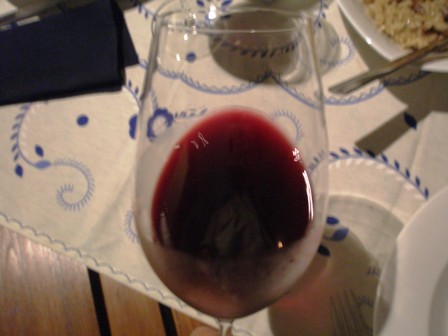
As customary in Portugal, a platter of appetizers is put in front of the diners. It consisted of home produced ham, local cheese, a sausage made from chicken and beef, melon and olives, all very delicious. We devoured the home made sausage made from chicken and beef. We drank the house red with the meal, a solid “Landwein” (table wine) as the German say.

The size of the portions is for (very) hungry workers

Our girls ordered a mixed grill type of dish with potatoes. I had a pork dish with chestnuts. As customary in Portugal rice and potatoes are consumed simultaneously. We had various desserts. I show you two of them, a ‘Crême brulée’ and the “secret” of the house, Papa’s D’Anjo.

The pork in chestnut

Crême brulée

Papa’s D’Anjo

Papa’s D’Anjo is a local dessert made of eggs and sugar syrup as far as I can recollect. It is very intense and one needs a lot of stomach space left to leave the plate behind empty. But what a delight this dish is. The fruit flavours are just incredible.

The end of the meal was celebrated with a “digestivo” which was equally a local invention. It’s the “trademark” of Quinta da Lama and is called Xiripiti, consisting of brandy home-distilled, with honey and cinnamon.

There is only one thing I can say, come to rural Portugal and visit Quinta da Lama in Vila Meã near Peñafiel just about an hour east of Porto in the Minho Region.

I will let you know more about rural Portugal soon. There are so many wonderful things we saw and experiences we were able to make. The hospitality of the people is just unbelievable, especially at Quinta da Lama.

Address
Quinta da Lama
Restaurante Tipico
Real
4605-348 Vila Meã
Tel.: 255-733-548


The last Mohican

August 24, 2008

A Diam cork, the cork of the last ‘2004 Two Hills Merlot’

The last Sunday lunch in our Jakarta home was a ripper of a lunch. The lamb stew (Australian lamb) with green beans and the mushed potatoes (Bandung potatoes are stunning for mashing) were such a delight. My taste buds were exploding. This is ‘orgasmic food’ at its best, I might add. The recipe came from Marcella Hazan’s “Classical Italian Cooking Book” of course.

The lamb stew

This time I was right with the choice of wine. The last bottle of ‘2004 Two Hills Merlot’ went.

I quote from the tasting notes of my friend and wine connoisseur Thomas Weber. He wrote about the 2004 Merlot some time ago:

The ‘2004 Two Hills Merlot’ also displays ripe wild berry fruit but not the liquorice and nuts flavours. The wine is very subtle, elegant with great finesse. It is medium bodied, dry, with good acidity, and a long finish. Its tannins are firm and give the wine a fine balance.

The wine was just a perfect match for the meat stew. We could not have spend our last Sunday in our Jakarta home in a better way.

The last Mohican (bottle) of 2004 Two Hills Merlot

Farewell, so long, auf Wiedersehen, good bye!

PS: The good news is that we have a reasonable supply of ‘2006 Two Hills Merlot’ which we are going to release in fall 2008. Friedel Engisch (in Wuerzburg) and Gert Kueck (in Leipzig) are the only ones in possession of some bottles of our 2004 Merlot. Lucky you.


Another year gone bye

August 23, 2008

Because of our move to Bangkok, Friday was a busy day. Packers everywhere, the house is like a nest of wasps, it seemed. Not easy under such conditions to find some peace of mind, but I did.

Another year had gone bye. My daughters had woken me early in the morning to wish me happy birthday. More well-wishers would come to join them over the day. My birthday dinner consisted of a ‘Risotto ai Funghi Porcini’, hm, that was beautiful as we say in Australia. I have loved risotto ever since we lived in Rome, Italy. And ‘funghi porcini’ is just the best “profumo” you can imagine.

What a wonderful ruby red colour the Shiraz from Hanging Rock has.
Risotto ai Funghi Porcini

Unfortunately, we did not have an Italian wine to go with it. Since my wine cellar is almost empty, I had not much choice. There were only three bottles of Australian wine, all red, left,

a ‘2004 Two Hills Merlot’ (reserved for the last evening in our house),

a ‘2001 D’Arenberg Coppermine Road Cabernet Sauvignon’ from McLaren Vale (I had paid US$ 40 for this bottle) and

a ‘2004 Hanging Rock Cambrian Rise Shiraz’ from Heathcote.

The two whites I have reserved are for lunch on Saturday and Sunday:

a ‘2005 Kitzinger Hofrat, Silvaner dry’ from Bernhard Voelker, Kitzingen in Franconia

and

a ‘2003 Saar Riesling’ from Van Volxem Estate in Wiltingen, Saar.

The tasting room of Van Volxem Estate in Wiltingen, Saar (picture taken in July this year)

I chose the ‘2004 Hanging Rock Shiraz’. The bottle was given to me by Andrew at the cellar door when we went on a wine tasting in August last year. If you visit the region of the Macedon Ranges in Victoria, you have to see this vineyard and taste its award-winning wines (see also my blog entry from 09. September 2007).

Hanging Rock has also a vineyard in the Heathcote wine region, Central Victoria where its award-winning Shiraz wines are grown which enjoy an enormous demand from consumers in China.

The Hanging Rock winery in the Macedon Ranges. In the back you can see the rock. The photo was taken in August 2007.

The wine is a blend from several vineyards near the Mt. Carmel range. It is beautiful, has a ruby red colour, and very intense plum and cherry aromas; it is very fruity, has immense depth, a good structure and actually everything you want from a Shiraz from the Heathcote wine region with its hot summers. The Cambrian soils of the Heathcote region are the key to the fame of its Shiraz wines.

Isn’t the ruby red colour of the Shiraz of Hanging Rock wonderful?

Pity the wine did not match the food (my mistake). The ‘funghi porcini’ were too delicate and subtle and the wine just overpowered the fragrance of the earthy mushrooms. We did not care this time, enjoyed the tropical garden view and the sweet heat of a dry-season evening. One last time. I wonder where I will celebrate my next birthday. Over these thoughts I blew the smoke of a Partagas cigar which was given to me by my friends Liz and Walter in Jakarta. Delicious!


Simple Eating: Local Inns in Portugal

August 19, 2008

Portugal is a country shaped by catholicism and any town and village is literally “littered” with churches, many of them in beautiful architecture. There is a lot of interesting things to be detected behind curtains and other visuals blocking the general view.

While looking for restaurants in Porto we were faced with the same camouflage but managed finally to find some small eating places, usually narrow, corridor-type cafes with a dining room in the back, which were extremely charming. One of them I would like to introduce to you. “Pirilampu” is its name and it is located in Rua Firmeza, the same street where our hotel – Hotel Menfis – was located.

The dining room of “Pirilampu” all in blue

The food on offer is simple, harty food, home cooking so to say, not expensive but very tasty and usually served in large portions. Rustique food as above is served usually with potatoes and rice.

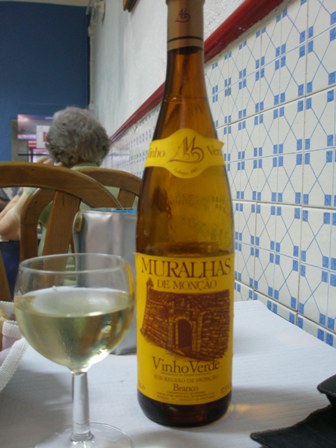
Favourite wine in northern Portugal is Vinho Verde, the young, fizzy wine, characteristic for the Minho Region. ‘Muralhas’ is one of the more common Vinho Verde wines on offer in many restaurants and cafes in Porto.

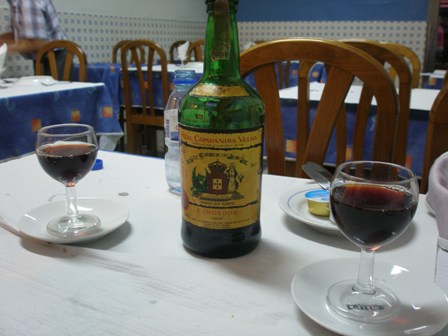
After the meal, cafe is served and then: it’s “Port wine time”, mostly Tawny and Ruby in small eateries and bars and less often vintage port. Delicious, delicious.

Needless to say that the waiters (often the owners themselves) are usually very friendly and that most of the guests are regulars. The homely atmoshere makes you fell very welcome. Try it out if in Portugal.

Address:
Rest. Churr. Pirilampo
Rua Firmeza,
155-Porto


The next big thing: Sherry

August 18, 2008

One of the hottest tips if you want to enjoy Sherry, the fortified wine originating from Jerez, Spain in Madrid is “La Venencia” in Calle Echegaray 7, Madrid. Sherry (and water) is the only drink on offer.

In the bar “La Venencia” in Madrid

The bar man writes your order with chalk down at the wooden counter and later calculates your bill there as well. The Sherry is taken from big wooden vats, filled into bottles and served in Sherry glasses. Green olives and other snacks are complimentary.

The place has a great atmosphere with all the patina (on the wall paper and all other furnishings) we expect from a place of character and great character “La Venencia” has. Sherry is not an old ladies drink! The bar was full of people from all walks of life and all ages, mostly male I might add.

We tasted the whole repertoire. Needless to say, all the sherries offered were delicious. One can forget completely that other wines could be enjoyable drinks. I had the feeling that only Sherry would matter to me in the future.

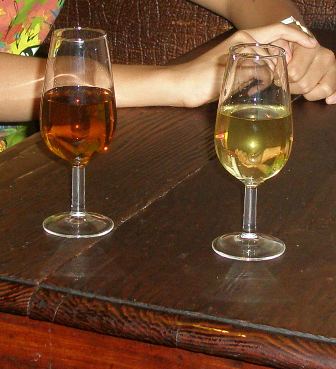
Beautiful Sherry

You will find all colors, from the Fino – pale, fruity, the Manzanilla – blue straw, grass taste, the Amontillado – dark caramel coloured, with a toffee aroma, the Oloroso -darkest colour, light brown, smelling like pralines.

“La Venencia” is such a great place. We did not want to leave but we finally succumbed to our stomachs and left to find a place for dinner.

Heaven must be a place where they serve Sherry, that’s for sure. My resolution included to drink more Sherry in the future.

If you visit Madrid, a visit to the La Venentia is a must, otherwise you have not been there.

Address:
La Venencia
Calle Echegaray 7
28014 Centro Modarid
Tel.: 914297313
Opening hours daily 19:30 -1:30 h


Asian Food and Riesling Wines

August 17, 2008

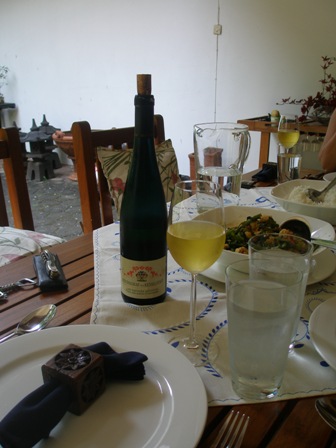
The Riesling wines I selected for Sunday lunch were just the right complement to the Asian food we were having for the last joint family lunch in our Jakarta home. Tomorrow our girls will be laving for Bangkok to attend the opening of the new school year at their new school.

The lunch consisted of a typical Indonesian composition of Kankung (a green water vegetable) with prawns. We ate it with rice using spoons and forks only as it is the custom in Indonesia. The wine we had with the meal was of course not an Asian invention but a Celtic one.

The semi-dry Riesling (“Feinherb” as the Germans say) from the Saar was a perfect match for the food. We had the last bottle of ‘2003 Wiltinger Gottesfuss Riesling Kabinett Feinherb’ , (alc. 11% vol.) from Reichsgraf von Kesselstatt in Trier (www.kesselstatt.com). The spicy food was just the right dish to have with this Riesling wine from my home region.

The sun was shining, my garden green and lush despite the dry season, and so 10 years came to a beautiful end for the four of us.

PS: As “dessert” we had a second bottle of German wine (which was also the last one in my possession), one coming from the Nahe wine region where my grandfather used to live, ‘2003 Sitzius Kreuznacher Rosenberg Spaetlese, Scheurebe’ (with only 9.5 alc./vol.) from Weingut Alfred Sitzius in Kreuznach-Bosenheim (www.weingut-sitzius.de). The variety is mainly found in Germany and Austria and produces highly aromatic wines often made into sweet wines but also available in its dry incarnation. It shows honey, blackcurrant and grapefruit flavors but retains also some of the Riesling character, though it is less acidic, in short beautiful wine can be produced from this grape variety.


Chinese Liquor

July 13, 2008

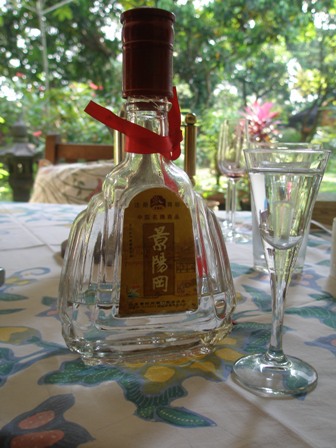
It is not just the grape wine bottles which we are drinking up before moving to Bangkok. I have a small collection of exquisite Chinese liquors given to me over the years by Chinese and Taiwanese friends.

The sorghum based spirits are wonderful though Western people often have difficulties appreciating the scent (some say it smells, well it does: of Sorghum of course). The Shandong liquor was smooth as silk. For ‘Gu Jing Gong Jiu’ you need to be in a youngish suicidal mode and not afraid of headaches.

‘Maotai’, if it is the real stuff, is not only expensive, but a very nice drink. During my time in Beijing we drank a lot of rough ‘Er Gou Jiu’, but the bottle below is a ‘de luxe’ version.

Unfortunately, the bottles cannot come to Bangkok, so we enjoy them now. Soon our reserves will be gone and we can start anew to collect them. Thanks god that I have so many friends in Mainland China and Taiwan.

Shandong Bai Jiu, smooth like silk

Kweichow Maotai, 43% and Gu Jing Gong Jiu, 38%

Lao Beijing Ming Jiu (Er Gou Jiu), 45%


Exploration trip to Bangkok

July 11, 2008

The other day, the four of us went to Bangkok. I had a seminar and staff training with my new team and the three women checked out the new school and were going on house hunting to find a new home.

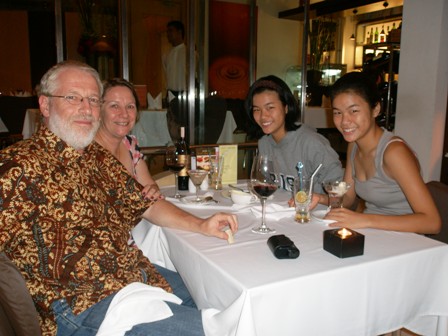
The last evening of our stay we met and compared notes. Nothing could be better for such undertaking than a family meal at a nice Thai restaurant. We walked down the street right into the Ninth Cafe.

What a great time we had

The restaurant is a very pleasant place. I was there once before. The staff was very friendly and we were very hungry. We ordered a couple of appetizers. Margit and myself we had fish with mashed potatoes and the girls had a Chinese chicken soup. It all tasted delicious. We were in a jolly good mood. Everything had worked out so well and we are very optimistic about our coming move to Thailand.

Of course the adults had a bottle of wine with their meal. We choose a bottle of Hardy’s Cabernet Sauvignon, nothing special but delightful and it suited the mood.

A typical Thai appetizer

Appetizers for the hungry kids – chicken wings

Fish with mashed potatoes

A Chinese type dish

Happy girls

The gods were smiling on us

Address
The Ninth Cafe
59/5 Soi Langsuan, Ploenchit Road
Bangkok 10330

Note: This restaurant gets excellent recommendations and reviews. Go and visit.


Family meals and the emptying of my wine “cellar”

July 4, 2008

Our last 60 days in Jakarta have started. Soon we will be moving to Bangkok. We try to enjoy every day. Apart from sorting out things, we are spending our time at home with family meals and drinks.

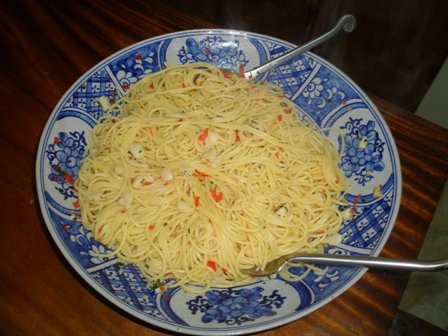
A delicious seafood pasta

I do not have a large supply of fine wines left but some of the bottles I have kept for special occasions. So what did we drink over the last couple of days? Here is a quick run-down:

‘2002 Léon Baur Gewürztraminer Grand Cru Pfersigberg’, alc. 13.5 % Vol.
We drank it before lunch as an aperitif. This is an aromatic wine, very generous in its flavours. It comes from a limestone “terroir” and is the gem of the Léon Baur collection. Low yields make great wines. It’s rather high in alcohol and has 15.2 g/l in sugar. A very enjoyable Gewürztraminer typical for this grape variety (www.leon-baur.com)

‘2003 Wiltinger Gottesfuss, Riesling Kabinett Feinherb, Reichsgraf von Kesselstatt’ , alc. 11 % Vol.
As you know, I love wine from the Saar River, and Wiltingen is one of the major location to produce first class Riesling wines. “Feinherb” is the German word for semi-dry. “Gottesfuss” is one of the best locations in Wiltingen, a very steep, stony slate ground which produces a fine, acidic, and balanced wine. Normally I prefer dry Rieslings but with a spicy Asian meal, the semi-dry version does very well. (www.kesselstatt.com)


‘2005 Hollick Coonawarra Reserve Chardonnay’,
alc. 13.5% Vol.
We had it with a seafood pasta. What a delicious Chardy this was. Although cellaring for up to 7 years is recommended, the bottle did not last that long. It displayed aromas of white peach, had crisp acidity and balanced creamy overtones. Though the wine was matured in French oak for 10 month, it was not “over-wooded”. Beautiful (www.hollick.com).

‘1999 Mildara Coonawarra Cabernet Sauvignon’, alc. 13.5% Vol.
The Mildara brand belongs to the Fosters Group (www.fosters.com). Liz and Walter brought it with them and we had it with all kinds of cheeses, salamis, coleslaw, salads and all kinds of “nibblies”. Despite its age, it displayed all the freshness of a typical Coonawarra wine. The colour was a deep purple. The intense aromas ranged from cassis, to dark berries and plum with hints of mint and herbs. The 18 months in oak have given the wine great depth and bony tannins, mellowed by age. The wine had an excellent structure. It was well aged.

‘2004 Knappstein Clare Valley Enterprise Vineyard Cabernet Sauvignon’, alc. 14.5% Vol.
The bottle retailed for US$ 26.50 at the Jakarta duty free store in Jalan Fatmawati. I had it reserved for a special evening. the wines is Clare Valley Cabernet Sauvignon at its best. Wonderful creamy, cassis, blackberry and mulberry flavours. A big Australian wine, full and complex but heavy which lingers on long after you swallowed the last drop. The fruit is grown on the “terra rossa” soils. Low yields guarantee the quality of the fruit. 2005 was an excellent year with a long ripening season. We had it after a meal just for enjoyment. This is a great wine indeed. (www.knappsteinwines.com.au)

The farewell dinner with our Australian friends (Brett, Janie, John and Dhanya) last night was a delight. We drank some very good wines. I only mention them in passing. Hope you don’t mind. We started with a pre-dinner drink, a ‘2006 Vasse Felix, classic dry white’ from Margaret River, Western Australia. The entreés we washed down with a ‘2007 Yarra Burn Sauvignon Blanc Semillon’ from the Yarra Valley, Victoria. We switched to red before the main course (a pasta bolognese), first to a ‘2004 Cape Mentelle Cabernet Merlot’ and then a ‘2003 Vasse Felix, classic dry red’. Three Margaret River wines stood against the cool climate SB form the Yarra Valley. It was a wonderful evening. No sadness was to find only the joy of being together and having a good time. I love this Australian attitude to life.


Restaurants in Germany – Lutter and Wegner im Künstlerhaus, Munich

June 27, 2008

While in Munich I stumbled across another one of the Lutter and Wegner chain restaurants – Lutter and Wegner im Künstlerhaus – and could not resist to have lunch there before departing to Frankfurt (www.l-w-muenchen.de).

The outside terrace

Colourful room “Venezia” with great views upon the Lenbachplatz

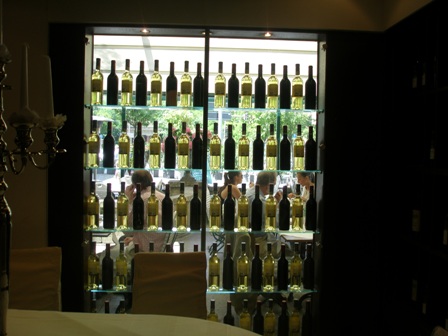
Bottles arranged like art

Art for the wine aficionados

Lutter and Wegner is not just a restaurant but a symbiosis of bar, lounge, gallery and in the evening live and other music are performed. Moreover, about 350 wines are on offer. I could only sample two of them with my lunch, hope you are more successful. The restaurant was the perfect choice of a enjoyable lunch before leaving this wonderful city and returning to tropical Jakarta. I could not resist the mushroom risotto. It was delicious, a wonderful combination of flavours.

The mushroom risotto

Of course I had to have a wine with my food. My first wine consisted of a ‘2005 Grauer Burgunder, dry’ (Pinot Gris) of Weingut Otto Laubenstein, Baden (www.laubenstein.com). It had a rather yellowish colour which came as a surprise to me, I had expected something more pale, straw colour like. The wine suggestion for the risotto was a ‘2007 Bürklin Wolf – Weissburgunder’ (white Burgundy). I should have tried my meal with this wine too, I guess.

My second glass of wine which I drank instead of having a dessert is considered a rarity in other parts of the world and this is exactly why I ordered it. The ‘2006 Blauer Zweigelt, Weingut Tement’, Südsteiermark (www.tement.at), showed a beautiful deep red colour. It displays flowery aromas, dominated by red berries, and is very smooth indeed and not heavy (12.5% alc.). The wine is aged for only about six months in small oak barrels.

Blauer Zweigelt (created in 1922 in Klosterneuburg by Fritz Zweigelt) is a cross between Blaufraenkisch and St. Laurent. It is the most widely planted red variety in Austria (resistance to frost) but has also gained some presence in Canada: the Niagara Region in Ontario and British Columbia.

Wine prices I found reasonable. The Pinot Gris sold for € 3.5 and the Blauer Zweigelt for € 4 for a 0.2 ltr/glass.

Address
Lutter und Wegner im Künstlerhaus
Lenbachplatz 8
80333 Munich
Te.: +49-895459490