Come to my garden !

December 16, 2010

Right now it’s winter time in Thailand. Temperatures are between 24 and 28 during the night and up to 32 Celsius in the daytime in Bangkok. A nice time of the year. This is why so many tourist are now arriving here in Thailand.

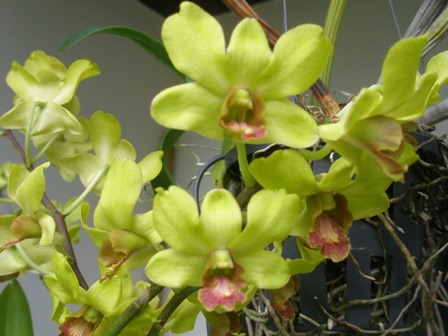
These days my terrace garden is in full bloom. Some of the beauty I will share with you. Just fill you glass with a delicious and crisp Chardonnay, a Sauvignon Blanc or a Riesling and scroll down at your leisure.

Season’s greetings from the Happy Gardener


Dr Mayer Riesling – fine wine from the Remstal, Germany

December 1, 2010

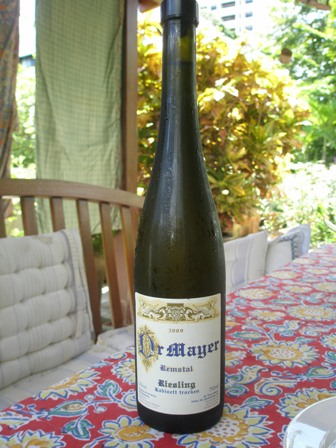
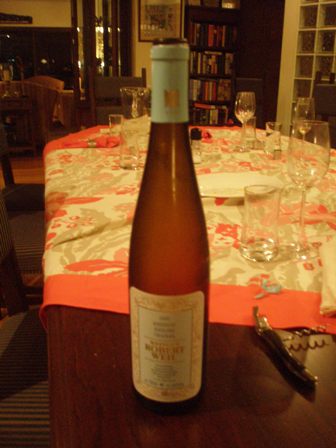
‘2009 Dr. Mayer Riesling’, Remstal, Wuerttemberg, Germany

We were lucky that Timo Mayer, vintner and wine-maker of the Mayer Vineyard in the Yarra Valley, Victoria, carried with him a bottle of the ‘2009 Dr. Mayer Riesling’ with him when he dropped by recently here in Bangkok.

Timo came back from a wine making and wine selling visit to Germany where he had also made his ‘2009 Dr. Mayer Riesling’ from fruit sourced from his native Remstal (to be precise from a village called Grossheppach) in Wuerttemberg.

The dry Riesling has 12.5% alcohol

The wine is under a glass enclosure which gives it a very elegant appearance. It’s a beautiful dry Riesling, elegant and fruity with a good structure and a long and intensive finish, in short a treasure of a wine.

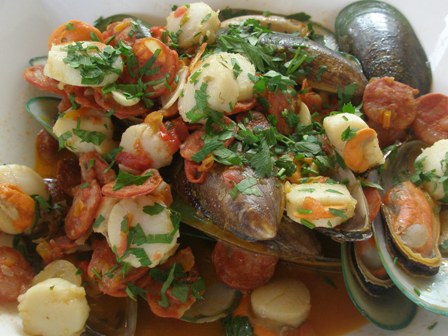
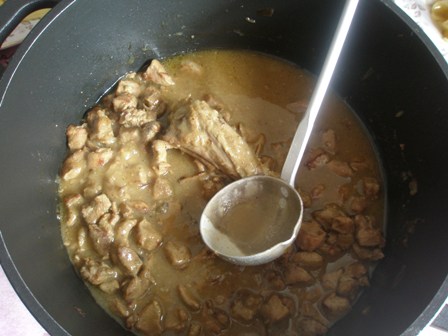
Mussels and clams with chorizo sausage

We saved the bottle for a special occasion, and surprise, surprise, the occasion should arrive very, very soon: a beautiful tropical Saturday afternoon lent itself for a delicious meal consisting of mussels, clams with chorizo sausages. This is a yummy dish and ideal light lunch.

The bad news is, one cannot buy this wine in Germany, the motherland of Riesling wines.

The good news is one can buy it from Timo Mayer in the Yarra Valley and the outlets carrying his wines in Victoria.

Timo got only about a pallet, so you have to be quick. Better rush.


Mosel Riesling: Weingut Heymann-Löwenstein

October 30, 2010

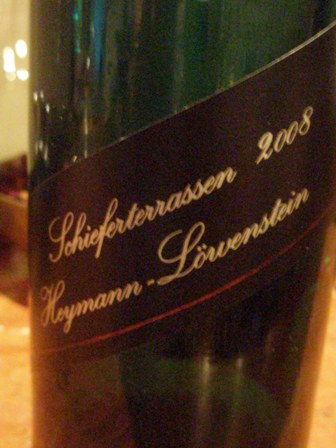
2008 Slate Terraces Riesling Heymann-Löwenstein

The website of Weingut Heymann-Löwenstein starts with a poem of Ingeborg Bachmann, a famous Austrian poet and writer (1926-1973). The first line reads as follows:

»One should be able to pick up the stone
and hold it in wild hope
until it begins to bloom«

That’s in fact what Heymann-Löwenstein does. The earth or better the rocks (slate in this case) in which the vines grow is at the centre of his attention.

I know the sound of slate from my youth growing up in Trier, Mosel. Slate was all around us. The roofs of the houses were in slate, covers of walls, and walls themselves, all in grey slate. We liked to break individual thin pieces into smaller ones and the grey slate dust trickled through our fingers.

Reinhard Löwenstein, who founded the winery in 1980, was carefully searching for the best locations (terroir) before starting his venture in Winningen, a small hamlet along the lower Mosel (south of Koblenz). He is an innovator whose wine styles differ from the Mosel tradition, an inspiration to many young wine-makers at the Mosel river.

Yields are kept low, harvest is late and the steep slopes of the slate stone reflect the days heat during the night. Moreover, the juice is allowed to stay with the skin for up to two days. Some Botrytis infected fruit is sometimes also added giving complexity to the wine. Rheinhard Löwenstein’s wine making philosophy is non interventionist. He intends to bring out the terroir.

The ‘2008 Slate Terraces Riesling’ by Heymann-Löwenstein has an intense golden colour in the glass. It’s alcohol is 12.5%. The wine is full and round, with a balanced acidity. It is dry, displaying a fine minerality and beautiful aromas of citrus fruit. The wine has a good structure and a stunning finish.

Timo Mayer had brought the above bottle with him when he came on a stop-over to Bangkok. We enjoyed it together with some food during a night which saw many exquisite bottles of the fine wines being opened and consumed with great delight.

The winery Heymann-Löwenstein is ranked by Riesling.de as one of the top ten Riesling producers in Germany. The area under cultivation is about 16 ha with an annual production of 100,000 bottles.

And the good news for residence in the Healesville area in Victoria is that Barrique, the wine store in this lovely little town, has some bottles of Heymann-Löwenstein Riesling on offer. Two years ago I have bought a few there. Delicious.

Address:
Winery (Weingut) Heymann-Löwenstein
Bahnhofstrasse 10
56333 Winningen
Tel.: +49-2606-1919
Fax: +49-2606-1909
www.heymann-loewenstein.com


German Riesling: Weingut Robert Weil

October 21, 2010

2008 Robert Weil Estate Riesling dry

A friend of mine made me taste this wine some time ago in Berlin. I brought a bottle of the 2008 vintage back to Bangkok. During the visit of a wine-maker friend from Australia, I opened my treasure trove, and the Robert Weil Riesling, from Rheingau, Germany was one of the many bottles of fine wine which we sampled.

The winery Robert Weil is a well known household name among Riesling producers and wine connoisseurs in Germany. As many of the German wineries, Robert Weil goes back a fair bit. The winery was founded in 1875. Although vineyards were among the family properties in the village of Kiedrich, Rheingau for some time.

The founder of the winery, Dr. Robert Weil, was a professor of German language at the Sorbonne University in Paris. The change in career turned out to be very beneficial for the professor and his descendants as well as the wine fraternity.

With about 3,100 ha under vines, the Rheingau is one of the smaller German wine regions. Robert Weil bought some of the best locations (terroir) and vineyards in the vicinity of Kiedrich and thereby consolidated his winery. Today, the total area under vines is about 75 ha. This is more than just a small family vintner.

Many of the vines are 50 and more years old. Plant density is between 5,000 and 6,000 vines per hectare (quite dense in comparison with the 2,700 vines on my own vineyard). The operation is characterized by the use of organic fertilizers and the minimization of the use of industrial pesticides.

The wines of Robert Weil are regular award winners. The winery is among the top 10 of the German Riesling Forum.

Beautiful colour of the Robert Weil Estate Riesling

The colour of the wine is pale straw (12% alcohol). The 2008 vintage is still a young wine; it is fresh and spritzy with lemon and lime aromas and some mineral notes. The residual sugar is about 8 grams. The wine is fruity with a well balanced acidity; it has a good structure and a long finish.

The pity was: I had only one bottle. Wine is just not suitable for air travel.

The Rheingau is a beautiful place and just a stone throw away from Frankfurt airport. if you have the chance just go and check it out yourself. Cheers mate

Address:
Weingut Robert Weil
Mühlberg 5
D-65399 Kiedrich / Rheingau

Tel.: +49-6123 2308 begin_of_the_skype_highlighting              +49-6123 2308      end_of_the_skype_highlighting begin_of_the_skype_highlighting              +49-6123 2308      end_of_the_skype_highlighting begin_of_the_skype_highlighting              +49-6123 2308      end_of_the_skype_highlighting begin_of_the_skype_highlighting              +49-6123 2308      end_of_the_skype_highlighting
Fax: +49-6123 1546

info@weingut-robert-weil.com
www.weingut-robert-weil.de

Opening hours:
Monday to Friday 8.00 – 17.30 h
Saturday 10.00 – 17.00 h
Sunday 11.00 – 17.00 h


Emrich-Schönleber Riesling Sekt, Nahe. Germany

August 31, 2010

One of the best wineries along the Nahe river is Weingut Emrich-Schönleber in the village of Monzingen. The family vineyards (about 33 acres) produce great wines, mostly Riesling.

In 2010 the Gault Millau Wine Guide gave 10 of the 17 wines of the Emrich-Schönleber Estate 90 or more points. The wine writer Jancis Robinson was extremely impressed by the ‘2009 Halenberg Auslese’. 19.5 of 20 points was her verdict which is truly awesome.

Recently we visited the winery. Coming straight from Frankfurt Airport, we drove along the Nahe wine route, passed Bad Kreuznach, and spontaneously dropped in to pick up some bottles of wine.

In the yard, we bumped into Mr. Emrich-Schönleber senior, who was on his way out. In passing he referred us to his wife who was so kind to introduce us to the wines of the estate. Since it was early in the morning, we did not feel like tasting wine (we just came from breakfast in the small town of Sobernheim). Moreover, after many hours of flight, we had just gotten off the plane.

Our selection was quick but firm. I knew some of the ‘grand cru’ locations of Monzingen. After all, I had spent most of my school holidays in the neighbouring village of Martinstein where my maternal grandfather (Hans-Heinrich Schuessler) had introduced me to the amazing world of Nahe wines at a rather tender age.

We chose a nice cross section of Emrich-Schönleber’s wines including two sparkling ones. Ms. Emrich-Schönleber was so kind to add a small bottle of sweet desert wine as a gift. We were flabbergasted.

The bottle of Riesling Sekt (Sekt is German for ‘sparkling’) below did not last long. Only after a couple of hours, when the bottle was sufficiently cold, we opened it to celebrate the start of our holidays in Trier. What an auspicious start to a summer holiday in Europe?

Emrich-Schönleber Riesling Sekt

The Riesling Sekt is produced using the classical method of bottle fermentation. Everything is done by hand. Due to the acidity of the Riesling fruit, the wine displays a beautiful spectrum of fine acids. Moreover, it is dry and fruity with lots of fizz. The magnificent minerality of the wine is another characteristic.

Emrich-Schönleber Riesling Sekt

Nahe wines, especially the Rieslings, are one of the best kept secrets in Germany. You should visit this internationally little known wine region. It’s just about an hours drive west of Frankfurt Airport. I promise you: you will not regret it.

Address:
Weingut Emrich-Schönleber
Soonwaldstraße 10a
D-55569 Monzingen
Tel.: +49-67 51-27 33
Fax: +49-67 51-48 64
www.emrich-schoenleber.de


Venison from a roe deer for Sunday lunch in Trier

August 24, 2010

My stories from July and August do not come in any particular order. When arrived in early July in Trier at my mother’s place we were greated by a feats, as always. And beecause her partner Heinz is a hunter we often eat game. This time it was venison from a German roe deer (in German: Reh) he had just shot. Needless to say that my mothers cooking is just delicious as you can see from the pcitures below.

Tender venison, a meal in the making

With noodles of course

2008 Saar Riesling Van Volxem Estate

The wine I choose for this meal was a Riesling from Van Volxem Estate in Wiltingen, near Schoden (where the venison was from), one of my favourite producers from the Saar. Tough this is just a “simple” wine, it deplays all the character of a Saar Riesling, fine and delicate which machted the tender venison just perfectly.

Address
Weinmanufaktur Van Volxem
Roman Niewodniczanski
Dehnstrasse 2
54459 Wiltingen, Saar
Ph.: +49-6501-16510
e-mail: vanvolxem@t-online.de


Flammkuchen everywhere

August 14, 2010

Flammkuchen

Everywhere we went in Germany (except Bavaria) during our holidays, “Flammkuchen” was on the menu. Flammkuchen is the German name for an Alsacian dish called ‘flammekueche’ or ‘tarte flambée’ in French. The dish is in fact of ‘alemannic’ origin. The Alamanni , an alliance of different Germanic tribes settled in what is today south-west Germany, eastern France and northern Switzerland (the area south of lake Bodensee); composed today roughly of the regions of Alsace, Baden and the Palatinate.

The thin, bread-like dough comes often in a round shape and is, in its traditional form, covered with crème fraîche, onions, and lardons. However, there are many variations of this old recipe. Similar to pizza all kinds of toppings have found their way onto Flammkuchen. I found different styles as far north as Muenster.

In my home town Trier at the river Mosel, we had the delicious dish from time to time and just loved it. Usually I had a Bitburger Beer with it, preferably in a mug. But the local wines make also a good drink, for instance an Elbling or a local Riesling wine are perfect for the enjoyment of a Flammkuchen. Try it.

Flammkuchen and a Bitburger Beer


Winery Review: Vereinigte Hospitien, Trier, Mosel

June 2, 2010

vereinigtehospitien1

The St Jacob of United Hospices wine label

I grew up just next to the convent of St. Irminen at Irminenfreihof No. 5 in Trier, Mosel. The convent belongs to Vereinigte Hopitien, a foundation which also ownes a well known winery with the same name. Their English name is “United Hopices Wine Cellars“. The patron saint of United Hospices is St Jacob, an image of which is also used on the wineries labels.

As a kid I played in the cellars and warehouses of the convent. I also remember them sending their vats and barrels for controlling purposes to the Eichamt, the local Weights and Measures Office, which my father was heading. We played around the barrels and I vividly remember the smell emitted by the oak and the moist wood.

vereinigtehospitien3

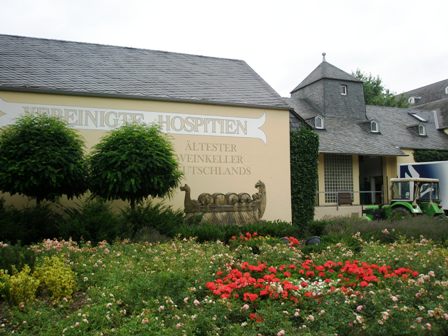
The winery

United Hospices owns vineyards along the Mosel (locations: Piesporter Goldtroepfchen and Triere Augenscheiner) and the Saar (locations in Wiltingen, for instance Hoelle, Scharzhofberg and Kupp, Kanzem and Serrig). Most of the vineyard originally belonged to monastries and convents. Today about 25 ha are under vines, 90% of which are planted with Riesling grapes (my favourite grape variety), the rest consists of Pinot Gris, Blanc and Noir.

As many of the wineries in Trier, also United Hospices has a large traditional wine cellar (some parts of it dating from the 3. century) which you should have a look at. Wine tasting in ths historic atmoshere are unforgettable events. United Hospices top wines are the dry and sweet (Trockenbeerenauslese) Scharzhofberger Riesling wines from the Saar some of which sell for up to 100 Euro/bottle. The ordinary Riesling wines cost about 6.20 Euro/1 l. bottle.

I hope you are going to visit Trier this summer and drop in for a wine tasting. Cheers

vereinigtehospitien4

The main hospice building along the Mosel

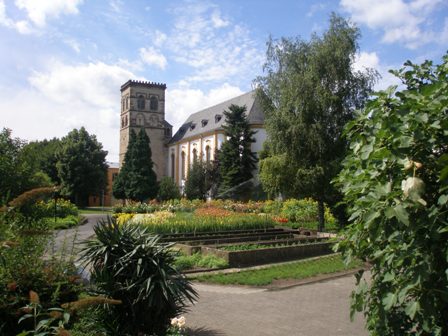
vereinigtehospitien2

Church St Irminen

Address:
Vereinigte Hospitien
Krahnenufer 19
54290 Trier
Tel.: +49-651/945-1210 o. 0651/945-1211
Fax: +49-651/945-2060
Opening hours: Mo. – Thu. 08-12:30 and 13:30 to 17h; Friday closing at 16h, Saturday 10-14h


Riesling – Domaines Schlumberger, Alsace

May 25, 2010

Mussels

These days mussels are inexpensive in Bangkok. So why not having a large pot of mussels of Sunday lunch? Done. I like them cooked with chorizo sausages. In this combination of flavours the mussels are amazing. The pork sausage with the red paprika somehow bring the shells from the sea “to land”, so to say. The dish has bite.

Mussels with chorizo

What to drink with it, was the question? White, OK. But I could not think of any better wine than a Riesling from Alsace. Fortunately, such a Riesling was just at hand. The ‘2006 Les Princes Abbés Riesling’ from Domaines Schlumberger in Guebwiller, about 20 km south of Colmar, Alsace, France, was the ideal wine to go with our food.

Front label

Since 1810 this estate is in the hands of the Schlumberger family. That’s lot’s of tradition in an Australian context. It started with 20 ha under vines. Today the family farms (in sixth generation) about 140 ha of vines of which about half is classified as “Grand Cru”, best locations.

The location (terroir), “The Princes Abbés” ,originally belonged to the monastery in Murbach. Monks always knew what was good for body and spirit. Today “The Princes Abbés” label offers seven Alsatian wine varieties. It is does not belong to the Grand Cru locations of the estate (4 “terroirs” : Kitterlé, Kessler, Saering, Spiegel).

The back label

The Schlumberger’s grow all the fruit for their wines themselves. Yields are kept low. Many vineyards are very very steep. The Schlumberger’s also use drought horses to work their vineyard. This is also one of my dreams when finally settling in Glenburn, Victoria. I intend to buy a pair of Percheron horses for farm work.

The Schlumberger’s farm more land in the vicinity of their vineyards according to organic and bio dynamic principles. Total wine production per year is about 70,000 cases. Well, I should acquire some more of their bottles.

Light golden coulor, gorgeous liquid

“The Princes Abbés” Riesling has great character. It has zest and structure and is a citrus bomb with the oily characteristic of the Alsatian Riesling.

A cork to close the bottle

I should visit the Alsace again. It’s such a wonderful region, easy to reach, just about a two to three hours drive south from Frankfurt. See you there, maybe?

Address:
Domaines Schlumberger
100 rue Théodore Deck
68501 Guebwiller Cedex –
France
Téléphone: +33 3 89 74 27 00,
Fax : +33 3 89 74 85 75


Australia: WFA Vintage Report 2010

May 17, 2010

Two Hills Vineyard Merlot grapes 2010

The new figures are out. Today the Daily Wine News presented the Winemakers Federation of Australia (WFA) vintage report 2010. About 360 wineries participated in the survey, representing about 89% of total production.

The basic findings are well known to grape growers, vintners and wine makers. 2010 was a dreadful year especially for grape growers. The 2010 vintage of about 1.53 million tonnes (did they count my grapes as well?) was lower than 2009 (-12%) and 2008 (-5%).

The decline in white wine grapes was sharper (-14%) than the red ones (-8%), but I sold my white though almost nobody bought my Merlot and the Pinot Noir). My own experiences do not conform to the trend, I guess. Especially regarding my Pinot I must have missed something (+26% increase to 35,ooo tonnes). Or was it the other way round: because of the increased intake I could not sell my Pinot Noir?

Well the real reason is that my buyer walked out on me after a perfectly beautiful fruit which my buyer wanted to have some more days of sun was subsequently hit by rain and with it the destruction rain might bring at this time of the year.

Australia’s Sauvignon Blanc crush increased by 15%. OK, I sold all of mine. SB is still Australia’s third most important white variety after Chardonnay and Semillon.

Good that I ripped out my Cabernet (total production 213,000 tonnes), it further decreased in intake (by 14%) as did Merlot (total tonnage 109,000 tonnes), The big winner seems to be Shiraz which we unfortunately do not produce at Two Hills Vineyard. I love Australian Shiraz wines.

What does the enthusiastic Riesling drinker from the Mosel think of the Australia’s Riesling vintage: incredible, there is a 11% decrease in the crush of Riesling. Can you believe this? My most favoured wine available in much less quantity? I hope the quality shows just the opposite trend.