As they say: it’s never to early for a Frueh Koelsch

September 5, 2012

Cheers – ‘Es ist nie zu frueh’, is the slogan of the Frueh Brewery in Cologne

Our family holidays in Germany are what a Thai colleague of mine called “edu-tainment”, we combine fun with some educative elements.

Since my twin daughters are very interested in history and culture, it was inevitable that we should end up visiting Koeln/Cologne just about 200 km north of my home town Trier.

After our walk through the historic city centre, we needed nurishment. A good place to experience the local food and the local culture is the outlet of the Frueh Brewery right in the centre of town.

‘It’s never to early’ for a beer by Frueh

‘Koelsch’, as the beer is called, is a speciality of Cologne. There is even a ‘Koelsch Convention’ specifying how this beer has to be brewed and what quality criteria it must fulfill.

So what is ‘Koelsch’ you might ask?

‘Koelsch’ is a pale and hoppy top-fermenting beer. The beer is warm-fermented and cold-conditioned. It is rather light, less bitter than most other German beers and therefore very refreshing ; in summer as well as in winter, I might point out. During my university time in the neighbouring city of Bonn, I had ample time to sample various brands of ‘Koelsch’.

The beer is served by a so called ‘Koebes’, the local name for an excusively male waiter. They are easily recognized by their dark blue aprons. Be prepared for a culture-clash of some sort. But do not worry, in the end they are very friendly and very proud of their heritage.

Herring with potatoes

German cullinary delights are many. I opted for a fish dish, a marinated herring with potatoes. I tell you it was super delicious.

In case you visit Cologne and you want to experience something authentic, go and check out the Frueh Brewery.

Address:
Cölner Hofbräu P. Josef Früh KG
Gastronomie und Verwaltung
Am Hof 12-18
50667 Köln
Tel.: +49-221 / 2613 – 0


Summer wine – Merlot Rosé from the Mosel River

August 31, 2012

The sun in a glass of rosé

When we arrived in germany the temperatures were not excactly summer like. However, that changed over the course of the four weeks. Luckily there is plenty of “summer wine” available, young wines with low alcohol levels which excite the palate also of the non-wine drinker.

Nothing is better fitting a barbecue than a nice and clean rosé wine. My friend Josef’s main house wine producer is the winery of Rudolf Hoffmann in Detzem, Mosel. This is partly because vintner Hoffmann has leased some of his vineyards from the Arnoldi family, and my friend Josef is married to an Arnoldi girl. Both love to drink wines made from the vineyards which were once cultived by the parents and grand-parents.

Lovely Merlot Rosé by Rudolf Hoffmann, Detzem

And here we are with a ‘2010 Esprit Merlot Rosé’ by Rudolf Hoffmann from Detzem, Mosel. This is exactly how you want a rosé to be. The Merlot’s fruitiness is here a bonus as well as the alcohol of only 11%. I suggest: drink more of this type of Mosel wine.

If German summers would just be a bit warmer…..

Address:
Weingut Rudolf Hoffmann
Neustraße 19
54340 Detzem, Germany
Tel.: +49-173 3573982
www.weingut-hoffmann.de


Roman Villa Urbana in Longuich, Mosel

August 27, 2012

Vineyards near Longuich – Opposite the steep slopes of the Mosel

The cultivation of grapes along the Mosel river and its tributaries Saar and Ruwer is more than 2,000 years old. For the Romans wine was an important commodity. All along the Mosel river one can find traces of the Roman wine industry, among them wine presses and fermentation tanks, vineyard implements, residues of grapes, statues of gods and godesses etc.

Among the treasures are the ruins and foundations of many Roman rural villas. One of them can be found in Longuich-Kirsch, just a few kilometers downstream from my hometown Trier. Various types of these villas can be distinguished. Some of them contain large mosaics as the villa in Nennig.

The villa in Longuich is a “villa urbana”, the seat of a retired high official. It is very large (110 x 28 meters). It was built in the 2nd century after Christ and includes an extensive Roman bath consisting of a Caldarium (hot bath), Tepidarium (warm bath), Sudatorium (sauna), Frigidarium (cold bath) and Praefurnium (fire and heating system).

The foundations of the villa were accidentally discovered during land consolidation and reconstruction work in 1984. Next to the villa some agricultural buildings we found as well.

The villa urbana was restored and is today open to the public. Various billboards inform the casual visitor about various aspects of roman life including the two thousand years of grape and wine production.

Imagine that so long ago people were working in vineyards and wineries in the very same places where also todays wine is produced. Amazing. The work was even harder than today, I guess.

The production techniques of the Romans are well researched. The billbords explain todays challenges and how they were mastered recently. I loved the way ancient history was linked to contemporary modern life. I highly recommend visiting these villas. The view over the valley and its vineyards is another great experience.

Fortunately, the vineyards in the vicinity of the villa are still productive, and many wineries and vintners are happy to welcome visitors and introduce them to their excellent Riesling wines.


Von Othegraven Winery in Kanzem, Saar

August 25, 2012

Regular readers of my blog will have noticed that I usually abstain from writing negative comments about any wine experience. Today I will break with this tradition making a slight dent in my otherwise immaculate positivism.

Summertime in Germany is also the time of wine festivals and the time of visiting wineries and cellar doors. And keeping in the spirit of things, my family and I, we set out on a beautiful day in July to pay a visit to one of the wineries along the Saar river.

I needed a birthday gift for a dear friend of mine and I intended to honor him with a first class bottle of wine from a first class winery. Since my friend lives in the Ruwer valley, a location with excellent Riesling terroir, I wanted to contrast the Ruwer wines with a specimen from the Saar, the other tributary of the Mosel where excellent Riesling wines are produced.

My choice was the Von Othegraven winery in Kanzem, a small hamlet on the banks of the Saar river. This winery is quite well known in Germany because Guenther Jauch, a celebrity TV moderator and talk show host, is the owner of the place.

I could not have been more wrong in my choice.

We rocked up without an appointment (which we would regret), drove into the courtyard of the estate at the outskirts of Kanzem at the bottom of the steep vineyards of the Kanzemer Altenberg, the grand cru vineyard of the area.

We innocently rang the bell of the manor house but where greeted by a very grumpy vintner (it was the manager, not the wine-maker), who let us know immediately and in a very impolite way that we were not welcome, and should “buzz” off.

Uff, we were mentally not prepared for such a rude reception, and deeply regretted that we had bothered to come in the first place.

So my recommendation to the casual wine tourist is not to visit Von Othegraven. It is a waste of time. If you are still interested in their wines, go to my favourite wine bar, Weinsinnig in Trier, and buy a bottle of the outstanding Altenberg Riesling.


Mosel Riesling: Versuchungen (temptations)

August 21, 2012

What a beautiful Riesling: Versuchungen = temptations

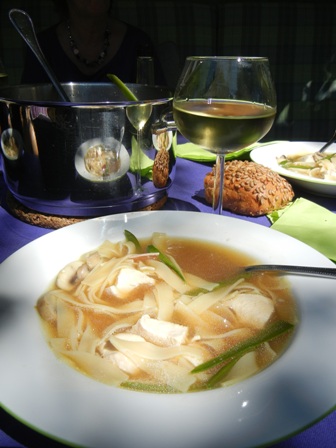
The wine is made by Andreas Bender, a contrarian of the German wine scene, of Weingut Bender. It is a semi-dry Riesling, usually not a wine style I very much like. But it perfectly machted the spicy Asian soup we had it with. Lovely buquet, fine acidity and a sweetness which was round and compassionate, like a kiss.

The wine is named in allusion to two quotes by Oscar Wilde, who must have said that “I can resist everything, except temptation” and “The only way to get rid of a temptation is to yield to it”.

I yielded to it as well. It was modestly priced at Euro 7.50 when I bought it at Weinsinnig, one of my preferred wine barS in My home town Trier.

Versuchungen and the spicy Asian soup

I have not made up my mind about this wine. I need to taste some of the dry wines Andreas Bender produces before I can come to a conclusion. But for the many off-dry wine lovers, this wine is a true temptation.


Restaurant review: Gasthof zur Saffenburg, Mayschoss, Ahr

August 20, 2012

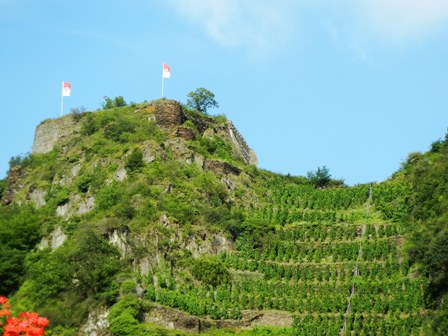
Castle Saffenburg in Mayschoss, Ahr

All good things come to an end. That applied also to our family vacation. From the Ruhr we made our way back to the Mosel region. Since we had some spare time on our hands, we decided that a short visit to the Ahr wine region would just be the right distraction.

The Ahr wine region is one of the smaller wine region in Germany (about 600 ha under vines). Despite its northern location the Ahr wine region is dominated by red wine production (about 80%),and is most famous for its outstanding Pinot Noir wines.

Country Inn zur Saffenburg in Mayschoss, Ahr

Since we were also hungry we dropped in at a counrty inn called Saffenburg in Mayschoss at the banks of the Ahr river.

The courtyard of the inn

Mayschoss, a small settlement with about 1,000 inhabitants, is also home to the oldest wine co-operative in Germany (founded in 1868).

Today the Mayschoss-Altenahr Wine Co-operative as it is called, has about 400 members and covers 140 ha under vines. It’s cellar door is located opposite the country inn.

Gasthof zur Saffenburg

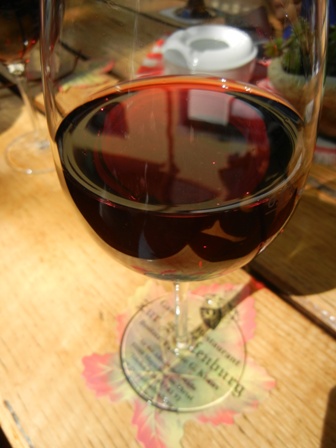
The first thing I did was oder a glass of Pinot Noir made by one of the famous Ahr producers: Jean Stodden.

Jean Stodden Pinot Noir

This is the “ordinary” Pinot Noir produced by Stodden but a good specimen of what the Ahr has to offer in Pinot Noir. Unfortunately, we had no time for a tasting at Jean Stodden. Instead we planned to pay a short visit to the wine co-operative across the street after our meal.

Nuernberger sausages with Kraut

German cuisine has a lot of very tasty dishes to offer. We went for Nuernberger sausages (photo above) and beef stew (photo below).

Beef stew

I love German cake

Irresistable were the cakes on offer, together with a coffee, they concluded our meal. Needless to say that the food was delicious. We sat on the terrace in the yard. The service at the country inn is exceptionally good. Five out of five, I would say. We had a jolly good time on our last day of our excusion in Germany.

The steep vineyards behind the inn on the other side of the Ahr river

I plan to also inform you about our visit to the wine co-operative in Mayschoss. Stay tuned.

The Ahr wine region is a very popular destination for day travellers but also suitable for longer excursions. I highly recommend the “Rotwein-Wanderweg”, the red wine hicking path crisscrossing the region with breathtaking views of the vineyards and the small settlements. Ideal is to explore the valley on a push bike.

Please also visit my blog entries from November 2007 regarding DAGERNOVA, another wine co-operative and vintage time along the Ahr.

Address:
Gasthof zur Saffenburg
Rotweinstrasse 43
53508 Mayschoss
Tel.: + 49 (0) 2643-8392
Handy + 49 (0) 171–9369257
Fax: + 49 (0) 2643-8100
E-Mail: info@gasthof-saffenburg.de
http://www.gasthof-saffenburg.de


“Weinsinnig” – wine bar in Trier

August 4, 2012

One of my favourite wine bars in my home town Trier is “Weinsinnig”, located right in the center of town.

The name of the bar is a kind of word play on “Wahnsinnig” (in English “mad” or “crazy”), and composed of two parts, a nomen, “Wahn” or “mania” (in English) and an adjective “sinnig” which can be translated as “plausible”, “make sense”, “evident”, “sensible” or “witted”. In the combination with “Wein”/”wine” it becomes something new, a compound with a new meaning which could be translated as “in the mood to enjoy wine”, “wine is sensible” or “crazy for wine”.

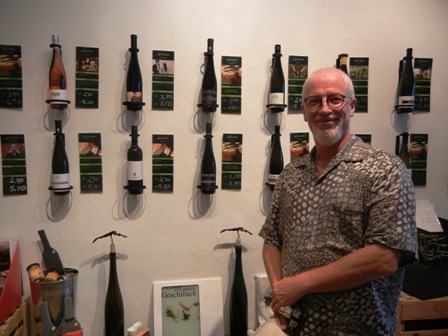
Weinsinnig is also a kind of cellar door for wineries from the Mosel. Moreover, it offers selected culinary delights, for instance “Flammkuchen”, a tarte flambe. And last but not least, Weinsinnig offers various activities related to wine and the people making it.

In front of the ‘walk along wine list’

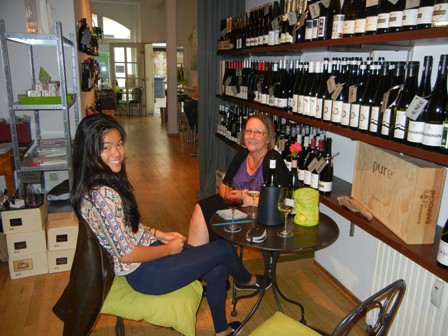
It was a rainy summer’s evening when we visited and therefore we sat inside. Weinsinnig offers also a couple of chairs and tables outside. One sits on the pavement on a narrow street. Fortunately, warm blankets are on offer.

My choice: a dry Riesling from the Ruwer

I love their selection of local wines, many of them produced by young and innovative vintners. I chose a ‘2011 Maximin Gruenhaeuser dry Riesling’ by one of the top producers from the Ruwer valley, von Schubert’sche Gutsverwaltung. I also bought some more of this wine and will only say that this is a Riesling to die for.

2011 Maximin Gruenhaeuser dry Riesling

Inside

By the way TripAdvisor rated it 4 of 5 on 16 Jun 2012 and ranked Weinsinnig as 69 out of 182 restaurants in Trier. In my view Weinsinnig belongs to the “must visit” category in Trier. Check it out.

Address:
Weinsinnig
Palaststraße 12
54290 Trier, Germany
Tel.: +49-651 9790156


The art of blogging and wine from Caves Alianca Dao, Portugal

July 11, 2012

No blog entry for two weeks, goodness me. Why I am so busy? It seems this is a terible time. No time for my blog. Moroever, I am going on an extended trip to my hometown Trier, Germany (this time on vacation), where I have very ittle access to the internet. Therefore the prospects are grim. Please bear with me. I plan to continue my blog despite the odds.

Today I have a last entry before the blog-free seasons starts. The good news is that I will be visiting the Mosel and its tributaries. This also means that I will probably visit some wineries and taste some delicious wines. I should come back to Bangkok with many more stories to tell and share.

A beautiful dark red colour

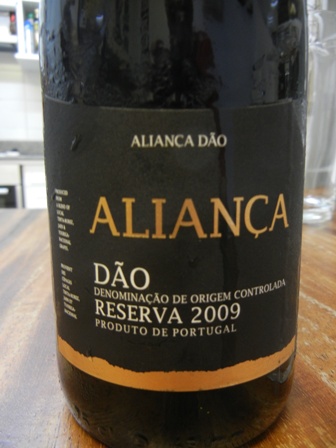
Last night, we had with our meal a beautiful red. It was a ‘2009 Caves Alianca Dao Reserva’, a blend of various Portuguese grape varieties (the label says: Tinta Roriz, Alfrocheiro, Jaén, Touriga Nacional).

The Dao wine region is consistently producing outstanding wines. Ever since our holiday along the Douro river, I am a big fan of Portuguese wines.

Caves Alianca Dao Reserva

With 14% alcohol this wine is big and mighty. It is also very smooth with lots of forest fruit. There is some hint of vanilla (from the oak). The wine has a good mid-pallet weight and a long finish.

The back label of the Alianca Dao

In Europe the wine retails for about 7 Pounds.

We had this beautiful and delectable wine with very spicy green beans and a beef fillet. Woh, that meal was super delicious and the wine was just a perfect match. I wish we had more of it. Well.

Soon we will be at the shores of the Mosel river and ive into the tasting of Riesling. What a consolation.


Dr. Loosen Riesling from the Mosel and spicy prawn pasta

June 24, 2012

While in transit at Frankfurt airport I picked up a bottle of German Riesling. I just could not help it.

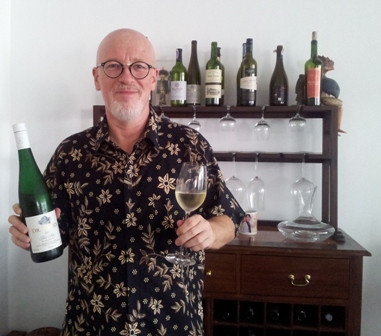
The ‘2011 Dr Loosen Blue Slate Riesling Kabinett’ was just too tempting. i forcked out eleven EURO and the bottle was mine.

It only has 8% alcohol which is pretty low. This off-dry wine would go very well with spicy Asian food, I thought. And so it was.

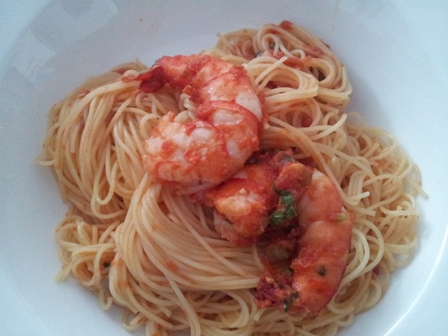
In the end I had it with a spicy prawn pasta. What a wonderful sensation. This mineral driven semi-dry Riesling from my native and beloved Mosel river was the perfect match to the soft chillies used for the pasta.

The fine acidity with the remaining sweetness of the Riesling was mouth watering, refreshing and extremely pleasant on the palate. I was glad that I did not go for a bone dry wine but instead opted for a “Kabinett”. And I have to add that I usually avoid off-dry wines.

A salute to Dr Loosen and his fine wines from the Bernkastel region along the “Mittelmosel”.


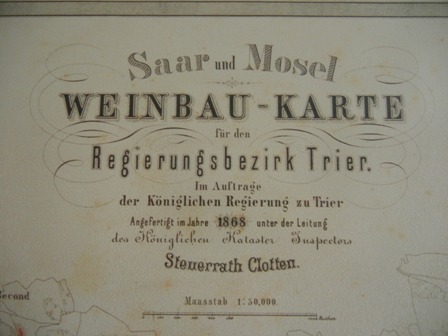
My beloved Mosel river – 1868 map of its terroir

March 6, 2012

I am very excited. Finally, my historical map of the Mosel river, which I had bought some years ago at Karlsmuehle, a winery cum restaurant at the Ruwer river, was put in a proper frame here in Bangkok. It’s a replica and not an original of course. But I looks very nice on my wall.

Vineyard location and quality map of 1868

The map shows the quality of the terroir in different shades of red. The more intense the red is, the better the quality and the higher the tax category. The Royal Prussian government had produced this map in order to streamline their tax collection.

The newly framed map of the Mosel, Saar and Ruwer

I can already see this map hanging in my house in Australia on our vineyard in Glenburn. I will tell my grand-children where I come from and how much I love my native town, Trier, and the Mosel river.