East meets West – 龙徽

March 26, 2011

Finally, we managed to have a dinner in our new home like in the good old days in Thonglor. All four of us sat on the terrace and enjoyed a family meal together.

The pasta (zucchini) below was just delicious.

I went through my wine fridge but could only produce a bottle of ‘2008 Cabernet Sauvignon’ by Beijing Dragon Seal Winery, China. It was given to me by the hotel manager during my last trip to Beijing.

A bottle of Dragon Seal red wine was one of our first wines when we moved to China in 1990. The winery has quite some history which goes back to 1910 and some French friars in Beijing who started to grow grapes and make wine. Ever since French viticulturists and oenologists have been associated with the brand. The modern Dragon Seal Winery was founded in 1987. Various white and red wines are produced today.

The grapes are grown in Huailai County (怀来县) in Hebei Province about 150 kilometers northwest of Beijing which has a semi-arid climate. The precipitation in this part of China is very low (below 400 mm per year). Mean temperatures range from -7.4 Celsius in January to about 24.4 Celsius in July. Humidity in August-September is between 60 and 70% only.
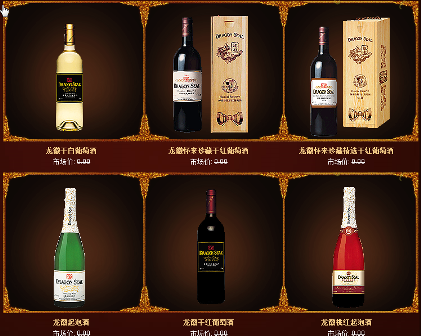
Product range – screen-shot from the Dragon Seal website

The flagship wines of Dragon Seal Winery are it’s Huailai Reserve, a blend of Cabernet Sauvignon (50%) and Syrah (50%) which is matured for a year in French and American oak and it’s Cru de Huailai, a 100% Syrah made from grapes grown in Donghuayuan (东花园镇).

Does this not sound very exotic in your ears?

Well, the 2008 Cabernet Sauvignon is a solid but overall ordinary wine (‘Landweinkatagoerie’). The enclosure consisted of a plastic “cork” (uuh). I was immediately suspicious. 2008 vintage (!), but was the bottle sealed properly?

Yes it was. The wine has only 12% alcohol. The colour was a beautiful dark red. But the taste was OK. It is a rather light wine with pleasant red fruit aromas. We did not regret opening the bottle, and it also matched the pasta somehow. I must try the two flagship wines mentioned above. They won medals at international wine shows. That’s my resolution from this wonderful family meal in Ekamai.


Another wine experience in China

November 7, 2010

One of the privileges of a frequent traveller, even if exclusively travelling on economy class, is the use of the lounge. As a “wino” this is great territory to sense and experience some of the global trends in the wine industry and/or the airline service providers.

One such trend seems to be the use of paper cups instead of proper glasses. That’s at least what my recent experience in the business class lounge (star alliance) at Shanghai Pudong International Airport suggests.

I found the “wine ensemble” below. Isn’t it cute?

Wine at your service

I could not resist a tasting of the two wines on offer, a white from China and a red wine from France. Unfortunately I could not find any trace of the French wine in the internet. I had noted down “Tour Gouvercin” as the name of the wine (a Cabernet Sauvignon) which was quite pleasant to drink, fruity with body and structure.

The second wine, a ‘Clos des Chenes, dry white wine’ by Imperial Court, a brand re-designed and re-established by Shenma Winery. The wine was a bit “thin” but since the cooler (as seen in the picture above) guaranteed a pleasant temperature, I found it not so bad, light but technically well made.

My wine tasting at Shanghai Airport

China is not only an emerging world power but also a booming market for oversees wines. Chinese grape wine consumption increased from 554 million bottles in 2004 to 899 million bottles in 2008. However, per capita consumption is still very low, about 0.4 litres per person per year.

That’s all good news for wine producers and distributors. Also that imported wines account doe only about 11.8 % (2008) of total domestic consumption is “music in the ears” of the non-Chinese wine industry.

Wine educators have their tasks outlined for them as well. Chinese consumers do not like tannins and acids, often perceive grape wines as “sour” only. This is why the mixing of red Bordeaux wines with coke and spite is quite common consumption habit. This needs to be changes, I guess. Since Chinese people have very complex taste buds, it should not be too difficult to make them appreciate the wonders of fine wines.


Shanghai: on the run

November 6, 2010

I had not much time for food and drink while on a business trip to Shanghai this week. But it is always interesting to visit the “Paris of the East”. Now that the World Expo is over, it was a bit more quiet than the last six months but the controversy of the award of the Nobel peace prize to Liu Xioabo kept the blood of CCP officials boiling.

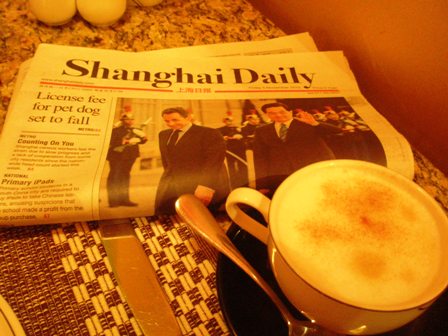
What did the Shanghai Daily say? Hu’s visit to France which has become a good old friend again and the order of 100 airbus planes made the front page. This contrasted well with issues the Shanghai people are concerned with: the high tax/licence fees for their pet dogs. Nice mix of local and global.

My breakfast: coffee and the Shanghai Daily

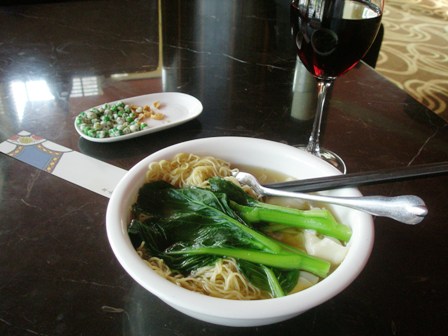
After my talk which I gave to German students I had some time for a quick lunch snack: dumplings in a broth with noodles, and a glass of the house red, of cause a Chinese wine. Delicious. Nice mix of East and West.

Lunch snack with red wine


The Bund Brewery in Shanghai – 上海外滩啤酒总汇有限公司

June 29, 2010

A wheat beer brewed in China

A couple of weeks ago when I visited Shanghai I ended up in a very nice watering whole, the Bund Brewery. The brewery is located in one of the side-streets of the famous stretch along the Bund where droves of people stroll along the river and enjoy the spectacular city scenery.

The bar with the brewery equipment

The Bund Brewery is a crowded and noisy place, full of Chinese customers interspersed with a couple of foreign tourists. I went straight to the bar and ordered what my neighbor was drinking, a wheat beer. I should not regret it. The beer was very nice, just like a good Bavarian wheat beer. Excellent, and not too expensive. Later I had some snacks as well.

German brewing equipment from Bamberg

When looking around I realized that some of the equipment came from Bamberg in Franconia. I had to take a photo of the plaque.

If you stroll along the Bund and you do not want to visit one of the many posh, elegant and exclusive cocktail bars, the Bund Brewery is the right place for you, a true “people’s place” for common folk and others alike.

Address:
Bund Brewery
上海外滩啤酒总汇有限公司
11 Hankou Lu, near Zhongshan Dong Yi Lu
汉口路11号,中山东一路
Shanghai, China
Tel.: 6321 8447
Opening: Fri+Sat 11am – 4am, Sun-Thu 11am – 2am
http://www.thebundbrewery.com.cn


Schanghai: The new Bund at night

May 28, 2010

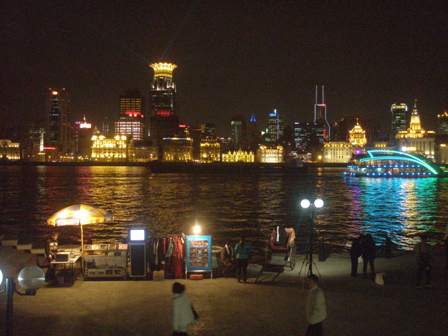
The Bund at night from the terrace of “M on the Bund”

Shanghai has seen a tremendous development over the last 10 years. Last year when I visit the “Paris of the East”, as Shanghai used to be called, its famous “Bund” was still closed for renovations. With the World Expo came also the re-opening of this part of the metropolis which presents itself in a new incarnation.

I had dinner with an old friend on the terrace of the South Beauty restaurant 俏江南 overlooking the Huangpu river on the 10th floor of the Super Brand Mall in Pudong. The terrace offers a splendid view at night. South Beauty is a chain restaurant with dependencies in the capital Beijing and other provinces. It is seen as one of best Sichuan food restaurants in Pudong and Shanghai. The food was good, but we ordered too much of it. We were rather late and the service was friendly but quite slow. But I liked the food. In internet reviews South Beauty received varying reviews. Some rank it 57th of the 320 restaurants in Shanghai, other see it as 100. Some reviewers see the quality as 3.5 out of 5, others rank it 8 of 10.

After our meal, we crossed to the other side of town. because it was late, we had to take a taxi but there is a tunnel under the Huangpu river which is spectacular transportation. If in Shanghai you should try it, instead of a taxi. our object was the terrace of another landmark of Shanghai’s nightlife: M on the Bund.

I had visited it’s sister restaurant, Capital M in Beijing a couple of months ago. The terrace is wonderful and the new Bund presents itself as it always did: in great style. The Glamour Bar, one floor below M on the Bund and run by the same owner, is the place to have what we German’s call “Absacker”, a night cap.

Opened in January 1999 M on the Bund is located in the Nissin Shipping building which was built in 1921, the same year the Communist Party of China was founded (also in Shanghai). The Miele Guide ranks the restaurant as one among the top 20 in Asia! That’s quite an achievement.

The picture above gives you and idea of the views. The place to be, I guess.

Address:
South Beauty
10/F Super Brand Mall, 168 Lujiazui Lu,
陆家嘴西路168号正大广场10楼
Pudong, Shanghai
Tel.: 5047 1817

M on the Bund
7/F, No.5 The Bund ( corner of Guangdong Lu )
Shanghai 200002 China
中国上海市外滩广东路20号7楼
邮编 200002
Tel (86 -21) 6350-9988
Fax (86-21) 6322-0099


The People’s Paradise

May 27, 2010

In between meetings I had the opportunity to visit the World Expo in Shanghai. Goodness me how many Chinese visitors flooded the place. Their interest in foreign nations and foreign culture seemed without bounds. Already early in the morning long queues built up very quickly so that people had to wait for 2-3 hours before they could enter a pavilion.

I manged to see only three country pavilions from the inside: Bangladesh, Mongolia and North Korea. I did not have to queue up for either of them. The casual visit was very educative. Now I know where the people are king: in North Korea.

The main slogan in its pavilion was: Paradise for people.

I must have missed something. Abduction of foreigners, gun boat tactics, and starvation comes to mind; senseless nuclear programs to take the world hostage and pay for the extravagances of one family and medical treatment of its leader.

Go north young man and migrate to this country of the gods, where people live in paradise.

The North Korean pavilion, with no queues

No one queuing for North Korea

The inside: large pictures and posters of paradise


The wines of China

May 23, 2010

Soon, I will go the China again, and I very much look forward to this visit. When we moved to China in 1990 we were so happy that wine made from grapes was available at all. That was the time of the first French- or Italian-Chinese joint ventures. Ever since the Chinese wine industry has made great progress.

However, if you look for boutique vineyards, China is the wrong place. China after all was and is a beer drinking place. In the countryside it is “bai jiu” (high percentage white liquor or Schnaps) made from maize or sorghum (gao liang) which is consumed in large quantities.

Most of the grape wines on sale in shops and supermarkets in big Chinese cities come from the corporate wine producers such as Dynasty Wines or Great Wall Wines. In 1990 Dynasty, a joint venture of Remy Martin set up in Tianjin in 1980 (only the second joint venture in China at the time), was already 10 years old.

Dynasty Dry Red Wine

Back label

Great Wall Red Wine

Back label

As everything, wine-making goes back a long way in China. However, after the end of the cultural revolution and the start of the economic reform era, there was hardly any expertise left. With the help of wine-makers from France, Italy and Australia, Chinese vintners have made remarkable advances. The product range of the large corporate producers is quite impressive.

Today grape wines are gaining popularity. Especially red wine is popular among male consumers and a kind of status symbol as well. For Western wine connoisseurs some of the consumption habits of the Chinese are strange (or disgusting). For instance the custom of drinking first class Bordeaux wine mixed with soft drinks, called “Red wine set menu” (one bottle of red, ice and two cans of sprite or coke).

The largest producing region is Yantai-Penglai in Shandong province with about 40% of total production in China. It is estimated that China will match the quality of Bordeaux wines in about 50 years time.

I will check it out next week. I’ll keep you posted.


Capital M – Beijing

January 21, 2010

Capital M Beijing, an artists view

As always when I visit Beijing, I pay a visit to Brian Wallace, the director of Red Gate Gallery, my most favorite art gallery in China, and beyond. After about an hour of talking and catching up about Beijing’s art scene (and a quick box lunch), we also started talking about good food and inadvertedly talked about Michelle Garnaut and her newest restaurant in Beijing: Capital M.

Ever since Michelle started out in Hongkong in 1989 with 500 Dollar in her pocket but many good ideas and opened M at the Fringe, which won the Hongkong Dining Awards in 2009 as best restaurant, she has made a name for herself in restaurant and entertainment circles.

In 1999 she opened M on the Bund and later The Glamour Bar – self-declared as “Shanghai’s Sexiest Bar”.

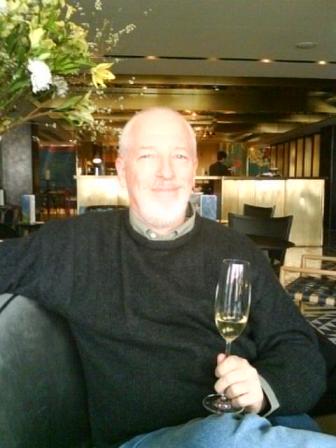
Unfortunately Michelle was not there when we entered the bar early that afternoon for a glass of bubbly. Brian treated me with a bottle of Taittinger. But first he showed me around so that I got an idea of the place and its stunning views. We had a great time.

From Brian’s handphone camera

I will try the food next time I visit Beijing. Looking forward to it. Cheers

Adresses:
Red Gate Gallery
北京市东城区崇文门东大街9号
Te.: +86-10-65251005
www.redgategallery.com/

Capital M Beijing
3/F, No.2 Qianmen Pedestrian Street
(just south of Tian’anmen Square)
Beijing 100051 China
中国北京市前门步行街2号3层
邮编 100051
Tel +86 -10- 6702-2727
Fax +86-10 – 6702-3737
http://www.m-restaurantgroup.com/capitalm/home.html


Sichuan food in Beijing

December 23, 2009

Christmas decoration at Chang an jie

Also China shines in Christmas lights these days. During my recent visit I could check out various department stores and restaurants where I could experience the magic.

My good old friend Xingyuan took me to a Sichuan restaurant not far from where he is working at Jianguomennei. He ordered so many dishes which I cannot show all in this blog entry.

We were too busy chatting and catching up after a long time apart anyway. My photo-taking was slack at best.

Below you find shots of two spicy Sichuan dishes we had. That it was delishes goes without saying. We could not finish all the food.

I love the spicy Sichuan cuisine though at times some of the dishes are too hot for me. I drank a beer with the spicy food; Xingyuan had a coke.

Happy reunion in Beijing


Shanghai delight

December 18, 2009

The Bund from the Pudong side

My friend Wolfgang took me out on a walk in Pudong. We started with dinner in a restaurant overlooking the Bund. After that we “climed” the two highest buildings in Shanghai and enjoyed the architecture and the view.

I just love Chinese food, especially the cuisines which are a bit more spicy such as Hunan, Sichuan but also Yunnan style food. The plates below give you and idea. The dishes were delicious and the presentation was also quite nice.

Green beans and stripes of beef

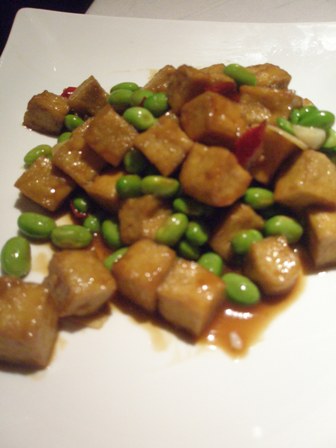
“Stinking dofu” with soybeans

Green pepers with octopus

A jelly desert

Tsingtao beer

We could have ordered a bottle of wine but beer, especially Chinese beers, go very well with Chinese food. It was a wonderful reunion after many years of only conversing via mail. For me it was also the first ever visit to Pudong. The highrises are worth visiting and exploring (many restaurants and bars with breathtaking views).

My suggestion: Go to Shanghai as long as you are still young.