The best Australian dessert

June 13, 2009

Pavlovl

The Australian Pavlova

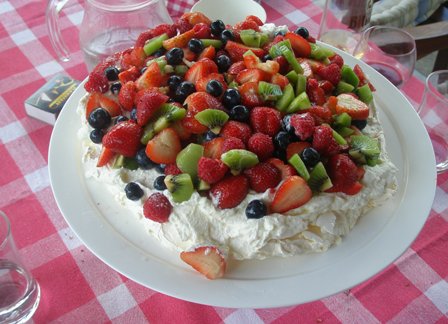
Have you heard of Pavlova? Well, for Australians that’s the stuff you want for dessert. It is wonderfully refreshing, smooth, fruity and just a delight.

Pavlova, you might think does not sound very Australian. And in fact it is not. The dessert is named to honour a Russian ballet dancer, Ánna Pávlova (Russian: А́нна Па́влова) touring Australia and New Zealand in the 1920.

Commonly referred to as “pav”, it is a cake of meringue with a crispy crust and soft inner part topped with red and blue forest fruit and some kiwis. The name is pronounced “pævˈloʊvə” unlike the name of the dancer which is pronounced “pɑːvləvə”.

The dessert is a very popular dish. It is also an important part of the Australian national cuisine. Isn’t this mazing.

However, research suggests that the Pavlova originated from New Zealand. Well, that’s no deterrent for a culinary delight.

Pavlovl2

Among friends

We had the above Pavlova on our terrace in Bangkok after a barbecue lunch with some friends. Lots of meat, salads and vegetables were consumed. Lashings of beer and wine made this consumption all the easier. But best was the company.

A recipe for Pavlova you can find on: http://en.wikipedia.org/wiki/Pavlova_(food)


Restaurant review: Chopin, Berlin

June 8, 2009

chopin1

The Chopin restaurant

Last year I had the chance to dine twice at Chopin restaurant which is located between Wannsee and Griebnitzsee in the South west of Berlin. The cuisine the restaurant specialises in is Silesian food. Today Silesia is a region of Poland smaller parts of which, however, are belonging to the Czech Republic and to Germany.

chopin3

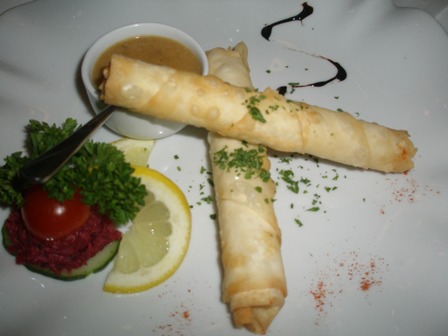
The entrée “Schlesische Zigarren

We had a fixed menu which was ordered for the occasion. The entrée consisted of “Schlesische „Zigarren“, Silesian cigars (price Euro 3,90), a puff pastry filled with sheep feta and a mustard sauce.

chopin2

The beef dish “Schlesischer Sauerbraten”

We could choose between two main dishes: a “Schlesischer Sauerbraten”, a marinated pot roast (price Euro 11,90) with red cabbage and apples, peaches and cranberries served with German dumplings, ….

chopin51

The pike perch (German: Zander)

…and a fish dish, consisting of a pike perch roasted in a sauce of dill and with zucchini (price Euro 13,90). Potatoes and vegetables were also presented.

Since we dined at the restaurant twice within a week, I had the opportunity to taste each of the main dishes.

Needless to say (you can see it from the pictures) the food at Chopin restaurant is delicious; it’s a splendid example of German country cuisine at its best.

chopin4

Pinot Gris

There were two wines served with the food: a white (Grauer Burgunder/Pinot Gris) from Baden, Germany and a red (Nero d’Avola) from Sicily (which is not on the wine list any more).

I had the white, a ‘2004 Oberbergener Bassgeige, Grauer Burgunder, Kabinett, dry’, from the Kaiserstuhl wine region in Baden.

It’s a massive white wine (13% alc.) not something light for the summer. It has substance and structure which make it an ideal partner for pairing with Silesian food.

The producer of the wine is a “wine-co-operative”. The Gault Millau as well as the Eichelmann Wine Guide award the co-operative “one bunch of grapes” (Gault Millau: reliable) respectively “two stars” (Eichelmann: good producer).

I very much like this cosy family restaurant. If you are in Berlin next time, please do not miss to pay it a visit.

Address:
Restaurant Chopin
Wilhelmplatz 4
14109 Berlin, Germany
+49-30-8053033


Plug the pipe – Unpopular View

June 6, 2009

I have written about the stupidity of the Brumby governments water policy in Victoria on this blog before. Surfing the net today I found a wonderful video on Plug the Pipe by a young man who summarised and assessed the Victorian Labour governments blunder. Great job I find. We farmers will pay the price and so will the Victorian taxpayer.

Watch this, it’s a great video. Congratulations. Similar things happen all over the globe when urban policy makers screw country folks.


We, the small people of wine

June 5, 2009

Today, I came across a quotation by Frances Ann (Fran) Lebowitz, an American social commentator, which reads like this:

“Great people talk about ideas, average people talk about things, and small people talk about wine”.

I am glad that there are so many of us, “small people” around, thinking, talking, sharing, writing and blogging about wine. The world would be a much poorer place without us. Ideas we have too, and a few things as well, I guess.

My friend Siggi Herzog sent me a youtube video which depicts a lovely German “drinking song”.

With this, I wish you a wonderful weekend, a time of food and wine, with song and laughter. Cheers


Fencing at Two Hills Vineyard

June 2, 2009

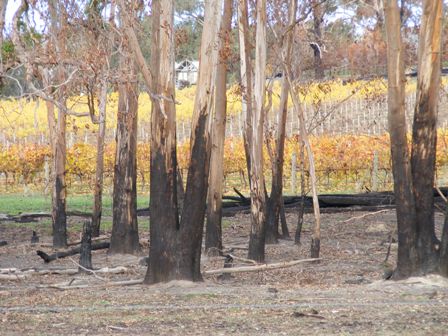
It’s autumn in Glenburn, Victoria. Our vineyard shows beautiful coloured leaves before the onset of the Australian winter. We are so happy that our property, though the fire went through it, did not vanish in the bushfire of February 7th. The volunteer fire fighters saved our place. Thank you again folks from the bottom of my heart.

Through the burned gum trees you can see the vineyard and our “shed”, the small house where we spend our holidays and which holds our vineyard equipment and machinery. We are so lucky to still have it.

Newfence1

Two Hills Vineyard in autumn

We lost some kilometres of fences, though. Our neighbours have started to rebuilt the damaged joint border fences. My brother-in-law, Michael and his wife Helen helped us to get the new fences going. Volunteers also showed up to help.

They came through Blaze Aid a civil society organisation mobilising support for those who suffered through the fires. Meanwhile several hundred of kilometres of fences have been resurrected by them. They helped us to take off the old wires and posts. Thank you folks. Blaze Aid is a great initiative and shows the vibrancy of Australian society.

Newfence2

Michael working on the fence at Two Hills Vineyard


The best German vintners and wine makers

June 1, 2009

Threewinegods

The wine gods (photo taken from a building in Berlin)

Its certainly a great honour to be called “vintner of the year”. Since 1994 Gault Millau, Germany’s wine guide and major authority regarding wine, wine business and the wine sector, is awarding the “vintner of the year” award.

Today the total number of vintners of the year is 16, seven of which come from the Mosel wine region. The current one, however, comes from the Pfalz (Knipser brothers).

But in the years 2007 (Theo Haart, Mosel), 2005 (Kartaeuserhof, Ruwer), 2001 (Loosen, Mosel), 1998 (Mueller-Scharzhof, Saar), 1996 (Joh. Jos. Pruem, Mosel), 1995 (von Schubert, Ruwer) and 1994 (Fritz Haag, Mosel) the vintner of the year came from my home, the Mosel river and its tributaries.

(Remark: the Mosel wine region was originally called: Mosel-Saar-Ruwer)

No other German wine region has provided that many “champions”. So far the Nahe and Pfalz wine regions had two vintners of the year; and Rheinhessen, Rheingau, Frankonia, Ahr and Baden had one each (for the names of the vintners of the year: Gault Millau).

I came about this fact only by accident while researching a story, I was going to write. I have to find more Mosel wines here in Bangkok, I guess. Wish me luck.


Country living: The good life in Ramsdorf, Westphalia

May 31, 2009

The land

Rams16

The Münsterland, Westphalia is not exactly a wine region. People in this rather flat but beautiful rural part of Germany, just an hours drive from the Industrial heartland of the Ruhr (the drive can be as short as 30 minutes only), prefer to drink beer and “Korn”, a spirit also called “Schnaps” distilled from wheat and other grains.

The farm houses are made of red bricks, have large wooden doors, usually green, high gables and are just magnificent. They stand alone within the land belonging to them, accompanied by large stables and barns, all erected in the same style, a wonderful sight. I went there to visit my friends Uli and Elfriede in a small hamlet called Ramsdorf.

Rams15

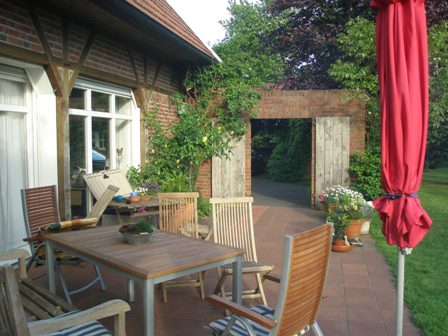
My friends Uli and Elfriede’s house, formerly a cottage of the estate (from the back)
Rams00

The backside with the outdoor furniture

The Food

As the people so the food, one could say. Rural people everywhere developed healthy, nutritional type of foods; no-nonsense stuff, usually based on the raw materials the land has to offer. So the Münsterlaender cuisine has a lot of sausages, ham and various kinds of meats, served with potatoes, and green vegetables.
Rams0

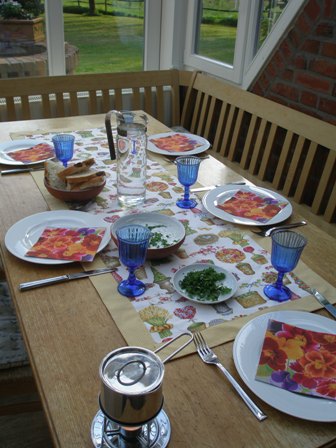
The table in the patio

Rams1

Beautiful beef

Rams2

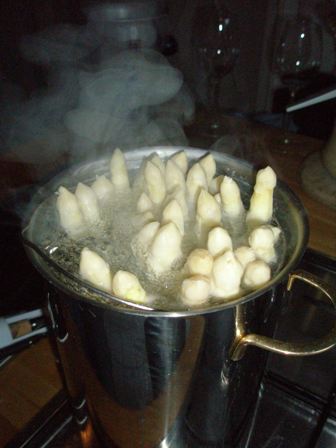
Fresh asparagus in a special asparagus cooker

Rams3

The finished product: asparagus

Rams4

The finished product: the steaks

Rams5

Our meal of asparagus, potatoes, ham and a steak with melted butter

The wines

We did of course also drink wine with this delicious meal. We started while the asparagus was still cooking with a ‘2008 Knipser Sauvignon Blanc dry’ by Weingut Knipser, Pfalz, a wonderful wine, fresh, fruity with structure and depth.

The brothers Volker and Werner Knipser (and since 2005 Stephan, Werner’s son) are the owners of this vineyard and winery in Laumersheim, Pfalz. The family operates the estate since 1876. Today about 40 ha are under vines. The brothers were the first in this part of the Pfalz to use small barriques barrels to mature their wines. They also increased the area under red varieties and replanted with high quality rootlings. In 2009 the were awarded “Vintner of 2009” by Gault Millau for their innovative ways and their high quality wines. My first Knipser wine, I drank many years ago when living in Beijing. My friend Norbert Finkel, a journalist from the Pfalz, introduced me to the Knipser wines long before they became fashionable.

Rams6

‘2008 Knipser Sauvignon Blan dry’ in the bottle

Rams7

..and in the glass

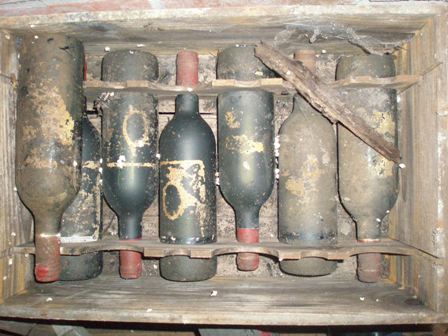
After the white, we longed for some red and went out into the shed where Uli stores his wines. Here we unearthed an old wooden box with red wines from Bordeaux, France.
Rams8

Treasure trove

Rams9

The chosen one

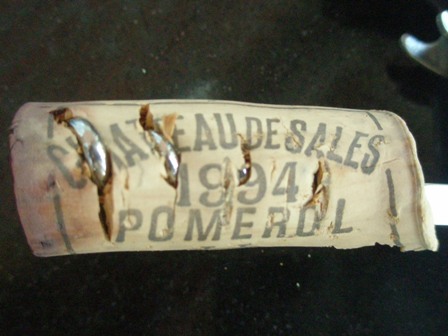
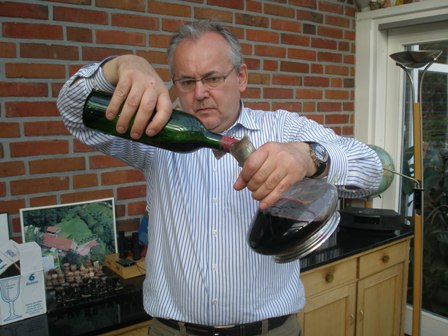
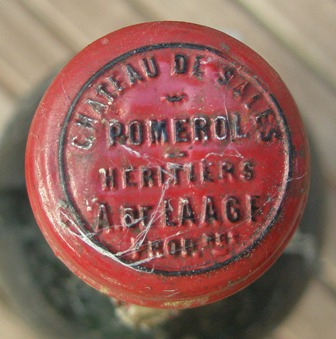
We selected a ‘1994 Château de Sales’, a Bordeaux blend from Pomerol, France. Uli de-cantered the wine, the drop was excellent but needed to be drunk. So we had “discovered” it at the right time. The blend was full flavoured, with structure and harmonious tannins and very enjoyable with our food. The wine sells on the internet in the UK for £ 30-35 and in continental Europe for about the same amount but in €.
Rams10

The top of the capsule

Rams11

The cork

Rams1112

Uli de-cantering the Bordeaux

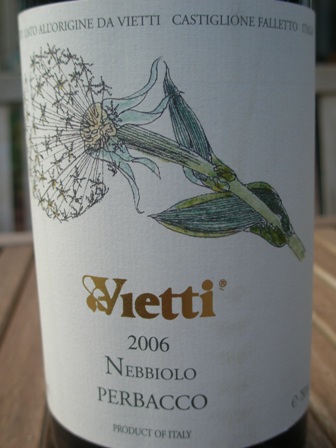
We finished the evening with an Italian wine, a ‘2006 Vietti Nebbiolo Parabacco’ from Langhe, Piedmont in Italy. That was quite a change from the Bordeaux. The wine was rich and complex. It showed well balanced tannins which were chewy at the finish, just great for a red. What a pleasurable wine to end a very pleasurable day with my friends in the Münsterland.
Rams12

The Nebbiolo bottle from Vietti

The people

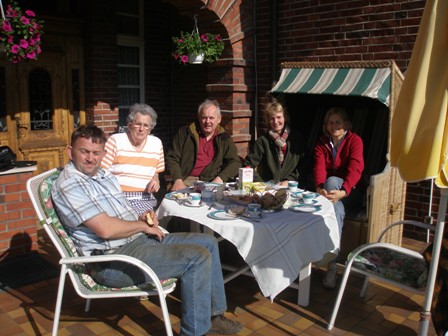
I quickly introduce my friends, the three Hillejan families. Georg and Barbara are the farmers, aunt Doris, the mother of Georg and Ulrich, and Ulrich and Elfriede, my old friends from University days. I used to work on the farm as an intern during my students days when Uli’s father Alfons was running the estate. I loved to work for uncle Alfons. He was a great man. But I did not only work but also play there. We celebrated quite a few events (a few weddings among others) on that farm, had wild parties and a great time playing farmers.
Rams13

Georg, aunt Doris, Ulrich, Barbara and Elfriede on the veranda of the old farm house

Rams14

Three men on a mission, Ulrich, me and Georg

Wisdom of the East

May 29, 2009

Wsidom

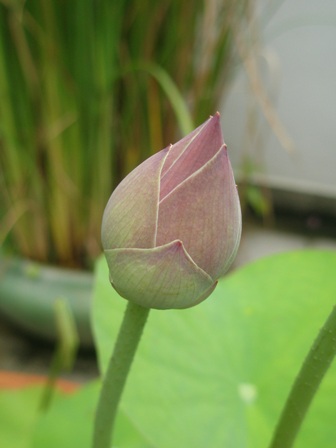
No time for blogging, isn’t it a shame. In the mornings I tend to my terrace garden. The are quite a few nice flowering plants there though the rainy season is not very kind to some of the more fragile blossoms.


German “Brotzeit”

May 27, 2009

Brotzeit

“Brotzeit” freely translated into English means “Time for a bread”; it is a German custom of a meal between meals, a snack one could say, which was very widespread in German lands when most of the population was doing hard physical labour.

During my recent visit to Germany I had the opportunity to indulge into this old German custom. Today, even small bottles of wine are “custom made” to this effect. Ever since my grandfather introduced me to Franconian “Bocksbeutel-wine”, I am a lover of Silvaner from the Main and the Fraconian wine region.


Germany: Asparagus season

May 26, 2009

Asparagus1

A spring delicacy in Germany

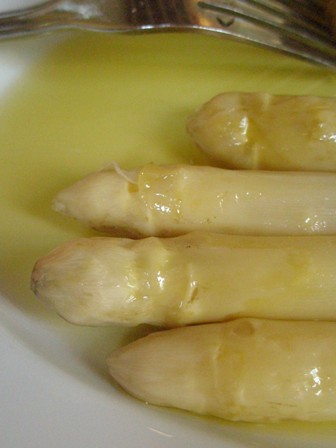
It is the asparagus season in Germany and I had the opportunity to indulge myself into quite a few “asparagus orgies”. Fresh white asparagus is so delicious. I like it with just some melted butter, a few potatoes, and maybe some fresh German ham.

Asparagus2

Tender asparagus tops

Asparagus3

Delicious potatoes

What wine do you drink with asparagus? Well, I had a simple Riesling from the Rheingau. But almost all white wines pair well with white asparagus. Germany is a Mecca for white wines. The recent edition of the “Weinwelt” (wine world) magazine identified four best buy whites to consume with asparagus. All were of different grape varieties (Vinho Verde, Silvaner, Sauvignon Blanc and Grüner Veltliner but no Riesling), and all can be purchased for under € 7.-, what a bargain. They were:

‘2008 Quinta de Azevedo Vinho Verde’ by Sogrape Vinhos, Portugal;

‘2008 Grüner Silvaner, dry’ by Weingut Manz, Rheinhessen;

‘2008 Tour de Pocé Sauvignon Blanc Réserve’ by Pierre Chainier, Touraine, France;

‘2008 Grüner Veltliner Hundschupfen, dry’ by Weingut Hagn, Mailberg, Austria.

I have not tried any of them as yet but reading the review brought tears to my eyes, my nose was hallucinating, and my taste buds seemed to feel the crispness of the wines.

Asparagus4

My “simple” Rheingau Riesling