Italian wines for Sunday lunch

September 23, 2009

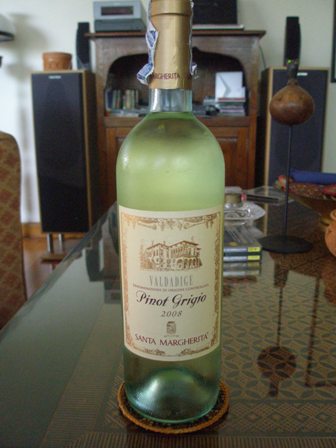
Sundays in Bangkok is usually fish day. There are many beautiful fish for sale in the markets. So for lunch we select a fish and a white wine. Often I choose to have a Riesling with the food. This time we went “Italian” and bought two bottles of white wine, one on the cheap side, the other a bit dearer. The former was a ‘2007 Montecelli Soave Classico’ from Piave in the Veneto, the latter a ‘2008 Santa Margherita Pinot Grigio’ from the Trentino, in Alto-Adige, Italy.

Pinot2

2007 Montecelli Soave Classico

Pinot3

2008 Santa Margherita Pinot Grigio

Pinot4

The Soave might costs about 3-4 Euro in Europe (or less). If I would buy the Pinot Grigio in the US I would have to pay 25 to 28 US$ for the bottle. In Thai Bath I paid about 500 for the Soave and about 1,000 for the Pinot, which corresponds roughly to 10 and 20 Euro respectively. We liked both wines. The Soave is a bit edgy and had a salty/oily after taste. The Pinot Grigio from Santa Margherita is just great, light bodied, spritzy with crisp acidity and a light lemon-citrus flavour.

Pinot6

Fried potatoes, zucchini and onions

Pinot7

Red snapper in caper and olive marinade

The food was simple. Red snapper is a beautiful fish which I like very much. The recipe is from the Philosopher’s Kitchen by Francine Segan. I have written about this fabulous cooking book in earlier entries of my blog.

I just love lunches like this one. We all relax, enjoy the food and the company. This was the first time we moved away from the dry Riesling-fish pairing and moved tp the Italian whites. We will repeat this, for sure.
And as Epicurus said: “Pleasure is the beginning and end of living happily”.


Birds growing up

September 22, 2009

BIBI1

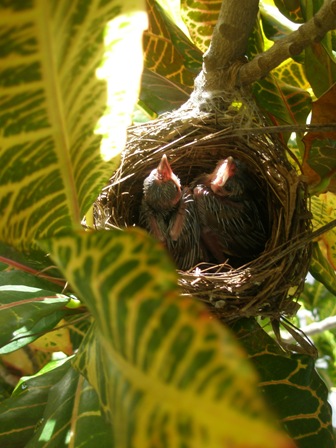
Birds with proper feathers

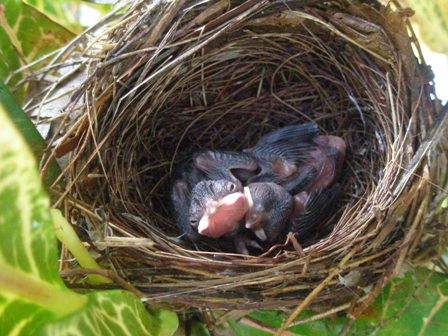
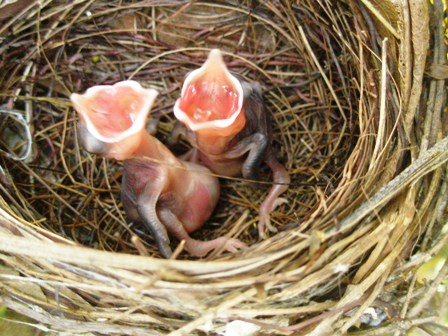
I regularly monitor the development of my two little birds, and as you can see from the photos, they are growing up fast, very fast. I am very protective of my Yellow-vented Bulbuls and hope they can grow up in safety to become beautiful birds. The nest is now getting smaller for the growing birds.

BIBI2

Always hungry

BIBI3

Also the parents are very attentive and wary of the humans of course.

The Yellow-vented Bulbul or Merbah Kapur (Pycnonotus goiavier) of the passerine family is quite common in South-East Asia. They originate from the mangrove forests and coastal scrubs which were so widespread in this part of the world. They forage not only on insects but also eat small fruit, berries, sip nectar and nibble on young shoots. They are also not afraid to browse for feed on the ground.

The adult birds are about 20 cm long, their crest is slight and they are yellow under their tail. They remind me of Zorro as the black stripes on their face look like a mask. Both parents incubate and raise the young. We had only two eggs but they lay up to five. I look forward to the next stage in their upbringing.


A Sunday at Bloody Hill

September 21, 2009

TimoM0

Great Yarra Valley views from the Mayer Vineyard (left to the dam)

On a beautiful Sunday in early August, we were in for a surprise visit to the Mayer’s. We bought some “nibblies” (Australian for cold meats, sausages, cheeses, condiments, etc.) and some wine in Healesville and drove up the steep drive to Bloody Hill on top of which their beautiful house (rammed earth) is situated. Alas, they were in and happy to welcome their unannounced intruders.
TimoM00

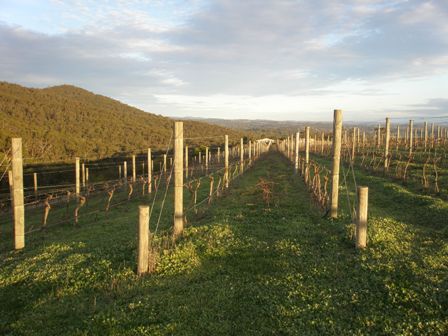
The vineyard at the crest of the hill is very neat

TimoM1

Some of the wines on “offer” (f.l.t.r.: a Silvaner from Franconia, Dr. Buerklin-Wolf, a Riesling from the Pfalz and a Dr. Mayer Pinot Noir from the Yarra Valley)

We came at the right time. A shipment of Riesling wine (about 60 cases) which Timo had made on a visit to Germany last year had just arrived and was ready for tasting. Moreover, as a member of the South Pack, Timo was in the preparation of a wine tasting tour to three Australian cities (Melbourne, Sydney and Brisbane). The South Pack is a group of eight innovative young Australian wine-makers who have raised the bar for the selling of premium and super-premium wines in sluggish markets.

TimoM3

The German Brotzeit

A quick “Brotzeit” was thrown up and the wine tasting could start. We did not drink in any kind of order but rather according to gusto and enthusiasm. First cap of the rank was the German Riesling Timo had made, Dr. Mayer Riesling of which I have no picture which speaks for itself. This was not a time for tasting notes but for joy and nourishment of body and soul, for Australian and Swabian story telling and song.

TimoM2

Bloody Hill Pinot Noir

Timo is a native of a small hamlet, called “Grossheppach” (about 4,500 inhabitants), today part of the small town called Weinstadt (translated: wine city) in the Rems valley (the Rems is a small river), Wuerttemberg, about 15 km east of Stuttgart. As everything in Germany, Grossheppach has a long history.

Grossheppach

Coat of arms of Grossheppach showing the river Rems and four grapes on a vine

Furthermore, the village has a long tradition of vine cultivation and wine making. Timo comes from a family of small vintners (and farmers).

In 1279 a historical deed is the earliest written testament of the flourishing wine production in Grossheppach. Magister Rudolf, a local doctor, had bequeathed his house in Esslingen and three vineyards in Grossheppach to the Abbey of Bebenhausen which was witnessed by knight ‘Fridericus miles de Heggebach’.

Timo showed as a historical chronicle of Grossheppach with black and white photos which also depicted his family in the 18th and 19th century. Here we are, thousands of kilometres away from the old land and talking grape production, wine traditions and wine styles. To cut a long story short, Timo had made his first ever Riesling wine in Grossheppach and shipped it for sale to Australia.

It was not the time for tasting notes, I guess. We opened one bottle after the next. First the Riesling wines, then Chardonnay and finally Pinot Noir and Shiraz, all Mayer Vineyard wines and Timo Mayer creations.

TimoM6

Mayer and Dr. Mayer Pinot Noir and a traditional German wine label with the coat of arms of Grossheppach

The Mayer Vineyard is only a small operation (2.5 ha under vines). All wines are hand crafted and from a single vineyard. Timo believes that wine is made in the vineyard, therefore there is minimal interference. The reds are unfined and unfiltered. Timo makes wines with a difference, with great character and individuality. As he says “he wants to bring back the funk”, and funky these drops are. James Halliday, “the wine pope of Australia”, has awarded his highest rating, a 5 stars, to the Mayer Vineyard.

The Dr. Mayer Pinot Noir is one of the newest creations from the masters hands; a great wine, elegant, whole bunch fermented if I am not mistaken. Timo assumed that all of it would be sold during the South Pack promotion tour together with the Riesling. By now there should be nothing left, I guess.

Needless to say that the day extended to the night and ended with a pasta feast for 9 hungry mouths.
TimoM5

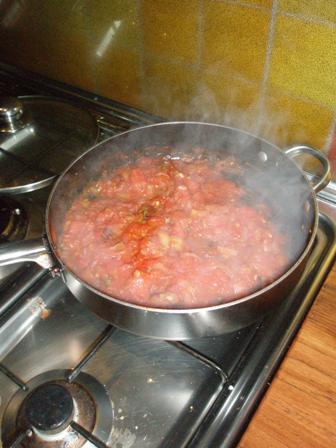
The pasta sauce in the making

TimoM4

TimoMM

The magician at work, this time in the kitchen and not in the wine cellar

We had a great time. The children played all afternoon. We walked the vineyard and Timo showed me where he shot a deer. Then we went to get some of that venison for us to take home. The “Brotzeit” led to dinner and then it was time to drive home to our own vineyard in Glenburn. Good news is that Timo is planning to make Riesling again in 2009 and maybe the following years.

For sales and enquiries contact:
timomayer@bigpond.com.au

The following wines are for sale:
Bloody Hill Chardonnay
Bloody Hill Pinot Noir
Big Betty Shiraz
Mayer Close Planted Pinot Noir (also as the Dr. Mayer Pinot Noir)

Two young birds

September 19, 2009

Bulbul2

My two little Merbah Kapur – Yellow-vented Bulbuls have grown a little. The parents are very busy collecting insects to fee the two hungry beaks. They have also grown some feathers.

Bulbul1


German wine regions: the Nahe

September 17, 2009

Nahe2

The Nahe wine region has a great significance for me and my family. It was here that I got first into contact with vine cultivation and wine appreciation at a rather tender age.

Why you might ask? Were you not from Trier, Mosel?
Well, my maternal grandfather, Hans Heinrich Schüssler, a native of Reichenberg, a village near Würzburg, used to live in Martinstein. Being from Franconia, another famous German wine region, he was the only wine drinker in the immediate family (my father preferred beer). He used to be the station master in Martinstein (today 322 inhabitants), a hamlet along the left bank of the Nahe river. The village was founded in the middle ages at a ford crossing the Nahe river. In 1340 it got a castle and even market (city) rights.

My brother and I, we used to spend the long summer holidays (and many other holidays) at my grandparents house in Martinstein. My grandfather used to take us on long walks in the forest and villages nearby. During these walks we always found a country inn where we could refresh ourselves, enjoy a drink or a “Brotzeit” (a typical German snack). He would drink a “Schoppen” (0.25 litre glass) of the local Nahe wine. He loved dry white wines. We would have a lemonade.

He was associated with a “hiking brotherhood” (called “Hunsrückhöhenverein”) whose members would walk in large groups on weekends to various destinations. Usually a country inn was the designated object of the hikers. Here the group converged for a hearty meal and some drinks. Shortly after vintage, “Federweisser” (freshly made but still half-fermented wine) was a popular drink.

But boys being boys, we would sip at his glass from time to time. He being deeply involved in conversation with fellow hikers, did not notice. Neither did we. The sweetness of the fresh wine veiled its dangers. To cut a long story short, we had the experience of a first inebriation of our young lives and could hardly walk strait on our long way home.

After my grandfathers retirement he moved out of the train station into a newly built home right in the middle of vineyards at the outskirts of the village towards the east. Vineyards stretched right to the door. Just a short walk up the hill and endless vineyards lay at your footsteps. Occasionally we would help during vintage time (more play than serious helping). But we would often taste fully ripened grapes and enjoy the fruit. I treasure these wonderful memories of my youth at my grandfathers house in Martinstein.

Map Nahe wine region

The Nahe wine region (photo source: wikipedia)

As you can see from the above map, the Nahe wine region stretches from Martinstein to the West along the river eastward, later north towards the estuary at Bingen where it flows into the Rhine river. The largest city in the region is Bad Kreuznach, a small town of about 45,000 inhabitants.

Nahe1

With about 4,200 ha under vines, the Nahe region is one of the smaller wine growing areas in Germany. It is still larger than, for instance the Yarra Valley in Victoria (with about 3,800 ha, about 2% of Australia’s total). The Nahe region is dominated by white grape varieties (about 74% of the total area under vines). The main variety is Riesling (26%) followed by Mueller-Thurgau (14%) and Dornfelder (13%).

Fifty years ago the variety distribution was very different. Silvaner used to be the most planted variety with about 50% of the total area but has ever since been replaced by the Burgundy varieties (Pinot White, Gris and Noir) as well as by Riesling, Dornfelder, Blauer Portugieser and Müller-Thurgau plantings.

The Nahe is divided into seven collective sites (Grosslagen) and 328 individual sites (Einzellagen). Due to its volcanic origins, the soils of the nahe show a great diversity. The wines reflect this. Only in 1971, the German wine law defined the nahe region. before that time, its wines were sold as “Rhine wines”. However, some of the best Riesling wines of germany originate from the Nahe and today Nahe wine can rival the best from Mosel and Rheingau or any other German wine region.

Nahe3

The Nahe can be divided into the upper (west) and lower (north-east) Nahe and the region around Bad Kreuznach. In Martinstein and the neighbouring village of Monzingen (first mentioned in 778) the oldest vineyards of the Upper Nahe are to be found. The soils of the Nahe range from sandstone to quartzite and slate. The region shows a temperate climate and some of the southern slopes enjoy a micro climate comparable to the Mediterranean. Elevations range from 100 to 300 meters altitude.

Nahe4

Who are the top producers of the Nahe wine region?

Well, the name Herrmann Doenhoff comes to mind. He is the leading vintner of the Nahe and his wines are ranked among the top Rieslings in Germany. Herrmann Dönnhoff has about 20 ha under vines and produces about 140,000 bottles a year. His winery is located in Oberhausen/Nahe. The 2007 vintage produced outstanding wines; the 2008 Riesling wines did not quite reach that quality level during recent tastings. But his ‘2008 Niederhäuser Hermannshöhle Riesling Gran Cru’ earned 93 Parker points.

Other top producers are Emrich-Schönleber in Monzingen (about 15 ha under vines, yearly production about 110,000 bottles), Schlossgut Diel (17.5 ha and 120,000 bottles) in Rümmelsheim and Schäfer-Fröhlich (14 ha under vines and 75,000 bottles annually) in Bockenau.

Wines and vintners I like very much are Sascha Montigny in Laubenheim and Weingut Edelberg at Gonratherhof 3 in Weiler just on the other side of Martinstein. The former I like because of the high quality of his red wines, especially the 2006 vintage; the latter produces solid country wines which remind me of my youth in Martinstein and the long hikes with my grandfather. The country inn at Gonratherhof was often our destination when the three of us set out from our little house in the vineyards.


New chicks on the block

September 13, 2009

Birds1

Two eggs only

Today I discovered that the little Yellow-vented Bulbul (Pycnonotus goiavier) or Merbah Kapur as we call them in Malay, which had built an elaborate nest in on of the bushes just next to the table on our terrace, and which had laid two eggs some time ago, has had young ones. Our terrace is about 80 sq. meters and we planted a lot of different pot plants. I found the two hungry birds today. Welcome to Bangkok.

Birds2

Eggs become chicks


Restaurant review: Al Majlis, Bangkok

September 11, 2009

AlMajlis1

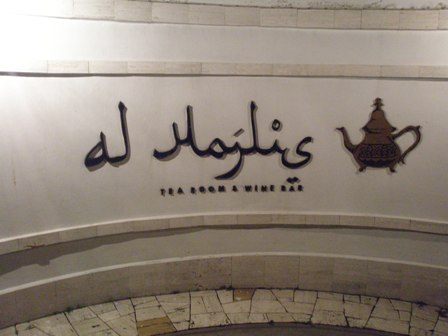
Do you want to have an atmospheric evening on a Friday night in Bangkok (actually any night will do)? If the answer is yes, then Al Majlis (actually the full name is Al Majlis Tearoom) is absolutely the right place for you. The Moroccon-inspired tearoom is the perfect place in busy Bangkok to relax and plunge in a long lost dream of a “Thousand an one night” experience.

I very much like the interior of the restaurant. Moreover, in the inner courtyard tent-like structures have been erected which remind me of a “caravanserai”. The sofa beds are very comfortable; it feels like sinking into a divan, a “Thousand and one night”-experience.

AlMajlis2

AlMajlis3

AlMajlis4

AlMajlis5

AlMajlis6

AlMajlis7

AlMajlis8

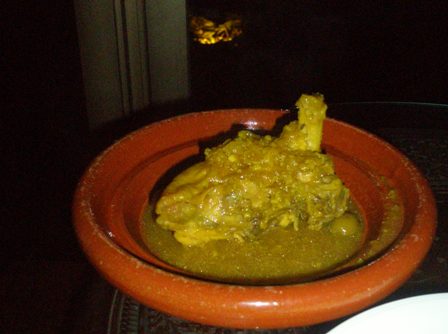
Needless to say the food is excellent (I love couscous), the service friendly and there is also a wine list which offers sufficient choice. Moreover, I just love the design and the furnishings; it gives you the illusion that you went away, far away, traveled in time to a leisurely place where the hassle of the modern world canot reach you. You order a water pipe, a shisha, and just relax.

Address:
Al Majlis Tearoom
Praduu Spa Club
83/8 soi Charoenchai (Ekamai 12)
Sukhumvit 63 road
Bangkok 10110

T: +662 392 2345
F: +662 392 2344
E: info@almajlis-tearoom.com

Opening Hours:
Mon-Fri: 4.30pm – 1am
Sat-Sun: 2pm – 1am


Melbourne’s water supply

September 10, 2009

When I read in the Age that Melbourne is planning to take 10 billion litres (which covers the city consumption for about 10 days only) from the Thompson River to make up for the shortfall which cannot be covered from the Yarra River, I was not impressed. The Labour government is desperate.

The interview of Tim Holding, the Victorian Water Minister, which Plug the Pipe has on its website is revealing. The North-South pipeline is completed ahead of schedule but there is no water. The conclusion I draw from it is, the Minister should change jobs before it is too late. The state’s water policy is a mess.

The cartoon below (from Plug the Pipe) summarises the situation. Whereever Melbourne turns to these days for water: there is none. There is hope though: elections are around the corner (2010).

Cartoon N-S Pipelineweb


From the sidelines: Judging the wine judges II

September 9, 2009

The day I received the results from the 2009 Decanter World Wine Awards, I also received an e-mail from Karl Storchmann from the American Association of Wine Economists announcing the newest publication of the Journal of Wine Economics (Vol 4, No 1).

The lead article in this issue of the journal is about the wine judges and their reliability in judging wines. This was the perfect contrast reading to the long list of award winners from Decanter. Again Robert T. Hodgson has summarized some more research about the topic in question.

The title of the article is “An Analysis of the Concordance among 13 U.S. Wine Competitions”. Hodgson followed over 4,000 wines entered in these competitions of which 2,440 wines were entered in more than three competitions. 47% of these wines received gold medals in one show but 84% of these same wines received no medals at all in the subsequent shows. These results indicate that winning a Gold medal is greatly influenced by chance alone. Or to put it another way: Wines which were deemed of an extraordinary quality by some wine judges were assessed as very ordinary by others.

In come the Decanter World Wine Awards 2009 results. What does the study say about these awards. Nothing, of course. My skepticism about wine shows, however, is rather stronger then before.

One may ask the question are the Hodgson findings about wine shows in the U.S. applicable to shows such as Decanter? Can we safely conclude that some of the Decanter award winners would be seen as ordinary by other wine judges at other shows, and that some of non-winners could easily win a Gold somewhere else. Or could the Decanter wine judges replicate the tasting with the exact identical findings? Or what would their “margin of error” or inconsistency be?

What Hodgson’s study also tells us is, that wine judges are just human beings who are inconsistent and unpredictable. But we might rightly assume that they are trying to do the right thing but fail in this from time to time. The judges at the wine competitions surveyed, though, seem to have a shared idea about the wines they do not like and therefore win no awards at all. That’s at least something.

A few wine blogs have taken up the issue as well. Alder Yarrow for instance writes on Vinography about the AAWE paper and calls for a stop of the proliferating state wine shows. He admits, however, that the shows surveyed where, and I quote, “essentially the largest and most prestigious wine competitions in America”.

What does this tell us wine consumers? Well, wine quality and medals won at wine shows are not “orthogonal”, the presence of one doesn’t imply the presence of the other. Therefore, trust your own taste and buy what you like, possibly after tasting and let the wine shows be wine shows.

How about the vintner? Well, it is very nice for any wine producer to be recognized for outstanding quality and performance. So it is nice to win a medal at a wine show or getting a five star winery rating from James Halliday for instance. But it is not the end if this is not coming along. Most important is that ordinary people like to drink and buy your wine; the rest takes care of itself.

papa290131

Cheers folks, trust your own judgment and taste as many wines as you can.


A night at the opera

September 8, 2009

I would would love to talk to Giuseppe Verdi.

He talked to me last night through his masterpiece, La Traviata, which was the opening act of Bangkok’s 11th International Festival of Dance and Music.

It was performed by Ekaterinburg Opera and Ballet Theatre, Russia. Playing Violetta Valery was soprano Natalia Starkova, a gold medallist at the International Bellini Vocalists’ Competition. Alfredo was played by Dymtry Kuzmin, a soloist with the National Opera of Ukraine. The conductor was Mikhail Granovsky from Bolshoi Theatre, Moscow.

To say it from the outset: this was a fantastic performance. Of course the end of La Traviata is tragic but the joyous parts are equally beautiful. All the singers were just great and they harmonised so well.

For me as a vintner, the so called “Drinking Song” (well its’ actually about the beauty of love) is just wonderful.
Here are the lyrics:

Alfredo
Libiamo ne’ lieti calici,
che la bellezza infiora;
E la fuggevol ora
S’inebrii a voluttà.

Libiam ne’ dolci frementi
che suscita l’amore,
poichè quell’ occhio al core
omnipotente va.
Libiamo, amore, amor fra i calici
più caldi baci avrà.

Tutti
Ah! libiam, amor fra’ calici
più caldi baci avrà.

Violetta
Tra voi sapò dividere
Il tempo mio giocondo;
Tutto è follia nel mondo
Ciò che non è piacer.
Godiam, fugace e rapido
E il gaudio dell’amore;
E un fior che nasce e muore,
Nè più si può goder.
Godiam!
C’invita un fervido
Accento lusinghier.

Tutti
Ah! Godiamo!
La tazza e il cantico
La notte abbella e il riso,
In questo paradiso
ne scopra il nuovo dì.

Violetta
La vita è nel tripudio.

Alfredo
Quando non s’ami ancora..

Violetta
Nol dite a chi ‘ignora.

Alfredo
E il mio destin così.

Tutti
Ah! sì godiamo..
La tazza e il cantico
La notte abbella e il riso;
Godiamo, in questo paradiso
Ne sopra il nuovo dì.

I could not find Natalia and Dymtry on youtube singing this song. That’s the bad news. The good news is you can go and see her performing live.

But I will not let you go without the song: here it is. There are many versions of this song on the internet. By chance I selected this one.
Salute Giuseppe