Bacchus Corner: wine shop in Saigon, Vietnam

June 26, 2010

One of the many good things in Vietnam is, that there is plenty of wine available (another one is that the Vietnamese seem to have capitalism in their blood – I love capitalism). When strolling through the streets of Hanoi and Saigon I was always on the lookout for wine shops.

In Saigon I found Bacchus Corner, not far from the Rex Hotel, the hotel with the famous terrace. The internet says that there is also a Bacchus Corner in Hanoi, but I did not manage to get there.

Thanks god that he Vietnamese have no local wine industry to protect like the Thais, and therefore wine prices are not too high, though still far higher than in Australia or Germany.

Bacchus Corner

When I took the photo above I was overcome with joy. I had walked the city for about one hour and could not spot a single place where wine was on sale. Alas, Bacchus Corner came into sight. But first I had to cross a busy street with millions of motorcycles – after more than 20 years in Asia I am experienced at that.

The inside

The staff was extremely helpful and very friendly. I browsed through the wine on offer and settled for a bottle of Four Sisters 2006 Merlot. For 380,000 Dong (US$ 1 = 19,000 Dong) it did not come cheap. Most wines were beyond my reach financially. But there must be a market for such pricey wines.

Bacchus Corner also offered excellent whiskeys, cognacs, brandies and other spirits. If you are looking for a hard to get vintage wine, go to Bacchus and ask them to get it for you. Since the shop is still in the setting-up stage (one room was still being renovated), you will have great prospects to get a real treat, I guess.

Address:
Bacchus Corner
17/11 Le Thanh Ton St, District 1, Ho Chi Minh City
Tel: =84-8-829-3306
Website: www.tankhoa.com


Chapel Hill 2009 Savagnin

June 25, 2010

While wandering aimlessly around in Ho Chi Minh City, I found a wine shop which caught my interest. It’s name was “Bacchus Corner”. Later I learned that there is also a Bacchus Corner wine shop in Hanoi. I browsed through their shelves and picked up an interesting bottle of wine. A ‘2009 Il Vescovo Savagnin’ by Chapel Hill Winery in McLaren Vale, South Australia.

2009 Savagnin by Chapel Hill in an unorthodox wine glass

When I bought the bottle I did not fully understand and appreciate what treasure I had acquired. I bought the wine because I had never before heard about the grape variety. What is Savagnin?

Well, Savagnin Blanc is a French grape variety grown mainly in the Jura region. However, Savagnin Blanc is also known as Traminer, grown around Tramin, a smlal Tyrolean town in Northern Italy. Experts think that the variety has “traveled” along the Alp mountains to the Jura region of France.

I also bought it because I found that most wines on offer were quite expensive. 340.000 Dong which is about US $ 17 is not small money for a bottle of white.

Chapel Hill Winery is of cause a well known producer of premium and award winning wines in McLaren Vale, South Australia. If you want to know more about this fascinating wine region, please visit the blog called “Lonely Grape” by Shane which makes an interesting read (it also contains interesting video clips).

2009 Savagnin

When researching this wine, I discovered that wine critics had awarded it 92 Parker point! Woh, I thought, what did I accidentally buy? The wine maker is Michael Fragos, and he has done an excellent job.

Alcohol is low (12.5%), and colour is a straw yellow. The wine is fresh and clean and shows fruity (lemon) and flowery aromas. It finishes rather abruptly but that does not take away anything from this exuberant and explosive white wine.

The crucial question you might ask is: Would I make it my house wine? Well, probably not. First of all it is not available in Bangkok were I live. Second, because of the price I most probably could not afford to drink it regularly. If you reside in Australia you belong to the lucky ones, I guess. My suggestion: indulge yourself.

Back label

If you are visiting Saigon/Ho Chi Minh City and you stay in the Rex Hotel, Bacchus is just around the corner in walking distance. Check it out.


Mount Nelson Sauvignon Blanc

June 24, 2010

Our fish

I just love to eat fish, all kinds of fish. And there is good fish on offer in the markets of Bangkok. Often we do not have carbohydrates with it. But veggies are a must. They are a great complement for the protein.

What you need in addition is, if possible: a superb wine, preferably white.

A plate of fish and veg

Very delicious veggies

I admit that sometimes I drink red wine with fish but most of the time I select a white. Since I love to drink Riesling wines, that’s often my preferred choice. Another option I like is Sauvignon Blanc. But it needs to be a really good one. I like Sancerre style wines and the ‘2007 Mount Nelson Sauvignon Blanc’, from the Marlborough wine region of New Zealand seemed to be the right stuff.

But I did not buy the bottle because SB wines from New Zealand are in fashion right now. I bought it because the Mount Nelson brand is a project of a famous Italian wine dynasty, the Antinori’s from Tuscany.

Piero and Lodovico Antinori are the 26th generation of Italy’s most famous wine family. I wanted to know how their interpretation of New Zealand SB fruit would turn out. I should not be disappointed as it turned out later.

2007 Mount Nelson Sauvignon Blanc

In 2004 the Antinori brothers bought for US$ 1.8 million a 32 acres vineyard on the banks of the Taylor River near the mouth of Cloudy Bay not far from the Wither Hill Vineyard. To make the Mount Nelson SB additional fruit (about 40%) is purchased from the adjoining Meadowbank vineyard.

The 2007 vintage is just the best ever. This is the unanimous verdict of the wine critics (91 Parker points). I can only confirm this. My recommendation: buy buy buy.

The wine has zest, is fragrant with lime and lemon flavours and some mineral notes. The colour is beautiful straw-like. The finish is lasting. I forgot the alcohol content and the price. But rest assured if I see it in my local market again, I will buy all the bottles on the shelve.

Beautiful colour in the glass

In early July, we will be in Italy. There I will taste some more of the Antinori wines. This time Italian wines.


Pomodoro, Italian cuisine in Saigon-Ho Chi Minh City, Vietnam

June 20, 2010

The historic Peoples Committee building next to modern high rises in glass

The menu of Pomodoro

“One cannot have always Asian food”, is how some people feel when traveling in Asia. Having the opportunity to check out an Italian restaurant was just too tempting. “Pomodoro” it was called, tomato. And in fact tomatoes were to be found not only on the menu, but also on the coasters. I took one as a souvenir.

The staff in the restaurant is very friendly, helpful and flexible. I craved for gnocchi when I detected them on the menu. Just simple “gnocchi al pomodoro”. They were delicious. I just had a salad with it, which made a perfect meal.

Gnocchi with tomato sauce

The restaurant has a very impressive wine list. Unfortunately, I do not know much about Italian wines. We asked what seemed to be “il padrone” (the boss), and he suggested we try the house wine, a ‘2007 Sandiliano Salento Rosso’ from Apulia.

A beautifully presented bottle of red

As I learned while writing this blog entry, the Apulian wine region is divided into two, the North and the South. Salento is situated to the south of the Brindisi-Taranto line. It is a peninsula of low, rolling hills that extends between the Adriatic and Ionian seas to the easternmost point of Italy. Thanks to the sea currents and breezes, the climate of Sorento is not too hot.

Therefore it wines have sufficient acidity and are not boring like “sultana wines” (or raisin wines as I call them). Salento’s traditional wines were the powerful, inky reds from Primitivo, Negroamaro and Malvasia Nera grape varieties. But increasingly fresher reds and rosés are produced, which show some unexpectedly bright and fruity characters.

The ‘2007 Sandiliano Salerno Rosso’, the house wine of Pomodoro, belonged to this latter category. It went very well with my gnocchi. The wine is a blend of Negroamaro and Merlot (12% vol. alc. only). It is fruity but not overwhelmingly so. It is a dark red and rustic wine, as I like them. One can taste the soil and the peasants hand.

Sandiliano Salento Rosso

Address:
pomodoro italian restaurant
79 Hai Ba Trung, District 1
Ho Chi Minh City
Tel.: +84-8-38238998
Fax: +84-8-38238957
e-mail: pomodoro@hcm.vnn.vn
http://www.pomodoro-vietnam.com

PS: For the Italophiles among you, I enclose herewith a little video clip on “Il padrone della casa”


Long Row Cabernet Sauvignon, Angove Family, Winemakers from South Australia

June 17, 2010

2007 Long Row Cabernet Sauvignon

The Angove family is one of the oldest wine making families in South Australia. Five generations of wine-making tradition, that’s a lot given the youth of Australia as a country. Founded in 1886 in Adelaide, the Angove Family Company is one of the largest private wine producers in the country.

With a total area under vines of about 480 ha, Angove is not a small operation. It’s Nanya vineyard is located in the flats of Riverland, in South Australia. Endless rows of vines dominate the view. Some of them are 5 km in length, a frightening thought for a German like me. It must be tiresome to work in these vineyards. The grapes are, of course, machine harvested.

The 2007 Long Row Cabernet Sauvignon is a blend, made of fruit sourced from across various wine regions in South Australia. The Long Row brand was established in 2003. This wine was classified by the Australian wine critic Jeremy Oliver in “The Australian Wine Annual” as a wine of “Top Ten Bargain Range”.

In fact it is a very nice drink, fruity, solid with structure and a good finish. In Australia you can have it for about A$ 10 per bottle, in Thailand you have to pay three times that amount.

I like the colour. Since I do not drink much Cabernet Sauvignon, the experience with this Angove Family Long Row wine, was pleasantly surprising. I will have to find out if our supermarket carries it as well or I will ask my wine merchant to locate a couple of bottles for me.

If you are in South Australia you might visit the two cellar door facilities operated by Angove, one at the Renmark Winery, the second at the original winery at Tea Tree Gully. Please visit their website for instructions how to get there.


La Domenica – A Tuscan feast with Tuscan wine

June 13, 2010

Jamie Oliver’s Italy

It was high time for some beautiful Italian food after my culinary peregrinations in Taiwan, especially since I am in the process of packing my suitcase again. I will be in Vietnam for the next two weeks and explore some of the foods in Hanoi and Saigon.

I am a lover of pasta, any pasta. Based on a recipe from the Jamie Oliver Italy book, we set out on a “fusilli con rague”. Imagine a sauce thick with the flavours of beef rosemary and tomatoes simmering on the kitchen stove for hours.

Our favorite Prosecco so that the waiting was bearable

The table waiting for the pasta

Voila: the pasta

It was delicious, just what I needed, earthy and robust, rooted in the peasant traditions of Italy.

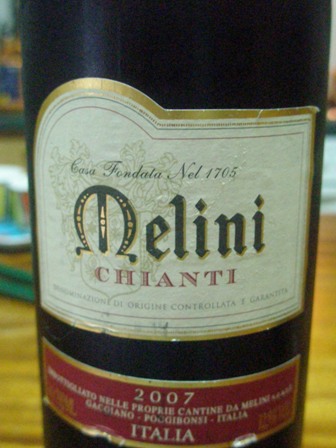
What about the wine? I bought a bottle of Italian wine from my favourite wine shop in Taoyuan just across from the International Center for Land Policy Studies and Training (ICLPST). Nothing special, but decent. It was a bottle of ‘2007 Chianti D.O.C.G.’ by Melini, one of the best wine makers of Tuscany.

In wine reviews it gets three, sometimes four, out of five stars. It has about 13.5 % alcohol and costs between US$ 8 to 12. This young Chianti is a solid wine for every day, with good fruit flavours, medium bodied with a long finish. It went very well with the pasta.

PS: The good news is that in July we will be in Rome and Florence with ample opportunity to taste many Tuscan wines.


Winery Review: Vereinigte Hospitien, Trier, Mosel

June 2, 2010

vereinigtehospitien1

The St Jacob of United Hospices wine label

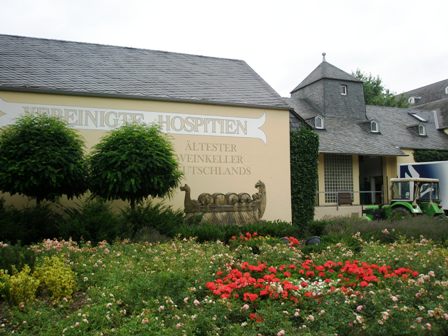
I grew up just next to the convent of St. Irminen at Irminenfreihof No. 5 in Trier, Mosel. The convent belongs to Vereinigte Hopitien, a foundation which also ownes a well known winery with the same name. Their English name is “United Hopices Wine Cellars“. The patron saint of United Hospices is St Jacob, an image of which is also used on the wineries labels.

As a kid I played in the cellars and warehouses of the convent. I also remember them sending their vats and barrels for controlling purposes to the Eichamt, the local Weights and Measures Office, which my father was heading. We played around the barrels and I vividly remember the smell emitted by the oak and the moist wood.

vereinigtehospitien3

The winery

United Hospices owns vineyards along the Mosel (locations: Piesporter Goldtroepfchen and Triere Augenscheiner) and the Saar (locations in Wiltingen, for instance Hoelle, Scharzhofberg and Kupp, Kanzem and Serrig). Most of the vineyard originally belonged to monastries and convents. Today about 25 ha are under vines, 90% of which are planted with Riesling grapes (my favourite grape variety), the rest consists of Pinot Gris, Blanc and Noir.

As many of the wineries in Trier, also United Hospices has a large traditional wine cellar (some parts of it dating from the 3. century) which you should have a look at. Wine tasting in ths historic atmoshere are unforgettable events. United Hospices top wines are the dry and sweet (Trockenbeerenauslese) Scharzhofberger Riesling wines from the Saar some of which sell for up to 100 Euro/bottle. The ordinary Riesling wines cost about 6.20 Euro/1 l. bottle.

I hope you are going to visit Trier this summer and drop in for a wine tasting. Cheers

vereinigtehospitien4

The main hospice building along the Mosel

vereinigtehospitien2

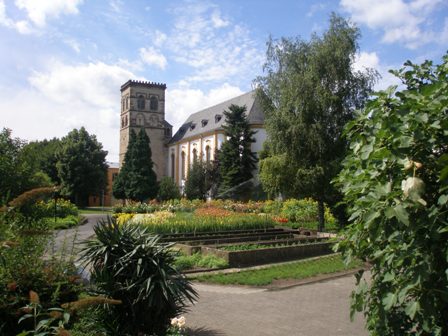
Church St Irminen

Address:
Vereinigte Hospitien
Krahnenufer 19
54290 Trier
Tel.: +49-651/945-1210 o. 0651/945-1211
Fax: +49-651/945-2060
Opening hours: Mo. – Thu. 08-12:30 and 13:30 to 17h; Friday closing at 16h, Saturday 10-14h


Australian barbecue

May 24, 2010

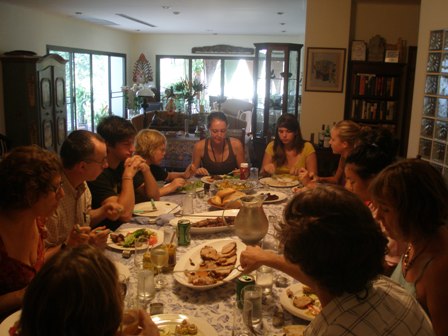
What do you do if there is a curfew at night? You celebrate in the daytime and this is what we did. We invited two families with their children and the 13 of us had a great time last Saturday. Starting at 1 pm gives you plenty of time, and we love it if our table can be put to good use.

We can easily sit 12 persons, and I just sneaked in on the corner. As it is Australian custom, the man has to operate the barbecue, and that’s what I did. My Weber is doing a great job. The recipes came from Italy though. I had a large piece of pork which we prepared the Italian way as “majale al rosto”. Moreover, we had, Italian “spiedini”, skewers consisting of spicy sausages, beef, bacon and sage leaves between them. All delicious stuff.

Seven teenagers and six adults around one table

And what comes at the end of an Australian barbecue? Right a pavlova, the wonderful and delicious, classical Australian dessert, especially if it has 40 Celsius outside.

Pavlova

We drank mostly beer but had also a couple of bottles of ‘2008 Yering Chardonnay’ from the oldest vineyard in the Yarra Valley, which they “flog” in our local supermarket at the moment (but which still costs about 12 EURO/bottle).

What a jolly good time we had.


The wines of China

May 23, 2010

Soon, I will go the China again, and I very much look forward to this visit. When we moved to China in 1990 we were so happy that wine made from grapes was available at all. That was the time of the first French- or Italian-Chinese joint ventures. Ever since the Chinese wine industry has made great progress.

However, if you look for boutique vineyards, China is the wrong place. China after all was and is a beer drinking place. In the countryside it is “bai jiu” (high percentage white liquor or Schnaps) made from maize or sorghum (gao liang) which is consumed in large quantities.

Most of the grape wines on sale in shops and supermarkets in big Chinese cities come from the corporate wine producers such as Dynasty Wines or Great Wall Wines. In 1990 Dynasty, a joint venture of Remy Martin set up in Tianjin in 1980 (only the second joint venture in China at the time), was already 10 years old.

Dynasty Dry Red Wine

Back label

Great Wall Red Wine

Back label

As everything, wine-making goes back a long way in China. However, after the end of the cultural revolution and the start of the economic reform era, there was hardly any expertise left. With the help of wine-makers from France, Italy and Australia, Chinese vintners have made remarkable advances. The product range of the large corporate producers is quite impressive.

Today grape wines are gaining popularity. Especially red wine is popular among male consumers and a kind of status symbol as well. For Western wine connoisseurs some of the consumption habits of the Chinese are strange (or disgusting). For instance the custom of drinking first class Bordeaux wine mixed with soft drinks, called “Red wine set menu” (one bottle of red, ice and two cans of sprite or coke).

The largest producing region is Yantai-Penglai in Shandong province with about 40% of total production in China. It is estimated that China will match the quality of Bordeaux wines in about 50 years time.

I will check it out next week. I’ll keep you posted.


Australia: WFA Vintage Report 2010

May 17, 2010

Two Hills Vineyard Merlot grapes 2010

The new figures are out. Today the Daily Wine News presented the Winemakers Federation of Australia (WFA) vintage report 2010. About 360 wineries participated in the survey, representing about 89% of total production.

The basic findings are well known to grape growers, vintners and wine makers. 2010 was a dreadful year especially for grape growers. The 2010 vintage of about 1.53 million tonnes (did they count my grapes as well?) was lower than 2009 (-12%) and 2008 (-5%).

The decline in white wine grapes was sharper (-14%) than the red ones (-8%), but I sold my white though almost nobody bought my Merlot and the Pinot Noir). My own experiences do not conform to the trend, I guess. Especially regarding my Pinot I must have missed something (+26% increase to 35,ooo tonnes). Or was it the other way round: because of the increased intake I could not sell my Pinot Noir?

Well the real reason is that my buyer walked out on me after a perfectly beautiful fruit which my buyer wanted to have some more days of sun was subsequently hit by rain and with it the destruction rain might bring at this time of the year.

Australia’s Sauvignon Blanc crush increased by 15%. OK, I sold all of mine. SB is still Australia’s third most important white variety after Chardonnay and Semillon.

Good that I ripped out my Cabernet (total production 213,000 tonnes), it further decreased in intake (by 14%) as did Merlot (total tonnage 109,000 tonnes), The big winner seems to be Shiraz which we unfortunately do not produce at Two Hills Vineyard. I love Australian Shiraz wines.

What does the enthusiastic Riesling drinker from the Mosel think of the Australia’s Riesling vintage: incredible, there is a 11% decrease in the crush of Riesling. Can you believe this? My most favoured wine available in much less quantity? I hope the quality shows just the opposite trend.