Advertising for China’s wine market

January 24, 2012

The other day when I travelLed in China, I realized that there are quite a few advertisements regarding grape wine displayed in prominent public places.

I found some attractive ads on a rotating billboard which I photographed. A glossy airline magazine had also a few ads which I found interesting.

Let us have a look at them.

The first four pictures below show caucasian men looking at wine bottles and/or seem to sample wine. The men are of a mature age and seem to know what they are doing. They emit the scent of experts, professionalism and sincerity suggesting that we the viewers can trust them.

I found the ad for icewine intriguing. The three others deal with red wine, the most appreciated grape wine in China.

The next Three pictures show specific wine brands promoted by the ad. Two of them are for Chinese brands, Chateau Junding and Niya, the thrid is for a French wine Chateau Marquis de Terme, Margaux? The price of 1600 Yuan is not insignificant, but many Chinese consumers go for the most expensive Frnech red wines. As almost everything in China wine consumption is booming. In 2012 China has overtaken the United Kingdom as the fifth largest wine consumer in the world.

The last two photos from an airline magazine cover a specific winery and wine region and invite people to visit the place. This is wine tourism in the making.

Given the fact that many prospective Chinese investors are visiting vineyards and wineries in Australia these days, and more and more buyers of Australian premium wines come from China, it is worthwhile to have closer look at the Chinese wine industry, wine consumption habits, change of tastes and many other issues related to the appreciation of fine wine.


Lunch on the farm with Rees Miller 2008 Thousand Hills Shiraz

January 16, 2012

I am back at work in Bangkok after a short and exciting assignment in Myanmar. Today was my first day at the office desk. I was staring into the computer screen, reading and answering e-mails, signing contracts and organized many odd and less odd work related things.

I usually skip lunch when working in my office. Instead I eat a muesli bar or some fruit. Green mango is one of my favourites. Naturally that I was reminiscing about the recent past, the glorious days of our Christmas vacation on Two Hills Vineyard.

One very memorable meal was an Anglo-Saxon kind of food combination with roasted potatoes, silver beet, carrots and a leg of lamb. From the pictures you can see how delightful these dishes looked like. But can you also imagine the taste? Gorgeous food, awesome stuff.

The question what wine should we have with this meal was easy to answer. First of course our own 2004 Merlot. But we wanted also something else, something strong and refined, a wine with zest and character.

I selected a ‘2008 Thousand Hills Shiraz’ by one of our neighbouring vintners from the Yea area, the Rees Miller Estate.

I have written a few blog entries about wines produced by Rees Miller Estate ( I also love their Merlot), and I do not want to repeat myself. Silke Rees and David Miller produce some of the best bio-dynamic wines in our region.

The ‘2008 Thousand Hills Shiraz’ is just a wonderful wine, full bodied and spicy with lots of fruit and an intense finish. It was just the ideal accompaniment for the lamb, the potatoes and the veggies. Frankly speaking it was one of the best red wines I drank in 2011. Watch Rees Miller and their wines.

Address:
Rees Miller Estate
5355 Goulburn Valley Highway,
Yea, Victoria, 3717.
Tel.: +61-3-613 5797 2101
E-mail: info@reesmiller.com


The many realities of life

January 10, 2012

The contrast between my life on the farm during the few weeks a year in Glenburn and my day-job as a “promoter of freedom”, as regional director for Southeast and East Asia in Bangkok could not be more striking.

There is a desk job with extensive travels in Asia on the one hand and a holiday “recreational program” on the farm, under the blue and at times not so blue sky in the fields, paddocks and the vineyard, on the other.

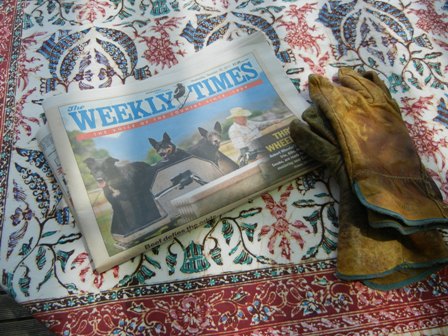
One day I study the Weekly Times, a local farm magazine, and read about farm gate prices, noxious weeds, cattle markets, vegetable growing, the newest farm machinery and the export projections for mutton and lambs. I talk to neighboring farmers about the weather, the hay harvest and beef prices. Vintners and wine-makers tell me about the last vintage and the prospects of the Australian grape and wine industry in the years to come. I learn about the current challenges, the successes and failures, the passions and sorrows of residents in our street, Two Hills Road, as well as the ups and downs of rural life in general.

The next day I am back on my desk in Bangkok and answer e-mails, make phone calls, study various progress reports, regional political analyses, accounts and financial documents. I read about parliaments, parties and policies, about the US influence in the Asia region, economic growth, the China factor and so on. I talk to project officers and partner personal, to political analysts and social activists, to Asian parliamentarians and business people.

My two realities could not be more different, I guess.

It takes some time to get used to either of them. I usually immerse myself in farm work the first few days after my arrival on Two Hills Vineyard, partly to forget the burdens and realities of my bread-winning work in Thailand- partly to experience myself what it means to sweat in the vineyard and concentrate on slashing the grass in the paddocks.

I very much enjoy the physical work, the exhaustion, the pleasure after the completion of a task. I can see the results of my efforts almost immediately. This is very satisfying and it is in stark contrast to my professional work about institutional, political and social change in complex transforming Asian societies in the region I am responsible for. These change processes take time (ages), in fact often much longer than our project planning permits and a very different kind of patience, persuasion and perseverance is required than in farm work.

In both I find conditions which I cannot change: the hail for instance which destroys my grapes or the change in global commodity prices, the fall of a government or the call for early elections. And in both I concentrate my efforts on the issues I can influence. I try to do “a good job”, try to be professional, diligent and hard working.

I am very grateful that I have the opportunity to experience these diverse realities; that I feel the pain and the joy which goes with them, and which reward my efforts – at times – or punish me for the lack of it and/or “bad” judgment.

The time on the farm together with family and friends is invaluable. It clears my mind as a beer clears a wine-makers palate. It refreshes me like a lime soda when I jump of the tractor. It connects me to people I love and treasure. It is proof that life is just beautiful.

Back to work now in Bangkok.


Last day of 2011 with bubbly near our dam

December 31, 2011

Two Hills

The last day of 2011 was rather hot (32 Celsius). The best place to be during hot weather is our dam. So we prepared some food and drink for a pick nick at Brownies Landing, that is how we called our jetty from which we jump into the water.

I threw a few lamb chops on to my barbecue, the girls prepared some dips, salads, cheese and other stuff and we were set for an afternoon at our dam. The water was cold and refreshing, and we stayed until sunset.

My lamb chops

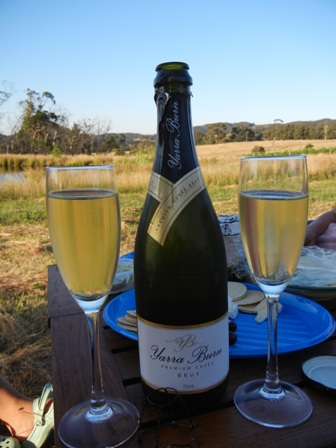
I had picked up a few bottles of bubbly for New Years evening. The dry sparkling of Yarra Burns is a fine bubbled wine made from Pinot Noir and Chardonnay which was very lovely.

Yarra Burns bubbly

Bring on 2012. We are ready for it.


Deen de Bortoli VAT Series – 2011 VAT 2 Sauvignon Blanc

December 30, 2011

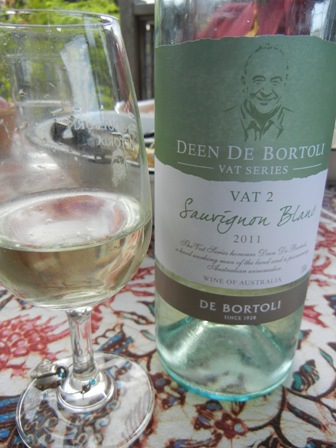
One of the nicest Sauvignon Blanc blends I had so far this summer is the ‘2011 Deen de Bortoli VAT 2 Sauvignon Blanc’ by de Bortoli Wines.

This is a fresh and clean wine with strong herbal and tropical fruit flavours. The wine is medium bodied and low in alcohol (12%).

About 50 % of the grapes for this brand come from old vineyards in the Riverina region in South Eastern Australia; the other half comes from the cool climate King Valley in Victoria.

As you probably know, 2011 was a difficult year for wine makers all over Australia. First, there was so much rain, second there was so much pressure from fungal diseases and third not all grapes would ripen perfectly.

We enjoyed the wine with a pasta with mussels and chorizo. The perfect choice.

Life is just beautiful.


A simple dinner on the farm with Inigo Shiraz

December 29, 2011

After a very enjoyable trip to Port Melbourne where we visited our friends Phillip and Julia who live in a former church (a very interesting dwelling), we returned to the farm and spend a quiet evening at home overlooking the vineyard and the paddocks.

Since we were spoiled with good food the whole day, we decided on a simple “German dinner” meaning cold dishes only. Some Australian cheese, cold cuts, olives, a salad and an avocado together with a German bread would do for the two of us.

Our dinner table

2008 Inigo Shiraz

From under the sink, my secret stash of fine wines, I produced a bottle of ‘2008 Inigo Shiraz’ by Sevenhill Cellars in the Clare Valley in South Australia.

The bottle was left from last years special order which we got through our friend Neville Rowe, who used to work there as marketing manager.

The ‘2008 Inigo Shiraz’ is an old fashioned red, beautifully round and full of flavours, with a lot of alcohol, in short an “umpf” wine, a wine with character. The grapes come from old vines (very old ones) and display black cherries and other dark fruit aromas. The tannins are smooth and has the spicy character we so much love in Shiraz. The finish is long and memorable.

Well, when I work in the vineyard, I inevitably think of the Bible and the many stories about vineyards in the biblical age. In fact many vineyards and wineries in my home town Trier and along the Mosel valley would not exist without “clerical” support.

The Jesuits of Sevenhill Cellars in the Clare Valley know how to make wonderful wines.

My tip: try some wines from Sevenhill Cellars. You won’t regret it.


Summer wine – Sauvignon Blanc from Australia and New Zealand

December 28, 2011

2011 Sauvignon Blanc from Pizzini, King Valley

Apart from Riesling, I also love Sauvignon Blanc wines. Summer is the ideal seasons to savour them. We had bought a couple of bottles from various origins from our local grocery shop.

Two of these wines I want to introduce to you today. The two could not be more different. The first is a ‘2011 Sauvignon Blanc’ by Pizzini in the King Valley, a cool climate wine region in Northeastern Victoria.

These days low alcohol wines are very much en vogues, especially white wines. The Pizzini SB is one of them (11% alcohol). 2011 was a difficult vintage in Victoria. That somehow also shows in this wine. It is a bit “muted” in my view, but still enjoyable. I love the apple aromas and the well balanced acidity.

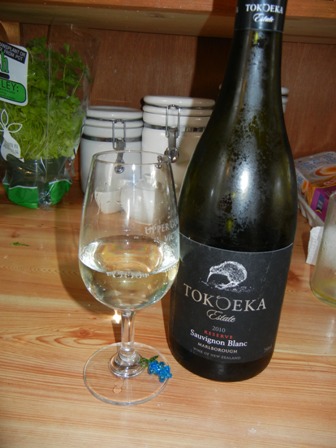
2010 Sauvignon Blanc by Tokoeka Estate in Marlborough, New Zealand

The second wine could not be more different from the first. The ‘2010 Sauvignon Blanc Reserve’ from Tokoeka Estate in Marlborough, New Zealand has 13.5% vol. alcohol.

It displays the full herbaceous character of the Sauvignon Blanc grapes. It is round and complex and has a long finish. The wine is clean, crisp and the acids are elegantly balanced.

Amazing what one can do with SB grapes.


First Christmas pick-nick at Two Hills

December 23, 2011

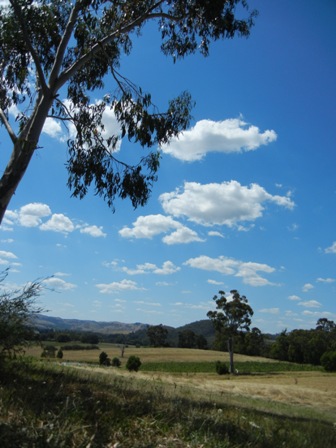
Dramatic clouds over the land

It was a glorious day on the farm in Glenburn. Just the right day for a first pick-nick near our second dam (the one we use to irrigate the vines).

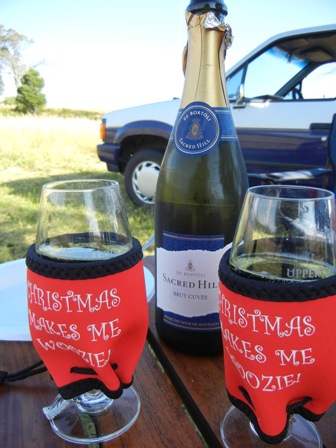
We had bought some inexpensive bubbly (below 7 A$), a ‘Sacred Hill Sparkling Brut’ (non vintage) by De Bortoli, from the Riverina in New South Wales.

Christmas makes me wozie

It was the perfect drink for a hot summers pick-nick, just days before Christmas. I liked the crisp acidity and the strawberry nose.

We thought that a bottle of ‘Sacred Hill’ would just be the right stuff to be drunk at Two Hills Vineyard.

Another day in paradise came to a marvelous end.


Back on the farm – heaven on a stick

December 21, 2011

We are back on the farm for our Christmas vacation. Yesterday was my first full day. After a long flight from Ulaan Baatar, Mongolia via Beijing, China and Bangkok, Thailand, I had finally gotten to Melbourne. My family picked me up and off we went to Glenburn which we reach at about midnight.

I had traveled a fair bit to get back to Australia, not only distance wise. But Mongolia had minus 37 Celsius (Beijing minus eight) and it went to about 26 plus in Bangkok. The Melbourne night was cool and I slept like a baby in our shed in the countryside about 2 hours north of the Victorian capital.

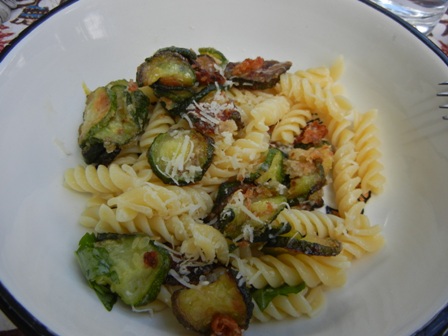
It is so quiet out here. The night is very dark. We are out in the countryside and one does not see many people. I worked a bit around the house. After that we had our first family meal together. I tell you it was just sensational to have a zucchini paste and an insalata caprese.

Look at the two pictures below, doesn’t the food look delicious?

What about the wine, you might ask?

No, we did not have a Two Hills Merlot with the meal, but instead….

Zucchini pasta

Insalata caprese

….we had a ‘2008 Sauvignon Blanc Chardonnay’ blend by Paul Bettio from the King Valley.

I am not a fan of a SB-Chardonnay blends in general. I prefer the two varieties as single grape wines. But this medium dry wine was just a great refreshing drink. The tropical and citrus fruit flavours went very well with the light pasta and the salad.

The King Valley is one of my favourite cool climate wine regions in Victoria. I will tell you more about its wines at a later stage.

2008 Paul Bettion Sauvignon Blanc Chardonnay


My favourite Primitivo di Manduria – from 60 year old wines at Bacco, Bangkok

December 3, 2011

One of my favourite wines is the ‘Primitivo di Manduria’ produced from 60 year old vines, either the 2006 or the 2007 vintages (I like both) which I usually have at Bacco ristorante and wine bar in Thonglor, which is my favourite Italian restaurant in Bangkok.

Look at the colour

Manduria is a small country town in the province of Taranto with about 30,000 inhabitants in Apulia, close to the coast of Southern Italy. Apart from its interesting history it is also a place where the best Primitivo grapes are grown and made into wine.

The DOC Primitivo di Manduria wines are unlike other Primitivo wines made with a 100% of Primitivo grapes. The wines are usually heavy, dark red and have at least 14% of alcohol. More than two thousands years ago the Primitivo grapes were brought from Greece to Southern Italy and ever since wine making was part of the local culture.

In the video clip above the vines are not supported by any trellis system. The grapes are harvested by hand without secateurs. The bunches are small. The farm vehicle delivering the grapes to the winery is tiny.

Italo Western come to mind when listening to the film music. The processing, however, is more on the modern side. And I love the end of the clip when a glass of Primitivo is presented.

The ‘2007 Primitivo di Manduria Sessantanni Old Wines’ by Feudi di San Marzano, is a great wine. I love the fruitiness, the elegance with the dense and velvety tannins, the finely balanced acids. Hmm, just like being in paradise.

Feudi di San Marzano is not a small producer though, it has 500 ha under vines and produces a wide range of wines, many from indigenous varieties.

So if you are in Bangkok and you want truly Italian experience, go to Bacco and order a bottle of Primitivo di Manduria. You will not be disappointed.