A day at the wine symposium in Chiang Mai – some highlights

November 14, 2011

Well, as you know, I am here in Chiang Mai at the 3rd International Symposium on Tropical Wine to learn (foremost), to meet interesting people from the wine industry (and learn) and to enjoy myself (which is not hard in beautiful Chiang Mai).

In the following, I cannot (and do not intend to) present to my esteemed readers all what happened today. Instead, I choose a somewhat eclectic (maybe arbitrary) selection of bits and pieces, incidents, moments of glory which were stuck in my short-term memory and/or excerpts from my notes scribbled in haste on real paper during the symposium.

Let me start with the start. I was joined in my morning breakfast on the river front terrace of the hotel by Khun Visooth, CEO of GranMonte Family Vineyard. We had a pleasant chat and got to know each other a bit more. That was a very good beginning, indeed.

Tasteful flower arrangement for Tropical Wine 2011

The opening ceremony, although delayed by some time, was a ripper of an opening. Our Thai hosts did not disappoint us. The podium was richly and tastefully decorated with flower arrangements. Moreover, wine bottles and glasses on a wine barrel indicated the topic and theme of the event.

Wine and wine barrel

Even if the hearts of the members of the German delegation from Geisenheim sank for a moment when they spotted their “treasure”, a 1957 (in words: nineteen hundred fifty seven) dry Riesling wine from the Rheingau, which the Germans had presented to the Rajamangala University of Technology Lanna (RMUTL) as a special gift, on the beautifully decorated display, they kept their composure while wildly speculating what would happen to their beloved wine before the event started.

The treasure from Geisenheim (left, in the ice bucket)

We were to find out soonest. When representatives of the Thai host organizations pressed the “opening button” of the event on an i-pad, the sacred bottle rose from the bottom of the wine cooler it was placed in. Dramatic music accompanied the unexpected and meteoric rise.

A waiter made sure that the bottle was liberated from its cork in no time. Its golden shimmering liquid was poured into three large wine glasses which were presented to the organizers who toasted to the opening of the symposium.

The organizers opening the symposium

Goodness me, how I envied them. That they could taste the golden liquid of my preferred grape, a Riesling from the Rheingau, a wine only three years my junior, was just unbelievable.

I immediately plotted to use an unguarded moment after the ceremony to put my lips to one of these glasses and take a sip of the holy nectar. Wild thoughts darted through my brain.

The occasion did not arise. A waiter took care of the matter and brought the half-empty bottle and the three glasses to a safe place.

As an interlude, a traditional Thai dance troupe performed a welcome dance for us. Rose petals were gracefully spread around and dancers with fans and dressed in colourful costumes entertained the audience.

The professors from Geisenheim

All three keynotes were memorable. Prof. Hans-Reiner Schultz from Geisenheim presided over the session.

First Prof. Alain Carbonneau from Montpellier presented some of the challenges to grow vinus vinifera in the tropics.

The flying wine doctor, Dr. Richard Smart, was second and introduced us to the centrality of canopy management for tropical vineyards. This was my first encounter with Dr. Smart. So far I had only studied his famous articles and essays written in many wine industry journals.

Now here was the man in full flesh and blood. I was surprised about his creaky voice. But having been “conditioned” by my Australian wife, I am in no way a stranger to Australian accents in creaky voices. I loved his powerpoint presentation. I also learned that he has only recently relocated from Tasmania to Cornwall.

Dr. Richard Smart, the wine doctor

The third keynote was by Umberto Camargo from Brazil. For the first time in my life I learned about the wine industry of this coming economic giant and emerging power of the Latin world.

Over lunch I had the chance to meet a couple of wine writers and wine professionals which added to my general knowledge. And as you know from your own experience with conferences, the time after a big meal is the worst of the day. But I made it through.

Prof. Monika Christmann from Geisenheim spoke about the current climatic changes and their repercussions on the wine industry in Germany, among them the need to reduce alcohol levels in wine.

After the good overview of the Thai wine industry presented by Khun Prayut Piangbunta, the wine-maker of PB Valley Estate, I decided to retire to my room and let the many impressions sink in. I also wanted to write this blog entry in order to have a free evening.

Last slide of the presentation of Prof. Christmann

Hope you enjoyed the read. Please visit the websites of the organizers and the Thai Wine Association for more information about the event and the Thai wine industry in general.

To sum it up: this was a very rewarding day for an amateur like me.

Stay tuned to day two of the symposium. More news from the wine symposium in Chiang Mai is about to come.


3rd International Symposium on Tropical Wine – Chiang Mai, Thailand 2011

November 13, 2011

Sorry folks, I have been absent from the scene for a while. My day job kept me busy, too busy, i.e. away from wine appreciation and culinary exposure trips. Frankly speaking, I had the chance to sample some good wines (alas) but I had no time to write about it.

But finally, my highlight of the year has arrived: I am in Chiang Mai, in northern Thailand, right now and participate in my first ever wine symposium:

the 3rd International Symposium on Tropical Wine.

The chairman of the Thai Wine Association welcoming the participants, Nikki, wine-maker of GranMonte, on the right

Boy can you believe it, me the amateur among all these experts, the wine makers, vineyard owners, oenologists, scholars and wine scientists. These serious guys come from many countries. Tonight at the welcome reception I talked to people from Thailand, India, Myanmar, Brazil, France, Australia, South Africa and my native Germany.

The enthusiastic wine tasters at work

As most scientist, the organizers did not waste words, but went right into the serious stuff and invited all the participants to indulge in tasting the wines on offer from Brazil, Myanmar/Burma and the host country Thailand.

At first I was a bit hesitant but then joined in the tasting wholeheartedly. I found it so interesting to talk to the wine-makers and vintners, and listen to the experts who went from table to table.

I cannot say which wine and/or winery I liked most. One thing is for sure Terry Cummins and the others at the organizing committee did an awesome job in getting this conference together and running.

Tomorrow the serious part of the symposium is going to start. I will need some good sleep to get ready for the many presentations and talks. Seeya tomorrow.

PS: The Thai Wines Association has currently six members, all of them professional and enthusiastic vintners. Congratulations to you for getting such a distinguished crowd of exerts together, luring them to come to northern Thailand during these times of floods is not an easy thing to do.


Riesling from the Nahe river

November 3, 2011

2010 Riesling S “Vom Buntsandstein” Pastorenberg by F.E. Schott

Very nice and very drinkable wines from the Nahe are wines from the F.E. Schott Family Estate in Wallhausen, Nahe. About a year ago, I have met Michael Schott, the family wine-maker, at a wine festival in a suburb of Berlin where he and his mother presented their wares to the German capital city’s consumers.

I had used the opportunity to sample some of the wines. Because of my maternal grand-father and my long connection with the Nahe wine region (about 4,200 ha under vines), I just cannot ignore the wines from this jewel of a wine region.

The Schott Family Estate Winery

The location (terroir) Wallhaeuser Pastorenberg is one of the five vineyard locations in Wallhausen and Bad Kreuznach the family cultivate today.

Since 2009 the brothers Michael and Benjamin have taken over the cultivation of the estate. benjamin is taking care of the vineyards and Michael is making the wine. Apart from Riesling, also Pinot Gris, Pinot Blanc are grown. The red grape varieties include Dornfelder, Dunkelfelder, St Laurent and Pinot Meunier (Schwarzriesling).

The 2010 vintage was not bad. The ‘2010 Riesling S “Vom Buntsandstein” Pastorenberg’ is a dry wine which won a gold medal at the local winery associations wine awards competition. The price is very reasonable (7 Euro/bottle). It is an easy drinking wine for every day consumption.

You should visit the family (they are very nice people) winery when you are near Bad Kreuznach. Wallhausen (with about 224 ha under vines) is a very pictureque little place.

Address:
WEINGUT F.E. SCHOTT
An der Ruh 2
D-55595 Wallhausen – Nahe

Tel: +49-67 06 – 402
Fax: +49-67 06 – 6283
Mail: weingut@schottwein.de
www.schottwein.de


Riesling from the Nahe – 2008 Monzinger Halenberg by Emrich-Schönleber

October 21, 2011

I love to eat fish. Red snapper is a good one. That one can prepare it with mushrooms was new to me. Alas there is Marcella Hazan and her cookery book which are always an inspiration.

Dinner in the making

Mushrooms on the fish

Unfortunately, I messed up the pictures of the food on the plate. I do not know how it happened. At times I am just too stupid to handle my new camera, it seems. Sorry folks, you have to be content with the two pictures above. I assure you that the fish was delicious. We served it with a bean salad in onions but had also some peeled tomatoes as a salad. We did not need carbohydrates.

A delicious fish, I usually enjoy with a good wine, not always white, sometimes red, but tonight it was white. From my last visit to Germany I had brought a bottle of my favourite winery in the Nahe valley, Weingut (winery) Emrich-Schönleber in Monzingen, a small village next to where my grandfather used to live (Martinstein) and where I spent almost all my school holidays.

The winery Emrich-Schönleber is one of the best wineries in the Nahe region and in Germany. It is famous for its dry and off-dry Riesling wines, mainly from the locations Halenberg and Fruehlingsplaetzchen. I usually visit them coming straight from the airport during my annual sommer break or home leave as it is called.

It is hard for a German Riesling lover who resides in Bangkok to find good Riesling wines. I am spoiled in this, I know.

But look at this colour? Golden, pure, with a fragrance of delicious grape fruit and citrus flavours. It has some residual sugar, so it’s not bone dry but the wine is creamy and dense, round and full, with good structure and a wonderful long finish.

It stays on the palate. If you ask me, it could stay there for ages. I was in paradise for the duration of the meal and woke up to the hard reality: no more Riesling from Emrich-Schönleber in my wine fridge.

Sigh, life can be hard.

2008 Monzinger Halenberg R by Emrich-Schönleber

Address:
Weingut Emrich-Schönleber
Soonwaldstraße 10a
D-55569 Monzingen
Tel.: +49-67 51-27 33
Fax: +49-67 51-48 64
www.emrich-schoenleber.de


GranMonte Estate – 2009 Sakuna Rosé

October 9, 2011

“New latitude wines”, is a catchphrase coined in 2004 by Bangkok based wine writer Frank Norel.

For a long time the tropics were not considered suitable for the production of grape vine. The territory between latitude 30 and 50 were vintners “nowhere land”, so to speak.

This has certainly changed over the last decade. Nowadays grapes are grown in places like Burma, Laos, Vietnam, Brazil, and of course Thailand.

In November this year (12.-18.11.) already the 3rd International Symposium on Tropical Wine will be held in Chiang Mai, Thailand.

Beautiful colour – Rosé is ideal for the hot days in Bangkok

So far, I have visited about half of the Thai wineries. I love the wines produces by GranMonte Estate, a Thai wine producer from the Khao Yai wine region in the Asoke valley.

GranMonte is a family business and boutique vineyard. At this years Decanter World Wine Awards GranMonte won two silver and one bronze medals. This is recognition of the hard work of Nikki and her parents, Sakuna and Visooth Lohitnavy.

GranMonte Estate – 2009 Sakuna Rosé

Recently I discovered that I had “forgotten” a bottle of 2009 Sakuna Rosé in my wine fridge. Since it was a beautiful sunny day, the GranMonte Rosé wine was my natural choice to accompany our lunch.

Thai wines lend themselves to be paired with Thai food as well. The high acidity of the whites is a good requisite for such food and wine pairing. The Colombard and Chenin Blanc varieties are doing well in the tropics and are producing stunning examples of New Latitude Wines. But also Syrah and Cabernet are doing well.

The back label advised to consume the bottle within one year. Oh, I thought, it’s 2011 now and the wine was from 2009! Would it be too late?

Alas, it turned out that the bottle was perfectly fine. The Rosé made from Syrah grapes tasted fresh and fruity as the previous bottles I had served.

In an earlier blog entry I have described how to get to GranMonte Family Vineyard. The winery is definitely worth a visit. The trip from Bangkok to the Asoke valley takes less than two hours. However, I do know how the current monster floods have affected the region and the roads to get there. Maybe the end of the rainy season is a better time for a visit.

Luckily there is shop in Bangkok where you can get the GranMonte wines.

Address:
Granmonte Co,Ltd.
17 / 8 Soi Sukhumvit 6, Sukhumvit Road,
Klongtoey, Bangkok 10110
Tel : +66-2653-1522 Fax : +66-2653-1977
Mb. : +66-8-9169-7766
Marketing@granmonte.com

Address at Khao Yai
Granmonte Vineyard & Wines
52 Moo 9 Phayayen, Pakchong,
Nakornrachasima, Thailand
Tel : +66-36-227-334-5


Pinot Noir from the Yarra Valley with Peking Duck

October 8, 2011

The beautiful “off-red” colour of a Pinot Noir

Well, I gave it almost away in the title of this blog entry.
Yes, it is a Pint Noir and yes, it comes from the Yarra Valley in Victoria.

But please answer me:

Mirror mirror on the wall which is my favourite wine of them all? ,

asks the wicked queen alias “the critical consumer of fine wines”?

Well, the answer is just below; on my wine cabinet so to speak.

Can you identify the producer?

I guess now you can.

2009 Bloody Hill Mayer Vineyard Pinot Noir

And yes, you are right, this is an awesome wine from the Yarra Valley, the eastern part of which has a truly cold climate. Timo Mayer is a great wine-maker. In his boutique vineyard near Healesville he produces outstanding fruit. His philosophy of minimum interference in wine-making does the rest and out of this comes a wonderful product of a vintners craftsmanship.

The bottle has DIAM cork, the real thing

It is just a shame that we cannot get this wine here in Bangkok.

In the UK, Ireland and in Germany you can order it.

By the way, right now Timo is on a sales tour in Europe. On September 28th he was special guest at the K&U Weinhalle, a wine merchant in Nuernberg. There is a nice story about Timo written by Martin Koesler.

Our Sunday lunch table with the Peking duck

PS: We made the Peking Duck ourselves. It was a beautiful feast on a warm tropical Sunday. Timo’s Pinot Noir is an ideal wine also with Asian food. The proof is in the eating and drinking. Trust me I know what I am talking about.

Which distributor in Asia is interested? Now is the time….


Wine village Kasel, Ruwer – Mosel Riesling at its best

October 7, 2011

This is the coat of arms of Kasel, a small village located at ther Ruwer river not far from my beloved Trier. The Ruwer river is one of the tributaries to the Mosel.
Originally our wine region was called ‘Mosel-Saar-Ruwer’ which named the two smaller rivers explicitely.

Grape vines all over the place

The slopes around Kasel are planted with grape vines

The Pauliner Landgasthof is part of Weingut von Nell

Von Nell Estate – Weingut von Nell

The newly refurbished Pauliner Hof is part of the Weingut von Nell.

We wanted to check it out and dropped in for lunch on a beautiful late summer’s day. The sky was blue and the Ruwer valley showed its most beautiful side.

I must say that I love this country inn right in the middle of Kasel, the lovely wine village.

During our high school days my brother Wolfgang and his friends used to help in vintage time and picked grapes at the steep slopes in the vineyards of the Von Nell Estate.

The interior of the inn is light and bright. The air well is covered by a glass roof and the subdivisions with rod iron and sheets of textiles give it a warm feeling. The big olive tree right in the middle of the restaurant gives the place a mediterranean flair. The service was excellent.

We had pork nuckle and a delicious mushroom dish, great German country food in my view.

Pork knuckel

The mushroom stew

My old folks

A shot of the wine list

I had an estate grown Riesling of course. The ‘2010 Kaseler Dominkanerberg Hochgewaechs’ was a very nice and fresh house wine, something for easy drinking and enjoyment with hearty country food. I just wish I would have access to it here in Bangkok (sight). Well, one cannot have it all.

The Ruwer valley is a true jewel, you should go there and check it out.

Address:
Pauliner Hof
Bahnhofstraße 41
54317 Kasel
Tel +49-651-9679090
Fax +49-651-96790916
www.restaurant-paulinerhof.de


Along the Mosel river – impressions from a train ride

October 6, 2011

Taking pictures from a train usuallay did not work for me in the past. However, the other day when I visited the Mosel river and my home town Trier, I tried it again with my new digital camera.

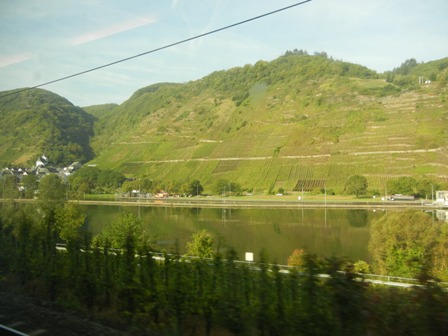
The outcome is not too bad, I think. And this is why I want to share it with you here on my blog. Unfortunately, I did not catch famous terroir, single vineyard locations and/or famous wine villages and towns, just some no-name impressions.

In any case, this is maybe the best view one can get of the Mosel: exploring the region on a train.

I suggest to any tourist and casual visitor to this part of Germany to take the train from Koblenz to Trier and enjoy from the regional express train the sometimes spectacular views of the Mosel valley and its vineyards.

You can feel the speed of the train – above the ‘Autobahn’ bridge at Winningen

Most ‘grand cru’ locations are to be found on the steep slopes (right) but there are also flat parts with vineyards (left)

Train station in Bullay with the view of two Mosel bridges

Vineyards on steep slopes

An autumn feeling

Blue slate on the roofs of the houses along the Mosel

The river bed, train tracks, and a country raod, all three have to find a space in the narrow Mosel river valley. That the vineyards are located on the steep slopes is not an accident. This is where the slate underground reflects the sunlight and keeps the vines warm for the optimal ripening of mainly Riesling grapes. The steep slopes are hard work for the vintners.

I love the Mosel. I find it extremely relaxing to sit on the train and watch the landscape along the winding valley.

Alternatively one can also visit the Mosel by pushbike or car. Every way of transport, every way of movement will bring new insights and offer other aspects of this magificent river landscape.


Roast venison in Trier with a Merlot from Two Hills Vineyard

September 30, 2011

Whenever I visit my family in Trier, they spoil me with super delicious food, mostly game dishes. Heinz is a passionate hunter and he reserves only the best meat for me. This time young roast venison was on the agenda = my plate. I tell you, it was awesome.

The young roast venison

Venison with vegetables and egg noodles

2001 Merlot from Two Hills Vineyard

I washed the venison down with a ‘2001 Two Hills Merlot’, which is still a drinkable wine. The softness of the Merlot tannins went well with the savoury taste of the young game.


Winery review – Closson Chase Vineyards, Prince Edward County, Ontario

September 23, 2011

I know that not that many people visit my blog entries on Canada, its wineries and wines. However, that may be, I am going to continue to introduce some of the places we have visited during our summer vacation. I have two reasons for this:

1. because I believe that Canadian wine is worth to take note of (tasting and drinking!), and
2. because I am convinced that in the next couple of years some of the Canadian wines will hit international wine markets and might be more readily available to consumers outside the Americas.

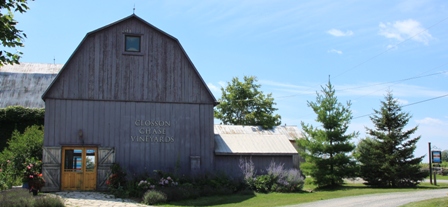
The Man from the Mosel in front of the famous Closson Chase entrance

The evening before we visited Closson Chase Vineyards, we had a glass of its 2009 Chardonnay which tasted strange, very strange. In hindsight I think it was off.

However, in some of the brochures collected from the Picton tourist office I had read a story about Deborah Paskus, the iconoclast viticulturist and celebrated wine-maker of Closson Chase, which led me to believe that we have to go and see the place with our own eyes.

Closson Chase was established in 1999. It produces exclusively the Burgundy varieties Chardonnay and Pinot Noir wines, some from its own vineyards, some from leased properties nearby.

We visited Closson Chase on the 2nd of August, a beautiful summers day. The cellar door is located in Hillier on the Western side of Prince Edward County.

Closson Chase has about 30 acres under vines. The soils are
limestone rich. The low yields and the French inspired vinification and barreling are responsible for the superior quality of its wines.

In 2009, Jancis Robinson, the guru of the international wine circuit, called Closson Chase Vineyards one of the two finest producers in Ontario.

The historic barn

The cellar door and tasting room is housed in a century old barn which has been restored. The day we visited an exhibition of moden art was shown on the premises.

The back side to the entry where the garden is located

The garden where we tasted the wines

The tasting at Closson Chase Vineyards is pricy in comparison with other place on Prince Edward County. For a tasting of three wines one had to pay 12 C$ (uff!!!). We drank two glasses of unoaked Chardonnay, and one glass of Pinot Noir.

The garden ist just wonderful located on the back side of the old barn. We sat their completely satisfied. The wines were stunningly good. We bought a bottle of Chardonnay and one Pinot Noir to take home to Bangkok. Only one bottle “survived” the journey. More about the Pinot Noir when we have it with a meal.

Closson Chase is a must visit if you are in Ontario.

A Closson Chase vineyard

Old vines with grapes

Address:
Closson Chase Vineyards
629 Closson Road, Hillier, Ontario K0K 2J0
Tel: +1-613-399-1418
Fax: +1-613-399-1618
E-mail info@clossonchase.com
www.clossonchase.com