Wine Promotion the Portuguese Way

August 16, 2008

During our recent holiday in Portugal, we visited the Palácio da Bolsa, the splendid Stock Exchange Palace, in the city of Porto (Oporto). It is the most visited attraction in this historic city of Northern Portugal (more than 200.000 visitors per year). It was used as the first stock exchange in Portugal, among others the results of intensive international trade especially in port and other wines.

Today, it is mainly a museum. The stock exchange has long moved to the capital city of Lisbon. The palace used to house the headquarters of the merchants guild. A modern “guild”, however, is still displaying its products there: Vini Portugal, the Portuguese Wine Trade Association, a mulit-stakeholder trade association to promote and support Portuguese wines at home and abroad (www.viniportugal.pt) maintains a small showroom in the basement.
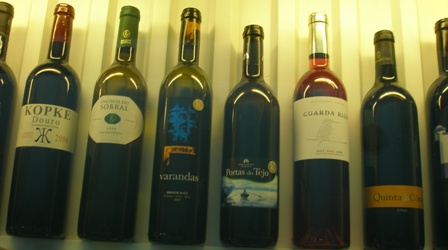
Some of the wines on display

Having a wine tasting and display room in the Palácio da Bolsa is a great asset and a clever public relations strategy given that so many people from all over the world visit the historic building. The guided tour includes an invitation to the free wine tasting in the Vini Portugal showroom. Wine enthusiasts such as us, had no choice but to pay it a visit and check out the place.

Margit in the showroom

Two wines were open for tasting both from the Douro wine region, a ‘2006 Costa do Pombal’, a white blend (‘cuveé’ sounds much better than ‘blend’ which has a slightly negative connotation; even better is the word ‘composition’ which somehow stresses the artistic qualities of the wine maker) of Rabigato, Gouveio, Vions(h)inho and Arinto (that is what the lady wrote down for me) and a ‘2003 Borges Reserva’ (14.5 % vol./alc.) blend of Touriga Nacional, Tinta Roriz, and Touriga Franca. I liked both wines, though they remained a mystery to me. I need to taste more Portuguese wines to develop my palate. Portugal has more than 200 autochthone vine varieties, maybe the largest in the world. Many of them have not been explored outside Portugal and they might be a tremendous potential for future development.


Bye bye Europe – welcome home in Jakarta

August 15, 2008

It was the last time that we should return to our home in Jakarta after a summer holiday in Europe. We are moving countries. After ten years in beautiful Indonesia we are packing up all our belongings. A new beginning awaits us in Bangkok/Thailand.

You can imagine that the emotions of our various family members are on a roller coaster, it ranges from one extreme to the other, varies between the sadness of leaving everything behind to the euphoria of a new beginning in another place.

The hectic of the preparations related to administrative and organizational matters pertaining to the move will not allow me to share with you all the exciting things I experienced in German and Portuguese wineries. I will try to slip in here and there some short notes and some of the many pictures we took on the way. More might come somehow someday.

Please bear with me.

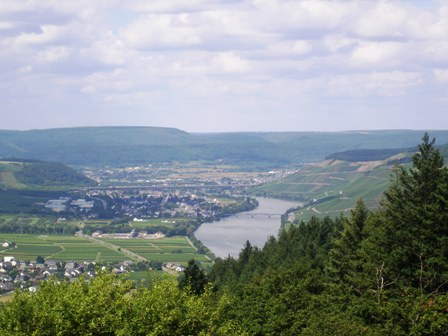
The Mosel valley and its vineyards near Schweich with the “wine villages” of Riol (left) and Longuich, photo taken from the freeway opposite Mehring in August 2008


Back from the real world

August 6, 2008

Yes, I am sitting in an internet cafe, how it is euphemistically called, in Porto, Portugal. Finally, after about two weeks absentia from blogging, I am back in the virtual world. Hurra!

The first couple of days that I could not access my beloved internet I suffered tremendously. Not checking my blogg every day caused me severe pain. I felt isolated, deprived of the only important good which mattered. The virtual world was spinning and turning, and I was not part of it. How could that be? Impossible.

Well, it could. I drowned my `pain´ first with beautiful Spanish later with Portuguese wines, visited museums, vineyards, restaurants, many churches, a beach and many more places of interest. I had time for the family, and only for the family which is good since I travel so much professionally.

I will have to sort out my material, my notes, the many photos I took and hopefully I can present you with some more stories about wine, vineyards and food.

I spent four days in Madrid, mainly on an educational visit.

After that I moved on to Porto, the “capital city” of Port wine production, to learn about northern Portugal and its wine regions. So much city exitment (more than one week fwe moved rom “monument” to “monument”) made me retreat to the country side near Penafiel, about 38 km east of Porto, where I enjoyed live on a Portuguese farm, a quinta to be precise. The week on the farm was much too short but our holidays are coming to an end soon.

What I can already say is this: you must visit Madrid and Porto (or Spain and Portugal for that matter). Both the Spanish and the Portuguese are fantastic people. I never experienced so much friendliness, so much help and courtesy and hospitality in my whole live.

And, both countries have exceptional good wines of course, and excellent food.


Augusta Treverorum – home at last

July 24, 2008

My hometown of Trier (lat.: Augusta Treverorum) from the ‘Kockelsberg’

Alas, we made it. Grandparents were very happy to see us. Blue sky and summer sunshine greeted us. A splendid holiday awaited us. In short, Germany at its best. We are so lucky.

The Mosel river

Margit and I, we went to check out our favourite “watering whole”: the wine bar of Reichsgraf von Kesselstatt opposite the cathedral and the church of “Liebfrauen”.

The ‘garden’ of the wine bar

Riesling was our choice. We had a ‘2007 Kaseler Riesling dry’ (subregion: Ruwer) and a ‘2007 Wiltinger Riesling dry’ (subregion: Saar). Both wines were young and fresh, which make them a delicious drink in a hot summers day. We both preferred the wine from Wiltingen, Saar.

Cheers, and “zum Wohl” as the Germans say.

PS: I am loading this up from a small flat in Madrid which we rented. The internet connection is weak and blogging difficult. Please bear with me.


Exploration trip to Bangkok

July 11, 2008

The other day, the four of us went to Bangkok. I had a seminar and staff training with my new team and the three women checked out the new school and were going on house hunting to find a new home.

The last evening of our stay we met and compared notes. Nothing could be better for such undertaking than a family meal at a nice Thai restaurant. We walked down the street right into the Ninth Cafe.

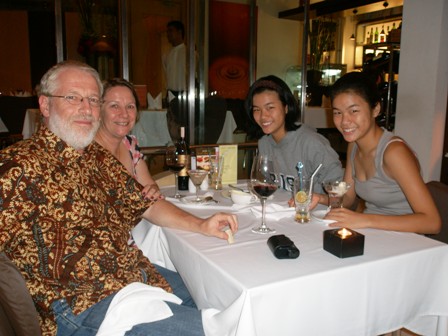
What a great time we had

The restaurant is a very pleasant place. I was there once before. The staff was very friendly and we were very hungry. We ordered a couple of appetizers. Margit and myself we had fish with mashed potatoes and the girls had a Chinese chicken soup. It all tasted delicious. We were in a jolly good mood. Everything had worked out so well and we are very optimistic about our coming move to Thailand.

Of course the adults had a bottle of wine with their meal. We choose a bottle of Hardy’s Cabernet Sauvignon, nothing special but delightful and it suited the mood.

A typical Thai appetizer

Appetizers for the hungry kids – chicken wings

Fish with mashed potatoes

A Chinese type dish

Happy girls

The gods were smiling on us

Address
The Ninth Cafe
59/5 Soi Langsuan, Ploenchit Road
Bangkok 10330

Note: This restaurant gets excellent recommendations and reviews. Go and visit.


Drowning in wine?

June 14, 2008

In todays Daily Wine news“, I found an article describing the recent changes in the Australian wine industry.

It starts with saying that “between 1997 and 1999 an unprecedented 40,000 hectares of grapevines were thrust into the soil across the nation”. Uff, I am one of those lunatics who put in vines during that time. Only a little, though, 3.5 ha to be precise. Now it (the land, our land) contributes as Two Hills Vineyard to the grape heap and/or wine lake. The increase in area under vines led to a 40% increase in output. Such growth was never seen in the history of the Australian wine industry before.

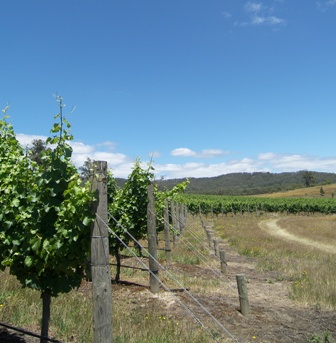
Two Hills Vineyard with the two hills in the background

Well, but I am actually exaggerating. There is no wine glut any more one could argue. Although it was not easy to find a market for our fruit, the very fact that there was fruit in abundance forced us to add value to the operation, e.i. make wine and sell it in Germany. We have survived so far. Of the last 8 vintages, two were to our full satisfaction, and the trend is positive. There is reason for optimism.

We are mainly growers and sell most of our fruit. The remaining part is turned into wine, mostly our Merlot grapes fall into this category. It allows me breathing space. I do not need to sell as fast as possible but rather on a pace we can stomach.

In the good old days growers had long-term contracts with wineries. Paradise has been lost ever since and the “spot market” is a true hassle. Some wineries are not relay reliable partners and it takes a while to sort out the ‘jewels’ from the ‘chaff’. That is costly for small vineyards. To run after small amounts of money and unpaid bills can be a hazard and it is a hassle. But some wineries treat their growers well. I know it from our friend Steve Sadlier, viticulturist (who tends our small property) and supplier of prime fruit to Yering Station in the Yarra Valley/Victoria.

Good to learn from the Daily Wine News article that the grower-producer relationship is about to change in response to the international market place and the flexibility required there. If that relationship, one of asymmetry in the past, would be more balanced, what a good news. Last vintage we had many cases of wineries retracting from earlier price offers. When they realised that the expected shortage of grapes was not to come and that they got sufficient fruit, they lowered fruit prices.

Another trend the Daily Wine News detected is that big companies shift away from developing their own vineyards. Well in the mid 1990s when the growers had no problem with selling any amount of fruit, wineries wanted to be on the save side and therefore invested in the establishments of their own vineyards. This is not only expensive, it also prevents the wineries from investing in other aspects of their business, for instance cellar technology, etc.. Some large wineries, it is said, rely on about 25-30% of their own vineyards, the bulk of their fruit intake is bought from growers.

Another welcome trend is that the industry is moving away from cheap fruit from warm and irrigated wine regions. That sounds nice to a small vintner from a cool climate region (the Upper Goulburn Wine Region). The rising water costs have hit growers hard and the change of demand does the rest: turn this land to other crops, maybe water saving food crops. The rising worldwide demand for food might be the incentive needed for that tectonic shift.

However, for small vineyards the development of boutique style wines and their own labels is a sine qua non for survival. And survive we will. Cheers


The mighty wine bloggers

June 10, 2008

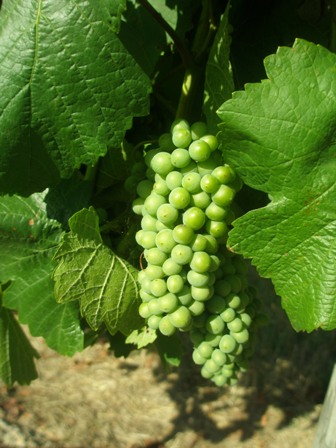
Two Hills Vineyard: newly planted Chardonnay

Blogging is all in vogue these days. Millions of people write in their free time entries into their electronic diaries or online journals as they are called.

The founder of “Vinography” a reward winning wine blog, Alder Yarrow is the pioneer of wine blogging. His blog won various awards over the last years. In 2008 it received the American Wine Blog Awards for ‘best overall wine blog’ and ‘best writing’; in 2007 the same award was bestowed on him for ‘best wine reviews’. Vinography won accolades by the Salon des Vins de la Loire Wine Blog (2007) and Food Blogging Awards (2006, 2005, 2004).

Vinography is more than a private blog (www.vinography.com), it is a professional undertaking with various distinguished contributors. But apart from very interesting information about wine, wineries and vineyards, food and everything related to wine, Alder also collects blogs and he assembled a list of wine blogs, which you can find on his website. This list is of course not complete. An undertaking like this is never completed, there are always new people starting their blogs out there, and it is tedious to find them.

The list of about 600 or so odd blogs and wine podcasts is a very interesting piece of information.

There are about 65 winery blogs and 43 wine podcasts, some of them quite entertaining. The remainder are blogs in various languages. English is of course the most common language used by wine bloggers; the next most prominent is Italian followed by French. There are even wine bloggers writing in Japanese, Chinese and Indonesian.

As I mentioned in an earlier blog entry that some of these bloggers are pretty organised and that they do things together. For instance the German wine blogger organise so called “wine rallys”, where they write about a common theme selected by the members and hosted by one of the bloggers where all pieces produced about this theme are collected, analyzed and propagated.

The Vinography list of wine blogs according to language goes as follows:

404 English
41 Italian
36 French
29 German
22 Spanish
11 Portuguese
5 Chinese
4 Dutch
2 Japanese
2 Hungarian
2 Norwegian
1 Indonesian
1 Slovak

There is a wealth of information to be found about wine, wine regions, wine-making, etc. Some of these blog are humble private tools for enjoyment and distraction, others are professional instruments for marketing, information, analysis, presentation and sale.

Check it out yourself and have fun. It’s worth it.


Back home again

June 6, 2008

Having lunch at Lutter und Wegner im Künstlerhaus, Munich

You might have sensed it. I was away for more than two weeks. Work took me to Germany and I had no time for blogging, only work, work, work. But fortunately, there were some occasions to taste good wines and enjoy some marvelous German food. More about this later.

In May the weather in Germany was much better than in March or April during my previous visits. The temperatures were very pleasant. The sky was always blue, everything was green, nature at its best.

The trip took me from Frankfurt to Bonn, Berlin, and Munich. For the first time I went by train from Berlin to Munich and from there back to Frankfurt Airport.

It was a lovely ride, the fields were green, acacia trees, linden trees and chestnuts in full bloom, farmers cutting grass to make hay, young barley, wheat and rye growing nicely, canola (rape seed) already advanced just after blooming, young maize plants just 10 cm high. Only here and there one could spot some cattle in lush paddocks. The German landscape seemed almost void of people although the country is much denser populated than Australia.

The six hours on the train were very enjoyable. I spotted the last vineyards in the Saale valley. When crossing the Hallertau, a couple of hours north of Munich, I saw huge trellis systems for the cultivation of hops for beer production. The next vineyards I should see were near Stuttgart when the train moved on to Mannheim and finally Frankfurt.

No I am back in steamy tropical Jakarta and we are getting ready to move to Thailand at the end of August. By then it’s 10 years that we lived in Indonesia, a decade of my life. Time passes. I am afraid that the next months will not allow me to write much since so many organizational tasks await me here. Bare with me.


Wine Rally – German wine bloggers on the move

May 6, 2008

German wine bloggers have established a monthly scheme called “wine rally” where one blogger hosts a blog entry collection around a predetermined theme. The last one was for instance about “Chenin Blanc”. wines.

I have participated in two rallies over the last couple of months and it was great fun. Moreover, I learned a lot about the topics discussed myself. I also binds the blogger community together somehow; it is networking in action.

Since the blog entries are in German, I will try to summarize some of the highlights of the last rally for you here in English. The host this time was Christoph Raffelt. On his blog Originalverkorkt one can find interesting wine reviews and stories around food and drinks. Also the photos on the blog are very appealing.

– About 15 bloggers participated this time.
– Most Chenin Blanc wines tasted by the bloggers came from the Loire Valley, some from South Africa but generally new world wines were not favourably reviewed.
– Many of the tasted wines came from biologic or bio-dynamic production.

Which wines were tasted?

– Crémant de Loire
– Les Doucinières von Vincent Girault (Loir)
– Crémant von Château Tour Grise (Loir)
– Domaine Patrick Baudouin Effusion 2004 (Anjou)
– Domaine de la Taille aux Loups by Jacky Blot
– Vouvray by Gaston Huet
– Coteaux du Layon by Jo Pithon
– Coteaux du Layon
– Plaisier der Domaine de Romchambeau (Coteaux de l`Aubance)
– Vouvray 1999, Domaine du Clos de L`Epinay
– 2001 Saumur Blanc Brézé by Clos Rougeard
– Clos de Coulaine by Claude Papin, Château Pierre Bise (Savennière)
– Raats Chenin Blanc and Raats Original Chenin Blanc (Steen, South Africa)

And who were the participants? In the following I just list blogs and their addresses. For readers who are fluent in German this could be a real treat because many of the German and Austrian wine bloggers are true originals. Check it out.

six-to-nine (Pivu)
vinissimus (Robert Freudenthaler)
myexperience4u (Svetlana Kittke)
Weingut Lisson (Iris Rutz-Rudel)
Kaulweinblog
K&M Gutsweinblog (Bernd Klingenbrunn)
Culinarium Curiosum (Sabrina und Simon Klaiber)
weinwelt (Michael)
Nikos Weinwelten (Niko Rechenberg)
drinktank (Mario Scheuermann)
Winzerblog (Thomas Lippert)
Weingut Steffens-Keß (Harald)
viva-vino (Matthias Metze)

I hope this gives you a first impression even if it might be rather superficial. I do not know of any such initiative by Anglo-Saxon wine bloggers and their various communities. If you know something, please get in touch with me. Yours


Australia: New Tax Regime on Wine and Beer

April 30, 2008

It came as a surprise when I learned yesterday from my “daily wine news” newsletter that the Rudd government intends to increase taxes on wine and beer by up to 300%.

This will increase the sales price of an ordinary glass of beer by about 46 cents and a glass of wine by 63 cents. The alcohol content is supposed to be the basis of the new taxation regime.

So cheap mass wines will be as heavily taxed as a superior quality wine given the same alcohol content. The ratio of this additional tax to the overall sales price, however, will be different.

Health care seems to be the prime motive for this move. After tobacco, now its alcohol which drifted into the field of vision of the health freaks. Of course the regulators have alcohol pops in mind. It seems that young girls abuse this kind of alcohol quite a bit.

I am not sure how many bottles of fine wine are going down in binge drinking. Dry wines are maybe not the stuff for teenage drinking parties anyway.

I guess this will not solve the problem. To learn how to deal with drugs is better achieved by demystifying them and by learning how to avoid intoxication. And wine is food in the first place. If we allow young people to experience this, the dangers are minor. Just look at Mediterranean culture where you hardly can find alcohol abuse among the young which is typical for Anglo-Saxon societies. In the end, teenagers will move on to cheaper sources of booze or other drugs.

In anticipation, the finance ministers might already count the additional dollars in their treasuries.

As a boutique vineyard, I feel we will not be too concerned. Our clients are not alcohol abusers. They also can afford the higher prices (and if not the producers will have to stomach the losses). Most likely the new burden will be shared between the two groups.

Then there is bartering, more and more common in rural areas of Australia because of the various taxes and impositions. You repair my roof for a couple of cases of prime wine. I slash you paddock for your locally produced beer.

Well, we will see what these do-gooders can achieve. And don’t forget, there are elections somewhere around the corner.

Cheers