Restaurant review: Gasthof zur Saffenburg, Mayschoss, Ahr

August 20, 2012

Castle Saffenburg in Mayschoss, Ahr

All good things come to an end. That applied also to our family vacation. From the Ruhr we made our way back to the Mosel region. Since we had some spare time on our hands, we decided that a short visit to the Ahr wine region would just be the right distraction.

The Ahr wine region is one of the smaller wine region in Germany (about 600 ha under vines). Despite its northern location the Ahr wine region is dominated by red wine production (about 80%),and is most famous for its outstanding Pinot Noir wines.

Country Inn zur Saffenburg in Mayschoss, Ahr

Since we were also hungry we dropped in at a counrty inn called Saffenburg in Mayschoss at the banks of the Ahr river.

The courtyard of the inn

Mayschoss, a small settlement with about 1,000 inhabitants, is also home to the oldest wine co-operative in Germany (founded in 1868).

Today the Mayschoss-Altenahr Wine Co-operative as it is called, has about 400 members and covers 140 ha under vines. It’s cellar door is located opposite the country inn.

Gasthof zur Saffenburg

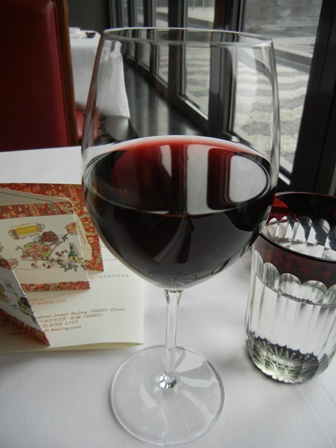
The first thing I did was oder a glass of Pinot Noir made by one of the famous Ahr producers: Jean Stodden.
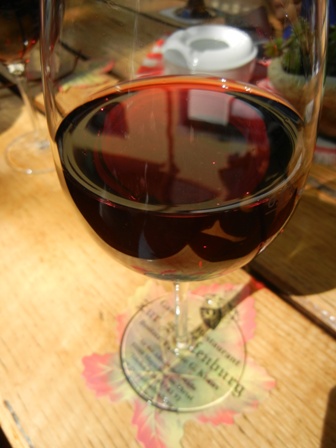
Jean Stodden Pinot Noir

This is the “ordinary” Pinot Noir produced by Stodden but a good specimen of what the Ahr has to offer in Pinot Noir. Unfortunately, we had no time for a tasting at Jean Stodden. Instead we planned to pay a short visit to the wine co-operative across the street after our meal.

Nuernberger sausages with Kraut

German cuisine has a lot of very tasty dishes to offer. We went for Nuernberger sausages (photo above) and beef stew (photo below).

Beef stew

I love German cake

Irresistable were the cakes on offer, together with a coffee, they concluded our meal. Needless to say that the food was delicious. We sat on the terrace in the yard. The service at the country inn is exceptionally good. Five out of five, I would say. We had a jolly good time on our last day of our excusion in Germany.

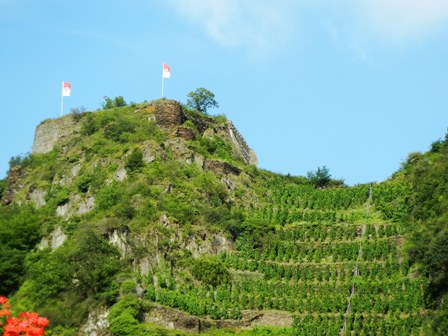
The steep vineyards behind the inn on the other side of the Ahr river

I plan to also inform you about our visit to the wine co-operative in Mayschoss. Stay tuned.

The Ahr wine region is a very popular destination for day travellers but also suitable for longer excursions. I highly recommend the “Rotwein-Wanderweg”, the red wine hicking path crisscrossing the region with breathtaking views of the vineyards and the small settlements. Ideal is to explore the valley on a push bike.

Please also visit my blog entries from November 2007 regarding DAGERNOVA, another wine co-operative and vintage time along the Ahr.

Address:
Gasthof zur Saffenburg
Rotweinstrasse 43
53508 Mayschoss
Tel.: + 49 (0) 2643-8392
Handy + 49 (0) 171–9369257
Fax: + 49 (0) 2643-8100
E-Mail: info@gasthof-saffenburg.de
http://www.gasthof-saffenburg.de


2010 Steingarten Riesling by Jacob’s Creek

June 12, 2012

2010 Steingarten Riesling by Jacob’s Creek

The other day I picked up two bottles of Australian wine at Beijing International Airport. I was in transit and browsed through the duty free shops when I saw them. First I thought them a bit pricy, but then I decided to take two, one white, one red.

The white wine was a ‘2010 Steingarten Riesling’ by Jacob’s Creek. Some wine critics call this wine a ‘benchmark of Australian Riesling’.

Usually, I avoid buying Jacob’s Creek because my wife hates the brand. For her it stands for cheap mass-produced wine. During our time in Beijing in the early nineties there was only cheap Jacob’s Creek available in some selcted shops. Ever since she does not like the producer.

However, I had heard about “Steingarten”, maybe one of the best Riesling terroirs in Australia. And because I am still searching for my favourite Australian Riesling, I thought to give it a try. The original Steingarten vineyard is located at Trial Hill in the Eden Valley, South Australia.

“Steingarten” is German and means “garden full of stones”, but in the case of Jacob’s Creek its a brand name. The wine is “cool climate” and the grapes come from selected locations at higher altitudes of the Barossa Valley.

The bottle had even an individual number (I bought bottle number 22947); and it was low in alcohol (12.5 %). I paid about 25 EURO for it which is not cheap. In my native Mosel valley there is plenty of first class Riesling around for such a price.

The wine was not bad. It had the normal Riesling aromas (lime, citrus and green apple in this case), a solid structure, fine acidity and a good finish. However, I must be spoiled by the German kind of this wine so that also this one did not trigger my enthusiasm.

Needless to say, the search for an Australian Riesling which satisfies me is going on.

The bigger disappointment was to come: the food.

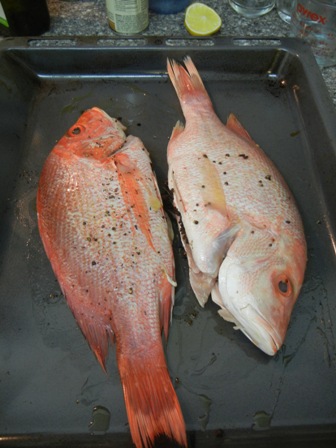
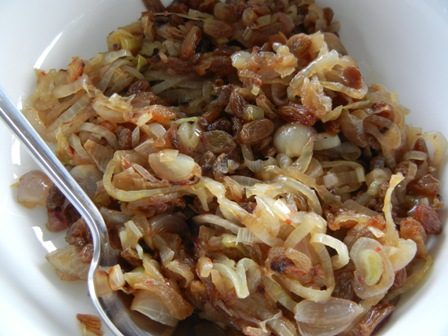
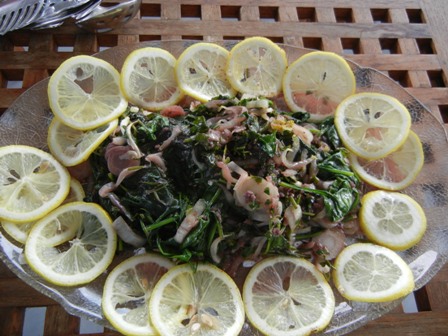
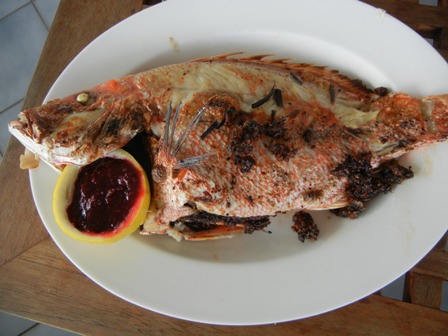
Of course we had the wine with food. Shakespearean cuisine was the go, which is a rather sweet affair with lots fo figs and raisin. Every individual dish tasted interesting. But we made a basic mistake: the various dishes did not harmonize at all with each other. I will just show some pictures and spare you the details of the dishes.

Here is what we had:

The fish

The raisins

Raisin-onion dish

Other veggies

…and the fish with jam


The little French thing with Spanish wine

May 29, 2012

9.69 EURO worth of food and wine

When I arrived yesterday morning here in Brussels I found myself caught out. It was a public holiday (Pentecost Monday) and everything seemed to be closed.

It was a beautiful sunny and warm day and I walked around a bit and explored the area around the hotel. Lots of tourist were doing the same thing. Fortunately, I found an open Carrefour express so that I could buy some groceries.

I was reminded of my glorious day as a student, and in reminiscing about the past, I bought some cheese, bread and red wine. Today, I know of course that red wine is not necessarily the best accompaniment with cheese. But I bought it nonetheless.

Normally, I always pack my Swiss army wife but this time I had left it behind in Bangkok. I knew this while browsing through the supermarket shelf with all the many wine bottles.

And that was the main reason why I settled for the bottle of Tempranillo: it had a screw cap, whereas most other bottles had a cork enclosure. I only paid 5.99 EURO for it which is cheap considering wine prices in Thailand.

2010 Tempranillo – REALCE by Union Campesina Iniestense

By sheer coincidence, I had found a treasure. This wine comes from the relatively new and unknown wine region of Manchuela which is located in the larger La Mancha wine region.

So it’s a Don Quixote wine, one could say.

One of the Spanish indigenous grape varieties grown in Manchuela is Bobal, a red grape, which comes originally from Valencia and is the third most planted variety in Spain (after Airén and Tempranillo).

If you want to learn more about the wines from Manchuela have a look at the video clip by Simon Woods.

Manchuela got its appellation status only in 2000. Of course vintners have grown grapes there since Roman times.

I was very happy.

It has intense red berry aromas, beautifully structured tannins, great resilience and character just like the old Don Quixote. I sipped along after I had finished my frugal peasant meal.

When I saw that the wine was made by a wine cooperative, the Union Campesina Intestense, I thought I have to find out more. Today the vintners cooperative has more than 1200 members and about 7,000 ha under vines. So this is a big undertaking.

The Tempranillo I had bought is one of their simpler wines. The reserva wines they produce cost more than 30.- EURO. Most of their wines are around 10 EURO/bottle.


Restaurant review: Weintor, Palatinate, Germany

May 12, 2012

My parents in front of the German “Weintor”

My parents came to see me when I was in Karlsruhe for a business meeting a couple of weeks ago. They took me for a drive around the southern Pfalz region, which is a major wine producing area in Germany.

It was a beautiful day in spring with mild temperatures and fast moving clouds. After a short rain, the sun came out for a while.

We ended up at a small village called Schweigen-Rechtenbach to have a look at the German “Weintor”, literally translated as the “German wine gate”.

It was built in 1936 and marks the starts of the German wine route which ends in about 85 km further north in a village called Bockenheim.

The terrace

We planned to have lunch in the restaurant at the “Weintor”. The large terrace was very inviting but it was still too cold to sit outside.

The foyer

The stone building looks very traditional from the outside. However, the foyer of the restaurant has a kind of post-modern funky look, “retro” one could also call it.

The entrance to the restaurant

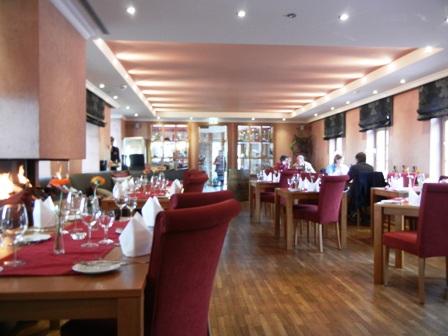
The inside of the restaurant

We sat near the fire place. The staff was very friendly, and convinced us to get started with a sparkling Pinot Meunier, or in German “Schwarzriesling”.

Sparkling Schwarzriesling – Pinot Meunier

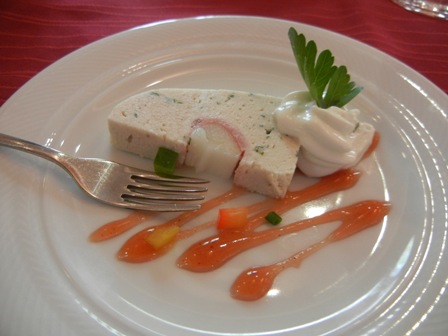
This was followed by “greetings from the cook”: a delicious pate, which was just the right starter. It wetted our appetite.

Courtesy of the cook

I could not resist and ordered the house Riesling, a dry wine from the Pfalz region.

Dry Riesling from the Pfalz

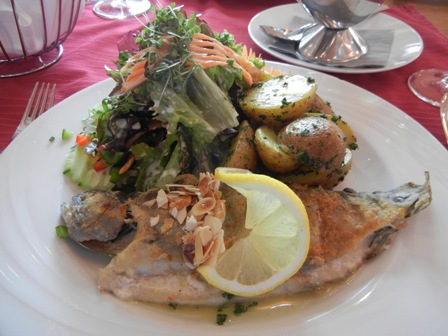
My main dish was a trout with almonds, with potatoes and salad. Just wonderfully delicious. It was the right hearty meal which made me forget my jet-lag. I had arrived the very same morning from Bangkok and needed some stimulation to stay awake. That’s why I could not resist the ice cream either.

Trout with almonds

Dessert

Espresso

We had a jolly good time. The food was delicious, the staff extremely friendly, the spring outside inspiring and the company just great. I could not imagine a better welcome to Germany.

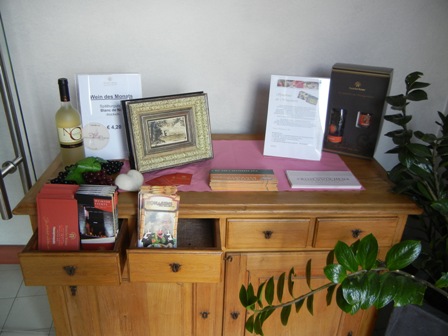
On our way out, I noticed the table with the informations about wine events and other local festivities. It was a pity that I could not stay a couple of days longer. The wine route through the Pfalz/Palatinate has so much to offer.

Address:
Deutsches Weintor Restaurant
Weinstraße 4
D-76889 Schweigen-Rechtenbach
T +49 (0) 6342 – 922 788 8
F +49 (0) 6342 – 922 788 9
www.weintor.de/restaurant.html


2011 in review

January 30, 2012

The WordPress.com stats helper monkeys prepared a 2011 annual report for this blog.

Here’s an excerpt:

Madison Square Garden can seat 20,000 people for a concert. This blog was viewed about 66,000 times in 2011. If it were a concert at Madison Square Garden, it would take about 3 sold-out performances for that many people to see it.

Click here to see the complete report.


My pre Christmas lunch in Beijing at Capital M

January 29, 2012

The Christmas tree at the entrance to Capital M in Beijing

As some of you know already, one of my favourite restaurants in Beijing is Capital M at Qianmen with its terrace overlooking Tiananmen square.

During a trip in mid-December, I had the opportunity to dine their again. It was another one of these occasions when I was ready for a treat.

A Christmas tree in the hall welcomed me this time. The whole of Beijing was full of Christmas decoration and Christmas songs were blasted from every loudspeaker in town, so it seemed.

The interior of Capital M

December view of Tian an men

The enlightenment – Bread and butter

I had come from the Enlightenment exhibition at the National Museum of China, and craved for a meal in a nice location, so my natural choice was Capital M at the south end of Tiananmen square with its warm atmosphere and splendid surroundings.

The art of the enlightenment exhibition, by the way, is a wonderful display of one of the most significant times in European history, and I was glad that I had finally found the opportunity to attend the event which is basically celebrating human freedom.

I had even bought the catalogue and had ample time to browse through it while dining at Capital M.

The lunch menu

It was not difficult to choose my meal. Unfortunately, I was by myself and hesitated to order a bottle of wine. Instead I went for the house wine by the glass which allowed me to taste two wines. Naturally, I went for the house wine which I knew from my earlier visits.

The Capital M house wine comes from Angoves, a family-owned and run winery in South Australia has supplied Capital M for two decades already.

I love the wines made by Angoves Family Winemakers which celebrated its 125 year anniversary in 2011.

Capital M’s wine list is very impressive. There is a short list with about 300 wines to choose from and a long list which makes you faint in delight.

Beetroot tart with glazed shallots, mild goats’ cheese and candied walnuts

This is just an awesome dish, smooth and full of flavours. It dissolves in the mouth and the white wine was just the right counterpoint.

A white wine from Angoves Family Winemakers

Pumpkin and almond ravioli in a sage and butter sauce

I did not feel “meaty” and therefore went for the non conventional pasta (how can you put pumpkin in a pasta?).

This is a wonderful composition of different ingredients with distinct flavours. The sage and butter sauce blows you away. My taste-buds had a wild party. The spiciness of the Shiraz accentuated the experience.

A glass of red wine by Angoves

Capital M has been founded by Michelle Garnaut, the well-known Melbourne-born restaurateur, and is the recipient of an impressive list of awards. I also like the GM, Espen Harbitz, who is always present, greeting the guests and asking for feedback.

If you should visit Beijing in the water dragon year, a meal at Capital M should be part of your itinerary.

Address:
Capital M
3/F, No.2 Qianmen Pedestrian Street
(just south of Tian’anmen Square)
Beijing 100051 China
中国北京市前门步行街2号3层
邮编 100051
Tel.: +86-10-6702-2727
Fax: +86-10-6702-3737
www.m-restaurantgroup.com


Lunch on the farm with Rees Miller 2008 Thousand Hills Shiraz

January 16, 2012

I am back at work in Bangkok after a short and exciting assignment in Myanmar. Today was my first day at the office desk. I was staring into the computer screen, reading and answering e-mails, signing contracts and organized many odd and less odd work related things.

I usually skip lunch when working in my office. Instead I eat a muesli bar or some fruit. Green mango is one of my favourites. Naturally that I was reminiscing about the recent past, the glorious days of our Christmas vacation on Two Hills Vineyard.

One very memorable meal was an Anglo-Saxon kind of food combination with roasted potatoes, silver beet, carrots and a leg of lamb. From the pictures you can see how delightful these dishes looked like. But can you also imagine the taste? Gorgeous food, awesome stuff.

The question what wine should we have with this meal was easy to answer. First of course our own 2004 Merlot. But we wanted also something else, something strong and refined, a wine with zest and character.

I selected a ‘2008 Thousand Hills Shiraz’ by one of our neighbouring vintners from the Yea area, the Rees Miller Estate.

I have written a few blog entries about wines produced by Rees Miller Estate ( I also love their Merlot), and I do not want to repeat myself. Silke Rees and David Miller produce some of the best bio-dynamic wines in our region.

The ‘2008 Thousand Hills Shiraz’ is just a wonderful wine, full bodied and spicy with lots of fruit and an intense finish. It was just the ideal accompaniment for the lamb, the potatoes and the veggies. Frankly speaking it was one of the best red wines I drank in 2011. Watch Rees Miller and their wines.

Address:
Rees Miller Estate
5355 Goulburn Valley Highway,
Yea, Victoria, 3717.
Tel.: +61-3-613 5797 2101
E-mail: info@reesmiller.com


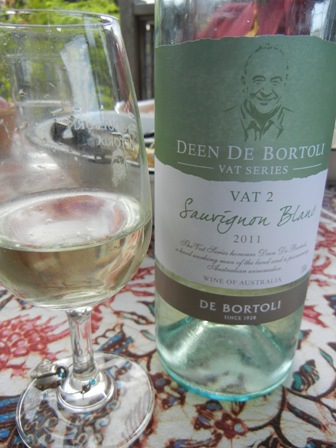
Deen de Bortoli VAT Series – 2011 VAT 2 Sauvignon Blanc

December 30, 2011

One of the nicest Sauvignon Blanc blends I had so far this summer is the ‘2011 Deen de Bortoli VAT 2 Sauvignon Blanc’ by de Bortoli Wines.

This is a fresh and clean wine with strong herbal and tropical fruit flavours. The wine is medium bodied and low in alcohol (12%).

About 50 % of the grapes for this brand come from old vineyards in the Riverina region in South Eastern Australia; the other half comes from the cool climate King Valley in Victoria.

As you probably know, 2011 was a difficult year for wine makers all over Australia. First, there was so much rain, second there was so much pressure from fungal diseases and third not all grapes would ripen perfectly.

We enjoyed the wine with a pasta with mussels and chorizo. The perfect choice.

Life is just beautiful.


A simple dinner on the farm with Inigo Shiraz

December 29, 2011

After a very enjoyable trip to Port Melbourne where we visited our friends Phillip and Julia who live in a former church (a very interesting dwelling), we returned to the farm and spend a quiet evening at home overlooking the vineyard and the paddocks.

Since we were spoiled with good food the whole day, we decided on a simple “German dinner” meaning cold dishes only. Some Australian cheese, cold cuts, olives, a salad and an avocado together with a German bread would do for the two of us.

Our dinner table

2008 Inigo Shiraz

From under the sink, my secret stash of fine wines, I produced a bottle of ‘2008 Inigo Shiraz’ by Sevenhill Cellars in the Clare Valley in South Australia.

The bottle was left from last years special order which we got through our friend Neville Rowe, who used to work there as marketing manager.

The ‘2008 Inigo Shiraz’ is an old fashioned red, beautifully round and full of flavours, with a lot of alcohol, in short an “umpf” wine, a wine with character. The grapes come from old vines (very old ones) and display black cherries and other dark fruit aromas. The tannins are smooth and has the spicy character we so much love in Shiraz. The finish is long and memorable.

Well, when I work in the vineyard, I inevitably think of the Bible and the many stories about vineyards in the biblical age. In fact many vineyards and wineries in my home town Trier and along the Mosel valley would not exist without “clerical” support.

The Jesuits of Sevenhill Cellars in the Clare Valley know how to make wonderful wines.

My tip: try some wines from Sevenhill Cellars. You won’t regret it.


Back on the farm – heaven on a stick

December 21, 2011

We are back on the farm for our Christmas vacation. Yesterday was my first full day. After a long flight from Ulaan Baatar, Mongolia via Beijing, China and Bangkok, Thailand, I had finally gotten to Melbourne. My family picked me up and off we went to Glenburn which we reach at about midnight.

I had traveled a fair bit to get back to Australia, not only distance wise. But Mongolia had minus 37 Celsius (Beijing minus eight) and it went to about 26 plus in Bangkok. The Melbourne night was cool and I slept like a baby in our shed in the countryside about 2 hours north of the Victorian capital.

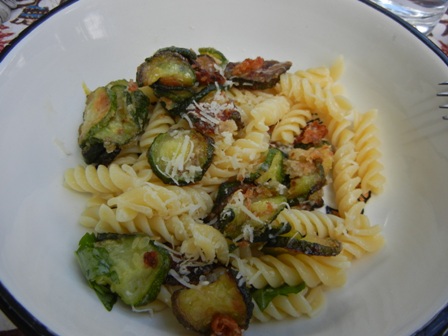
It is so quiet out here. The night is very dark. We are out in the countryside and one does not see many people. I worked a bit around the house. After that we had our first family meal together. I tell you it was just sensational to have a zucchini paste and an insalata caprese.

Look at the two pictures below, doesn’t the food look delicious?

What about the wine, you might ask?

No, we did not have a Two Hills Merlot with the meal, but instead….

Zucchini pasta

Insalata caprese

….we had a ‘2008 Sauvignon Blanc Chardonnay’ blend by Paul Bettio from the King Valley.

I am not a fan of a SB-Chardonnay blends in general. I prefer the two varieties as single grape wines. But this medium dry wine was just a great refreshing drink. The tropical and citrus fruit flavours went very well with the light pasta and the salad.

The King Valley is one of my favourite cool climate wine regions in Victoria. I will tell you more about its wines at a later stage.

2008 Paul Bettion Sauvignon Blanc Chardonnay