Restaurants in Germany – Hotel Prinzregent, Munich-Riem

June 25, 2008

Bavaria is just such a beautiful place. I just cannot get enough of it. Especially at this time of the year travelling around Upper Bavaria is truly enjoyable. Even sub-urban places such as Riem have their charm. I stayed in a small hotel at the outskirts of Munich to attend a conference at the Messe Zentrum (the fair).

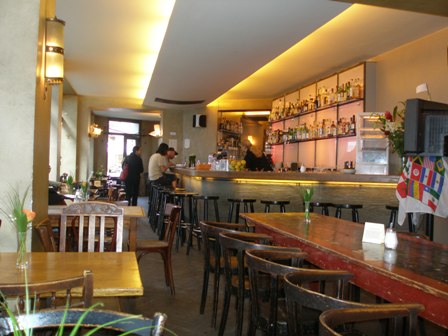
The very first evening, I asked the receptionist where one could have a decent bite of food, preferable Bavarian style and I was pointed into the direction of the Hotel Prinzregent (www.prinzregent.de), in fact a country inn style place along the main street in Riem. The ‘guest room’ of the public bar part was fairly busy at a Friday evening.

The Bavarian country inn – Hotel Prinzregent

As it was my first evening back in Germany I could not resist ordering a pork roast Bavarian style with ‘Semmelknoedeln’, a kind of cooked carbohydrates made from leftover bread crumbs. It was so delicious I completely forgot to take pictures for my blog. I drank wheat beer with the meal though the Prinzregent has a nice wine list available. For dessert, which I usually do not have, I had ‘Apfelkuechle’, a kind of apple backed in a doe and seasoned with raisin. After that mighty meal I was exhausted and went to bed early.
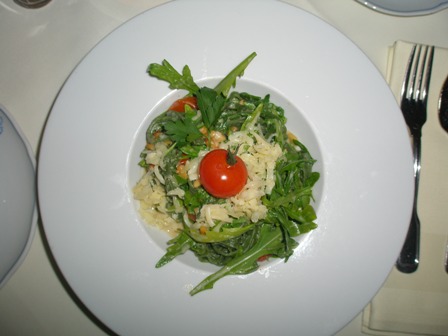
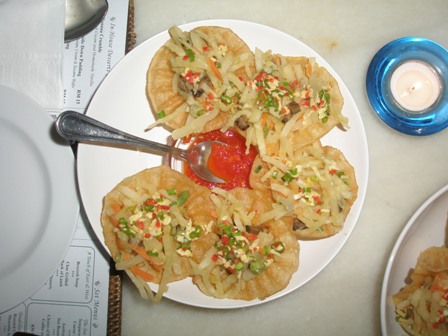
The pasta

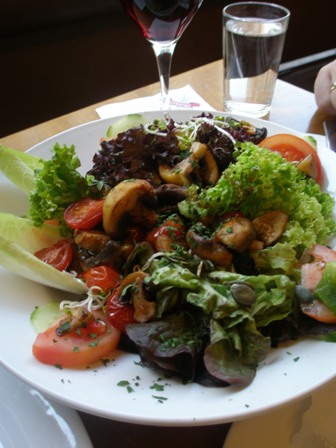
The very next day I came back to enjoy some more of the delicious food at the Prinzregent. Unfortunately, I did not order the roasted pork again (I should have) but went for a vegetarian pasta dish. It was ok but could not match the pork. The side salad was fresh and tasty.
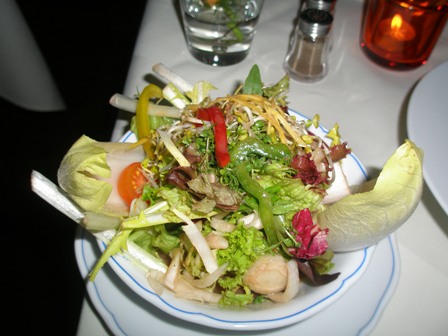
The salad

This time I tried some of the white wines with my food. First I ordered a Riesling from, of course, the Mosel. A ‘2006 Weingut Schmitges dry Riesling from grey slates’ was my choice. It is a young but very enjoyable wine, typical for the region, elegant, displaying aromas of citrus and green apples, a fruity, minerally kind of wine.

For my second glass I choose a Sylvaner from the native lands of my mother, Franconia (the most northerly part of Bavaria). Horst Sauer is one of the icons of the vintners and winemakers from Franconia. His ‘2006 Eschendorfer Lump’ is just divine. The Germans like to describe a wine as “filigran”, which my dictionary says means “lacy” or “filigree”. I do not know if that makes sense to you. Anyway, the wine shows the typical Franconian character, is complex and fine, well balanced, has a good structure and a lingering finish. The prices for the wines were not on the cheap. The fellow at the next table turfed the idea of having a glass of wine after he saw the prices. Well, I was in a festive mood that day and did not bother.

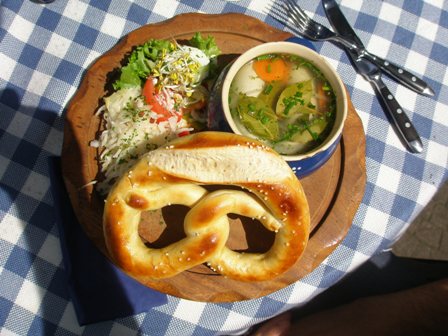
White sausages Bavarian style, isn’t this beautiful?

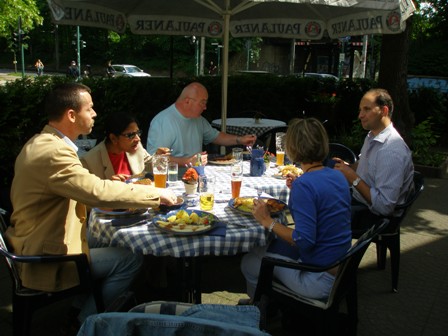
My last meal at this wonderful place I enjoyed sitting in the large beer garden under very old chestnut trees reminiscing about the wonderful time I had in Bavaria. It was rather a late breakfast than lunch and therefore I ordered the typical Bavarian “white sausages” which is eaten with sweat mustard. A wheat beer matches that perfectly. Sorry you wine folks.

Address:
Hotel Prinzregent an der Messe
Riemer Strasse 350
81829 Munich
Te.: +49-89-94539-0
http://www.prinzregent.de


Eating out in Yea, Victoria

June 24, 2008

When we are on our vineyard in Glenburn, Victoria, we love to visit wineries and vineyards in the vicinity but we also love to tour the small country towns, villages and hamlets in rural Victoria. One of our favourite destinations, and just about 32 km northwards of Two Hills Vineyard is the small town of Yea.

Yea is about 100 km north of Melbourne and has a population of about 1000 souls. In 1837 the first settlers arrived in the district – the Shire of Murrindindi – from New South Wales (under the leadership of the explorers William Hovell and Hamilton Hume) and ever since the area along the Goulburn River was settled as farmland. It was originally known as Muddy Creek settlement and later named after Colonel Lacy Yea, who was killed in the Crimean War. Before white settlement, the Woiwurung people of the Kulin nation occupied the area. Unfortunately, they had to bear the brunt of the effects of British settlement policy and were frequently and forcibly resettled and never obtained titles of their native lands.

Today Yea is a pleasant country town and centre for agriculture, forestry and tourism. Needless to say, quite a few wineries are located in the area, most of them members of the Upper Goulburn Winegrowers Association.

There are quite a few eating places to choose from. Depending on your time and your budget, the whole range of country food is available at your finger tips. We usually frequent three places which I would like to introduce to you today briefly.

1. Marmalades

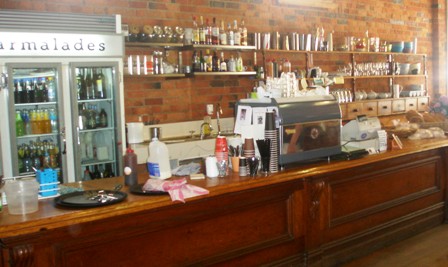
Marmalades is a cafe, tea house, local produce and wine store cum gallery and offers all kinds of local and international food. It has a very pleasant atmosphere. There is a library and a reading groom.

marmalades.jpg

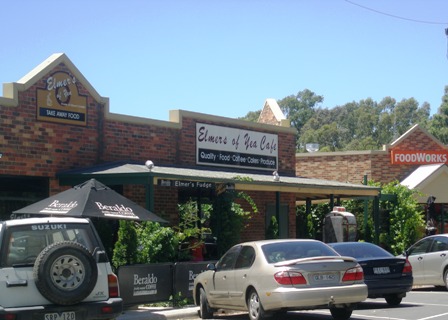
You can park right in front of the place.

The counter

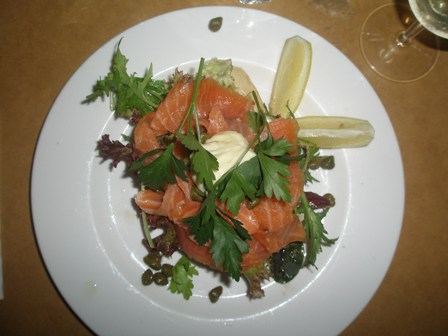
Below you can see some of our most preferred dishes.

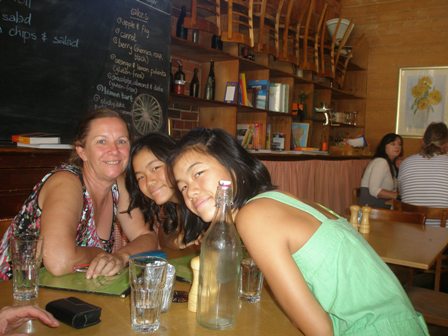
Margit, Charlotte and Lucy around the table

2. Elmers

A little bit further down the main road, near the Foodworks supermarket, you will find Elmers, another cafe cum restaurant. At times you need to book because it is so crowded. As the occasional tourist just try you luck.

Behind the counter at Elmers, people are very busy.

3. The Country Club Hotel

Located about between the two, is the Country Club Hotel. It has, as most Australian pubs or hotels, a public bar and a restaurant. There is usually some kind of life music in the restaurant on the weekends. This is a good place for the evenings to go out and/or meet with friends and family.

I somehow do not have pictures of the inside of the Hotel and of the food served. However, let me assure you that I ate there the best Kangaroo steak I had ever consumed in Australia.

Mind you my first Kangaroo meat I tasted during my university years in Bonn. The ‘mensa’, as it is called in German, the university eating place, a ‘cantina’ so to say, had offered it as a novum to its hungry young men and women some 30 years ago.

Also the other dishes on the menu are worth trying. The Country Club Hotel also offers local wines with their meals. So if you are in the vicinity and you want to try solid, modern and traditional country style food please drop in and give a couple of hours of your time to Yea and its eateries. You will be pleasantly surprised. You will also have the opportunity to sample some of the finest locally produced wines from the Upper Goulburn Wine Region since all three restaurants have a variety of locally produced wines on offer.


Friday again – ‘2003 Shaw and Smith Adelaide Hills Shiraz’

June 21, 2008

I was sick for a couple of days. There is a bad virus going around. I also seem to suffer from insomnia these days and its certainly not the European Soccer Championship which is causing the “insomnia”. My head spins in the night. There is so much preparation to do before we can leave for Bangkok.

But Friday night I felt a bit better and why not celebrate the end of the week with a beautiful glass of Australian red wine. I decided to open a bottle of ‘2003 Saw and Smith Adelaide Hills Shiraz’ (www.shawandsmith.com) which retails at the Duty free Show at Jalan Fatmawati (Bumi Ayu) for about US$ 30, not cheap indeed.

Here are my tasting notes:

Deep purple red colour in the glass, the wine has vibrant nose of raspberries, black currant, jam and jelly aromas, it is first peppery-spicy is the mouth, as typical for a Shiraz, than displays an intense, creamy, fat and rich aroma of wood berries, it is well balanced and ends with a long and intense finish. The wine has 14% alcohol.

The grapes for this wine were grown in the warmer parts of the Adelaide Hills near Macclesfield. The wine was aged for 12 months in old and new French oak barriques.

PS: At this point in time the Adelaide Crows are leading the Brisbane Lions in the footy game.


Restaurants in Germany – “Alte Fischerhütte” at Schlachtensee, Berlin

June 17, 2008

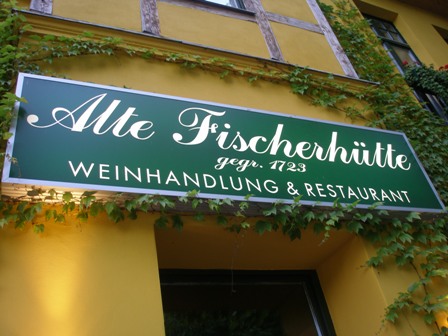
During my time in Berlin I had the opportunity to dine at “Alte Fischerhütte” at Schlachtensee in Berlin, a beautiful located restaurant at the shores of a small lake very popular with citizen for all kinds of leisure activities.

The restaurant is under the management of Lutter and Wegner, formerly the oldest wine merchant house in Berlin and today a chain restaurant owned by a corporation (http://berlineating.blogspot.com/2008/04/lutter-wegner.html).

Lutter and Wegner possesses various restaurants and wine shops around the city of Berlin but also outlets in Munich for example.

The “Alte Fischerhütte” offers many facilities. It is great to sit on mild spring and/or summer evenings on the beautiful outside terrace and enjoy the gorgeous surroundings.

The elegant dining facilities are magnificient, so is the wine list and the food.

Because of the rather formal character of the occasion, I could not take photographs of the food on offer.

We (a group of about 50 persons) were served a set dinner consisting of a three course meal: an entrée – green asparagus soup with scrimps – a main course – veal steak with asparagus, sauce Hollandaise and potatoes – and a dessert – fresh strawberries with vanilla ice cream. The quality of the food was excellent, and the month of May is asparagus season, nothing better on offer than this delicious vegetable.

As an aperitif we had a ‘Lutter and Wegner Riesling sparkling wine, extra dry’. Two wines, a white and a red, were on offer with the meal. The white consisted of a ‘2006 Schloss Vollrads dry Riesling’ from the Rheingau and the red was a ‘2006 Jean Stodden, Pinot Noir’ from the Ahr. Both producers have a long tradition in producing excellent wines, Schloss Vollrads for its Rieslings (www.schloss-vollrads.de) and Jean Stodden for its Pinot Noir (www.stodden.de). The wines matched the food extremely well. I loved the crispness of the Riesling, its intensive citrus notes, the well balanced acids and the beautiful finish. The Pinot Noir (13% vol, residual sugar 2.3 g/l) was also an excellent wine with an aroma of cherries and red berries, great structure and a long finish. I stayed with this wines longer than I should have, I guess. What a great selection that was.

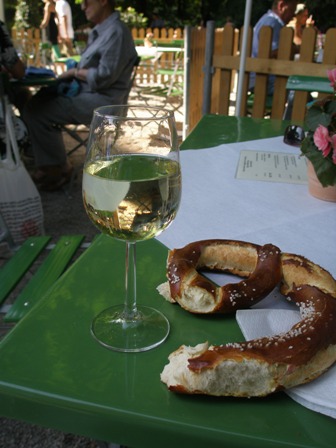
The dinner was utterly enjoyable. I was able to take a quick shot of the Riesling in my glass. Isn’t it beautiful, this fresh, light colour promises just the best German Riesling has to offer. I let any other Riesling wine “get warm along the roadside”, as we say, for the German stuff (ok, its exaggerated, I know. I might make an exception for some Alsation and some Austrian Rieslings). It was a splendid evening and I highly recommend a visit to “Alte Fischerhütte”.

Address:
Alte Fischerhütte am Schlachtensee
Fischerhüttenstrasse 136
D-14136 Berlin
Te.: +49-30-80498310


Beautiful Bavaria

June 14, 2008

I had the great chance to spend a weekend in Munich, the capital city of the state of Bavaria. The weather was splendid; it was the first weekend of June. Of course I had some to work but fortunately there were a couple of hours which I used to explore the surroundings. I just walked through the city and enjoyed the cheerful atmosphere. Of course I had also food and drinks in mind.

People over people in the English garden in Munich

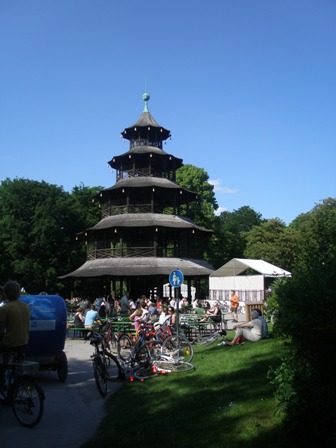
I ended up in the “English garden”, as it is called, a large park in the heart of the city where everybody seemed to converge on a Sunday afternoon. I asked two nice ladies for the way to the next beer garden (show me the way to the next whiskey bar) and they pointed me to the beer garden at the Chinese pagoda.

The Chinese pagoda beer garden

Unfortunately my small camera could not capture the atmosphere there. There were lots of people as well. Numerous stalls sold all kinds of Bavarian food and drinks, mostly beer in big and super big mugs or beer based mixed drinks. For instance one could order a “Russian” which is a mix of wheat beer with white lemonade, a nice drink to quench your thirst and thats what I did. There were horse carts, people on bicycles, and children on skate boards. There were street musicians along the wayside, larger and smaller groups of tourist and day visitors from all over the world. Here and there one could spot the odd local Bavarian, men dressed in the traditional ‘Lederhosen’ (leather pants) and women were dressed in elaborate ‘Dirndl’ outfits.

Bavarian folk music presented by a brass band in traditional leather pants

Munich is not exactly known as a wine growing region. Helas, there was also a part of the garden where a vintner from Franconia offered his wares, in this case delicious wines from this northerly part of Bavaria. “My heart jumped in my chest”, as we Germans say. here I had the opportunity to be regaled by the very wine of my mothers homeland.

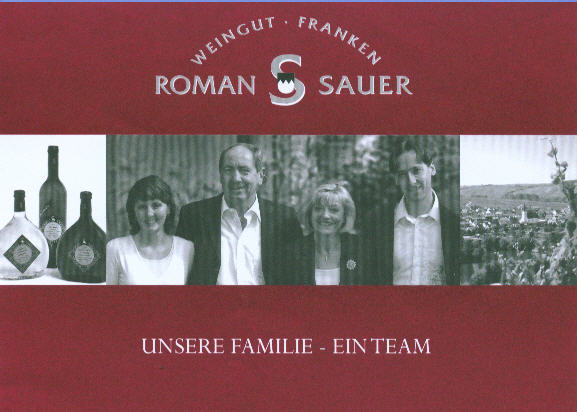
The vintner was Roman Sauer and his family from Nordheim in Franconia. They were very friendly and cheerful. For my next visit to Franconia I should schedule a tasting!

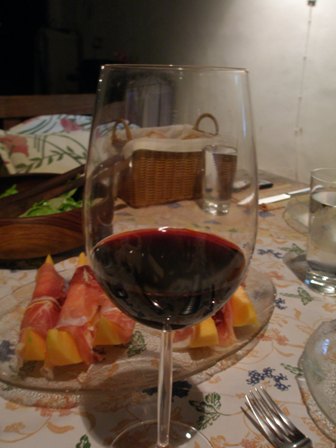
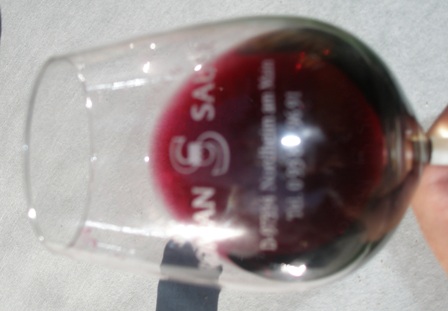
I first tried a Sylvaner (fresh and dry), then I moved on to a Riesling (crisp, citrus and apple aromas) and the last wine I tasted was a red wine (see the picture). Well, and now I face a memory lapse. Moreover, I cannot find my notes. I do not remember what it was. The colour is a deep and beautiful red. It should be a Pinot Noir but it could have been something more “exotic”. Needless to say the wines were all well made and delicious.

I would have tasted the rest of Roman Sauer’s wines on offer but that was just too difficult in the heat. The sun was shining on me and the three large glasses of wine had their own effect. The Bavarian music was entertaining, the beer garden visitors were loud and cheerful, and somehow I made my way back to the small hotel in Munich-Riem.

Below the flyer I collected which depicts Roman Sauer and his family. There was not much opportunity for a chat because the garden was so buy, guests coming and going. Unfortunately, I could not find a webpage of the Sauer Estate and learn more about his vineyard, wine making, etc.

Address:
Weingut Roman Sauer
Raiffeisenstrasse 11
D-97334 Nordheim
Tel.: +49-9381-9691


Restaurants in Jakarta: Champa – Wine and Spirits Circle Dinner

June 11, 2008

Saturday night marked a rare occasion, because the Jakarta Wine and Spirits Circle had not organised a function for a while. Therefore, the invitation for a dinner cum wine tasting came just at the right time. We are members of the Circle since many years and cultivate some very fond memories of past wine tastings.

The event took place at the Champa restaurant, which provides Vietnamese and Indochinese food. The Champa opened its doors to the public in 2002 and possesses a warm and cosy atmosphere. I had already been to this restaurant with friends and business associates a couple of times and always liked the food.

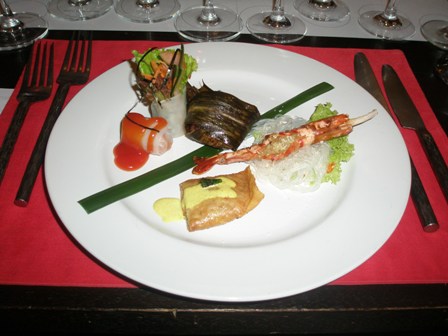
The tables were a bit crowded by the glasses

The menue showed exciting features

‘Four temptations’, the entree ‘Goi Cuon Ca hoi, Goi Cuon Malay, kai Hoer Bai teay, Tom Ham Pho Mat’, freele translated, it reads as follows:

– Champa fresh spring rolls made of salmon
– Crispy minced chicken and crab meat martabak style
– Thai famous deep fried herb chicken in Pandean leaves
– Roasted Tiger Prawn and herb crust with cheese on salad

The main dish named ‘Bo Nuong Hed Hom ca Hoi Mojo’ consisted of grilled tender loin with mushroom cheese and stir fried Norwegian salmon with Mojo.

The dessert, called ‘Da Vanni’, was a crepes filed with Banana and cream, vanilla ice cream, sprinkled with nuts and chocolate.

How about the wine you might ask. Well, Alsatian and Austrian wines were on the agenda. we started with an aperitif, a ‘2004 Domaines Schlumberger Sylvaner’. Woh, an Alsation Sylvaner, Sylvaner being the grape of Franconia and its famous Bocksbeutel wines. It felt fresh and fizzy, a nice aperitif, I must say.

We faced seven glasses on our table, it felt a bit crowded in the limited space available. Three were for whites and four for red wines.

White wines

– 2004 Domaines Schlumberger Pinot Gris
– 2004 Domaines Schlumberger Gewuerztraminer
– 2005 Leth Gruener Veltliner Kabinett

Red wines

– 2004 Leth St. Laurent Reserve
– 2004 Leth Linot Noir Classic
– 2006 Pfaffl Blauer Zweigelt
– 2003 Sepp Moser Blauburgunder Gebling

Let me say it from the outset: this was not an evening for scribbling down tasting notes. I was in a much too good a mood for that. I also do not know much about Alsatian and Austrian wines. But the evening confirmed one thing: one has to drink and taste a lot in oder to understand the intricacy of the various grape varieties and the wines. I promised myself to drink more wine from the two regions.

Domaines Schlumberger is a wine estate in Alsace. It was established in 1810 (these Europeans have awfully long traditions in wine making) and has 140 ha under vines, half of this area classified as “grand crus”. Schlumberger only vinifies his own grapes. Today, the sixth and the seventh generation of Schlumbergers run the estate. Much of the vineyards is organically farmed (60 ha organic and 30 ha biodynamic).

The Domaines Schlumberger Gewuerztraminer was semi-dry I would say but showed some very fine aromas and great balance. Also the Pinot Gris must have had some high residual sugar because I perceived it as almost sweet. Both wines went well with the Asian food. However, I liked the Sylvaner best. Unfortunately, I did not check the bottles to identify from which “terroir” the Schlumberger wines came from (there are 4 grand crus: Kitterle, Kessler, Saering and Spiegel) and the wine list is silent about their provenience. Maybe we drank only the “normal” wines (Les Princes Abbes) and not the ‘grand crus’.

The Sepp Moser Estate (www.sepp-moser.at) in Rohrendorf in the wine region of the Kremstal produces mainly white wines. The location Gebling has been used for vine cultivation since 1284 and is a steep south facing terraced vineyard. The Pinot Noir displayed the typical characteristics of the variety and the ‘terroir’ (hot days, coll nights during vintage time).

From the Pfaffl Wine Estate, located near Vienna in a region called “Weinviertel”, a Blauer Zweigelt was included in the tasting. Zweigelt is a red grape variety developed in Austria in 1922 and, of course, it bears the name of the developer (Fritz Zweigelt who should later became director of the Institute for Viticulture and Pomology at Klosterburg). Zweigelt is today the most widely grown red grape variety in Austria. Interesting is that the grape is also cultivated in the Niagara wine region of Ontario/Canada. The Pfaffl family cultivates about 30 ha of vineyards and goes back generations.

The Leth Estate is located in the village of Fels at the river of Wagram, Lower Austria and has about 40 ha under vines. The wine-plus website (www.wein-plus.com) awarded the winery three stars. The estate has practiced organic viticulture for decades and produces mainly white wines (70%). We were lucky to taste two reds from Franz Leth’s cellar.
In fact after all the tasting I settled in the end for the ‘2004 Leth St. Laurent Reserve’, which I liked best. It is a full bodied red with a fruity flavour and a mellow finish. The grape variety originates from France and belongs to the same family as Pinot Noir. St. Laurent (also called Pinot St. Laurent) is an aromatic dark red grape with aromas of forest berries and black cherries. Today it is mainly planted in Austria and the Czech Republic (and a small area in Palatinate and Rheinhessen in Germany).

When we left, and we were among the last guests, there was nothing left of this wine and many others. My resolution for the evening was to try more wines from these two wine regions.

Address:
The Champa
Jl. Wuaya 1/50
Kebayoran Baru
Jakarta 12170
Te.:+61-(021)-727-88668


The mighty wine bloggers

June 10, 2008

Two Hills Vineyard: newly planted Chardonnay

Blogging is all in vogue these days. Millions of people write in their free time entries into their electronic diaries or online journals as they are called.

The founder of “Vinography” a reward winning wine blog, Alder Yarrow is the pioneer of wine blogging. His blog won various awards over the last years. In 2008 it received the American Wine Blog Awards for ‘best overall wine blog’ and ‘best writing’; in 2007 the same award was bestowed on him for ‘best wine reviews’. Vinography won accolades by the Salon des Vins de la Loire Wine Blog (2007) and Food Blogging Awards (2006, 2005, 2004).

Vinography is more than a private blog (www.vinography.com), it is a professional undertaking with various distinguished contributors. But apart from very interesting information about wine, wineries and vineyards, food and everything related to wine, Alder also collects blogs and he assembled a list of wine blogs, which you can find on his website. This list is of course not complete. An undertaking like this is never completed, there are always new people starting their blogs out there, and it is tedious to find them.
The list of about 600 or so odd blogs and wine podcasts is a very interesting piece of information.

There are about 65 winery blogs and 43 wine podcasts, some of them quite entertaining. The remainder are blogs in various languages. English is of course the most common language used by wine bloggers; the next most prominent is Italian followed by French. There are even wine bloggers writing in Japanese, Chinese and Indonesian.

As I mentioned in an earlier blog entry that some of these bloggers are pretty organised and that they do things together. For instance the German wine blogger organise so called “wine rallys”, where they write about a common theme selected by the members and hosted by one of the bloggers where all pieces produced about this theme are collected, analyzed and propagated.

The Vinography list of wine blogs according to language goes as follows:

404 English
41 Italian
36 French
29 German
22 Spanish
11 Portuguese
5 Chinese
4 Dutch
2 Japanese
2 Hungarian
2 Norwegian
1 Indonesian
1 Slovak

There is a wealth of information to be found about wine, wine regions, wine-making, etc. Some of these blog are humble private tools for enjoyment and distraction, others are professional instruments for marketing, information, analysis, presentation and sale.

Check it out yourself and have fun. It’s worth it.


Kayzer Soza – bar cum resto in Berlin

June 8, 2008

I love Berlin; it’s a great city with so much on offer. My friend Rainer Heufers took me to a rustic place in Tucholsky street, near the synagogue, called “Kayzer Soza”, named after the mythic film figure. Rainer knows Berlin very well since he lived there for a couple of years.

The inside of “Kayzer Soza”

Berlin is a cosmopolitan city again with a growing Jewish community. Just across the street from the restaurant was a bagel bakery.

“Kayzer Soza” was buzzing with people, mostly young, happy people with lots of time on their hands. Many were seated on the pavement of the sidewalk where we could not find space so we went inside. There it was rather empty at this early time, but that was about to change soon.

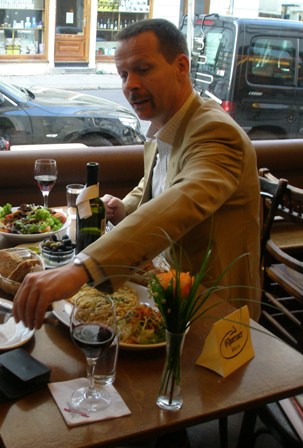
We ordered a hearty meal consisting of a strange selection of dishes: Suebian cheese noodles, a Mediterranean salad, olives, and a bottle of ‘Primitivo’, a ‘2006 Terre di Montelusa’ from Italy. We just felt like that after a long day meeting. The wine intrigued me because he comes from Brindisi in Apulia (Puglia) and I never knowingly drank a wine from there. It was a robust country wine. I guess the bottle did not cost more than 3 to 4 EURO. My last ‘Zinfandel’, as the ‘Primitivo’ is known in the US, I tasted more than 10 years ago during a winery tour in California.

When I opened the menu a poem jumped into my eyes. Freely translated it said the following:

“Good wine makes good blood.
Good blood makes good deeds and
good deeds lead mankind to heaven”.

It is said to originate from the Veneto, the lovely Italian wine region.

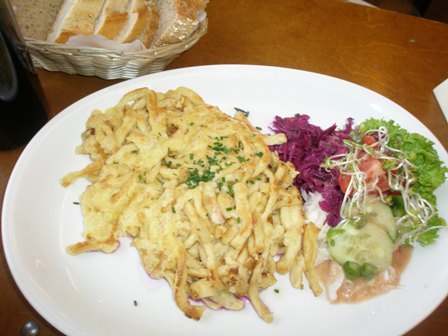
Suebian cheese noodles

The salad

A simple wine but matching the occasion

My friend Rainer tugging in


“Just off the boat….”

June 7, 2008

Colleagues from afar (fltr. Rainer, Sagarica, Joerg, Annemie, Philipp)

I attended a work conference in Potsdam near Berlin. The very first day, I went out with some colleagues to have lunch. We found a Bavarian Beer garden restaurant, usually no place to have a decent wine but plenty of good beers in big glasses. Wheat beet or “Weissbier” is one of my favorites.

Bavarian Wheat beer

May is asparagus time in Germany, usually enjoyed with a glass of white wine, maybe a Pinot Gris or Blanc, or a Riesling. Not so in a Bavarian environment, of course, but the beer was delicious too.

Asparagus, ‘old German style’

A typical Bavarian “snack” is “white sausages” served with sweet mustard. Well, Potsdam is far away from Bavaria so the sweet mustard was missing in this case.

Bavarian “Weisswuerste”

White and blue are the colours of Bavaria. Next time you find yourself in a Bavarian environment, try out some of the special local dishes.


Restaurants in Asia – Top Hat, Kuala Lumpur

May 15, 2008

I do not know what it is with these three letter words for restaurants, but another one of my favourite eating places in Kuala Lumpur is “Top Hat”, located in Jalan Kia Peng, the centre of town (www.top-hat-restaurants.com).

It looks very romantic not only in the night

The interior is very colorful

The food is amazing (here a typical Nyonya style appetizer)

The had a vegetarian pasta. Right, it is not true Western fusion or any Asian cousine, but I felt like having one. The food at Top Hat is excellent and shows great variety blending different local and foreign traditions. The desserts are to die for. The service is good as well. I can only highly recommend the place.

The wine was a “simple red” from Churchview Estate (www.churchview.com.au) from Margaret River, in Western Australia. Their ‘2004 Cabernet Sauvignon’ won the trophy for best CabSav in Australia at the Cowra Wine show.

I choose the ‘2004 Shiraz Premium Range’, a very deep red wine with intense dark fruit, plums and cherry aromas. The Shiraz was spicy and fresh which went very well with my pasta and some of the Asian dishes my friends had. It’s a big wine (15% alc.) with a good structure and a memorable finish.

If you intend to entertain friends or just yourself at Kuala Lumpur any time soon, pay a visit to this very memorable place.

Address
Top Hat Restaurant
No. 7, Jalan Kia Peng
50450 Kuala Lumpur
Malaysia
Te.: +60-3-21428611