Wine bars in Trier: Weinstube Kesselstatt

April 10, 2011

Wine bar Kesselstatt in Trier

A place I just love to visit while in my home town Trier, Mosel is a cosy wine bar-cum-restaurant near the cathedral, called Weinstube (wine bar) Kesselstatt.

It is housed in the historic administrative building of the Estate Reichsgraf von Kesselstatt, a well known winery with a long tradition (more than 600 years – difficult for us Australians to comprehend).

In front of the building is a replica of a tomb stone called the “Roman wine ship” found in Neumagen-Drohn, a village at the Mosel river, in 1878. In 220 it used to be one of two stones marking the grave of a Roman wine merchant. Honestly, I would love to get such a tombstone set on my own grave. What a hoot.

Today the winery is owned by the Reh family. Annegret Reh-Gartner manages the 36 ha of prime vineyards located along the rivers: Mosel (12 ha), Saar (12 ha) and Ruwer (12) ha. 98% of the area is under Riesling. The estate calls itself “the Riesling winery”.

When I strolled through the town at the end of March, I could not resist its magnetism and dropped in for a quick glass of wine.

The inside of wine bar Kesselstatt

Because the Kesselstatt estate owns vineyards along the three rivers constituting the former wine region of Mosel-Saar-Ruwer, one has a great choice of different Riesling wines.

I ordered a semi-dry Riesling from Scharzhofberg, a grand-cru of the outstanding Saar Riesling wines. Normally I avoid semi-dry wines but because of the early hours of my visit I just could not go for a dry Riesling.

2010 Scharzhofberger Riesling semi-dry, Reichsgraf von Kesselstatt

What a delight this wine is! I dissolved, so to say, this is Riesling at its best, and I tend to argue that none in the world is better. Lush and full, round but with zest, a titillating pleasure for the palate.

Below you will find pictures of the inside of the bar. There are old barrels filled with bottles, a old wooden press, and a side room with a map of the estates’ vineyard locations and other interesting wine paraphernalia.
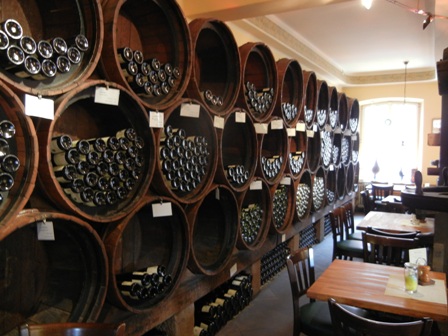
Wine bottles in old barrels

A huge wooden wine press with a church bench in front

The function room

When I left the Kesselstatt wine bar revitalized and in high spirits, I walked out to a cherry tree in full blossom with a splendid view of the adjacent church of St. Liebfrauen and the cathedral (Dom, left).


The first signs of spring in the vineyards of Olewig, Trier

March 31, 2011

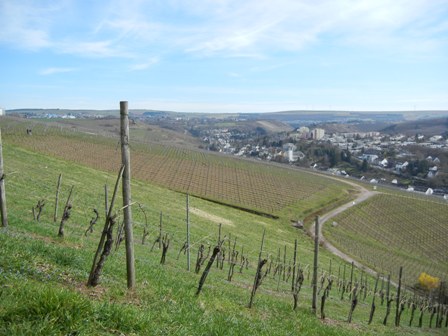
This is just a photo blog entry. One could sense spring when I visited my hometown Trier in March. I deliberately went to the hight at “Perisberg” and have a good look around the vineyards and the city. I love Olewig and its wine festival. Come to Trier, the oldest city in Germany, it’s worth a visit.

The village of Olewig

Steep slope vineyards

The vines are pruned and ready for another season

The main cathedral in Trier


The five best Riesling wines of 2010

February 18, 2011

Riesling the queen of white wine

Well, let’s be clear from the outset: this is not the result of an orderly wine tasting. I am reminiscing about the most remarkable Rieslings I drank in 2010. The five wines below are the ones I selected, and I call them “my best Rieslings in 2010 – the Man from the Mosel selection”.

As you might know, any recall from memory about events past is a tricky and challenging thing. I also do not have the opportunity to drink these wines parallel to each other (what a shame). But here is my top five list:

1. ‘2009 Dhron Hofberg Riesling GG’, by Grans-Fassian Estate, Leiwen, Mosel.

This is a marvellous Riesling. The 2009 vintage was great. Grans-Fassian is a top Riesling producer from the Mosel. With 95 Parker points the Dhron Hofberg Riesling is just divine. I could not believe my luck when I casually strolled into the cellar door and picked up these treasures.

2. ‘2008 Schieferterrassen Riesling’ by Heymann-Loewenstein, Winningen, Mosel.

Weingut Heymann-Loewenstein is another of the great Riesling producers from the Mosel. The wines are made in a different style from the mainstream. They show great character and have funk. Only on April 30, 2011 the 2009 vintage will be released. I am very excited and cannot wait to taste the 2009 Riesling.

3. ‘2008 Monzinger Halenberg Riesling trocken’ by Emrich-Schoenleber, Monzingen, Nahe

The wines made from fruit grown at Monziger Halenberg are among the best Riesling wines in Germany. The Nahe is the region where my maternal grandfather started to introduce me to wine when I was just a boy. Ever since I love this very diverse region.

Monzingen is a small village next to Martinstein where I spent time with my grand parents. I walked all the different hills and slopes in the vicinity. Emrich-Schoenleber is one of the top producers at the Nahe, a lovely family too where father and son make the wine together.

4. ‘2009 Riesling Leiwen Laurentiuslay GG’ by St. Urbanshof, Leiwen, Mosel

Another wonderful wine from the Mosel. Weingut St. Urbans Hof is located in Leiwen, Mosel. Recently we had a bottle of this Riesling with Sunday lunch. Goodness me what a treat that was. I had only one bottle with me when I came back from Germany in November. The good news is: I will be in Trier in mid March and guess what…..

5. ‘Dr. Mayer Riesling Kabinett trocken’ by Timo Mayer, (Yarra Valley), Remstal, Wuerttemberg

Timo Mayer is an Australian boutique wine maker of the Yarra Valley and a native of Grossheppach, Remstal. He made this wine while travelling in Europe. The grapes come from his brother and the family vineyard. The 2009 vintage was ideal for making this wine. Timo shipped about 60 cases back to Australia. We were so lucky to have access to a few bottles.

You might say, all these wines are German Rieslings, did you not drink others? Well, I did. I tried quite a few Australian ones but that’s usually not my cup of tea. But I am undeterred. My to to list (to drink list) is long.

I admit that I also love Riesling from the Alsace, France. Though they are creamer, heavy, earthy.

I also love Riesling from Rheingau und Rheinhessen, in fact there are so many good German Rieslings it is very difficult to say which one to drink first.

Please let me know what your best Riesling was in 2010.


Grans-Fassian Estate in Leiwen, Mosel

January 22, 2011

Grans-Fassian Estate in Leiwen

When I drove along the Mosel on a grey Saturday morning last November, I was heading to Leiwen to buy some good Riesling wines.

There were three reasons for this trip. It all started at Frankfurt airport when I bought the December issue of “Weinwelt” (World of Wine), the German wine magazine.

1. I had looked at the results of a wine tasting of grand cru (GG = Grosses Gewaechs) Rieslings: two of the top wines from the Mosel came from Leiwen; one of them was a ‘2009 Dhroner Hofberg’ by Grans-Fassian Estate.

2. Leiwen is just a 30 minutes drive from my mothers home in Trier at one of the most beautiful bights of my beloved Mosel.

3. I love German Riesling especially if it comes from the Mosel river and I wanted to know what a 95 point wine would taste like.

The original Grans-Fassian Estate manor house with the cellar door

So off I went by car and cruised along down the Mosel. I was lucky, the cellar door was open. Here I met Catherina, one of the two daughters of the owner, Gerhard Grans who had taken over the estate from his father Matthias in 1982.

We had a bit of a chat about wine, life and the universe. Catherina is a charming young lady. She is going to be an oenology student at Geisenheim soon.

Catherina Grans showing me the top wines

I tasted two of the wines (the ones mentioned in the magazine): the ‘2009 Riesling Dhroner Hofberg’ (95 points) and the ‘2009 Riesling Leiwener Laurentiuslay’ (92 points). I tell you these are Rieslings how I like them. Wonderful wines indeed. Tropical fruit the first wine, and a kind of a citrus bomb the second. Both with a good structure, young, minerally, powerful with a long finish.

The treasure box with Grans-Fassian wines

Furthermore, I learned that the estate has about 10 ha under vines. Some of the vineyards are lokated in the best terroir of the region, for instance Dhroner Hofberg, Leiwener Laurentiuslay, Piesporter Goldtroepfchen, and Trittenheimer Apotheke.

About 88% of the vines are Riesling, 10% Pinot Blanc and 2% Pinot Gris. The brochure shows the steep slopes of some of the vineyards, most of them with a southern or western aspect. The micro climate is ideal for Riesling. The soils consisting of red, grey and blue slate.

I bought a couple of the two wines I had tasted. By the way for someone like me who pays obscene prices for wine in Bangkok, these top wines were very reasonably priced, in fact they were a true bargain. It’s a pity that wine bottles are so heavy. I knew that I could only take one, maximum two of them with me on my long journey back to Thailand. What a pity, I thought.

The wine bloggers delight

Here is another hot “secret” for your next trip to the Mosel river: Grans-Fassian Estate in Leiwen should be your destination. Trust me, you will not regret it.


November at the Mosel river

January 21, 2011

It’s beautiful to drive along the Mosel river, even in the month of November. I had this opportunity last year and thoroughly enjoyed it.

The Mosel wine route (Mosel Weinstrasse) is a fine example of a scenic drive along the vineyards and wine villages in this part of Germany which I still call home.

The winding Mosel with the slopes covered in vineyards

Steep slopes promise hard work and exquisite wines

Vines on blue slate soils

Blue slate ideal for Riesling grapes

Every individual vine got one stake

Low lying vineyards at the river bank

As many as you like

Famous terroir: Poelicher Held
Famous terroir: Kluesserather Bruderschaft
The Roman wine route

The country I come from is just beautiful. Visit the Mosel and remember the Romans did this too about 2000 years ago. Spring (and Mosel Riesling) is waiting for you.


Wine village Leiwen at the Mosel River

January 18, 2011

The wine village Leiwen at the Mosel river

Last November I had the opportunity to visit Leiwen just about 30 minutes down the Mosel river from my hometown Trier.

Grape press

Leiwen (about 1,600 inhabitants) is not only a village known as a holiday destination but it is also a famous wine village. Here quite a few of the top Mosel wineries and members of VDP, the association of the top producers are located.

Leiwen got it’s name from Livia, the wife of the Roman emperor Augustus and has a long tradition in grape growing and wine making.

Riesling vineyards

Vineyards on the flats

Riesling, the aromatic grape of the Mosel, is the dominant variety here. Many of the vineyards are located on extremely steep slopes which are hard to cultivate. The ground is mainly gray, blue and sometimes red slate.

Many signs indicate the way to the various wineries

Many, mainly small and family owned wineries call Leiwen their home. The tasting rooms and wine cellars are usually located in the middle of the village. Space is certainly an issue.

On a quiet Saturday morning, the village was almost deserted. No tourist can be found during these times of the year. Vintners were in the vineyards busy pruning their vines. But I went to taste some wines of which I will tell you more soon.

But visit if you can, next spring or summer, any time is a good time. The wines are worth it.


Top Australian Riesling wines

December 21, 2010

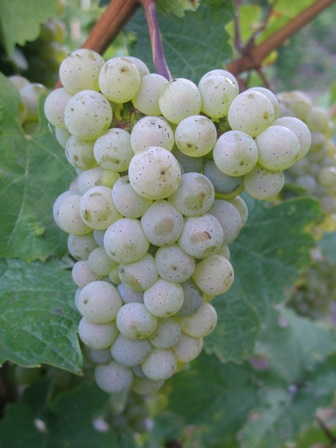
Riesling grape

I admit that as a German Riesling aficionado I have my problems with Australian Riesling wines. I try them again and again but, and to my great chagrin, I have not found what I am looking for.

Australian Riesling wines from the Adelaide Hills, the Clare Valley, the Eden Valley, Tasmania, Canberra District and from Great Southern in Western Australia enjoy a good reputation.

Also our own wine region, the Upper Goulburn Wine Region, produces some beautiful Riesling wines.

The September/October issue of the Australian and New Zealand Wine Industry Journal summarised the tasting of 26 Australian Riesling wines. All of them were under crew caps! Impossible in my native Germany.

Only one of them came from Victoria (Paradigm Hill 2009 Riesling from the Mornington Peninsula). The price range was from A$ 22 to A$ 45 (16.75 to 34.2 EURO). The four top rates wines were:

– 2010 Jacob’s Creek “Steingarten” Riesling (it is German for “stone garden”), a tank sample, Barossa Valley, South Australia

– 2009 “The Florita” Riesling by Jim Barry Wines, Clare Valley, South Australia

– 2009 Premium Riesling by Helm Wines, Canberra District, New South Wales

– 2009 Riesling by Plantagenet Wines, Mount Barker, Western Australia

The magazine carried also a photo of the vineyard where the Jacob’s Creek “Steingarten” Riesling is produced. It reminded me of my home region along the Mosel and Saar river. Here every vine has a single “stick” and is “wrapped” around it with no wire between the posts, nothing.

The “Steingarten” vineyard is entirely worked by hand because of it’s steepness. Also this reminds me of the Mosel with its ultra-steep slopes. The stones are of red colour, though, whereas the Mosel has blue and grey slate.

And believe me these Australian wine producers are not modest. At the recent International Riesling Challenge in Canberra they gave the top wine the title: Best Riesling in the World. Can you imagine. Modesty used to be a virtue which must have jumped out of the window down under.

The trophy was given to a ‘2005 Pauletts Aged Release Polish Hill Riesling’ from Polish Hill in the Clare valley, South Australia by Paulett Wines.

I cannot even try this wine because it is sold out. My search continues. I keep you posted.


November ambience in a Saar vineyard

November 29, 2010

Vineyard near Schoden, Saar

When I recently visited my home town Trier, I also had the chance to explore mother nature in nearby Schoden, Saar.

It was a grey and rainy November day as we like it. The weather makes you wish for a hot tea in a warm place, maybe near a window with a view. Or a walk through the steep vineyards in the Saar valley.

Individual vines trained on a “stick”

Some of the vineyards were already pruned. One could spot pruners here and there, alone or in small groups. Please note the pruning style of these vines. November is a good time to visit wine regions. It is less crowded and people have time for a yarn.


Where to eat in Seoul – Restaurant Review: Min’s Club

November 11, 2010

Tradition and…

Today Seoul, the capital of South Korea, is the host of the G-20 summit. Thousands of government officials from 20 major countries and journalists have converged on the city. The place is crowded, and very busy.

This summit is maybe one of the most contentious so far. South Korea, an OECD country, is the 13th largest economy of the world but was embedded in poverty only 50 years ago. Then per-capita income in South Korea was lower than in Nigeria, the Philippines and even North Korea. All together a different story today.

When I visited Seoul about two weeks ago, I had the chance to look around and get a feeling for this East Asian capital city. Of cause I also explored it’s culinary sides (as far as I could and my schedule allowed).

..the modern city

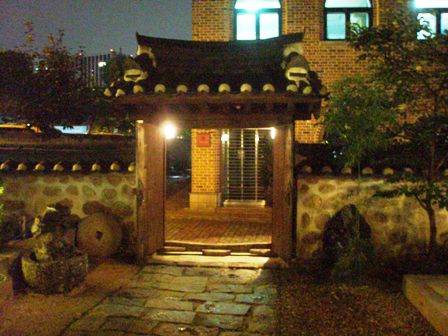
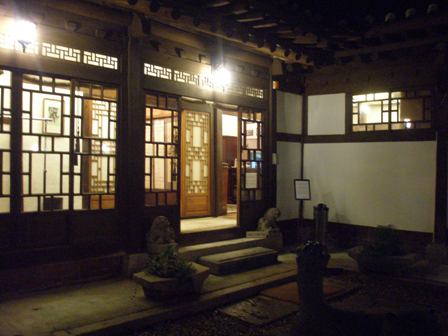
Seoul is a fabulous place, a modern city with many restaurants and eateries. Korean food is amazing; and distinct from other Asian cuisines. We were invited by our South Korean hosts to have dinner at Min’s Club, a Western style fusion restaurant housed in a traditional style Korean compound (the residence of Queen Min), the most beautiful surrounding one can imagine under such circumstances.

The gate

The main hall of the restaurant

The menu of the Min’s Club

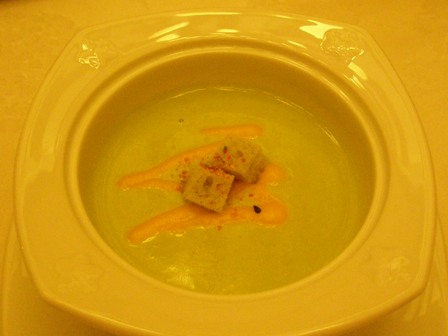
Our hosts had ordered a set-menu. It started with a fabulous tuna fish – incredible, the texture and the flavours -, followed by a pea soup (also with a very intense taste), reminding me of winter days in my native Trier, Mosel.

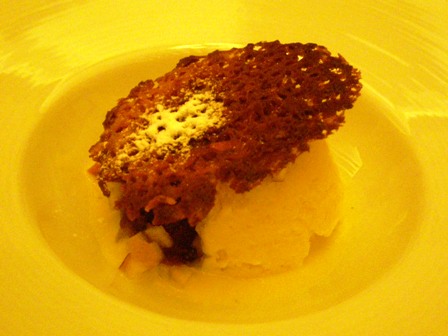
The next dish was a mussel decorated “fine cuisine style”, followed by a white fish with lemon on a bed of vegetables. I even did not say no to the dessert, vanilla ice cream with a crusty waffle cover.

The tuna carpaccio

The pea soup

An artisan’s mussel

White fish with lemon on vegetables

Dessert: ice cream with a hat

The rice water to conclude the meal

I might have missed to photograph a couple of dishes.

Interesting was that at the end of meal, a kind of sweet rice-water was served. It balanced the stomach acids which were heavily tilted towards acidity by the many fermented vegetables consumed as side dishes.

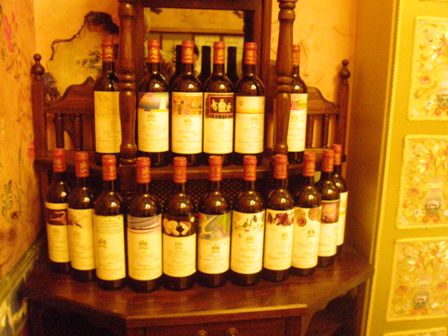
We drank French red wine with the meal, wine from one of the many Mouton Cadet Bordeaux lines. I could not find out which one. It would have been impolite towards out hosts to ask, I guess. My picture-taking was already embarrassing enough.

Red wine cabinet

The décor

The décor of our dining room was just beautiful with lots of Chinese calligraphy, wall paper made out of fabric with flowery motives, and antique European furniture.

A very happy camper

Our dinner was very lovely with lots of interesting and stimulating discussions and conversations. What a wonderful evening. If you are in Seoul look out of Min’s Club; it’s worth it.

Address:
Min’s Club – Fusion restaurant
66-7 Kyungun-Dong Jongno-Gu (Insadong),
Seoul, South Korea
Tel.: +82-2-733-2967 begin_of_the_skype_highlighting              +82-2-733-2967      end_of_the_skype_highlighting
http://www.minsclub.co.kr (Korean only)


Restaurant review: Chez Clément, Paris, France

September 8, 2010

Champs-Élysées

During our summer vacation we also visited Paris for a few days. It is only about 2 1/2 hours by train from my hometown Trier. So why not seeing the French capital?

One of the highlights of the visit was a lunch on the Champs-Élysées. We chose a nice “little” place (the inside is huge but quite lovely, as we discovered when looking for the bathrooms) called ‘Chez Clément’ , a chain restaurant though, but nevertheless very attractive.

The entrance of Chez Clément

Oysters was one of the starters we could not refuse. The unpasteurized Camembert was the other. For the main course three of us went for the Toulouse sausages, one took the Charolais beef tartar. The house white was just the right wine, a Sancerre if I am not mistaken.

The food was just divinely delicious. The service was great. It might have helped that we arrives slightly before the lunch time crowd did. It was one of the best meals we had in Paris during our stay. I can highly recommend the place. Just walk up to the triumphal arch and look out for Chez Clément.

Oysters from Brittany

Croustilland de Camembert

Toulouse sausage

Charolais beef tartar

Rucola salad with parmesan

And a espresso afterwards

Address:
Chez Clément
Champs-Élysées
Paris, France
http://www.chezclement.com

PS: I was traveling in Vietnam and had no access to wordpress.com for that time. This is why I had to postpone updating my blog. The above story is form this summer.