Riesling, Riesling….heaven on a stick

March 16, 2009

wildpig

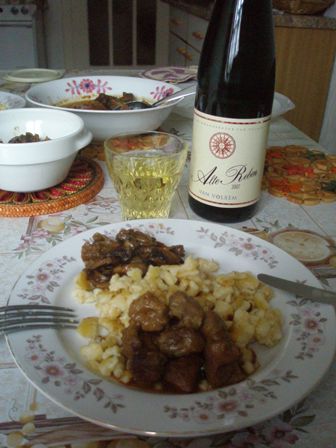
My welcome meal consisted of wild boar goulash, mushrooms and Suebian dumplings (Spaetzle). What a treat, so delicious. I washed it down with a bottle of my house wine, a ‘2007 Alte Reben, Van Volxem Riesling’ from Wiltingen, Saar river. I just love the Van Volxem wines.

wildpig1

The very same day, a parcel arrived for me containing a bottle of wine which I won when participating in an opinion survey of a German wine magazine, Weinwelt (www.weinwelt.info). I could not believe it. What a pleasant surprise this was. The wine is a “grand crue” (GG: Grosses Gewaechs) from the Pfalz, a ‘2007 Forster Ungeheuer GG, Reichsrat von Buhl in Deidesheim, Rheinpfalz. I decided to taste this wine another time and cellared it in my “treasure trove”. Thank you Weinwelt.

wildpig2

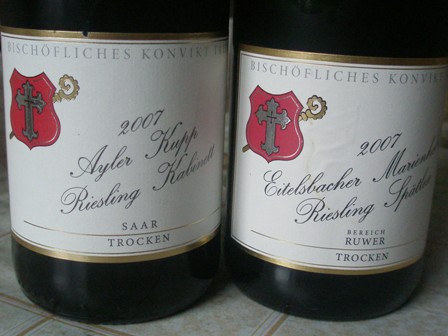
However, I could not resist to buy some more bottles of Mosel Riesling. I decided to try wines from Bischoefliches Konvikt. The two terroirs are very famous, one is Ayler Kupp at the Saar, the other is Eitelsbacher Marienholz from the Ruwer, another tributary of the Mosel.

The ‘2007 Eitelsbacher Marienholz Riesling’ I had with another serve of wild boar goulash the next day. It had all the zest I expected from a fresh Riesling from the Ruwer. The wine from the Saar I packed into my suitcase. Destination: Bangkok and reserved for a leisurely Sunday family meal in the tropics. I can only say: visit the Mosel and its tributaries. Here you’ll find heavenly Riesling wines. Cheers and zum Wohl.


Finally a wine fridge

February 27, 2009

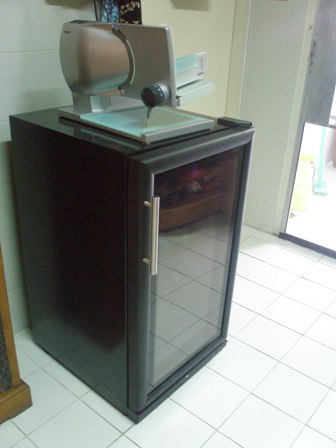
After so many years living in the tropics we finally decided to buy a wine fridge. Storing fine wine in a tropical climate is just no fun. In Jakarta we had a larder which was permanently air-conditioned. Wine would keep for some time but it was stored their with all the other food items a family of four needs.

wine-fridge0

Isn’t it a nice piece of furniture?

We bought only a small wine fridge here in Bangkok. Our kitchen is small and we did not want it to be too big. Anyway, strangely enough wine does not keep in our family. The fridge holds about 30 bottles which is usually sufficient. No cellaring folks.

wine-fridge1

Treasures, somehow

You might want to know what wine I store in this fridge. Well, some bottles of our house wine (Bushman’s Gully), some bottles of Thai wine (Gran Monte), some “rarities” given to me by friends (wines from China, Myanmar) and one lonely bottle of Saar Riesling (Van Volxem) for a Sunday treat.


Wild pig from Schoden, Saar

January 31, 2009

schoden111

The village of Schoden (left) at the Saar River

The Saar is one of my favourite tributaries of the Mosel river. I love its wines, the landscape, the villages and the people. In early December I was roaming the region again, and visited Schoden, a small village near Wiltingen, where my friend Heinz and his mates have rented a hunting territory for many years.

schoden12

Herrenberg, one of the best terroirs in Schoden, left the Saar river

There is also a vineyard and boutique winery called Herrenberg which is owned and operated by Claudia and Manfred Loch. The vineyard above belongs to them. Their wines are hand crafted and award winning.

schoden13

The vines are ready for pruning, single vines where two canes are tied down

schodenkeiler1

A young wild boar killed in early December offering good quality game

The forest along the Saar are inhabited by various wild animals. Particularly numerous and very difficult to hunt down are wild pigs. Wild pigs inflict huge damages to fields, orchards, paddocks and from time to time even on vineyards. But if a young pig has been successfully killed, the meat makes a wonderful lunch or dinner or both.

schodenkeiler21

Liver and kidneys of the wild pig above

Here is a wild pig goulash recipe:
-500 to 800 gr. of wild pig meat
-some bacon
-onions
-some oil
-tomato paste
-150 ml red wine
-350 ml of extract from boiling game
-sour cream
-laurel, tyme and juniper berries
-salt and pepper.

If you want to enjoy it with mushrooms, you could add a selection of various wild forest mushrooms, preferably “funghi porcini” (Steinpilze in German). I just love them; they are great with wild pig.

The cooking process is like any other goulash. Add the sour cream at the end so that the goulash is not too watery.

My tip: buy the wild pig meat from the hunter if you can and make sure the animal was “not too old” (buy meat from year-old animals). This is easy if you live in Germany.

As the pairing with wine is concerned, I suggest a good red (14% alcohol), preferably a Malbec from Argentina or a Tempranilo from Spain or a Barolo from Italy. A GMT from Australia, maybe from McLaren Vale, would also do. Of course you could also have a Saar Riesling with it. From Schoden I recommend a Riesling from the Loch family of Herrenberg.


As the river….

October 24, 2008

Most German wine regions (not all) take their name from the river which runs through the territory planted with grape vines. This is true for the Mosel, Saar, Ruwer, Rhine, and Nahe to name but a few. Vine growing in my native Germany is intrinsically linked to rivers and river systems which is partly due to the availability of steep slopes catching the last beams of sun.

The village of Schoden at the Saar river, in the background, the location Ayler Kupp (photo taken from the location “Herrenberg”)

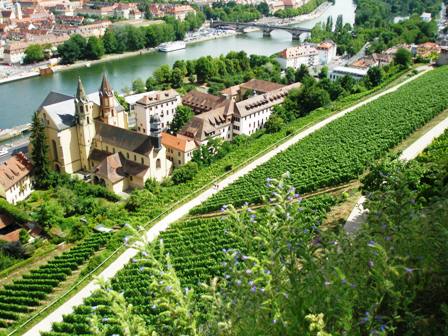
Recently my writing style has been characterized as “meandering” (by David Harden, thanks David) and meandering I do. In fact the purpose of my whole blog is meandering. Meandering between the old and the new world and its wines, meandering between my actual live in a big Asian metropolitan city and my desired live in a rural place in Victoria, Australia, meandering between the many identities I have acquired over the years working in Asia and my future as an Australian vintner and wine maker.

Wuerzburg at the Main river and its vineyards

The second part of the title sentence goes as follows: “…so the wine”. This is certainly true for Germany. I have to find a similar “alliteration” for Glenburn and the Upper Goulburn Wine Region.


Trier, Mosel: Wine Auction 2008

October 4, 2008

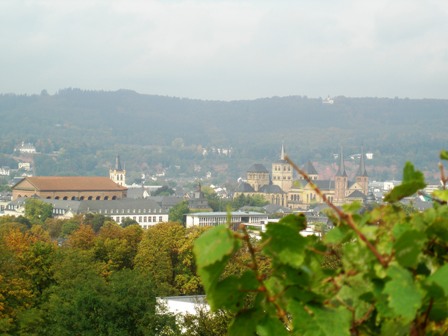
The wine city of Trier (from the Petrisberg side)

According to the website www.riesling.de the annual wine auction of the “grosser Ring” (freely translated as ‘big ring’) a subdivision of the regional section of the Association of German Prädikat Wine Estates (that is how on the website of the association, the German title: “Verband der Deutschen Prädikatsweingüter” is translated) was a full success. The association has about 200 members German wide. About 13,000 bottles of wine were auctioned off. The sale brought in an amount of € 1.3 million.

The top prices were earned by wines from Weingut Egon Müller (Saar), Weingut Joh. Jos. Prüm, and Weingut Dr. Loosen, all top producers of the Mosel wine region.

The most expensive wine of the auction was a single bottle of a ‘1959 Wehlener Sonnenuhr Riesling Trockenbeerenauslese’ by Weingut Joh. Jos. Prüm which was sold for € 5.097.96. Wow, isn’t that amazing.

But also prices for recent vintages were quite high. A ‘2007 Scharzhofberger Auslese Goldkapsel’ by Weingut Egon Müller sold for € 582.62 , a ‘2007 Graacher Himmelreich Auslese Lange Goldkapsel’ by Weingut Jo. Jos. Prüm for € 485.52 and a ‘2007 Erdener Prälat Auslese Lange Goldkapsel’ by Weingut Dr. Loosen for € 449.11

Wine bar Kesselstadt in Trier just opposite the church of Liebfrauen

The auction lasted for more than 5 hours much longer than a marathon run. The general trend as far as bottle size is concerned seems to be heading towards magnum bottles. For wines filled in such size bottles premiums were paid.

The tasting prior to the auction revealed the very high quality standard of the 2007 vintage Rieling wines. On www.riesling.de you can find the detallied rating of the individual wines and the prices paid for the various lots sold.

Even for ordinary mortals like me, the auction is good news. The superior quality of the 2007 Mosel Riesling vintage will also apply for more everyday wines which I can afford. Next time in Trier I will indulge myself again. Why don’t you come with me.


Wine tasting at Van Volxem Estate in Wiltingen, Saar

September 8, 2008

In April this year, my friend Heinz and I, we had visited the Van Volxem Winery (www.vanvolxem.de) in Wiltingen, Saar for the first time. Unfortunately, all wines were sold out then. Dominik Völk, the wine maker, served us a delicious coffee instead and we were invited to visit again in the month of July when part of the new vintage would be released.

Steep slopes for maximum exposure to the sun at the Saar

And that’s what we did. This time I brought my whole family (mother, wife, children). Our appointment was at 14 h in the afternoon on a rainy summers day. Ms. Niewodniczanski, the wife of the owner Roman Niewodniczanski, served us six newly released wines, all of which were excellent representatives of the Saar region. Van Volxem calls these wines ‘classic dry wines’, though residual sugar in Van Volxem Riesling wines may go up to 9 g./l.. For Franconian vintners, for instance, 7.5 g./l. is the agreed maximum. Van Volxem, however, believes that the higher residual sugar content contributes to the overall harmony of its wines. The only exception to the dry wines we tasted was a semi-dry ‘2007 Rotschiefer Riesling Kabinett’.

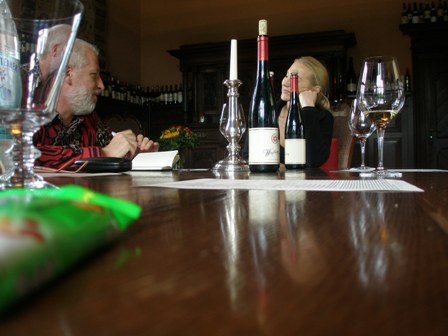
Contemplating about Riesling wines with Ms. Niewodniczanski

Five of the six were Riesling wines, one was a Pinot Blanc. The following list shows the six wines:

– ‘2007 Weissburgunder’ (Pinot Blanc), 9.90 Euro/0.75 l
– ‘2007 Schiefer Riesling’ (“slate” Riesling), 8.60 Euro/0.75 l
– ‘2007 Saar Riesling’, 9.80 Euro/0.75 l
– ‘2007 Wiltinger Braunefels Riesling’ (a single location/vineyard wine), 12.50 Euro/0.75 l
– ‘2007 Alte Reben Riesling’ (from old vines), 13.80 Euro/0.75 l
– ‘2007 Rotschiefer Riesling Kabinett (red slate), semi-dry, 9.90 Euro/0.75 l

We liked all of them but some more than others. Heinz bought some bottles of Saar Riesling and the semi-dry Rotschieder Riesling Kabinett. Apart from Saar Riesling I bought some bottles of ‘Alte Reben’ (old vines).

The Van Volxem tasting room is a wonderful place, with old wooden furniture and beautiful old maps on the walls.

The estate will release the Grand Cru wines later this summer. We were to early to taste them.

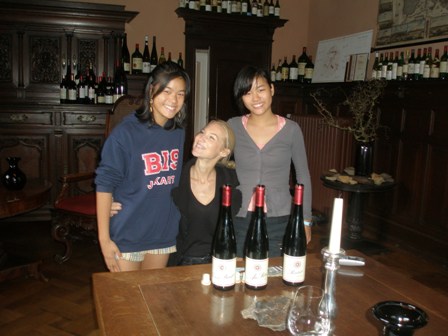
Farewell, but we will come back (my daughters Lucy and Charlotte with the vintner’s wife).

If you are interested in German Riesling, you have to visit the Saar region. Wiltingen is a must, so is Van Volxem Estate. Have fun tasting the best German Riesling has to offer.

Address:
Van Volxem Estate
Dehenstr. 2
54459 Wiltingen, Saar
Te.: +49-6501-16510
e-mail: vanvolxem@t-online.de
www.vanvolxem.de


Another year gone bye

August 23, 2008

Because of our move to Bangkok, Friday was a busy day. Packers everywhere, the house is like a nest of wasps, it seemed. Not easy under such conditions to find some peace of mind, but I did.

Another year had gone bye. My daughters had woken me early in the morning to wish me happy birthday. More well-wishers would come to join them over the day. My birthday dinner consisted of a ‘Risotto ai Funghi Porcini’, hm, that was beautiful as we say in Australia. I have loved risotto ever since we lived in Rome, Italy. And ‘funghi porcini’ is just the best “profumo” you can imagine.

What a wonderful ruby red colour the Shiraz from Hanging Rock has.
Risotto ai Funghi Porcini

Unfortunately, we did not have an Italian wine to go with it. Since my wine cellar is almost empty, I had not much choice. There were only three bottles of Australian wine, all red, left,

a ‘2004 Two Hills Merlot’ (reserved for the last evening in our house),

a ‘2001 D’Arenberg Coppermine Road Cabernet Sauvignon’ from McLaren Vale (I had paid US$ 40 for this bottle) and

a ‘2004 Hanging Rock Cambrian Rise Shiraz’ from Heathcote.

The two whites I have reserved are for lunch on Saturday and Sunday:

a ‘2005 Kitzinger Hofrat, Silvaner dry’ from Bernhard Voelker, Kitzingen in Franconia

and

a ‘2003 Saar Riesling’ from Van Volxem Estate in Wiltingen, Saar.

The tasting room of Van Volxem Estate in Wiltingen, Saar (picture taken in July this year)

I chose the ‘2004 Hanging Rock Shiraz’. The bottle was given to me by Andrew at the cellar door when we went on a wine tasting in August last year. If you visit the region of the Macedon Ranges in Victoria, you have to see this vineyard and taste its award-winning wines (see also my blog entry from 09. September 2007).

Hanging Rock has also a vineyard in the Heathcote wine region, Central Victoria where its award-winning Shiraz wines are grown which enjoy an enormous demand from consumers in China.

The Hanging Rock winery in the Macedon Ranges. In the back you can see the rock. The photo was taken in August 2007.

The wine is a blend from several vineyards near the Mt. Carmel range. It is beautiful, has a ruby red colour, and very intense plum and cherry aromas; it is very fruity, has immense depth, a good structure and actually everything you want from a Shiraz from the Heathcote wine region with its hot summers. The Cambrian soils of the Heathcote region are the key to the fame of its Shiraz wines.
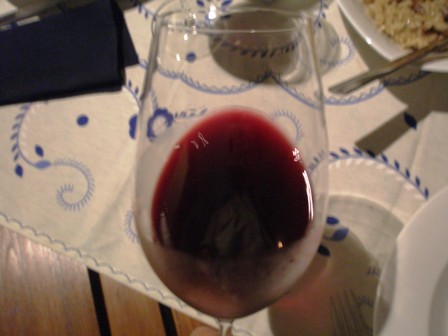
Isn’t the ruby red colour of the Shiraz of Hanging Rock wonderful?

Pity the wine did not match the food (my mistake). The ‘funghi porcini’ were too delicate and subtle and the wine just overpowered the fragrance of the earthy mushrooms. We did not care this time, enjoyed the tropical garden view and the sweet heat of a dry-season evening. One last time. I wonder where I will celebrate my next birthday. Over these thoughts I blew the smoke of a Partagas cigar which was given to me by my friends Liz and Walter in Jakarta. Delicious!

Asian Food and Riesling Wines

August 17, 2008

The Riesling wines I selected for Sunday lunch were just the right complement to the Asian food we were having for the last joint family lunch in our Jakarta home. Tomorrow our girls will be laving for Bangkok to attend the opening of the new school year at their new school.

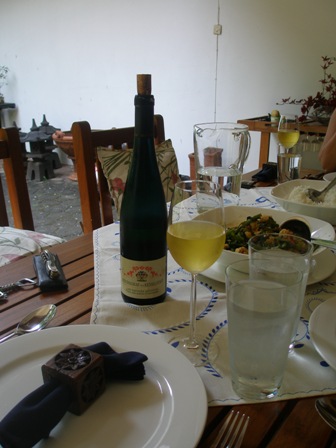
The lunch consisted of a typical Indonesian composition of Kankung (a green water vegetable) with prawns. We ate it with rice using spoons and forks only as it is the custom in Indonesia. The wine we had with the meal was of course not an Asian invention but a Celtic one.

The semi-dry Riesling (“Feinherb” as the Germans say) from the Saar was a perfect match for the food. We had the last bottle of ‘2003 Wiltinger Gottesfuss Riesling Kabinett Feinherb’ , (alc. 11% vol.) from Reichsgraf von Kesselstatt in Trier (www.kesselstatt.com). The spicy food was just the right dish to have with this Riesling wine from my home region.

The sun was shining, my garden green and lush despite the dry season, and so 10 years came to a beautiful end for the four of us.

PS: As “dessert” we had a second bottle of German wine (which was also the last one in my possession), one coming from the Nahe wine region where my grandfather used to live, ‘2003 Sitzius Kreuznacher Rosenberg Spaetlese, Scheurebe’ (with only 9.5 alc./vol.) from Weingut Alfred Sitzius in Kreuznach-Bosenheim (www.weingut-sitzius.de). The variety is mainly found in Germany and Austria and produces highly aromatic wines often made into sweet wines but also available in its dry incarnation. It shows honey, blackcurrant and grapefruit flavors but retains also some of the Riesling character, though it is less acidic, in short beautiful wine can be produced from this grape variety.


Augusta Treverorum – home at last

July 24, 2008

My hometown of Trier (lat.: Augusta Treverorum) from the ‘Kockelsberg’

Alas, we made it. Grandparents were very happy to see us. Blue sky and summer sunshine greeted us. A splendid holiday awaited us. In short, Germany at its best. We are so lucky.

The Mosel river

Margit and I, we went to check out our favourite “watering whole”: the wine bar of Reichsgraf von Kesselstatt opposite the cathedral and the church of “Liebfrauen”.

The ‘garden’ of the wine bar

Riesling was our choice. We had a ‘2007 Kaseler Riesling dry’ (subregion: Ruwer) and a ‘2007 Wiltinger Riesling dry’ (subregion: Saar). Both wines were young and fresh, which make them a delicious drink in a hot summers day. We both preferred the wine from Wiltingen, Saar.

Cheers, and “zum Wohl” as the Germans say.

PS: I am loading this up from a small flat in Madrid which we rented. The internet connection is weak and blogging difficult. Please bear with me.


Family meals and the emptying of my wine “cellar”

July 4, 2008

Our last 60 days in Jakarta have started. Soon we will be moving to Bangkok. We try to enjoy every day. Apart from sorting out things, we are spending our time at home with family meals and drinks.

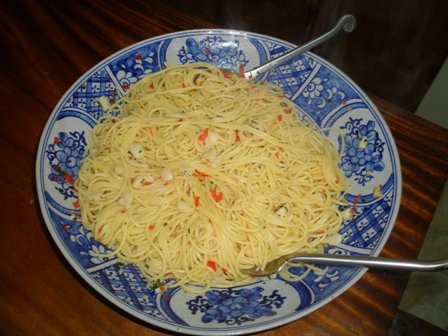
A delicious seafood pasta

I do not have a large supply of fine wines left but some of the bottles I have kept for special occasions. So what did we drink over the last couple of days? Here is a quick run-down:

‘2002 Léon Baur Gewürztraminer Grand Cru Pfersigberg’, alc. 13.5 % Vol.
We drank it before lunch as an aperitif. This is an aromatic wine, very generous in its flavours. It comes from a limestone “terroir” and is the gem of the Léon Baur collection. Low yields make great wines. It’s rather high in alcohol and has 15.2 g/l in sugar. A very enjoyable Gewürztraminer typical for this grape variety (www.leon-baur.com)

‘2003 Wiltinger Gottesfuss, Riesling Kabinett Feinherb, Reichsgraf von Kesselstatt’ , alc. 11 % Vol.
As you know, I love wine from the Saar River, and Wiltingen is one of the major location to produce first class Riesling wines. “Feinherb” is the German word for semi-dry. “Gottesfuss” is one of the best locations in Wiltingen, a very steep, stony slate ground which produces a fine, acidic, and balanced wine. Normally I prefer dry Rieslings but with a spicy Asian meal, the semi-dry version does very well. (www.kesselstatt.com)


‘2005 Hollick Coonawarra Reserve Chardonnay’,
alc. 13.5% Vol.
We had it with a seafood pasta. What a delicious Chardy this was. Although cellaring for up to 7 years is recommended, the bottle did not last that long. It displayed aromas of white peach, had crisp acidity and balanced creamy overtones. Though the wine was matured in French oak for 10 month, it was not “over-wooded”. Beautiful (www.hollick.com).

‘1999 Mildara Coonawarra Cabernet Sauvignon’, alc. 13.5% Vol.
The Mildara brand belongs to the Fosters Group (www.fosters.com). Liz and Walter brought it with them and we had it with all kinds of cheeses, salamis, coleslaw, salads and all kinds of “nibblies”. Despite its age, it displayed all the freshness of a typical Coonawarra wine. The colour was a deep purple. The intense aromas ranged from cassis, to dark berries and plum with hints of mint and herbs. The 18 months in oak have given the wine great depth and bony tannins, mellowed by age. The wine had an excellent structure. It was well aged.

‘2004 Knappstein Clare Valley Enterprise Vineyard Cabernet Sauvignon’, alc. 14.5% Vol.
The bottle retailed for US$ 26.50 at the Jakarta duty free store in Jalan Fatmawati. I had it reserved for a special evening. the wines is Clare Valley Cabernet Sauvignon at its best. Wonderful creamy, cassis, blackberry and mulberry flavours. A big Australian wine, full and complex but heavy which lingers on long after you swallowed the last drop. The fruit is grown on the “terra rossa” soils. Low yields guarantee the quality of the fruit. 2005 was an excellent year with a long ripening season. We had it after a meal just for enjoyment. This is a great wine indeed. (www.knappsteinwines.com.au)

The farewell dinner with our Australian friends (Brett, Janie, John and Dhanya) last night was a delight. We drank some very good wines. I only mention them in passing. Hope you don’t mind. We started with a pre-dinner drink, a ‘2006 Vasse Felix, classic dry white’ from Margaret River, Western Australia. The entreés we washed down with a ‘2007 Yarra Burn Sauvignon Blanc Semillon’ from the Yarra Valley, Victoria. We switched to red before the main course (a pasta bolognese), first to a ‘2004 Cape Mentelle Cabernet Merlot’ and then a ‘2003 Vasse Felix, classic dry red’. Three Margaret River wines stood against the cool climate SB form the Yarra Valley. It was a wonderful evening. No sadness was to find only the joy of being together and having a good time. I love this Australian attitude to life.