Wild pig from Schoden, Saar

September 15, 2010

I am afraid some of you might not like this post and the pictures which I present today. But meat comes from animals and they have to die so that we can enjoy the meals we make from it. Wild pigs are a real pest in Germany theses days, and very difficult to hunt and kill. My friend Heinz shot the little boar in Schoden, Saar.

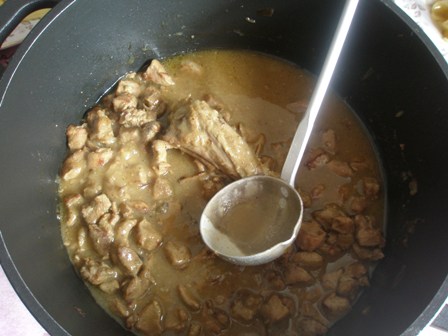
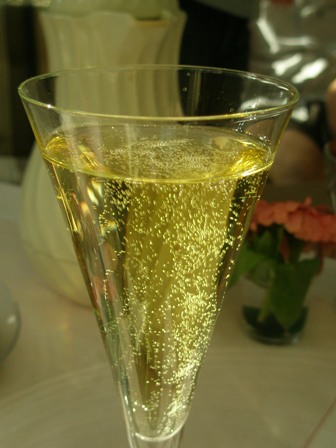
My mother prepared a wonderful Sunday lunch with the best parts of the meat. We enjoyed it together with a bottle of our Merlot (2004 Two Hills Merlot), and I tell you that was just heaven on a stick, as we say in Australia.

Wild piglet hide

The carcass

…from a different side.

The butchered boar meat

…and in the pan

…and finally on the plate

How tender is this?

My favorite Australian Merlot


Venison from a roe deer for Sunday lunch in Trier

August 24, 2010

My stories from July and August do not come in any particular order. When arrived in early July in Trier at my mother’s place we were greated by a feats, as always. And beecause her partner Heinz is a hunter we often eat game. This time it was venison from a German roe deer (in German: Reh) he had just shot. Needless to say that my mothers cooking is just delicious as you can see from the pcitures below.

Tender venison, a meal in the making

With noodles of course

2008 Saar Riesling Van Volxem Estate

The wine I choose for this meal was a Riesling from Van Volxem Estate in Wiltingen, near Schoden (where the venison was from), one of my favourite producers from the Saar. Tough this is just a “simple” wine, it deplays all the character of a Saar Riesling, fine and delicate which machted the tender venison just perfectly.

Address
Weinmanufaktur Van Volxem
Roman Niewodniczanski
Dehnstrasse 2
54459 Wiltingen, Saar
Ph.: +49-6501-16510
e-mail: vanvolxem@t-online.de


Back from the Mosel River

August 12, 2010

Photo taken in Paris at the City Museum

The Man from Mosel River is back in action. After a long, long flight yesterday, we got home to Bangkok safely but exhausted. The summer holidays are over. Needless to say that we had a great time in Europe.

I gained extremely valuable experience with old and new wines and in the process of wining and dining three to four kilos of additional weight. I am also “loaded” with stories of wine, food and play “incidents”.

Europe and its people were kind to us. The summer was just wonderful; blue sky and warm, even hot (we had 45-48 Celsius in Rome) at times, with long and glorious evenings which we spent in beer gardens, restaurants and at barbecues with family and friends.

It is nice to be home again. The weather in Bangkok is humid and cooler than when we left Thailand five weeks ago. Moreover, today is a public holiday and I have time to recover from the excruciating flight.

Sparkle sparkle little wine

I was not able to produce any blog entry after the one on Villa Bucci, Italy. Ever since we have visited Paris, the “Muensterland”, Bavaria, and enjoyed wines from the Mosel, Saar, Nahe and Main (Franconia) among others. In the days to come, I will try to work on my material and extract some interesting information which I will post on the Man from Mosel River.

Bear with me and cheers to the good times.


Winery Review: Vereinigte Hospitien, Trier, Mosel

June 2, 2010

vereinigtehospitien1

The St Jacob of United Hospices wine label

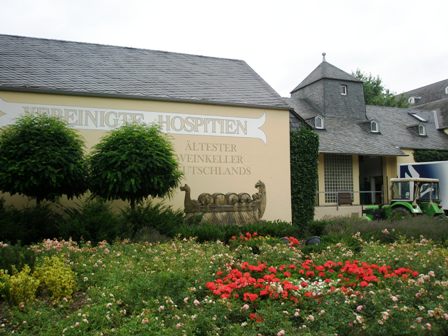
I grew up just next to the convent of St. Irminen at Irminenfreihof No. 5 in Trier, Mosel. The convent belongs to Vereinigte Hopitien, a foundation which also ownes a well known winery with the same name. Their English name is “United Hopices Wine Cellars“. The patron saint of United Hospices is St Jacob, an image of which is also used on the wineries labels.

As a kid I played in the cellars and warehouses of the convent. I also remember them sending their vats and barrels for controlling purposes to the Eichamt, the local Weights and Measures Office, which my father was heading. We played around the barrels and I vividly remember the smell emitted by the oak and the moist wood.

vereinigtehospitien3

The winery

United Hospices owns vineyards along the Mosel (locations: Piesporter Goldtroepfchen and Triere Augenscheiner) and the Saar (locations in Wiltingen, for instance Hoelle, Scharzhofberg and Kupp, Kanzem and Serrig). Most of the vineyard originally belonged to monastries and convents. Today about 25 ha are under vines, 90% of which are planted with Riesling grapes (my favourite grape variety), the rest consists of Pinot Gris, Blanc and Noir.

As many of the wineries in Trier, also United Hospices has a large traditional wine cellar (some parts of it dating from the 3. century) which you should have a look at. Wine tasting in ths historic atmoshere are unforgettable events. United Hospices top wines are the dry and sweet (Trockenbeerenauslese) Scharzhofberger Riesling wines from the Saar some of which sell for up to 100 Euro/bottle. The ordinary Riesling wines cost about 6.20 Euro/1 l. bottle.

I hope you are going to visit Trier this summer and drop in for a wine tasting. Cheers

vereinigtehospitien4

The main hospice building along the Mosel

vereinigtehospitien2

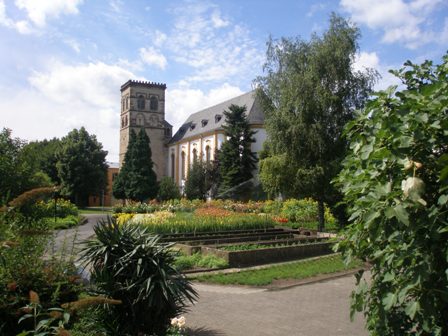
Church St Irminen

Address:
Vereinigte Hospitien
Krahnenufer 19
54290 Trier
Tel.: +49-651/945-1210 o. 0651/945-1211
Fax: +49-651/945-2060
Opening hours: Mo. – Thu. 08-12:30 and 13:30 to 17h; Friday closing at 16h, Saturday 10-14h


Restaurant review: Gasthaus Bidinger, Schoden

May 5, 2010

Bidinger00

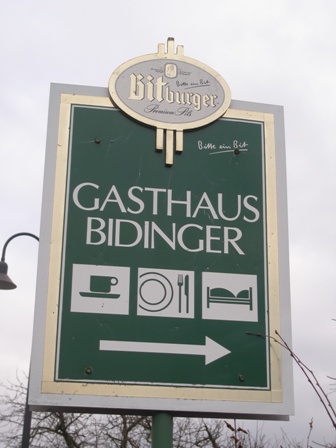
Show me the way

It’s a public holiday in Thailand today (coronation day), and this might be the reason why I am in a reminiscing mood, the dominant “mood of old people”. But Gasthaus Bidinger (Gasthaus/Gasthof = inn) in the hamlet of Schoden, Saar would be a nice place to visit today. Lunch at Bidinger is one of my favourites when with my mother in Trier, Mosel. The food is traditional German country tucker, solid and substantial, and very enjoyable.

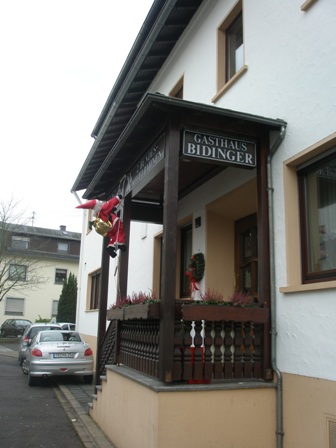
Bidinger0

Gasthaus Bidinger, front entrance

Apart from rustique rural food, Gashof Bidinger offers also a nice selection of traditional drinks, for instance Bitburger Pils beer and the local apple-pear cider, called “Viez”. Viez is usually a quite sour, low alcohol drink widely consumed by the local peasantry. Mixed together with some sparkling water it is very refreshing in summer. Moreover, Bidinger also bottles his own local wines. The Saar produces some of the best Riesling wines in Germany, and is one of my favourite wine regions.

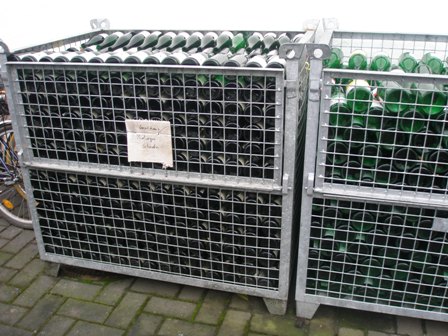
Bidinger2

Many empty bottles

Bidinger3

“Moselaner” apple cider, locally called: Viez

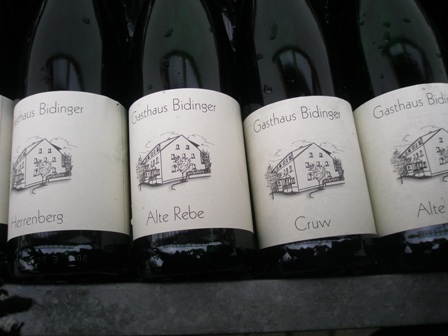
Bidinger1

Wines from the Saar

I would love to be at the Saar today. If you have the chance to visit, do so. It’s a jewel, hidden away somewhat but still easily accessible. A visit to the Saar can be combined with a trip to see Trier, the oldest German city and Luxembourg, just next door.

Address:
Gasthaus Bidinger,
Klosterstr. 30,
54441 Schoden
Tel: +49-(0)-6581/99260
Fax: 06581/99261
e-mail: Gasthaus-Bidinger@t-online.de
www.gasthaus-bidinger.de


The top German Vintners or the VIP club of German wineries: VDP

March 1, 2010

The logo of the VDP

VDP stands for “Verband Deutscher Praedikatsweingueter”. The German can be freely translated as “Association of German Wineries of Excellence”. The VDP is a club-like organisation with 196 member wineries.

It was founded in 1910 and celebrates this year its 100th anniversary. According to its website, VDP is the oldest association of the top quality wine estates. membership requirement is to adhere to the standards of the association which includes among others the strict limitation of yields. There is an inspection and certification process in place which members must submit to in oder to not loose the membership status. It is supposed to uphold the high quality of the produce.

The sign of quality are the eagle (no surprise for Germans who have made it part of their national insignia) and the cluster of grapes, usually embossed on the bottles of their “Erstes Gewaechs” comparable to France’s “premier cru”, wine made from grapes from the best terroir or locations.

The members of the association sell about 35 million bottles per year, for an average price of about 9 Euro /bottle. 80% of their production is sold on the domestic market, 20% is exported. Almost half of the bottles are sold directly to consumers.

The members come from all German wine regions. More than half of them (acounting for about 6% of all Riesling plantings worldwide) produce the finest Riesling wines Germany has to offer. In 1990 it had 161 members. Since then 73 wineries have left and 108 have joined the association.

According to www.riesling.de it’s newest three members are:

Klaus Zimmerling, Saxonia
Konrad Schloer, Taubertal
Thomas Seeger, Baden

Some of my favourite producers are members of the association, for instance Van Volxem Wine Estate in Wiltingen at the Saar.


Sunday walk in the vineyard – a wish

February 21, 2010

“Bildstock” near Nittel, Upper Mosel

Today, I would love to walk through a vineyard with my mother, preferably along the Mosel or the Saar. It is her 80th birthday today. I salute you mum and wish you many more years on this earth.

We could have lunch in one of the many country inns and enjoy a local Riesling wine.

But instead I am far away from the action, in Bangkok, in the tropics. This is one of the downsides if one works in far away places. As consolation I will open a bottle of Saar Riesling later with lunch.


The Australian Wine Industry: oh boy!

January 7, 2010

The new year has started slow for me as a wine blogger. I have a couple of pieces in the making, for instance on my winery tour in Thailand where we visited three wineries and tasted their produce. But reading through the mail on the internet does not lend itself to optimism if you are an Australian vintner like me.

Here are some of the facts, suggestions and ideas for 2010 and beyond:

– rip out 35,000 ha of vineyards to restore a balance between demand and supply

– overproduction of 20-40 million cases of wine equivalent to 300,00 to 500,000 tonnes of fruit, ergo the need to rip out between 20,00 and 40,000 ha

– “clean skin” bottled wine available for A$ 1.99 or “two buck chuck”

– wine surplus being sold for 50 cent a litre

– grape prices of around A$ 150-200 per tonne of fruit

– in only seven years, I guess from 1995 to 2002, Australians planted 75,000 ha which was meant to be planted over a 25 year period

– estimated financial losses in the Australian wine industry of about A$ 124 million in 2009

-medium-sized producers such as De Bortoli Wines (our neighbour in the Yarra Valley) posted a loss of A$ 1.6 million in 2008-2009

– vineyards are unsellable, Cockatoo Ridge Wine, for instance, could not sell its Monash Winery (valued at $14.3 million) in Riverland

– more than 300 grape-grower contracts cancelled in the Murray

– Murray Valley Winegrowers removed about 2,000 ha of vineyards.

I could continue this list of bad news (for instance mentioning the strong Australian dollar) but do not want to depress you further. However, there is good news too. Consumers can finally enjoy good quality wines at much more affordable prices. I can feel this even in my Bangkok supermarket where Australian wines sell cheaper than last year.

I personally think that Australian wine prices were too high in the past. In my native Germany, many family wineries survived on much lower producer prices for many years. In my hometonw Trier you can get an excellent Riesling wine bought from the producer directly for about 5-8 EURO/bottle (A$ 8-12). These are Riesling wines from ultra steep cliffs, and everything is done by hand. On an aggregate, of course, German farmers and vintners are supported by various government subsidy schemes which we (alas) do not have in Australia.

Peolpe who say, that “the Australian wine industry did not know where to stop” are of course mistaken in their analysis. In a market economy the “overshooting” is punished by declning prices and unsold produce which in turn will lead to the reduction in production capacity. But since wine is an agricultural good which relies on a three to four year growing period before you can have additional grapes, the delay in decision-making can be costly.

The “irrational excuberance” was in fact the result of rational decision-making. Investors wanted to make a profit. That some of it was tax-fuelled is proof of irrational government interference by providing wrong incentives (tax credits). The second group party blamed for the glut is “lifestyle winemakers and vintners” to which I also belong. I still hope that my long-term view will “save” me and that I can indulge in grape growing and wine making after my retirement for a couple of more years. Since there is no succession plan, our enterprise might be short lived but such is life.

Cheers folk, after such heavy stuff I need a drink. Maybe, as Jancis Robinson suggest in her latest column, a German Riesling. How about a Forster Ungeheuer from the Pfalz or a Van Volxem Riesling from the Saar?

2007 Forster Ungeheuer, Grosses Gewaechs


Climate change and grape varieties

November 2, 2009

RieslingSchoden

Riesling grapes in Schoden, Saar, shortly before vintage 2009

Uff, I am reading in todays “Your Daily Wine News” newsletter that some of Australia’s top wine experts think that over the next 20 years climate change will be responsible for the decline of Shiraz and Chardonnay and the rise of varieties such as Vermentino, Arneis, Nebbiolo, Pinot Grigio and Viognier (some call them “alternative varieties”).

This is bad news for me and my own small vineyard. At Two Hills Vineyard we have concentrated on some of the traditional French varieties: Sauvignon Blanc, Pinot Noir, Merlot and Chardonnay (first vintage in 2011 or 2012). Our fruit ripens usually well (if we do not suffer severe frosts) and shows a superior quality. But will that persist under the conditions of climate change?

I still remember vividly how I pulled out the 2 1/2 acres of Cabernet. it was hard work, wrapping a chain around every single vine and lifting the hydraulic of the tractor. I should have left them in, I guess. If temperatures rise in Glenburn, the drought persits, and/or we’ll have less percipitation in the future, Cabernet could have been the ideal variety for our spot. I ripped the vines out because the grapes would not fully ripen. At the moment we have sufficient water, our two dams are overflowing after years of drought but that might change quickly again.

Another issue is age, my age. At 55 I might still have a chance to enjoy some of the coming Chardonnay vintages but replanting would “cost” me many years of waiting. I could contemplate to plant on our second hill where we still have another 5-6 acres of space. Well, let us see what is going to come.

At least there is no politician who tells me what to do and chances are small that an elector such as Clemens Wenzeslaus of Saxonia, who changed the Mosel by instructing vintners to ripp out their red varieties and replant with Riesling, would appear on the Australian scene. However, danger is looming from the anti-alcohol lobby in Canberra which is working day and night to convince law-makers that the purchase of alcoholic beaverages needs to be made more costly for the consumer and profitable for the taxmen.


Moufflon leg and Loch Riesling

October 15, 2009

Loch1

When I am at home in Trier, Mosel my mother cooks for me. This time Heinz had shot a young moufflon (a kind of wild sheep) in Schoden. He prepared a leg of the lamb and we had it the traditional way. It was simmering on low heat for ages. The meat was tender and had a fine gamy taste.

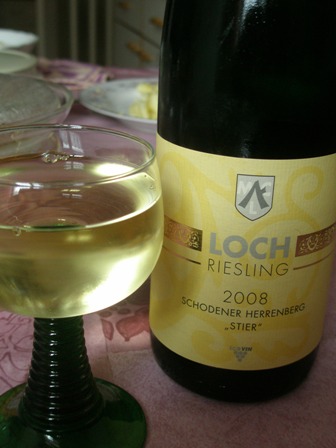
This feast was accompanied by a wine from the same place, a ‘2008 Schodener Herrenberg “Stier” by Weinhof Herrenberg and the Loch family in Schoden. This Riesling shows that it was made by hand. It has a fine character, is minerally and fruity with good acidity and length, a perfect Saar wine to be enjoyed right away or cellared for a couple of years.

Nothing could be more perfect, I thought. The moufflons might have roamed the very location of the Herrenberg, the vineyard where the Loch Riesling was produced. I consumed the fruits of the land, the forests of Schoden and the dedicated vintners from the Saar. I am glad my mum is such a good cook. Cheers

Loch2

It’s vintage time at the Saar right now. Why not go on an outing and drive along the romantic Saar river, visit wineries and enjoy rustic German food?

Address:
Claudia and Manfred Loch
Weinhof Herrenberg
D-54441 Schoden/Saar
Tel.: +49-6581-1258
Fax: +49-6581-995438
info@lochriesling.de
www.lochriesling.de