Restaurant Review: Libertine in Melbourne

January 22, 2009

libertine

During the four weeks in Glenburn, Victoria I made it to the big city (= Melbourne) only once. My friend Tony Arthur had organised a lunch with Joe and Helen and myself at “Libertine”, a French restaurant in North Melbourne.

When Tony mentioned the name of the place we were supposed to meet in town over the phone, I was already enthralled. For a liberal like me, “libertine” augured well, promising freedom of French provenance.

libertine1

The restaurant is tucked away between various other entrances and not easily glimpsed. I came in my pick-up truck from the countryside and had to circle the place.

The dining area downstairs is rather small but I understand they have more facilities upstairs. When I arrived at 12:30 sharp, my friends had already assembled. Most tables were still empty but that would change very quickly. The place was packed just a little later.

Tony, Helen and Joe had been travelling together in France. As a native of Trier, Mosel, just a few kilometres from France I am not exactly a stranger to French culture and cuisine and consider myself a “francophile”.

We started with aperitifs. I was introduced to a Floc de Gascogne. Based on a XVI century local recipe, this is a fortified sweet wine, a blend so to say, between fresh grape juice (2/3) and Armagnac (1/3). It is kept for about 10 months in the cellar. The aromas it displays are almond, jasmine, roses and honey. The alcohol content of the drink varies between 16 and 18%.

Also the second aperitif, a Pommeau de Normandie was a “mistelle”, in this case a mixture of apple juice with Calvados. It’s usually aged in oak barrels for about 30 months and contains 17% alcohol. The drink displays aromas of vanilla, caramel and butterscotch flavours.

libertine2

The Pommeau de Normandie

libertine3

The Floc de Gascogne

The next two photos introduce the diners. A happy lot they were. We had not met for more than a year. It was easy to lure me down to town from my farm upcountry in the Upper Goulburn to meet up and dwell on the happenings of the past months.

libertine5

Tony and Joe

libertine41

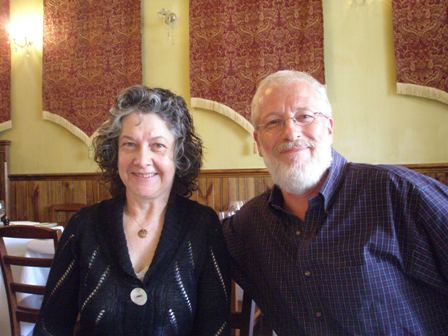
Helen and me

libertine6

My steak

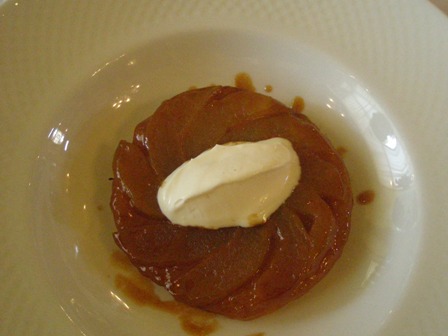
We all ordered the set menue were you have a couple of choices. I opted for the fresh onion soup, followed by a steak. The dessert I choose was a “tarte de pomme”, all very delicious. The service was relaxed but very attentive; the food of an excellent quality and taste for a very reasonable price.

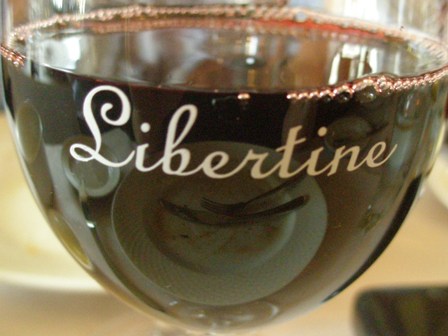
We were also advised on the wines. We went with the house wine, all from bottles, a Roundstone Cabernet Merlot from the Yarra Valley. Helen had a Lis Neris Bianco from Italy. The blokes followed up with a glass of Tempranillo but by that time we were beyond producers and other wine information. I just did not record any of it any more because we were deep in philosophical conversation about love, life and the universe.
libertine7

The dessert

We had a coffee at the end, bid each other farewell and scattered in all direction with the sincere promise to repeat this as soon as possible but latest at our next visit in Australia.

The Libertine is a great restaurant. If you visit Melbourne you should schedule a meal either lunch or dinner with your friends in this atmospheric little place.

Address:
Libertine
500 Victoria Stret
North Melbourne 3051
Melbourne, Victoria
Australia
Tel.:+61-3-93295228
http://www.libertinedining.com.au


Connoisseurs delight: a wine tasting in Berlin of a special kind

January 15, 2009

schlau0

While in Berlin an old friend of mine, Gerhard Schlaudraff, had invited me spontaneously to join and celebrate his birthday in his new home near Warschauer Platz. Since Gerhard is not only a wine lover but a real wine expert, the feast promised to be something special. And indeed, it turned out to be a wine tasting of a special kind.

schlau1

I was about an hour late and many wines had been already swallowed up by gay drinkers. I came just in time for the two reds, the ‘1995 Corton Grand Cru Domaine Bonneau du Martray and the ‘1996 Grand Vin Château Beychevelle Saint-Julien’.

We all agreed that the two wines should have been drunk some time ago, they had, unfortunately, already passed their prime. That’s why we moved on swiftly without loosing too much time.

schlau21

The ‘2003 Kuenstler Reichestal Spaetburgunder’ from the Rheingau was a ripper of a wine. It can hold itself against the best Pinot Noirs from Burgundy. The wine was well balanced despite the “horror” announcement of 15% alcohol on the label. So forget about France and Burgundy and explore this wonderful drop from the Rheingau. More and more Germany is showing itself as a Pinot Noir producer of high distinction. My tip: get a bottle of this wine now and enjoy it, preferably over a good meal, with family and friends.

schlau3

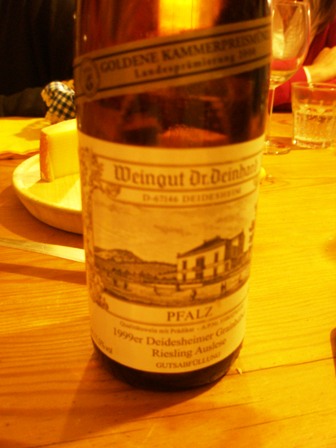
After that we moved on to sweet wines for dessert. We started with a ‘1999 Deidesheimer Grainhübel Riesling Auslese’ from Weingut Dr. Deinhard, Pfalz. This wine was “heaven on a stick”, a dessert Riesling which you want to try. Our eyes rolled in their sockets with delight and our taste buds were exposed to an opulence and richness from which mere human palates are often excluded.

schlau4

The last wine came from my adopted home, Victoria, Australia. It was a Muscat from Rutherglen, a wine region about three hours north from our own place in Glenburn.

The ‘Chambers Rosewood Vineyards Grand Muscat’ was the highlight of the evening. Chambers produces outstanding Muscat wines of superior quality. The average age of its Grand cuveés is about 70 years.

The Chicago Wine Company gives the wine 98 out of a 100 and has given up to describe the wine, because tasting notes would read the same year after year.

For me this wine was the perfect ending to an utterly enjoyable wine and birthday celebration. From here on only spirits with a much higher alcohol content could be taken. I left the diners to it when I made my way home on the subway.


Restaurants in Germany – “Alte Fischerhütte” at Schlachtensee, Berlin

June 17, 2008

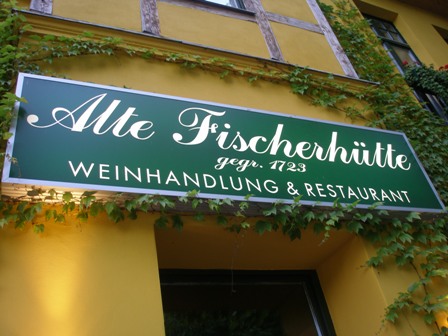
During my time in Berlin I had the opportunity to dine at “Alte Fischerhütte” at Schlachtensee in Berlin, a beautiful located restaurant at the shores of a small lake very popular with citizen for all kinds of leisure activities.

The restaurant is under the management of Lutter and Wegner, formerly the oldest wine merchant house in Berlin and today a chain restaurant owned by a corporation (http://berlineating.blogspot.com/2008/04/lutter-wegner.html).

Lutter and Wegner possesses various restaurants and wine shops around the city of Berlin but also outlets in Munich for example.

The “Alte Fischerhütte” offers many facilities. It is great to sit on mild spring and/or summer evenings on the beautiful outside terrace and enjoy the gorgeous surroundings.

The elegant dining facilities are magnificient, so is the wine list and the food.

Because of the rather formal character of the occasion, I could not take photographs of the food on offer.

We (a group of about 50 persons) were served a set dinner consisting of a three course meal: an entrée – green asparagus soup with scrimps – a main course – veal steak with asparagus, sauce Hollandaise and potatoes – and a dessert – fresh strawberries with vanilla ice cream. The quality of the food was excellent, and the month of May is asparagus season, nothing better on offer than this delicious vegetable.

As an aperitif we had a ‘Lutter and Wegner Riesling sparkling wine, extra dry’. Two wines, a white and a red, were on offer with the meal. The white consisted of a ‘2006 Schloss Vollrads dry Riesling’ from the Rheingau and the red was a ‘2006 Jean Stodden, Pinot Noir’ from the Ahr. Both producers have a long tradition in producing excellent wines, Schloss Vollrads for its Rieslings (www.schloss-vollrads.de) and Jean Stodden for its Pinot Noir (www.stodden.de). The wines matched the food extremely well. I loved the crispness of the Riesling, its intensive citrus notes, the well balanced acids and the beautiful finish. The Pinot Noir (13% vol, residual sugar 2.3 g/l) was also an excellent wine with an aroma of cherries and red berries, great structure and a long finish. I stayed with this wines longer than I should have, I guess. What a great selection that was.

The dinner was utterly enjoyable. I was able to take a quick shot of the Riesling in my glass. Isn’t it beautiful, this fresh, light colour promises just the best German Riesling has to offer. I let any other Riesling wine “get warm along the roadside”, as we say, for the German stuff (ok, its exaggerated, I know. I might make an exception for some Alsation and some Austrian Rieslings). It was a splendid evening and I highly recommend a visit to “Alte Fischerhütte”.

Address:
Alte Fischerhütte am Schlachtensee
Fischerhüttenstrasse 136
D-14136 Berlin
Te.: +49-30-80498310


Easter Sunday Lunch

March 23, 2008

Easter calls for some special celebrations. Because we were at home, the four of us for the first time since a long time, we needed something yummy.

We had a red snapper left in the fridge and decided to prepare it in the style of Guadeloupe and Martinique. The recipe we got from Mark Bittman, “Fish – The complete guide to buying and cooking”, Hungry Minds Co, New York 1994, and it goes as follows:

– 4 firm-fleshed steaks from a large red snapper, scaled, gutted (head on or off as you like it best)
– 2 cups of water
– 1/2 cup fresh lime juice
– salt
– 1/4 cup olive oil
– 1 cup chopped shallots, scallions (both green and white parts)
– 1 tablespoon minced garlic
– 1 hot pepper, deveined, seeds and chopped
– 1 1/2 cups chopped fresh tomatoes,
– 1 bay leave
– 1/4 cup chopped fresh parsley
– 1/2 table spoon minced fresh thyme
– freshly ground black pepper
– lime wedges

You marinate the fish in the water, lime juice and 1 table spoon of salt (make sure the fish is completely covered) for about 30 minutes (drain, refrigerate if the weather is too warm, as it is here in tropical Jakarta).

Heat the oil and cook the shallots, about two thirds of the garlic and the chopped red pepper until soft, then add the tomatoes and herbs, season with salt and pepper and cook for about 5 minutes. Drain the fish and add the above together with some of the marinade, add some more garlic and simmer over low heat for about 10 minutes. Spoon the marinade over the fish and serve with rice and the lemon wedges.

Voilá, that’s what it may look like.

fisheaster.jpg

Court Boullion, red snapper

Needless to say, the red snapper was delicious. We had rice and some steamed vegetables with it. Since we ran out of white wine (how terrible in a vintner’s family), we opened instead a bottle of Pinot Noir. It came from South Baden (Kaiserstuhl), a ‘2005 Ihringer Winklerberg Spätburgunder’, dry wine, 13.5 % alcohol, produced by the Ihringer Winegrowers Co-operative (www.winzergenossenschaft-ihringen.de).

It was a typical Pinot Noir as far as the colour was concerned. It was fresh, fruity and showed well balanced tannins and acids. The aromas were dominated by forest berries. But despite this it complemented the hot chili taste of the red snapper very well.

The bottle was given to me by Birgit Lamm, the director of our International Academy for Leadership in Gummersbach, Germany after I facilitated a training recently. It did not last long. But wine in the tropics needs to be consumed rather earlier than later. Thanks again for this nice gift. I’ll come back for more soon.

jhringer.jpg

2005 Ihringer Winklerberg Spätburgunder (Pinot Noir)

After the meal we had espresso and cognac together with some thin chocolates. I smoked a Juan Clemente cigar (made in Santiago, Dominican Republic) which was excellent. I had acquired them during my recent trip to my hometown Trier, Germany, from Wolsdorff Tobacco where I usually stock up on cigars.


9. Wine Rally – Wines for every day

March 8, 2008

weinrallye.jpg

Sorry folks, but this time it does not work. I cannot avoid to write pro domo. The wine I drink every day, is our own. I have to add that this only applies if we are in Glenburn, Victoria. In the past we had once the opportunity to import our own wine for private consumption in Jakarta. But ever since, due to the vagaries of importing into Indonesia, we were not in the position to establish Two Hills as a ‘house wine’ for everyday consumption.

At Two Hills Vineyard we have so far made two varietal (single vineyard) wines from our grapes:

– a single vineyard Sauvignon Blanc (2000, 2001 and 2002 vintage) and
– a single vineyard Merlot (2001, 2004 and 2006 vintage)

Thomas Weber (www.wein-als-geschenk.de) wrote the following tasting notes for the ‘2002 Sauvignon Blanc’:

“Dezent hellgruener Farbton, Holunder- und vor allem Stachelbeerenaromen vor einm rauchig minieralischen Hintergrund. Kraftvolle lebendige Saeure und ein langer fruchtiger Abgang.”

In English this might read as follows:

“Subtly light green hue, elderberry and especially gooseberry aromas before a smoky mineral background. Powerful lively acids and a long fruity finish.”

And the ‘2004 Merlot’ was described by Thomas as follows:

“Der blutrote Wein duftet aus einem eleganten ausdrucksvollen Koerper vielschichtig nach reifen Waldbeeren. Eine angenehme Saeure vor fein ausbalancierten kraeftigen Tanninen fuehrt zu einem langanhaltenden Finish.”

which translates into:

“From an elegant complex expressive body the dark red wine shows aromas of mature berries. Pleasant acidity before finely balanced tannins, leads to a long-lasting finish.”

Well, thats what Thomas wrote for a blind wine tasting in Trier last year. Since I drink it every day (unfortunately, when I’m in Australia only), usually with a meal (lunch or dinner), I lost the ability to describe the wine anyway.

picture-077w.jpg

This is were we drink most of our wine. On the space at the entrance, I hesitate to call it terrace, of our little house cum vineyard shed. Apart from drinking Two Hills wines, we drink our friends wines. Usually, we swap cases of 12 bottles. We swap with Gayle Jewson and Steve Sadlier.

Gayle has a small vineyard in front of her house in the Yarra Valley, in fact just a couple of acres of Pinot Noir and Chardonnay. The Pinot is a “cleanskin” (Gayle has no label as yet) and it is called ‘Pip’s Paddock Pinot Noir’, a wine which can only be bought directly from Gayle.

The other house wine, we consume, is from Steve. His vineyard is called Nenagh Park. He is mainly a contract grower (about 9 ha under vines) for Yering Station and other well known wineries in the Yarra Valley. Steve’s Chardonnay is to die for, so is his Pinot Noir. He sells his wines (cleanskins) without label to friends and through a private network. Watch out for Nenagh Park in the future.

Visit us, and I will serve you all these wines. Promise.


News from Two Hills Vineyard

January 23, 2008

twohillsinjanuary.jpg

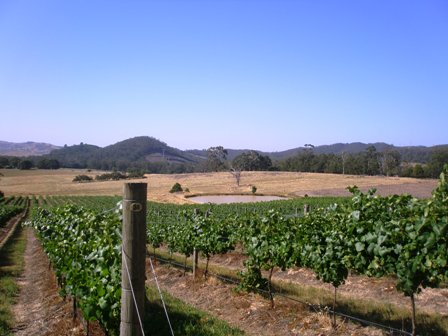
In the back, you can see the two hills which gave the vineyard it’s name.

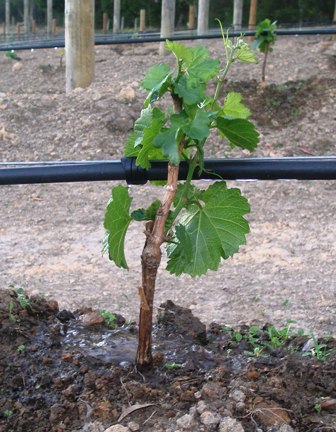
2008 promises to become our best year ever in the almost 13 years history of Two Hills Vineyard. A new block of Chardonnay has been successfully planted in early December 2007 and with this we will be able to produce on site one more ‘single vineyard wine’ in a couple of years from now, to be precise in about 2013. I will hopefully have retired by then from my work overseas.

chardy-1.jpg

Young Chardonnay plant

chardy-2.jpg

Morning in the Chardonnay

chardy-3.jpg

Chardonnay block

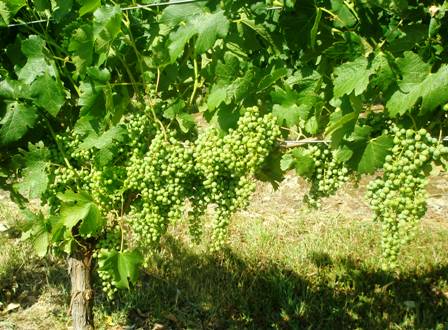
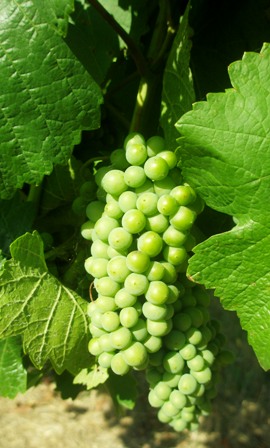
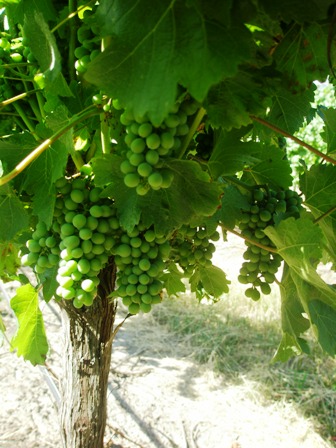
The fruit on the vines of the other three varieties looks really good (as the pictures below show). Despite the already mentioned freak hail storm on December 22nd, the fruit is healthy and in abundance. We expect to harvest about 25 tonnes of fruit from 3.5 ha under vines this year.

Because of the extreme heat we had in early January, vintage time might be earlier than in previous years, maybe in late February; usually it is in the middle or end of March. We in the Upper Goulburn Wine Region (www.uppergoulburnwine.org.au) are usually starting to harvest our grapes later than the colleagues in the Yarra Valley further south.

young-merlot-grapes.jpg

Young Merlot grapes

young-pinot-grapes.jpg

Young Pinot Noir grapes

young-sb-grapes.jpg

Young Sauvignon Blanc grapes

Our old Fiat tractor will be retired in 2008. Because of a generous donation from my mother it can be replaced with a newer model with some more horse power. We will also retire our old Mazda 626 car which is not exactly a useful farm vehicle but which served us well as a means of transport during the short months we spend on the vineyard during the last 12 years.

We will hopefully also get around in sowing one of the front paddocks with a horse loving grass mixture. Then we will have the plot fenced in by Peter Thwaites and turned into a horse paradise where our horse enthusiastic daughters, Lucy and Charlotte, can keep their ponies and other horses when we visit Glenburn.

We have started to irrigate our vines. I hope their will be no large bushfires as in 2007 when extensive smoke tainted many grapes. If the high temperatures persist, the likelihood of fires will rise too.

Finally, we have decided to extend our dwelling on the vineyard. We plan to link the old shed with a new wing to become our house, a proper residence so to speak.

Let us see what 2008 has up its sleeves.


The next big thing: German Pinot Noir

October 10, 2007

d1000110pinot.JPG

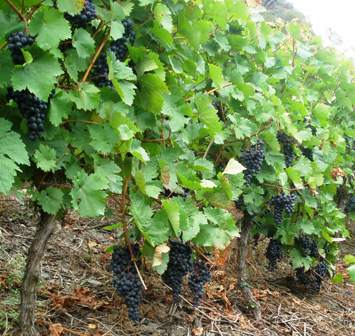
Pinot Noir grape

It seems that I’ve been drinking the right stuff: “Blauer Spätburgunder” as the Germans call it, Pinot Noir is all the vogue in “the German lands”. Traditionally, Germany has always been considered a white wine producer. The recent rediscovery of Riesling and the boom in worldwide Riesling demand supports this view.

Now it seems domestic attention has shifted to the colour red. In particular the Pinot Noir wines show a tremendous rise in quality and consumer demand. Wine experts in Germany praise the progress made and estimate that an increase in demand for German Pinot Noir is going to follow the Riesling boom.

But red varieties are no strangers to Germany, as I have pointed out in one of my recent blog entries (“Old friends, wine from the Mosel and other culinary delights”, 16. September 2007). Where would German red wines be if politicians had not meddled in the vintners’ affairs in the 18th century, as elector Clemens Wenzeslaus of Saxonia did along the Mosel?

d1000133pinot2.JPG

Vintage time for Pinot Noir 2007

My recent explorations of German wines made from the Pinot Noir grape can only confirm the wine writers’ opinions, though they mainly point to the wine regions of Ahr, Baden, Rheingau and Rheinhessen and seem to forget the next big thing, Pinot Noir from the Mosel.

I argue that the quality of Mosel Pinot Noir wines is as good as wines from the other regions and you will get a good drop at much less expense. The Ahr, pioneering Pinot Noir grapes for many decades, has always been considered a high-price red wine region. However, you do not have to spend €12 to 20 per bottle.

My favourite Mosel Pinot Noir wine producer, the winery of Alfons Sebastiani in Mehring offers a beautiful Pinot Noir for €5,40 the 0.75 litres bottle.

Another great Pinot Noir producer on the Mosel is Weingut Markus Molitor in Wehlen. I tasted his 2004 Molitor Spätburgunder at the Weinhaus in Trier (opposite the Karl Marx Haus in Brückenstrasse 7); it is very drinkable.

Less affordable are the Molitor 2004 Pinot Noir wines from the locations Graacher Himmelreich and Brauneberger Klostergarten (€35 to 49 /075 l bottle). These prices are an indicator for the general trend; Mosel Pinot Noir wines seem to be becoming the new cult wines. Wine producers and consumers will benefit from it.

As for the average wine drinker like myself, I do not worry about high prices as long as there are plenty of new wines to find, explore, and taste. My recommendation is to try some German Pinot Noir wines.


Karl Marx and Mosel wine

September 26, 2007

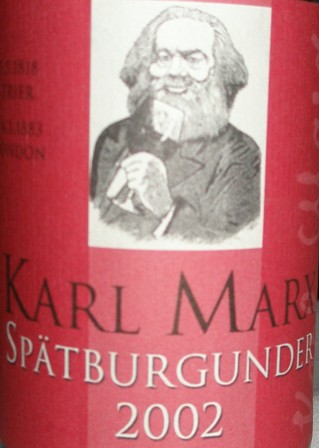
When I visited my hometown Trier recently, I also went to the place where Karl Marx, the most famous of our citizens, was born in 1818 (the Karl Marx Haus). What I did not know about him was his relationship to wine and the Mosel wine industry. From a leaflet collected at the tourist paraphernalia shop I learned that the parents of Karl Marx were vineyard owners along the Ruwer in Mertesdorf where they owned several parcels. It was quite common for bourgeois families of the times to acquire vineyards either for their own wine consumption and/or for investment and old age security reasons. The Marx family vineyard was found in the location “Viertelsberg” a medium quality terroir near the castle ‘Gruenhaus’. Today, the ‘Weingut Erben von Beulwitz’ produces a 2002 Spaetburgunder (Pinot Noir) wine with a Karl Marx label to commemorate this famous “son” of Trier. The wine is not exactly from the old Marx family vineyard but derived from vineyards nearby. Some time ago I had tasted this wine with some delicious venison (big horn sheep) which my mother had prepared for me.

karlmarxweb.jpg

The label with Karl Marx

Marx himself was fond of drinking wine and appreciated the value of it. More interesting is the fact that among others the misery of the Mosel wine producers inspired Marx to study and research economic issues in general. In various newspapers Marx reported about the problems of the Mosel vintners. He criticized the Prussian government for its lack of support which in the end brought him into conflict with the authorities in the 1840ies which in the end led to his exile first in Paris, later in Brussels and finally in London.

After Napoleon lost the war and with it the once occupied lands west of the Rhine river, these territories were given to the Kingdom of Prussia after the peace congress of Vienna in 1815 and administered as the Prussian Province of the Lower Rhine. This marked the beginning of a golden age for Mosel wine producers since they benefited from tax-free export of their wines to Prussia. Unfortunately, the phenomenon was short lived when, with the introduction of the German Customs Union (Zollverein) in 1834, vintners from the southern German states were in the position to successfully displace their competitors from the Mosel. This in turn brought wine prices down. An unfavourable Prussian tax policy coupled with bad harvests led to the pauperization of many vintners at the Mosel. Marx was appalled by their suffering, criticized the government, violated press censorship requirement and in the end had to leave into exile.

In 1857 the Marx family sold its vineyards in Mertesdorf. But due to the efforts of the Weiss family (the owners of the Weingut Erben von Beulwitz, www.hotel-weiss.de), we can enjoy today a Pinot Noir depicting the face of Karl Marx on the label. These bottles can also be bought at the aforementioned shop (7.5 €/0.75 l bottle).

mertesdorf-ruwer.jpg

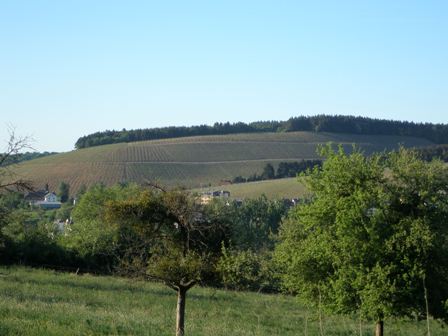
Ruwer vineyards near Mertesdorf in spring

PS: I personally think that it is a pity that the wide adoption of his ideas in Eastern Europe, Vietnam and China for instance brought so much misery to mankind. Less emphasis on the collective and more on individual freedom would have gone a fair bit. Marx should have stayed with drinking and enjoying wine and give up writing in the first place, one is tempted to argue.

In a letter to the father-in-law of his daughter he mentioned that “a man who does not love wine will never achieve anything good for mankind”. Unfortunately, wine drinking is not a guaranty for such deeds as his own life showed.


Along the Mosel River

September 12, 2007

I have often traveled along the Mosel River by train. Last weekend I decided to abolish the train and drive by car from Kobern-Gondorf to Trier. Unfortunately, the sun did not shine. But despite this handicap it was one of the most marvelous trips I have recently made.

The Mosel River valley was buzzing with visitors and tourists. Groups of cyclists, tour buses, camper vans as well as people on foot, motorcyclists and others were cruising along the river and swarming the small towns and villages. Almost every settlement advertised its ongoing or imminent wine festival and vintners’ fair. Everywhere one could buy wines, have a meal or stay overnight. Vintage was in full swing in many places and the young fermented grape juice, in German called “Federweisser” was everywhere on offer.

rivermosel.jpg

Barges and a ferry on the river and a castle in the background

moselriver2.jpg

Steep slopes and a narrow valley, vines on “Graywacke” slate plates

The appelation of the wine region “Mosel-Saar-Ruwer” is the result of the Wine Act of 1909. From 1936 onwards wine labels could show this designation. In 2006 the German Parliament passed a new law abolishing “Mosel-Saar-Ruwer” and simply replacing it with “Mosel” and since August 1st, 2007 the region is officially called “Mosel” only.

The region consists of six sub-regions with 19 locations (Grosslagen) and 524 individual locations (Einzellagen). 5,500 wineries and vineyards are spread over 125 settlements, villages and towns. The total area under vines is about 9,000 ha, which produce annually about 850,000 hectoliters of wine (including 75,000 hectoliters of red wine). The largest wine producing acreages can be found in the settlements of Piesport, Zell (Mosel), Leiwen, Konz, Neumagen-Drohn, Mehring, Bernkastel-Kues and Trittenheim. I passed through some very famous vineyard locations such as “Bremmer Calmont”, “Wehlener Sonnenuhr”, “Erdener Treppchen”, “Ürziger Würzgarten”, “Piesporter Goldtröpfchen”, “Bernkasteler Doctor” and many others.

steepslopes1.jpg

The elevator “sledge”

steepslopes2.jpg

The “rail” for the “elevator”

The region has the largest extent of vineyards on steep slopes (inclinations range from 30% till 60%) in Germany. The Mosel region is also the biggest Riesling producer in the world (with about 5.000 ha acreage). Recently some of the more extreme locations have fallen fallow. Traditionally vines were planted on the steep slopes using single posts. In recent times they have been gradually replaced by modern trellis systems. For transport purposes, elevator systems were installed in some locations, as shown on the photos below. I was very surprised to find a lot of red grapes planted in the flat lands near the river. Most of them are Pinot Noir and Dornfelder grapes. There is an increasing trend to extend the acreage for red varieties and the Mosel has once again become a superb producer of red wines, especially Pinot Noir.

redgrapes1.jpg


Mama’s kitchen: tender bighorn fillet with mushrooms

May 11, 2007

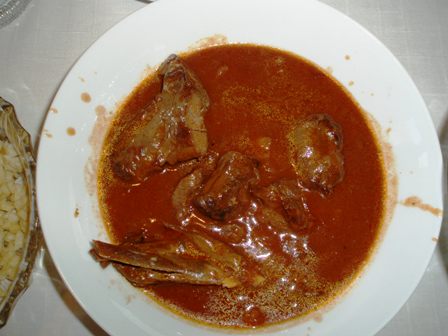
Because I am from a hunter’s family, we have from time to time dished with meat from wild animals at home. During my recent visit to Trier, my mother prepared a tender fillet of a young bighorn sheep (Mufflon in German). The young Mufflon was shot in Schoden at the Saar river by my friend Heinz. She served it with freshly collected wild mushrooms (Steinpilze also from Schoden), a cabbage salad and spaetzle (literally translated: little sparrow), a kind of tiny noodles or dumplings made with flour, eggs, water or milk, salt and sometimes nutmeg mainly used in the South German (my mother comes from Franconia), Austrian, Alsace and Swiss cuisine. I took some photos of the delicacies so that one gets a better idea. It was such a wonderful meal.

p5020662web.jpg

The bighorn fillet

p5020661web.jpg

The mushrooms

p5020664web.jpg

The old folks

When I raided my mother’s wine cellar, I found a bottle with the picture of Karl Marx, one of the most famous sons of my home town Trier. Agreed, the application (or the interpretation hereof) of his ideas has brought much misery to the world. However, now mankind knows for sure that planning economies do not work, but that market based economic co-ordination systems are much better for us all.

p5020656web.jpg

This bottle was given to me for my 50th birthday a couple of years ago. It contained a 2002 Eitelsbacher Marienholz Pinot Noir (Spaetburgunder) from the von Beulwitz Estate (www.von-Beulwitz.de), now owned by the Weis family in Mertesdorf, one of the villages at the Ruwer river, a small tributary to the Mosel (and part of the Mosel-Saar-Ruwer denomination). The Ruwer terroir has about 300 ha under vines in various locations (Ruwer/Eitelsbach, Mertesdorf, Kasel, among others). Some of the best German Riesling is grow here since Roma time. In fact the earliest findings of vine cultivation date back to the 2nd century. A stone relief called “The vintner in his wokshop” is the one of the oldest historical relicts (the other one is the wine ship of Neumagen).

p5010602web.jpg

Ruwer vineyards

The von Beulwitz estate goes back about 140 years and produces mainly Riesling wines, many of which have won international awards and trophies. The most recent one is the “Trophée d’excellence” “Riesling du monde”/Strassbourg for it’s 2003er Kasler Nies’chen, Riesling Auslese, “Alte Reben” (old vines). The 2005 Riesling Spaetlese from this location gained 97 points.

The estate grows vines on about 5 ha, mainly in steep locations in Kasel and Eitelsbach. Yields are kept low in order to produce wines of great elegance and finesse. Unfortunately, the Pinot Noir of 2002 did not fall into this superb category, it was a rather ordinary wine. But despite this, we enjoyed the meal and the wine and had a good time at home. I promised myself to try some of the award wines next time.