Wine village Leiwen at the Mosel River

January 18, 2011

The wine village Leiwen at the Mosel river

Last November I had the opportunity to visit Leiwen just about 30 minutes down the Mosel river from my hometown Trier.

Grape press

Leiwen (about 1,600 inhabitants) is not only a village known as a holiday destination but it is also a famous wine village. Here quite a few of the top Mosel wineries and members of VDP, the association of the top producers are located.

Leiwen got it’s name from Livia, the wife of the Roman emperor Augustus and has a long tradition in grape growing and wine making.

Riesling vineyards

Vineyards on the flats

Riesling, the aromatic grape of the Mosel, is the dominant variety here. Many of the vineyards are located on extremely steep slopes which are hard to cultivate. The ground is mainly gray, blue and sometimes red slate.

Many signs indicate the way to the various wineries

Many, mainly small and family owned wineries call Leiwen their home. The tasting rooms and wine cellars are usually located in the middle of the village. Space is certainly an issue.

On a quiet Saturday morning, the village was almost deserted. No tourist can be found during these times of the year. Vintners were in the vineyards busy pruning their vines. But I went to taste some wines of which I will tell you more soon.

But visit if you can, next spring or summer, any time is a good time. The wines are worth it.


Top Australian Riesling wines

December 21, 2010

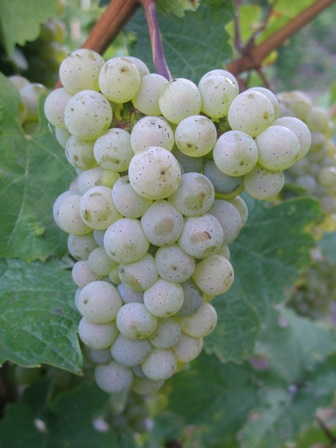
Riesling grape

I admit that as a German Riesling aficionado I have my problems with Australian Riesling wines. I try them again and again but, and to my great chagrin, I have not found what I am looking for.

Australian Riesling wines from the Adelaide Hills, the Clare Valley, the Eden Valley, Tasmania, Canberra District and from Great Southern in Western Australia enjoy a good reputation.

Also our own wine region, the Upper Goulburn Wine Region, produces some beautiful Riesling wines.

The September/October issue of the Australian and New Zealand Wine Industry Journal summarised the tasting of 26 Australian Riesling wines. All of them were under crew caps! Impossible in my native Germany.

Only one of them came from Victoria (Paradigm Hill 2009 Riesling from the Mornington Peninsula). The price range was from A$ 22 to A$ 45 (16.75 to 34.2 EURO). The four top rates wines were:

– 2010 Jacob’s Creek “Steingarten” Riesling (it is German for “stone garden”), a tank sample, Barossa Valley, South Australia

– 2009 “The Florita” Riesling by Jim Barry Wines, Clare Valley, South Australia

– 2009 Premium Riesling by Helm Wines, Canberra District, New South Wales

– 2009 Riesling by Plantagenet Wines, Mount Barker, Western Australia

The magazine carried also a photo of the vineyard where the Jacob’s Creek “Steingarten” Riesling is produced. It reminded me of my home region along the Mosel and Saar river. Here every vine has a single “stick” and is “wrapped” around it with no wire between the posts, nothing.

The “Steingarten” vineyard is entirely worked by hand because of it’s steepness. Also this reminds me of the Mosel with its ultra-steep slopes. The stones are of red colour, though, whereas the Mosel has blue and grey slate.

And believe me these Australian wine producers are not modest. At the recent International Riesling Challenge in Canberra they gave the top wine the title: Best Riesling in the World. Can you imagine. Modesty used to be a virtue which must have jumped out of the window down under.

The trophy was given to a ‘2005 Pauletts Aged Release Polish Hill Riesling’ from Polish Hill in the Clare valley, South Australia by Paulett Wines.

I cannot even try this wine because it is sold out. My search continues. I keep you posted.


November ambience in a Saar vineyard

November 29, 2010

Vineyard near Schoden, Saar

When I recently visited my home town Trier, I also had the chance to explore mother nature in nearby Schoden, Saar.

It was a grey and rainy November day as we like it. The weather makes you wish for a hot tea in a warm place, maybe near a window with a view. Or a walk through the steep vineyards in the Saar valley.

Individual vines trained on a “stick”

Some of the vineyards were already pruned. One could spot pruners here and there, alone or in small groups. Please note the pruning style of these vines. November is a good time to visit wine regions. It is less crowded and people have time for a yarn.


Where to eat in Seoul – Restaurant Review: Min’s Club

November 11, 2010

Tradition and…

Today Seoul, the capital of South Korea, is the host of the G-20 summit. Thousands of government officials from 20 major countries and journalists have converged on the city. The place is crowded, and very busy.

This summit is maybe one of the most contentious so far. South Korea, an OECD country, is the 13th largest economy of the world but was embedded in poverty only 50 years ago. Then per-capita income in South Korea was lower than in Nigeria, the Philippines and even North Korea. All together a different story today.

When I visited Seoul about two weeks ago, I had the chance to look around and get a feeling for this East Asian capital city. Of cause I also explored it’s culinary sides (as far as I could and my schedule allowed).

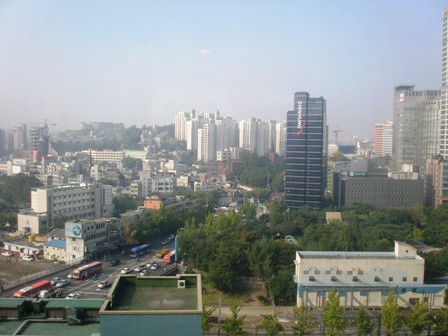
..the modern city

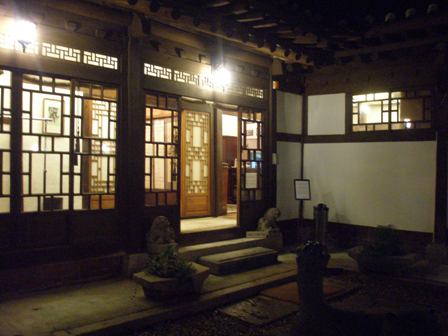
Seoul is a fabulous place, a modern city with many restaurants and eateries. Korean food is amazing; and distinct from other Asian cuisines. We were invited by our South Korean hosts to have dinner at Min’s Club, a Western style fusion restaurant housed in a traditional style Korean compound (the residence of Queen Min), the most beautiful surrounding one can imagine under such circumstances.
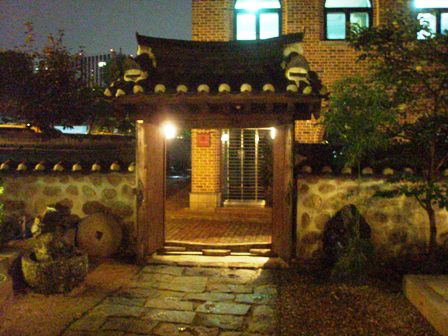
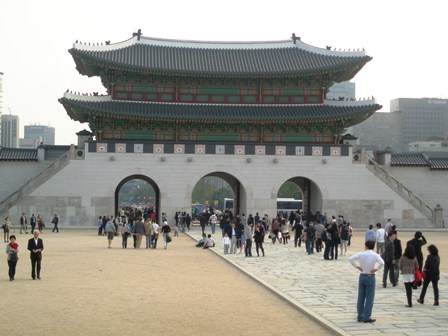
The gate

The main hall of the restaurant
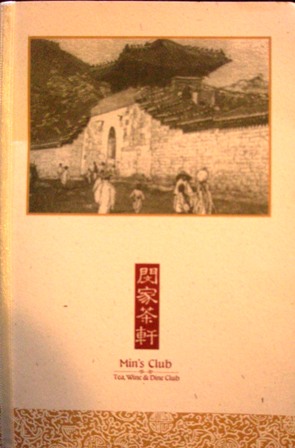
The menu of the Min’s Club

Our hosts had ordered a set-menu. It started with a fabulous tuna fish – incredible, the texture and the flavours -, followed by a pea soup (also with a very intense taste), reminding me of winter days in my native Trier, Mosel.

The next dish was a mussel decorated “fine cuisine style”, followed by a white fish with lemon on a bed of vegetables. I even did not say no to the dessert, vanilla ice cream with a crusty waffle cover.
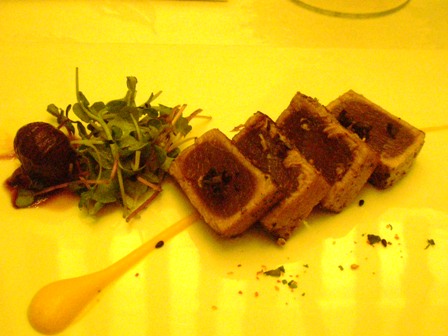
The tuna carpaccio
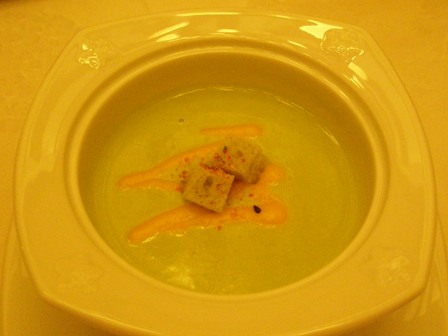
The pea soup
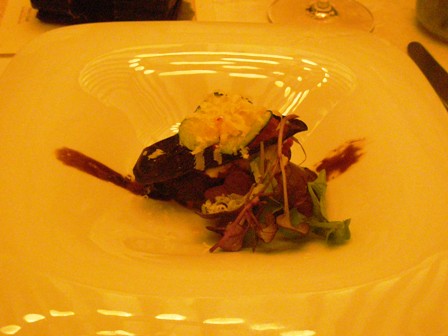
An artisan’s mussel
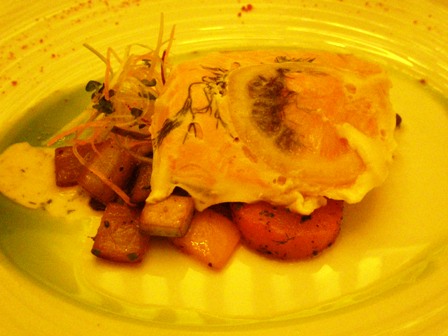
White fish with lemon on vegetables
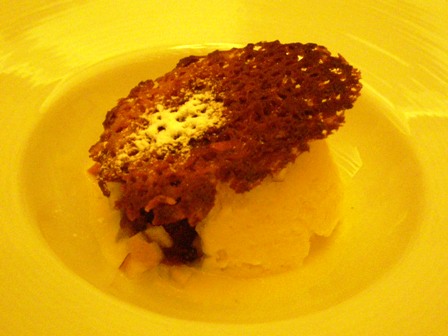
Dessert: ice cream with a hat

The rice water to conclude the meal

I might have missed to photograph a couple of dishes.

Interesting was that at the end of meal, a kind of sweet rice-water was served. It balanced the stomach acids which were heavily tilted towards acidity by the many fermented vegetables consumed as side dishes.

We drank French red wine with the meal, wine from one of the many Mouton Cadet Bordeaux lines. I could not find out which one. It would have been impolite towards out hosts to ask, I guess. My picture-taking was already embarrassing enough.
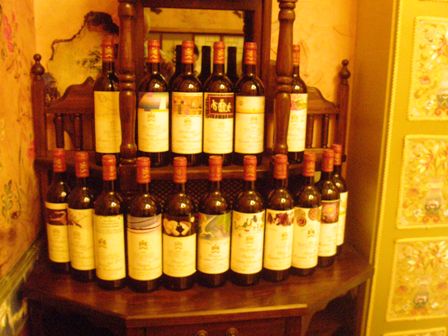
Red wine cabinet
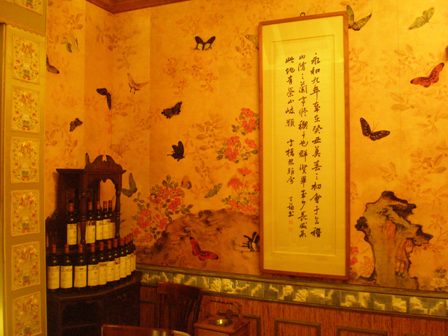
The décor

The décor of our dining room was just beautiful with lots of Chinese calligraphy, wall paper made out of fabric with flowery motives, and antique European furniture.

A very happy camper

Our dinner was very lovely with lots of interesting and stimulating discussions and conversations. What a wonderful evening. If you are in Seoul look out of Min’s Club; it’s worth it.

Address:
Min’s Club – Fusion restaurant
66-7 Kyungun-Dong Jongno-Gu (Insadong),
Seoul, South Korea
Tel.: +82-2-733-2967 begin_of_the_skype_highlighting              +82-2-733-2967      end_of_the_skype_highlighting
http://www.minsclub.co.kr (Korean only)


Mosel Riesling: Weingut Heymann-Löwenstein

October 30, 2010

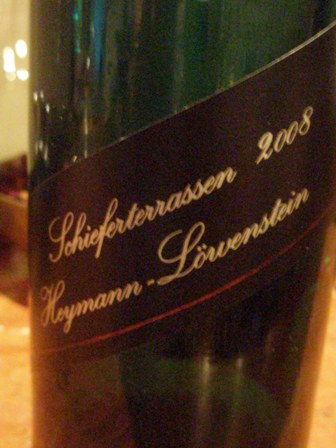
2008 Slate Terraces Riesling Heymann-Löwenstein

The website of Weingut Heymann-Löwenstein starts with a poem of Ingeborg Bachmann, a famous Austrian poet and writer (1926-1973). The first line reads as follows:

»One should be able to pick up the stone
and hold it in wild hope
until it begins to bloom«

That’s in fact what Heymann-Löwenstein does. The earth or better the rocks (slate in this case) in which the vines grow is at the centre of his attention.

I know the sound of slate from my youth growing up in Trier, Mosel. Slate was all around us. The roofs of the houses were in slate, covers of walls, and walls themselves, all in grey slate. We liked to break individual thin pieces into smaller ones and the grey slate dust trickled through our fingers.

Reinhard Löwenstein, who founded the winery in 1980, was carefully searching for the best locations (terroir) before starting his venture in Winningen, a small hamlet along the lower Mosel (south of Koblenz). He is an innovator whose wine styles differ from the Mosel tradition, an inspiration to many young wine-makers at the Mosel river.

Yields are kept low, harvest is late and the steep slopes of the slate stone reflect the days heat during the night. Moreover, the juice is allowed to stay with the skin for up to two days. Some Botrytis infected fruit is sometimes also added giving complexity to the wine. Rheinhard Löwenstein’s wine making philosophy is non interventionist. He intends to bring out the terroir.

The ‘2008 Slate Terraces Riesling’ by Heymann-Löwenstein has an intense golden colour in the glass. It’s alcohol is 12.5%. The wine is full and round, with a balanced acidity. It is dry, displaying a fine minerality and beautiful aromas of citrus fruit. The wine has a good structure and a stunning finish.

Timo Mayer had brought the above bottle with him when he came on a stop-over to Bangkok. We enjoyed it together with some food during a night which saw many exquisite bottles of the fine wines being opened and consumed with great delight.

The winery Heymann-Löwenstein is ranked by Riesling.de as one of the top ten Riesling producers in Germany. The area under cultivation is about 16 ha with an annual production of 100,000 bottles.

And the good news for residence in the Healesville area in Victoria is that Barrique, the wine store in this lovely little town, has some bottles of Heymann-Löwenstein Riesling on offer. Two years ago I have bought a few there. Delicious.

Address:
Winery (Weingut) Heymann-Löwenstein
Bahnhofstrasse 10
56333 Winningen
Tel.: +49-2606-1919
Fax: +49-2606-1909
www.heymann-loewenstein.com


Venison from a roe deer for Sunday lunch in Trier

August 24, 2010

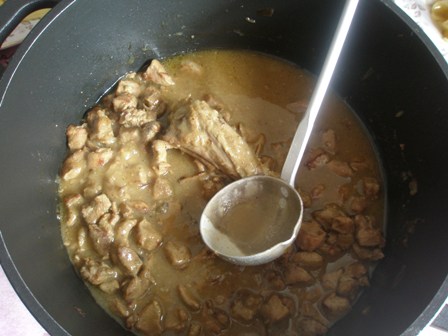
My stories from July and August do not come in any particular order. When arrived in early July in Trier at my mother’s place we were greated by a feats, as always. And beecause her partner Heinz is a hunter we often eat game. This time it was venison from a German roe deer (in German: Reh) he had just shot. Needless to say that my mothers cooking is just delicious as you can see from the pcitures below.

Tender venison, a meal in the making

With noodles of course

2008 Saar Riesling Van Volxem Estate

The wine I choose for this meal was a Riesling from Van Volxem Estate in Wiltingen, near Schoden (where the venison was from), one of my favourite producers from the Saar. Tough this is just a “simple” wine, it deplays all the character of a Saar Riesling, fine and delicate which machted the tender venison just perfectly.

Address
Weinmanufaktur Van Volxem
Roman Niewodniczanski
Dehnstrasse 2
54459 Wiltingen, Saar
Ph.: +49-6501-16510
e-mail: vanvolxem@t-online.de


Enoteca “13 gradi” and Angelo Consorte, in Garbatella, Rome

August 15, 2010

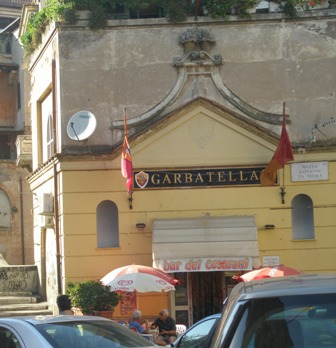
The precinct of Garbatella in Rome

When we lived in Rome, we had an apartment in Via Tamburini in Garbatella. During our holidays in Rome we could not resist to visit the old stomping ground and wander around. Apart from having “reconnecting” with “our” old pizzeria (more about this at a later stage), we also found a treasure of a wine shop, an “enoteca”, as it is called in Italian.

Name cards of Alfredo Pinot, manager of Enoteca “13 gradi” in Garbatella

By accident we stumbled into Angelo Consorte’s wine shop named “13 gradi” (13 per cent). After dinner we just wanted to take some wine with us to the old farmhouse where we stayed near Appia Antica. We were lucky, “Enoteca 13 gradi” was still open.

The inside of the treasure house

Angelo Consorte and me

The four of us immediately felt at home in the place. We waited for another customer to be served. I used the opportunity to browse through the shelves and had picked up six bottles which I lined up in a row.

Then we started to talk to Angelo. He took Margit for a local, the rest of us was obviously foreign (we have broken Italian only). We introduced ourselves and had a great conversation.

Angelo was very kind to help me identify the wines I wanted to try. He analyzed my selection which helped him to get an idea what types of wines I intended to try. Here and there he replaced a bottle with another one and in the end we walked out with eight bottles for which he made us a really good price.

We learned that Angelo had traveled along the Mosel and Rhine rivers by bike and was quite familiar with the wines from my home region. In fact he is involved in the organization of winery tours on bikes, very interesting I found.

My girls had a good time

My take from “13 gradi”

In the end my take was the following:

– 2008 Marabino, Noto, Nero d’Avola
– 2009 Le Favole, Bosco Bando, Traminer Aromatico, Friuli
– Graf von Meran, Riesling by Unterberger, Alto Adige
– 2008 Pinot Grigio, by Nals-Margreid, Alto Adige
– Marcarini Fontanazza
– La Luna des Rospo, Silente
– Zeno Blauburgunder Riserva, Alto Adige
– La Corte del Pozzo, Valpolicella Fasoli Gino

I apologize for the sloppy registration. I missed out on some of the vintage indication. But I will provide an account of these wines in the context of their consumption (usually with food and during lavish dinners).

However, I also noticed that my notes are not complete (after all I was on holidays and not on a wine tasting venture). I might skip one or the other of the above wines. Some of them we took with us as gifts for friends and therefore I do not posses all tasting notes.

Angelo is certainly a find. Please visit him at “13 gradi” when in Rome. He has a great selection of Italian wines and a great passion for them. Below his address.

Address:
Enoteca “13 gradi”
Piazza Bartolomeo Romano 4
00154 Roma
Tel.: +39-328-5589211 begin_of_the_skype_highlighting              +39-328-5589211   
E-mail: a.pinto@13gradi.it

PS: Thank’s to Alfredo Pinto earlier mistakes in my blog entry could be corrected. What would we do without the internet. Thank you Alfredo for making me aware of my misconceptions.


Flammkuchen everywhere

August 14, 2010

Flammkuchen

Everywhere we went in Germany (except Bavaria) during our holidays, “Flammkuchen” was on the menu. Flammkuchen is the German name for an Alsacian dish called ‘flammekueche’ or ‘tarte flambée’ in French. The dish is in fact of ‘alemannic’ origin. The Alamanni , an alliance of different Germanic tribes settled in what is today south-west Germany, eastern France and northern Switzerland (the area south of lake Bodensee); composed today roughly of the regions of Alsace, Baden and the Palatinate.

The thin, bread-like dough comes often in a round shape and is, in its traditional form, covered with crème fraîche, onions, and lardons. However, there are many variations of this old recipe. Similar to pizza all kinds of toppings have found their way onto Flammkuchen. I found different styles as far north as Muenster.

In my home town Trier at the river Mosel, we had the delicious dish from time to time and just loved it. Usually I had a Bitburger Beer with it, preferably in a mug. But the local wines make also a good drink, for instance an Elbling or a local Riesling wine are perfect for the enjoyment of a Flammkuchen. Try it.

Flammkuchen and a Bitburger Beer


Back from the Mosel River

August 12, 2010

Photo taken in Paris at the City Museum

The Man from Mosel River is back in action. After a long, long flight yesterday, we got home to Bangkok safely but exhausted. The summer holidays are over. Needless to say that we had a great time in Europe.

I gained extremely valuable experience with old and new wines and in the process of wining and dining three to four kilos of additional weight. I am also “loaded” with stories of wine, food and play “incidents”.

Europe and its people were kind to us. The summer was just wonderful; blue sky and warm, even hot (we had 45-48 Celsius in Rome) at times, with long and glorious evenings which we spent in beer gardens, restaurants and at barbecues with family and friends.

It is nice to be home again. The weather in Bangkok is humid and cooler than when we left Thailand five weeks ago. Moreover, today is a public holiday and I have time to recover from the excruciating flight.

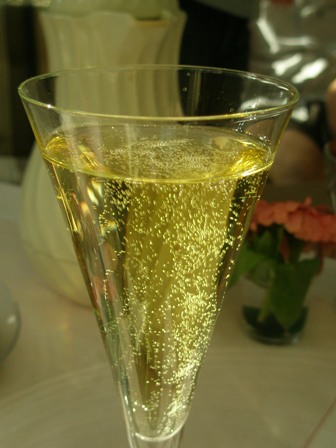
Sparkle sparkle little wine

I was not able to produce any blog entry after the one on Villa Bucci, Italy. Ever since we have visited Paris, the “Muensterland”, Bavaria, and enjoyed wines from the Mosel, Saar, Nahe and Main (Franconia) among others. In the days to come, I will try to work on my material and extract some interesting information which I will post on the Man from Mosel River.

Bear with me and cheers to the good times.


Elbling wine in Echternach, Luxembourg

July 8, 2010

We went on a drive along the Mosel river to make good use of our limited time in Germany. It was a beautiful summers day with blue sky and temperatures in the low 30ies. We drove upriver to Wasserbilligerbrueck and north along the Sauer, a tributary of the Mosel.

The two towers of the main church of the abbey

Echternach on the Luxembourg side was our aim, a beautiful medieval town in eastern part of the Grand Duchess at the border to Germany. Echternach is famous for the rhythm of its annual procession, the “Echternacher Springprozession”: two steps forward, one step backward, the rhythm of many political reforms.

The orangery

Elbling is an old grape variety with an obscure origin but it has been widely planted in the Mosel wine region for many centuries. From medieval times until the 20th century Elbling was the most planted variety in this part of Germany. Nowadays it is a variety in decline. Not much is left of it, though, maybe only about 600 ha in Germany and about 150 ha in Luxembourg.

Elbling grapes make a rather neutral white wine with high acidity. It is the wine for every day in the southern part of the Mosel wine region. More often than not it is used for sparkling. In wine tastings Elbing does usually not feature at all.

There is even a revitalized Elbling wine route along the Upper Mosel at the right side of the river from Thorn, Palzem, Wincheringen, Nittel, Wellen, Temmels, Oberbillig until Wasserliesch and at the left side of the river from Igel to Langsur and along the Sauer river, a tributary of the Mosel from Mesenich to Metzdorf.

Local Elbling

We explored the town, the cathedral, the abbey and many of its public places which were filled with locals and some foreign tourists. When we finally settled in a small cafe, it was clear what we were going to order, the house-wine of the place. While the children enjoyed an ice cream, we indulged in a local Elbling. It was dry, clean and crisp with fine acidity; a great drop for a hot summers day. Come and visit this part at the heart of Europe. It’s worth it.