Wine heaven – my visit to Berlin

May 16, 2009

Wineandcigar

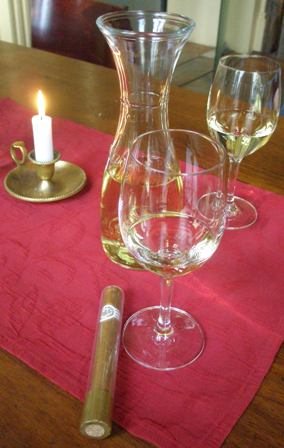
During my brief visit to Berlin, I tasted quite a few fine wines. I do not want to bore you with long stories. The following three wines are, according to my taste buds, highly commendable.

‘2007 Sauvignon Blanc Baron de Philippe de Rothschild, Languedoc-Roussillion, France

I do not know much about French wines, but this SB is just perfect. I loved it with the fresh asparagus dish. It had all the varietal character of an SB and a crispness which blew me away. Very dry with wonderful passion and kiwi fruit aromas with a formidable minerality.

‘2006 Merlot Weingut Leopold Aumann, Tribuswinkel-Thermenregion, Austria

Austrian wines are the vogue in Germany (highest increase in exports to Germany this year). This Merlot by Leopold Aumann was an excellent example of the high art of wine making by our Austrian neighbours. I could not get enough of it, soft and full blown fruitiness.

‘2007 Künstler Kirchenstück Dry Riesling’, Rheingau, Germany

“Kirchenstück” is one of the oldest (1271 !!!!) and best “terroirs” of the Rheingau. This young and very dry Riesling is a wine with great finesse, filigree and a wonderful lingering finish. I am sure it will ripen well in the bottle and in your cellar. If you can get hold of some bottles: buy, buy, buy.

Soon more about fine wines. Germany is just a Mecca for wine lovers (so are France and Austria).


Restaurant Review: Libertine in Melbourne

January 22, 2009

libertine

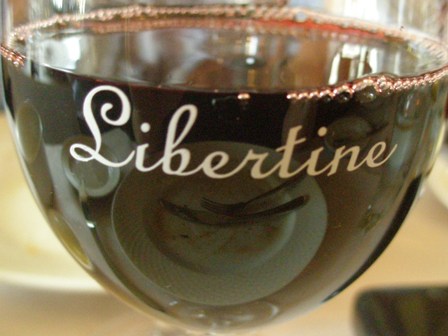
During the four weeks in Glenburn, Victoria I made it to the big city (= Melbourne) only once. My friend Tony Arthur had organised a lunch with Joe and Helen and myself at “Libertine”, a French restaurant in North Melbourne.

When Tony mentioned the name of the place we were supposed to meet in town over the phone, I was already enthralled. For a liberal like me, “libertine” augured well, promising freedom of French provenance.

libertine1

The restaurant is tucked away between various other entrances and not easily glimpsed. I came in my pick-up truck from the countryside and had to circle the place.

The dining area downstairs is rather small but I understand they have more facilities upstairs. When I arrived at 12:30 sharp, my friends had already assembled. Most tables were still empty but that would change very quickly. The place was packed just a little later.

Tony, Helen and Joe had been travelling together in France. As a native of Trier, Mosel, just a few kilometres from France I am not exactly a stranger to French culture and cuisine and consider myself a “francophile”.

We started with aperitifs. I was introduced to a Floc de Gascogne. Based on a XVI century local recipe, this is a fortified sweet wine, a blend so to say, between fresh grape juice (2/3) and Armagnac (1/3). It is kept for about 10 months in the cellar. The aromas it displays are almond, jasmine, roses and honey. The alcohol content of the drink varies between 16 and 18%.

Also the second aperitif, a Pommeau de Normandie was a “mistelle”, in this case a mixture of apple juice with Calvados. It’s usually aged in oak barrels for about 30 months and contains 17% alcohol. The drink displays aromas of vanilla, caramel and butterscotch flavours.

libertine2

The Pommeau de Normandie

libertine3

The Floc de Gascogne

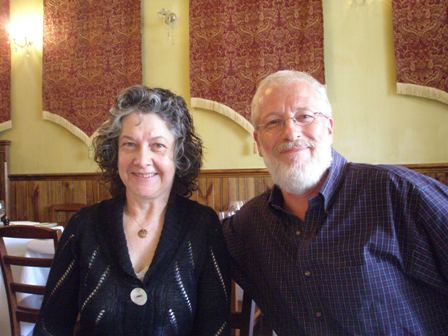
The next two photos introduce the diners. A happy lot they were. We had not met for more than a year. It was easy to lure me down to town from my farm upcountry in the Upper Goulburn to meet up and dwell on the happenings of the past months.

libertine5

Tony and Joe

libertine41

Helen and me

libertine6

My steak

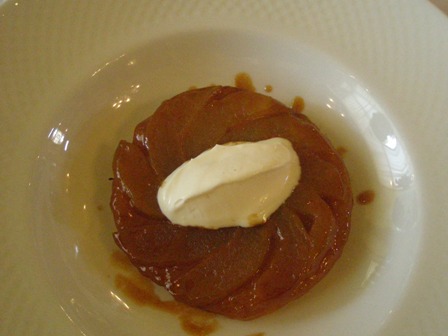
We all ordered the set menue were you have a couple of choices. I opted for the fresh onion soup, followed by a steak. The dessert I choose was a “tarte de pomme”, all very delicious. The service was relaxed but very attentive; the food of an excellent quality and taste for a very reasonable price.

We were also advised on the wines. We went with the house wine, all from bottles, a Roundstone Cabernet Merlot from the Yarra Valley. Helen had a Lis Neris Bianco from Italy. The blokes followed up with a glass of Tempranillo but by that time we were beyond producers and other wine information. I just did not record any of it any more because we were deep in philosophical conversation about love, life and the universe.

libertine7

The dessert

We had a coffee at the end, bid each other farewell and scattered in all direction with the sincere promise to repeat this as soon as possible but latest at our next visit in Australia.

The Libertine is a great restaurant. If you visit Melbourne you should schedule a meal either lunch or dinner with your friends in this atmospheric little place.

Address:
Libertine
500 Victoria Stret
North Melbourne 3051
Melbourne, Victoria
Australia
Tel.:+61-3-93295228
http://www.libertinedining.com.au


Last supper

January 10, 2009

last-supper

The Merlot went very well with the pizza

I am not much of a cook but I can ‘heat things up’. My last dinner on the vineyard was very enjoyable. I sat on the terrace and watched the sun go down. With some sambal olek the pizza margherita was spiced up ( I did not use the tomato sauce).

Our ‘2001 Two Hills Merlot’ though already quite “aged” is holding well. My friend Timo Mayer (winemaker of Gembrook Hills) called this vintage an “umpf” wine, meaning that it is high in alcohol and shows strong tannins. The 2004 vintage in contrast produced a rather elegant Merlot. I am still pleasantly surprised that this wine aged so well and is still a very enjoyable drink.

The evenings on the vineyard are so peaceful. After the birds are gone to sleep, there is no sound. I love the quiet of the Australian country side.


Welcome 2009

January 1, 2009

clouds2009

Clouds over the hills around Healesville with mount St. Leonard (1028 m) to the left

As customary, we spent Christmas and New Years Eve with Michael, my brother in law, and his lovely wife Helen in their cosy family home in Healesville, Victoria. Boy did we have a great time. The time went by just too fast for the six of us.

The year 2008 is gone and with it the anxiety, the joy, the disappointments, the chagrin and the happiness. We deplore the losses, and welcome the changes.

The past year brought great changes to our family. We moved from Jakarta/Indonesia to Bangkok/Thailand, experienced a new job, a new school, a new environment, a new culture to get acquainted with and it will take us some more time to adjust, to understand, to appreciate, and to feel at home.

For 2009 our expectations are high. Our ambitions at Two Hills Vineyard are to continue to produce first grade fruit for excellent wines. Despite the loss of about 50% of our Pinot Noir grapes due to a severe frost at the end of October, we are very optimistic about the coming vintage. The Sauvignon Blanc fruit look very good, and our Merlot is in a good condition. The Chadonnay vines, now one year old, prosper and we have very few losses.

alan-johns1

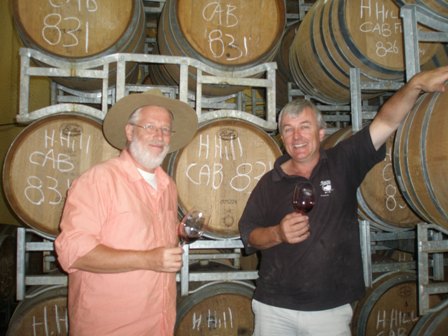
Tasting the 2008 Two Hills Merlot with Alan Johns, owner and winemaker of Yering Farm Wines

Our 2008 Merlot also showed promising first results. At Yering Farm, we tasted the young wine from various barrels. The wine was fruity, had good structure for a medium bodied wine, and the tannins were just right. We hope it will mature nicely so that we can present our customers with another excellent vintage of our flagship red wine from Two Hills Vineyard.

th2008new

Two Hills Vineyard, Sauvignon Blanc (left) and Chardonnay (right)

Temperatures are low for this time of the year but we had some rains which helped to make everything looking very green. A little digging, however, shows that the soil is still very dry and that we urgently need more rains. The general drought has bot been broken as yet.

A new year means new opportunities. Also in 2009 grapes will be grown, wines will be made, and we will get ample material to apply our taste buds to. Sampling fine wines and enjoy them with good food, either within the family or with our friends, will be our prime pastime in the 12 months to come. Hope you can join us. Cheers and a happy New Year to you all.

PS: I write this new blog entry from our vineyard. Yes, we installed a broadband internet connection on the last day of 2008. From now on, I do not have to hurry to a wireless spot (35 km from here) or any other place with an internet connection. Blogging will take a new dimension. Hurray!


The last Mohican

August 24, 2008

A Diam cork, the cork of the last ‘2004 Two Hills Merlot’

The last Sunday lunch in our Jakarta home was a ripper of a lunch. The lamb stew (Australian lamb) with green beans and the mushed potatoes (Bandung potatoes are stunning for mashing) were such a delight. My taste buds were exploding. This is ‘orgasmic food’ at its best, I might add. The recipe came from Marcella Hazan’s “Classical Italian Cooking Book” of course.

The lamb stew

This time I was right with the choice of wine. The last bottle of ‘2004 Two Hills Merlot’ went.

I quote from the tasting notes of my friend and wine connoisseur Thomas Weber. He wrote about the 2004 Merlot some time ago:

The ‘2004 Two Hills Merlot’ also displays ripe wild berry fruit but not the liquorice and nuts flavours. The wine is very subtle, elegant with great finesse. It is medium bodied, dry, with good acidity, and a long finish. Its tannins are firm and give the wine a fine balance.

The wine was just a perfect match for the meat stew. We could not have spend our last Sunday in our Jakarta home in a better way.

The last Mohican (bottle) of 2004 Two Hills Merlot

Farewell, so long, auf Wiedersehen, good bye!

PS: The good news is that we have a reasonable supply of ‘2006 Two Hills Merlot’ which we are going to release in fall 2008. Friedel Engisch (in Wuerzburg) and Gert Kueck (in Leipzig) are the only ones in possession of some bottles of our 2004 Merlot. Lucky you.


Drowning in wine?

June 14, 2008

In todays Daily Wine news“, I found an article describing the recent changes in the Australian wine industry.

It starts with saying that “between 1997 and 1999 an unprecedented 40,000 hectares of grapevines were thrust into the soil across the nation”. Uff, I am one of those lunatics who put in vines during that time. Only a little, though, 3.5 ha to be precise. Now it (the land, our land) contributes as Two Hills Vineyard to the grape heap and/or wine lake. The increase in area under vines led to a 40% increase in output. Such growth was never seen in the history of the Australian wine industry before.

Two Hills Vineyard with the two hills in the background

Well, but I am actually exaggerating. There is no wine glut any more one could argue. Although it was not easy to find a market for our fruit, the very fact that there was fruit in abundance forced us to add value to the operation, e.i. make wine and sell it in Germany. We have survived so far. Of the last 8 vintages, two were to our full satisfaction, and the trend is positive. There is reason for optimism.

We are mainly growers and sell most of our fruit. The remaining part is turned into wine, mostly our Merlot grapes fall into this category. It allows me breathing space. I do not need to sell as fast as possible but rather on a pace we can stomach.

In the good old days growers had long-term contracts with wineries. Paradise has been lost ever since and the “spot market” is a true hassle. Some wineries are not relay reliable partners and it takes a while to sort out the ‘jewels’ from the ‘chaff’. That is costly for small vineyards. To run after small amounts of money and unpaid bills can be a hazard and it is a hassle. But some wineries treat their growers well. I know it from our friend Steve Sadlier, viticulturist (who tends our small property) and supplier of prime fruit to Yering Station in the Yarra Valley/Victoria.

Good to learn from the Daily Wine News article that the grower-producer relationship is about to change in response to the international market place and the flexibility required there. If that relationship, one of asymmetry in the past, would be more balanced, what a good news. Last vintage we had many cases of wineries retracting from earlier price offers. When they realised that the expected shortage of grapes was not to come and that they got sufficient fruit, they lowered fruit prices.

Another trend the Daily Wine News detected is that big companies shift away from developing their own vineyards. Well in the mid 1990s when the growers had no problem with selling any amount of fruit, wineries wanted to be on the save side and therefore invested in the establishments of their own vineyards. This is not only expensive, it also prevents the wineries from investing in other aspects of their business, for instance cellar technology, etc.. Some large wineries, it is said, rely on about 25-30% of their own vineyards, the bulk of their fruit intake is bought from growers.

Another welcome trend is that the industry is moving away from cheap fruit from warm and irrigated wine regions. That sounds nice to a small vintner from a cool climate region (the Upper Goulburn Wine Region). The rising water costs have hit growers hard and the change of demand does the rest: turn this land to other crops, maybe water saving food crops. The rising worldwide demand for food might be the incentive needed for that tectonic shift.

However, for small vineyards the development of boutique style wines and their own labels is a sine qua non for survival. And survive we will. Cheers


Yering Farm Wines

June 13, 2008

Enough of Europe and Indonesia, today I will take you to my future home country, Australia. This might be a sign of homesickness. Usually during the months of June-July-August we go back to our farm and spend splendid winter days in Glenburn, work a bit in the vineyard, plant trees, watch the kangaroos, have friends and family over for lunches on the grass (it’s not a lawn) and visit neighboring wineries and pubs.

As you probably know from earlier blog entries, the owner-winemaker of Yering Farm Wines (www.yeringfarm.com.au), Alan Johns, is also the person making our Merlot wines. In his huge shed thousands of bottles of Two Hills Wines wait to be consumed and in a dozen or so barrels our 2008 Merlot is doing what young wines do.

Yering Farm is beautifully located. When you turn off the Maroondah highway (also known as Whitehorse Road taking the name from White Horse Hotel in Box Hill) in Coldstream on the way to Yarra Glen, you will find it on the right hand side long before you see the town. The cellar door is an old hay shed with a very rustique character and great views of the Yarra Valley. Since I have posted pictures with these beautiful views before, I present today photos from the inside of the cellar door.

yeringfarm-2.jpg

The cellar door and tasting room

yeringfarm1.jpg

Many medals on the wall

yeringfarm-3.jpg

yeringfarm-4.jpg

Alan introducing his wines to a group of wine tourists

My hot tip of the day: when you are in the neighborhood visiting Yering Farm should be on your to do list. Have a good time there and say hello to Alan.


9. Wine Rally – Wines for every day

March 8, 2008

weinrallye.jpg

Sorry folks, but this time it does not work. I cannot avoid to write pro domo. The wine I drink every day, is our own. I have to add that this only applies if we are in Glenburn, Victoria. In the past we had once the opportunity to import our own wine for private consumption in Jakarta. But ever since, due to the vagaries of importing into Indonesia, we were not in the position to establish Two Hills as a ‘house wine’ for everyday consumption.

At Two Hills Vineyard we have so far made two varietal (single vineyard) wines from our grapes:

– a single vineyard Sauvignon Blanc (2000, 2001 and 2002 vintage) and
– a single vineyard Merlot (2001, 2004 and 2006 vintage)

Thomas Weber (www.wein-als-geschenk.de) wrote the following tasting notes for the ‘2002 Sauvignon Blanc’:

“Dezent hellgruener Farbton, Holunder- und vor allem Stachelbeerenaromen vor einm rauchig minieralischen Hintergrund. Kraftvolle lebendige Saeure und ein langer fruchtiger Abgang.”

In English this might read as follows:

“Subtly light green hue, elderberry and especially gooseberry aromas before a smoky mineral background. Powerful lively acids and a long fruity finish.”

And the ‘2004 Merlot’ was described by Thomas as follows:

“Der blutrote Wein duftet aus einem eleganten ausdrucksvollen Koerper vielschichtig nach reifen Waldbeeren. Eine angenehme Saeure vor fein ausbalancierten kraeftigen Tanninen fuehrt zu einem langanhaltenden Finish.”

which translates into:

“From an elegant complex expressive body the dark red wine shows aromas of mature berries. Pleasant acidity before finely balanced tannins, leads to a long-lasting finish.”

Well, thats what Thomas wrote for a blind wine tasting in Trier last year. Since I drink it every day (unfortunately, when I’m in Australia only), usually with a meal (lunch or dinner), I lost the ability to describe the wine anyway.

picture-077w.jpg

This is were we drink most of our wine. On the space at the entrance, I hesitate to call it terrace, of our little house cum vineyard shed. Apart from drinking Two Hills wines, we drink our friends wines. Usually, we swap cases of 12 bottles. We swap with Gayle Jewson and Steve Sadlier.

Gayle has a small vineyard in front of her house in the Yarra Valley, in fact just a couple of acres of Pinot Noir and Chardonnay. The Pinot is a “cleanskin” (Gayle has no label as yet) and it is called ‘Pip’s Paddock Pinot Noir’, a wine which can only be bought directly from Gayle.

The other house wine, we consume, is from Steve. His vineyard is called Nenagh Park. He is mainly a contract grower (about 9 ha under vines) for Yering Station and other well known wineries in the Yarra Valley. Steve’s Chardonnay is to die for, so is his Pinot Noir. He sells his wines (cleanskins) without label to friends and through a private network. Watch out for Nenagh Park in the future.

Visit us, and I will serve you all these wines. Promise.

News from Two Hills Vineyard

January 23, 2008

twohillsinjanuary.jpg

In the back, you can see the two hills which gave the vineyard it’s name.

2008 promises to become our best year ever in the almost 13 years history of Two Hills Vineyard. A new block of Chardonnay has been successfully planted in early December 2007 and with this we will be able to produce on site one more ‘single vineyard wine’ in a couple of years from now, to be precise in about 2013. I will hopefully have retired by then from my work overseas.

chardy-1.jpg

Young Chardonnay plant

chardy-2.jpg

Morning in the Chardonnay

chardy-3.jpg

Chardonnay block

The fruit on the vines of the other three varieties looks really good (as the pictures below show). Despite the already mentioned freak hail storm on December 22nd, the fruit is healthy and in abundance. We expect to harvest about 25 tonnes of fruit from 3.5 ha under vines this year.

Because of the extreme heat we had in early January, vintage time might be earlier than in previous years, maybe in late February; usually it is in the middle or end of March. We in the Upper Goulburn Wine Region (www.uppergoulburnwine.org.au) are usually starting to harvest our grapes later than the colleagues in the Yarra Valley further south.

young-merlot-grapes.jpg

Young Merlot grapes

young-pinot-grapes.jpg

Young Pinot Noir grapes

young-sb-grapes.jpg

Young Sauvignon Blanc grapes

Our old Fiat tractor will be retired in 2008. Because of a generous donation from my mother it can be replaced with a newer model with some more horse power. We will also retire our old Mazda 626 car which is not exactly a useful farm vehicle but which served us well as a means of transport during the short months we spend on the vineyard during the last 12 years.

We will hopefully also get around in sowing one of the front paddocks with a horse loving grass mixture. Then we will have the plot fenced in by Peter Thwaites and turned into a horse paradise where our horse enthusiastic daughters, Lucy and Charlotte, can keep their ponies and other horses when we visit Glenburn.

We have started to irrigate our vines. I hope their will be no large bushfires as in 2007 when extensive smoke tainted many grapes. If the high temperatures persist, the likelihood of fires will rise too.

Finally, we have decided to extend our dwelling on the vineyard. We plan to link the old shed with a new wing to become our house, a proper residence so to speak.

Let us see what 2008 has up its sleeves.


Merlot Night

July 2, 2007

Looking at the calendar, we were alarmed that quasi “half of the year is already over”. Time flies, it seems. What have we been doing? How could it go so fast? Consequently, we spontaneously decided to celebrate this event with a wine tasting on the last evening inJune.

Merlot was our choice of the day. Our wine cellar had only two brands left:

● a 2003 Hungerford Hill, Orange Merlot from the Hunter Valley and

● a 2004 Two Hills Merlot from the Upper Goulburn Wine Region.

The Hunter Valley (www.hunterweb.com.au) is one of the oldest wine regions in Australia. Its flagship wines are Semillion and Shiraz but it has also pockets of cool climate sites. The Upper Goulburn Wine Region (www.uppergoulburnwine.org.au) is a significant cool climate grape growing area in Victoria with quite remarkable diversity of varieties and wine styles.

We had the two wines after dinner with a most delicious cheese, a Brie “au lait entier”, processed according to traditional methods by “Paysan Breton” and fresh baguette.

Both wines come from cool climate regions. Hungerford Hills Merlot belongs to the regional series of the brand (www.hungerfordhill.com.au). It is produced in Orange in New South Wales, a rather new location on the Australian wine map (established in 1983). Formerly it was know as the Central Highlands centred on the slopes of Mount Canobolas which is an important fruit producing area (apples, pears, cherries). The first commercially planted vineyards were established in the 1980s. The location of some of the vineyards for this regional wine is above 600 m altitude.

The 2003 vintage is under cork whereas the Orange Merlot 2004 is already under metal capsules. Both are available at duty free bottle shops in Jakarta, retailing for about 23 to 26 US$ per bottle. The internet order form of the winery shows 28 A$ per bottle for the Merlot (22.40 A$ for wine-club members). Whereas the 2003 bottle does not show wine awards stickers, the 2004 shows a gold medal and other distinctions at the 2006 Sydney International Wine Competition. The winemaker is Philip John.

As you probably know, Two Hills Vineyard also produces cool climate wines. The Geographical Indication (GI) for the Upper Goulburn Wine Region was only recently identified (formerly also called Central Victorian High Country) but grapes have been grown there since more then 30 years. The vineyard is a single site on a slight northerly slope. The 2004 vintage is under a DIAM cork closure. The wine is made by Alan Johns, the owner-winemaker cum viticulturist of Yering Farm Wines in the Yarra Valley (www.yeringfarm.com.au). Retail price at the Old England Hotel (www.oldenglandhotel.com.au) in Heidelberg, Melbourne should be around 15-17 A$/bottle. It can also be obtained at the upcoming Upper Goulburn Wine and Food Expo (Saturday, 11th August, in Alexandra Town Hall).

picture-076webmerlot.jpg

Tasting notes
Both wines show excellent dark crimson red colours. The nose of the Hungerford Merlot shows complex aromas of wild berry fruit with a slight nose of liquorice and nutty French oak. The wine is a blend from different vineyards in Orange. It is medium bodied, has a soft finish and displays balanced tannins.

All wines at Two Hills Vineyards are hand crafted. The grapes for Two Hills Merlot are coming from a single site, the vines are hand pruned and the grapes are hand harvested. The ‘2004 Two Hills Merlot’ also displays ripe wild berry fruit but not the liquorice and nuts flavours. The wine is very subtle, elegant with great finesse. It is medium bodied, dry, with good acidity, and a long finish. Its tannins are firm and give the wine a fine balance.

Hungerford Hill, Orange Merlot 2003
14% alcohol, matured in 60% new and 40% old French oak for about 15 months

Two Hills Merlot 2004
13.5 % alcohol, matured in 90% old and 10% new French oak for about 18 months