Wine Rally – German wine bloggers on the move

May 6, 2008

German wine bloggers have established a monthly scheme called “wine rally” where one blogger hosts a blog entry collection around a predetermined theme. The last one was for instance about “Chenin Blanc”. wines.

I have participated in two rallies over the last couple of months and it was great fun. Moreover, I learned a lot about the topics discussed myself. I also binds the blogger community together somehow; it is networking in action.

Since the blog entries are in German, I will try to summarize some of the highlights of the last rally for you here in English. The host this time was Christoph Raffelt. On his blog Originalverkorkt one can find interesting wine reviews and stories around food and drinks. Also the photos on the blog are very appealing.

– About 15 bloggers participated this time.
– Most Chenin Blanc wines tasted by the bloggers came from the Loire Valley, some from South Africa but generally new world wines were not favourably reviewed.
– Many of the tasted wines came from biologic or bio-dynamic production.

Which wines were tasted?

– Crémant de Loire
– Les Doucinières von Vincent Girault (Loir)
– Crémant von Château Tour Grise (Loir)
– Domaine Patrick Baudouin Effusion 2004 (Anjou)
– Domaine de la Taille aux Loups by Jacky Blot
– Vouvray by Gaston Huet
– Coteaux du Layon by Jo Pithon
– Coteaux du Layon
– Plaisier der Domaine de Romchambeau (Coteaux de l`Aubance)
– Vouvray 1999, Domaine du Clos de L`Epinay
– 2001 Saumur Blanc Brézé by Clos Rougeard
– Clos de Coulaine by Claude Papin, Château Pierre Bise (Savennière)
– Raats Chenin Blanc and Raats Original Chenin Blanc (Steen, South Africa)

And who were the participants? In the following I just list blogs and their addresses. For readers who are fluent in German this could be a real treat because many of the German and Austrian wine bloggers are true originals. Check it out.

six-to-nine (Pivu)
vinissimus (Robert Freudenthaler)
myexperience4u (Svetlana Kittke)
Weingut Lisson (Iris Rutz-Rudel)
Kaulweinblog
K&M Gutsweinblog (Bernd Klingenbrunn)
Culinarium Curiosum (Sabrina und Simon Klaiber)
weinwelt (Michael)
Nikos Weinwelten (Niko Rechenberg)
drinktank (Mario Scheuermann)
Winzerblog (Thomas Lippert)
Weingut Steffens-Keß (Harald)
viva-vino (Matthias Metze)

I hope this gives you a first impression even if it might be rather superficial. I do not know of any such initiative by Anglo-Saxon wine bloggers and their various communities. If you know something, please get in touch with me. Yours


Karl Marx and Mosel wine

September 26, 2007

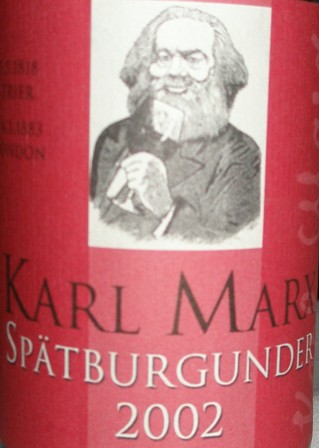
When I visited my hometown Trier recently, I also went to the place where Karl Marx, the most famous of our citizens, was born in 1818 (the Karl Marx Haus). What I did not know about him was his relationship to wine and the Mosel wine industry. From a leaflet collected at the tourist paraphernalia shop I learned that the parents of Karl Marx were vineyard owners along the Ruwer in Mertesdorf where they owned several parcels. It was quite common for bourgeois families of the times to acquire vineyards either for their own wine consumption and/or for investment and old age security reasons. The Marx family vineyard was found in the location “Viertelsberg” a medium quality terroir near the castle ‘Gruenhaus’. Today, the ‘Weingut Erben von Beulwitz’ produces a 2002 Spaetburgunder (Pinot Noir) wine with a Karl Marx label to commemorate this famous “son” of Trier. The wine is not exactly from the old Marx family vineyard but derived from vineyards nearby. Some time ago I had tasted this wine with some delicious venison (big horn sheep) which my mother had prepared for me.

karlmarxweb.jpg

The label with Karl Marx

Marx himself was fond of drinking wine and appreciated the value of it. More interesting is the fact that among others the misery of the Mosel wine producers inspired Marx to study and research economic issues in general. In various newspapers Marx reported about the problems of the Mosel vintners. He criticized the Prussian government for its lack of support which in the end brought him into conflict with the authorities in the 1840ies which in the end led to his exile first in Paris, later in Brussels and finally in London.

After Napoleon lost the war and with it the once occupied lands west of the Rhine river, these territories were given to the Kingdom of Prussia after the peace congress of Vienna in 1815 and administered as the Prussian Province of the Lower Rhine. This marked the beginning of a golden age for Mosel wine producers since they benefited from tax-free export of their wines to Prussia. Unfortunately, the phenomenon was short lived when, with the introduction of the German Customs Union (Zollverein) in 1834, vintners from the southern German states were in the position to successfully displace their competitors from the Mosel. This in turn brought wine prices down. An unfavourable Prussian tax policy coupled with bad harvests led to the pauperization of many vintners at the Mosel. Marx was appalled by their suffering, criticized the government, violated press censorship requirement and in the end had to leave into exile.

In 1857 the Marx family sold its vineyards in Mertesdorf. But due to the efforts of the Weiss family (the owners of the Weingut Erben von Beulwitz, www.hotel-weiss.de), we can enjoy today a Pinot Noir depicting the face of Karl Marx on the label. These bottles can also be bought at the aforementioned shop (7.5 €/0.75 l bottle).

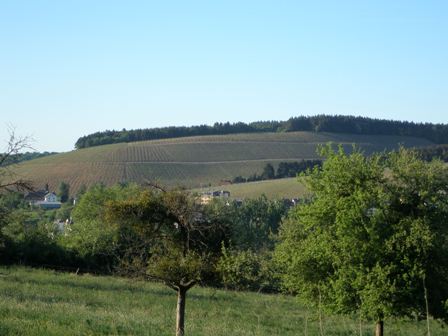
mertesdorf-ruwer.jpg

Ruwer vineyards near Mertesdorf in spring

PS: I personally think that it is a pity that the wide adoption of his ideas in Eastern Europe, Vietnam and China for instance brought so much misery to mankind. Less emphasis on the collective and more on individual freedom would have gone a fair bit. Marx should have stayed with drinking and enjoying wine and give up writing in the first place, one is tempted to argue.

In a letter to the father-in-law of his daughter he mentioned that “a man who does not love wine will never achieve anything good for mankind”. Unfortunately, wine drinking is not a guaranty for such deeds as his own life showed.


Along the Mosel River

September 12, 2007

I have often traveled along the Mosel River by train. Last weekend I decided to abolish the train and drive by car from Kobern-Gondorf to Trier. Unfortunately, the sun did not shine. But despite this handicap it was one of the most marvelous trips I have recently made.

The Mosel River valley was buzzing with visitors and tourists. Groups of cyclists, tour buses, camper vans as well as people on foot, motorcyclists and others were cruising along the river and swarming the small towns and villages. Almost every settlement advertised its ongoing or imminent wine festival and vintners’ fair. Everywhere one could buy wines, have a meal or stay overnight. Vintage was in full swing in many places and the young fermented grape juice, in German called “Federweisser” was everywhere on offer.

rivermosel.jpg

Barges and a ferry on the river and a castle in the background

moselriver2.jpg

Steep slopes and a narrow valley, vines on “Graywacke” slate plates

The appelation of the wine region “Mosel-Saar-Ruwer” is the result of the Wine Act of 1909. From 1936 onwards wine labels could show this designation. In 2006 the German Parliament passed a new law abolishing “Mosel-Saar-Ruwer” and simply replacing it with “Mosel” and since August 1st, 2007 the region is officially called “Mosel” only.

The region consists of six sub-regions with 19 locations (Grosslagen) and 524 individual locations (Einzellagen). 5,500 wineries and vineyards are spread over 125 settlements, villages and towns. The total area under vines is about 9,000 ha, which produce annually about 850,000 hectoliters of wine (including 75,000 hectoliters of red wine). The largest wine producing acreages can be found in the settlements of Piesport, Zell (Mosel), Leiwen, Konz, Neumagen-Drohn, Mehring, Bernkastel-Kues and Trittenheim. I passed through some very famous vineyard locations such as “Bremmer Calmont”, “Wehlener Sonnenuhr”, “Erdener Treppchen”, “Ürziger Würzgarten”, “Piesporter Goldtröpfchen”, “Bernkasteler Doctor” and many others.

steepslopes1.jpg

The elevator “sledge”

steepslopes2.jpg

The “rail” for the “elevator”

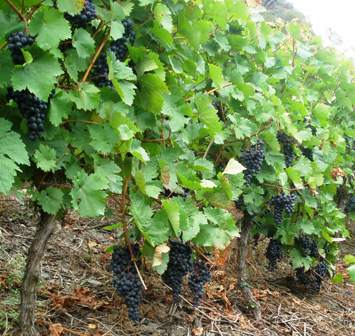
The region has the largest extent of vineyards on steep slopes (inclinations range from 30% till 60%) in Germany. The Mosel region is also the biggest Riesling producer in the world (with about 5.000 ha acreage). Recently some of the more extreme locations have fallen fallow. Traditionally vines were planted on the steep slopes using single posts. In recent times they have been gradually replaced by modern trellis systems. For transport purposes, elevator systems were installed in some locations, as shown on the photos below. I was very surprised to find a lot of red grapes planted in the flat lands near the river. Most of them are Pinot Noir and Dornfelder grapes. There is an increasing trend to extend the acreage for red varieties and the Mosel has once again become a superb producer of red wines, especially Pinot Noir.

redgrapes1.jpg


Obituary to a name: Mosel-Saar-Ruwer

July 5, 2007

Decisions have been made to rename the wine region where I come from. Soon it will not be called any more by the familiar name of Mosel-Saar-Ruwer but only Mosel. The two tributaries, Saar and Ruwer, where some of the best Rieslings of the world are grown, will not feature any more in the name of the wine region. Personally I find this a pity. I love the two tiny wine producing areas with their distinct character. They are the most charming and lovely destinations for wine lovers and other tourists alike.

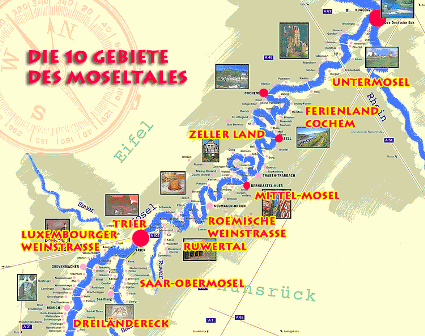
The Mosel-Saar-Ruwer wine region

gebiete-moselbauweb.png

Source: http://www.die-mosel.de


The top 100 Wineries in Germany

June 14, 2007

Today, I visited the website of the winery Adolf Schick (Jugenheim/Rheinhessen) which I had visited with a group of Indonesian politicians some years ago. The visit and the tasting was a great adventure, because Mr. Schick was so enthusiastic about his wines and his family business with a tradition of winemaking going back to 1590!

Our Indonesian guests were very impressed and so was I. Well, as an Australian boutique vineyard vintner I find a family business going back to 1590 very remarkable. At that time kangaroos were hopping through the forests where today, Two Hills Vineyard is located, I guess.

w_gut.jpg

Weingut Adolf Schick in the heart of Jugenheim

The winery is located in the village of Jugenheim, a very charming place, which I know from own experience. The family does not only produce high quality wines, it also owns the Hotel Weedenhof. The hotel’s restaurant is very good too. We had lunch there. The vineyard consists of 9.8 ha planted with the Burgundy varieties, Chardonnay, Rieling, Kerner, Portugieser and Dornfelder. Needless to mention that the wines won many local and national awards. The wines are very reasonably priced and you will find a wide range of different products including grape juice. All my Indonesian friends all bought some bottles of it.

As in previous years, the Weingut Adolf Schick (www.weingutschickjugenheim.de) was also in 2006 ranked (by the DLG, the German Agricultural Society) among the 100 best wineries in Germany (rank 47). Only 12 wineries from Rheinhessen can be found in the top 100. From my home region, the Mosel, 11 wineries made it into the list (www.wein.de), and only one of them came from Trier (Weingut Deutschherrenhof). I loaded down the list to plan my next excursion to German wineries when I will be visiting again in September. Happy tastings ahead of me, I guess.


The “wine map” of Trier

June 6, 2007

My friend Elisabeth from Berlin sent me an interesting article the other day. It was from the Brigitte magazine (www.brigitte.de/trier) and showed a map depicting some recommended wine bars, bistros, restaurants and country inns where fine wines and good food could be enjoyed in my home town Trier (Augusta Treverorum) at the Mosel river.

I must admit that I grew up as a beer drinker, from time to time also enjoying the local cider called “Viez” (very dry) and maybe a Schnaps called “Trester” and made from distilled pressed grapes. My maternal grandfather (Hans-Heinrich Schuessler), however, came from a small hamlet (Reichenberg) near Wuerzburg at the Main river, and was an enthusiastic wine connoisseur. In fact, it was he who introduced me at the tender age of 15-16 to the world of fine wines, mostly dry Silvaner (Bocksbeutel) from the Main region. But because he lived in Martinstein at the Nahe river, we also drank wines from this terroir. He did not like the Mosel wines much.

As you probably know, I usually patronize “Weinstube Kesselstatt” (a wine bistro) near the cathedral. During my recent visit to Trier, I found some of the wine drinking places described in the Brigitte magazine. Due to the shortage of time, however, I could not try them out. I found for instance the wine-restaurant “CUMVINO” which belongs to the diocese of Trier. The catholic church, monasteries and the clergy, were traditionally always lovers of fine wines and developers, promoters and masters of vineyards and wine production.

Other places mentioned in the magazine, I have never heard of, for instance the restaurant “Beckers” in the valley of Olewig at the outskirts of Trier in the middle of steep vineyards. I have to try some of these places. My plan for September and October, when I will be visiting Germany and Trier again, is getting fuller and fuller.

p5030692web.jpg


Country Inns in Germany: Asparagus and river perch

May 18, 2007

While travelling in Germany recently, I had a lot of fish and seafood dishes, the reason for this being that I accompanied a group of visiting Indonesians to a number of coastal towns on the East and the North Sea. Since Germany had a splendid spring, this was the more enjoyable.

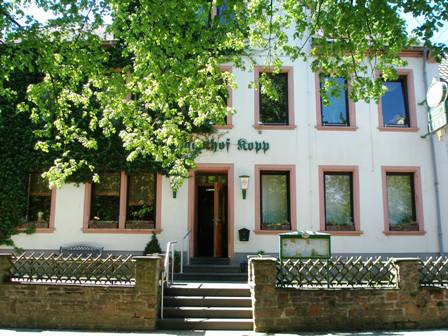
Later, together with my brother and my old folks in Trier, I visited one of the traditional German country inns so prevalent in my home area, the Mosel River Valley, the Landgasthof Kopp (www.landgasthofkopp.com) in Hentern, a small village between the Mosel tributaries Ruwer and Saar.

p4300582web.jpg

Landgasthof Kopp main entrance

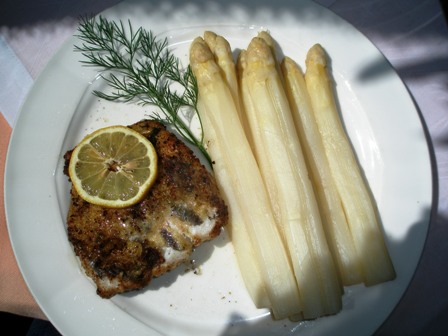
Springtime in Germany is ‘asparagus time’. Everywhere the lush white sticks can be purchased or consumed. All four of us ordered some kind of an asparagus dish. I had asparagus with perch (German: Zander).

p4300579web.jpg

River perch with asparagus

With this delicious meal, I drank the house wine, Ockfener Scharzberg Riesling, a local product from a small village on the Saar river called Ockfen (www.ockfen-home.de). Ockfen has about 700 inhabitants and of the agricultural used land of 246 ha about 90 ha are under vines on very steep slopes. The most famous terroir is ‘Ockfener Bockstein’ which is among the best wines from the Saar. The wines from this location are very dry, minerally and fruity with a good structure.

From the Middle Ages onwards it was the monasteries along the Saar river that cultivated vines and promoted the wine industry. The wealth and prosperity of Ockfen was almost exclusively based on its wine industry. The many small villages and towns along the Saar river are worth visiting (among them Saarburg, Ayl, Kanzem, Oberemmel, Serrig, Wiltingen to name only a few. I highly recommend this very beautiful part of Germany.

As regards the inn, the Landgasthof Kopp, this place is a must, not only because of the superb quality of the food and the service. The price too was a pleasant surprise, unbeatable, I must say. For the four of us, including drinks, we spent a total of only 60 Euro for a memorable family lunch.


My hometown: Augusta Treverorum – a short visit to Trier

May 5, 2007

It was four busy days in Trier, running from appointment to appointment. Spring this year in Germany is most beautiful. Temperatures almost like in summer, sunshine, blue skies and very dry, no rains (bad for all the farmers and vintners). The four days included among others a family gathering with brother Wolf and my old folks, visits of old friends, meals in country pubs and at home, long walks in Trier, barbecues, afternoon coffee and cake, a Riesling wine tasting with the winemaker, a hunting trip in the forests of the Saar river, and a birthday party of my niece Adriane who turned 24!. When I finally had my train ticket to Frankfurt in my hands, I knew the time had come to say good bye. I payed a short visit to my favourite wine bar, Kesselstatt, opposite the cathedral (Trierer Dom) and had a last drink, a fine and dry 2005 Wiltinger Riesling. Then I went to an internet cafe near the train station but could not enter this text into my blog so I had to defer it to later. “Good byes” as always in the hope that you meet again and off I went on the train to catch my plane in Frankfurt for Jakarta.

Weinstube Kesselstatt

Weinstube Kesselstatt in Trier

The train trip makes the farewell easier. Along the Mosel river to Koblenz I could enjoy the beautiful Mosel valley with its steep vineyards, old castles, small settlements, and lovely countryside. After a change of trains follows the middle Rhine river valley with magnificent castles, stepp slopes covered in vines, the narrow valley, and the beautiful and winding river. When I had passed Bingen and entered Mainz, the long farewell had almost come to an end. From the familiar to the unfamiliar, the known to the unknown; the ancient, rural, pituresque and wine producing land gave way to industrial landscapes, big cities and finally the airport. My time in Germany had come to an end. So long, farewell, Auf Wiedersehen, good bye and the promise to return in September with more time on my hands for family and friends and the tasting of fine wines from the Mosel-Saar-Ruwer.

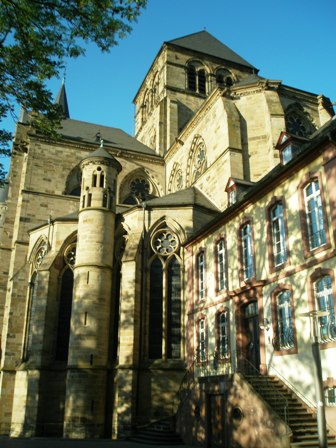
Trierer Dom

Trierer Dom and Liebfrauenkirche


Up North

April 8, 2007

I travelled north, from Jakarta to Taoyuan, Taiwan where I am going to teach for a week at the International Center for Land Policy Studies and Training (ICLPST). The flight was very comfortable in the business class of China Airlines. The menu I chose was all seafood. Boiled baby prawns with tomato and lettuce leaves as entrée and fish and prawn satay in ginger light soya sauce with Shanghai noodles as main course. On top of the wine list I found to my surprise a German Riesling from the Mosel-Saar-Ruwer, my home region in Germany where also Trier, my hometown, is located (www.trier.de). Home sweet home, and out of this melancholy, I asked for it.

menu-taiwan-small.jpg

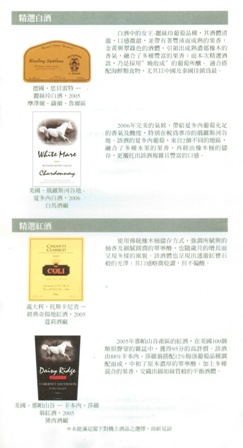
It said: 2005 Spaetlese, but I could not resist! The description claimed the wine is “rich, buttery layered with flavours of orange zest, Asian pears and golden delicious apples, with a subtle, smoky back note”. I could not taste any of this. For me it was “sugary” and the steward was so kind to let me have the second white wine on the menue: a Chardonnay from the US. 2006 White Mare Russian River Valley (Sonoma County), depicting a white horse on the label, not my type of label but what could I do. I did not know the winery. There was also a red (Cabernet Sauvignon), 2005 Daisy Ridge with the same white horse label.

The second red wine was from Italy, a Chianti Classico 2005 from Coli in Tuscany. After a couple of glasses of the Chardonnay, which I quite liked, I moved on to the Italian wine and stayed with it for the rest of the flight. By the way, the service was great at this flight, so many nice stewards and stewardesses, unbelievable. I can only recommend China Airlines. The wine list, though, could be changed. OK, I did not try the champagne, a Drappier Brut which got 89 point from the wine spectator. There are much better Rieslings from the Mosel or the Saar to choose from. I would also replace one of the US wines with an Australian Shiraz maybe or a Merlot.

I watched a movie, read in my Tim Winton book (The Turning) and arrived in Taoyuan in no time, well rested, fed and happy.

temple-small.jpg


The Treverer

February 4, 2007

The first time the river Mosel is mentioned in a written document is the account of Gajus Julius Caesar in his De Bello Gallico, IV in 55 B.C. where he describes his battle and the subsequent victory over two German tribes, the Usipeter and Tencterer. Around the same time we also learn about the original settlers in the Mosel river valley and around Trier, the Celtic Treverer.

“The Treverer are cleverer” sounds a line in a popular song of a local rock music group called “Leiendecker Bloas”. But not only that. The Treverer were feared by the Roman invaders as well.

Treviros vites censeo. Audio, “capitales” esse; mallem, auro, argento aeri essent.

This is what Marcus Tullius Cicero wrote to a friend during Caesar’s war against the Treverer in about 55 B.C. In a free translation that reads as “better avoid the Treverer; they go for your throat. I wish those guys would rather work as silver and gold smiths”. The Romans in fact had some troubles in controlling the Celtic population of the Mosel valley. In 69/70 A.D. the Treverer revolted against the imperialists from Rome but were defeated again. The Roman general Petilius Cerealis did not lose his composure in battle despite the fact that his cavalry was already wiped out, his camp fortification destroyed and the walls overrun by the fierce Celtic fighters from the Mosel.

But over the decades that followed the Celtic swineherds were transformed into vintners and the people thanked the god of wine – Sucellus – for this. The Treverer were known to be hungry for fame, quarrelsome and rowdy. They were also known to be big drinkers, more so than even the Germans. The many drinking competitions they held are ample proof of their favourite pastime. The ones who could not drink were despised as weaklings. That people could call themselves lucky if they got away alive from those fierce drinking competitions, was a common notion. That’s how it was: The good old days. These times have long gone and modern man does of course some drinking here and there but we are all more or less domesticated in some way or another. We go to work 5 days a week. We do sports in our free time, watch TV, send sms and e-mail, write blogs and so on.

Joseph Roth in “The Radetzky March” describes the changes at the turn of the 19th to the 20th century but his description can certainly also be applied to earlier times and ages.

Everything that grew took long to grow
and everything that ended took a long time to be forgotten.
Everything that existed left behind traces of itself
and people then lived by their memories,
just as we nowadays live by our capacity to forget,
quickly and comprehensively.

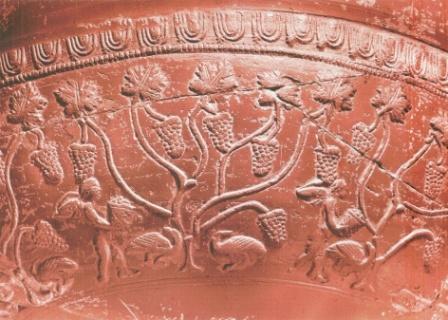
Schale

Terra Sigillata bowl found in Trier (Karl-Josef Gilles: Bacchus and Sucellus, Briedel 1999)

Vinum vires is what the Romans said, wine gives power! My suggestion for the day: open a bottle of your favourite wine and enjoy the Sunday.

Bene tibi sit “Wohl bekomms” or To your health, salute, cincin and so on

————————
Reading tip: Edgar Christoffel: “Mosel und Wein – Stimmen aus zwei Jahrtausenden”, Trier 2003