Wine shopping in Healesville, Yarra Valley

August 16, 2009

Barrique

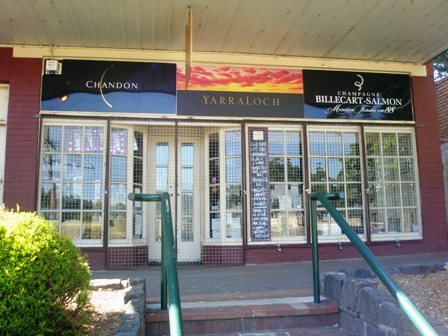
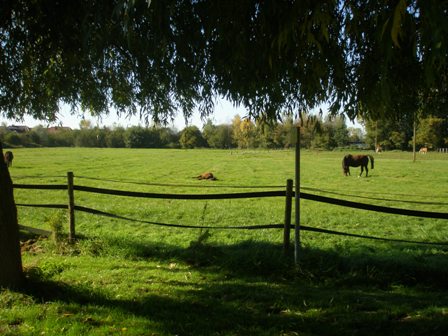
For a long time I wanted to write about my wine shopping experience in Healesville, a charming tourist town in the Yarra Valley, about an hour’s drive from Melbourne. One can find a jewel of a wine store in this rural retreat, called Barrique. I took the photo above Christmas last year.

Barrique2

This is the old shop front

When visiting Healesville again in July 2009, I was shocked to not see the above signpost in the old place. I was afraid that the global financial crises and the bush fires might have let to the closure of this little wine shop. Alas, it had only moved a block further along the main street into the city centre. I was so happy when I found it again.

Barrique3

The “new” Barrique, a block further up the main street

I could not resist the temptation. Previously, I had bought German wines from this shop. I dashed in to see what was on offer. The wines are beautifully displayed. There was so much out there. I could not stop browsing through the shelves.

Barrique5

The inside of Barrique

Barrique4

So many bottles

Barrique6

Wines from all over the world

Barrique7

The “German box” with selected Riesling wines from various German wine regions

The box above announces some of the best German Riesling producers from Mosel, and Nahe. I just love Riesling wines. In the end I picked up four bottles, one from the Pfalz, three from the Mosel. I will not tell you what they were today. More about the tastings of these wines later. Stay tuned to the Man from Mosel River.
Cheers


German wines: delight in red and white

July 4, 2009

Traveling in Germany I had the opportunity to taste some marvelous wines with some of my friends. Two of these I would like to briefly present to you, one red, one white wine, one from the Pfalz and one from my native land, the Mosel or to be precise the Saar.

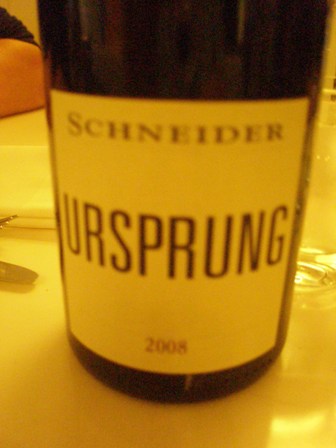
Over a dinner at “Schneeweiss”, a fashionable restaurant in the eastern part of Berlin offering “cuisine from the Alp mountain lands”, we had a bottle of ‘2008 Schneider Ursprung’, a cuveé made of Cabernet Sauvignon, Merlot and Portugieser by Markus Schneider.

Markus Schneider is one of the young but accomplished vintners who earned the highest praise from wine critics and experts from the wine and hospitality industry. This cuveé is made from grapes grown on a rather warm location at the “Feuerberg”, a terroir known for its capacity of heat retention by the local gravel stones which allows the grapes to fully ripen.

The wine is of a deep purple colour. It displays flavours of a lot of fruit, plum, some mint, chocolate and shows some peppery notes. The wine is very round and extremely smooth, for me just a bit too perfect in the mouth, I must say. It went extremely well with the food that I had ordered (Italian pasta filled with mushrooms). The wine is perfect and was a good choice. It retails for about 8 to 11 EURO but is worth the money.

Schneider Ursprung

A very simple label on the bottle: “Schneider Ursprung”

Schneider ursprung2

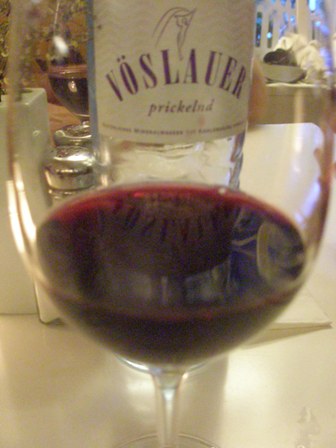
What a beautiful deep purple colour

Later the same evening, we tasted a dessert wine from my native lands, the Mosel, actually from the Saar river. It was a ‘1992 Ockfener Bockstein Riesling Spaetlese’ from “Staatliche Weinbaudomaene Trier”.

OckBockRiesAus

What a delight this wine was, a drop from heaven. It had aged well, was fresh and round. Although low in alcohol (only 8%), the acids were vibrant so that the wine was extremely well balanced, honey sweet, just wonderful. Only my friend Gerhard can wait for a wine like this to ripen in the cellar and patiently await the right moment to open a treasure like this.

I know the terroir quite well, Ockfener Bockstein, just a couple of meters away from the boundaries of the hunting grounds of my friend Heinz in Schoden, Saar which borders on Ockfen. The vineyards here are extremely steep and all work in manual. The 1992 vintage of this Riesling Auslese is just wonderful. I have no words to describe this nectar and do justice to the wine.

Address:
Schneeweiss
Kern Ranogajec GbR
Simplonstraße 16
10245 Berlin
Proprietors: Denis Ranogajec and Ralf Kern
Tel.: +49-30/29 04 97 04
Fax: +49-30/29 04 97 05

Weingut Markus Schneider
Am Hohen Weg 1
67158 Ellerstadt
(near Wachenheim, Pfalz)
Tel.: +49 (0)62…
Fax.: +49 (0)6237 – 977230

Administration:
Georg-Fitz-Straße 12
67158 Ellerstadt
info@black-print.net
http://www.black-print.net

Staatliche Weinbaudomänen Trier
Deworastr. 3
54290 Trier, Germany
+49 651 97598-0
www.staats
weingueter.rlp.de


Country living: The good life in Ramsdorf, Westphalia

May 31, 2009

The land

Rams16

The Münsterland, Westphalia is not exactly a wine region. People in this rather flat but beautiful rural part of Germany, just an hours drive from the Industrial heartland of the Ruhr (the drive can be as short as 30 minutes only), prefer to drink beer and “Korn”, a spirit also called “Schnaps” distilled from wheat and other grains.

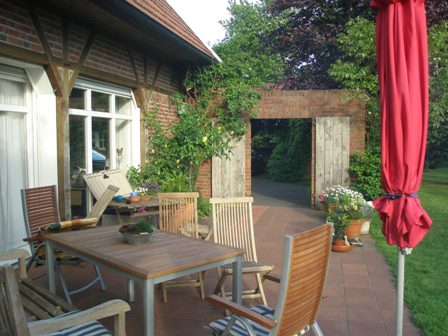
The farm houses are made of red bricks, have large wooden doors, usually green, high gables and are just magnificent. They stand alone within the land belonging to them, accompanied by large stables and barns, all erected in the same style, a wonderful sight. I went there to visit my friends Uli and Elfriede in a small hamlet called Ramsdorf.

Rams15

My friends Uli and Elfriede’s house, formerly a cottage of the estate (from the back)
Rams00

The backside with the outdoor furniture

The Food

As the people so the food, one could say. Rural people everywhere developed healthy, nutritional type of foods; no-nonsense stuff, usually based on the raw materials the land has to offer. So the Münsterlaender cuisine has a lot of sausages, ham and various kinds of meats, served with potatoes, and green vegetables.
Rams0

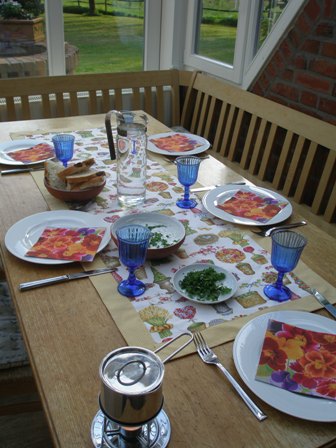
The table in the patio

Rams1

Beautiful beef

Rams2

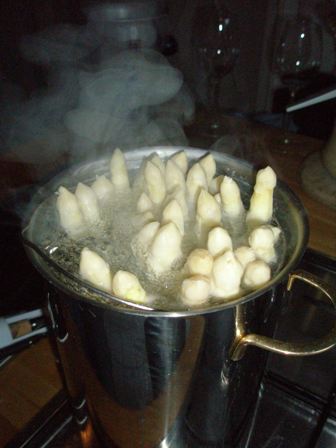
Fresh asparagus in a special asparagus cooker

Rams3

The finished product: asparagus

Rams4

The finished product: the steaks

Rams5

Our meal of asparagus, potatoes, ham and a steak with melted butter

The wines

We did of course also drink wine with this delicious meal. We started while the asparagus was still cooking with a ‘2008 Knipser Sauvignon Blanc dry’ by Weingut Knipser, Pfalz, a wonderful wine, fresh, fruity with structure and depth.

The brothers Volker and Werner Knipser (and since 2005 Stephan, Werner’s son) are the owners of this vineyard and winery in Laumersheim, Pfalz. The family operates the estate since 1876. Today about 40 ha are under vines. The brothers were the first in this part of the Pfalz to use small barriques barrels to mature their wines. They also increased the area under red varieties and replanted with high quality rootlings. In 2009 the were awarded “Vintner of 2009” by Gault Millau for their innovative ways and their high quality wines. My first Knipser wine, I drank many years ago when living in Beijing. My friend Norbert Finkel, a journalist from the Pfalz, introduced me to the Knipser wines long before they became fashionable.

Rams6

‘2008 Knipser Sauvignon Blan dry’ in the bottle

Rams7

..and in the glass

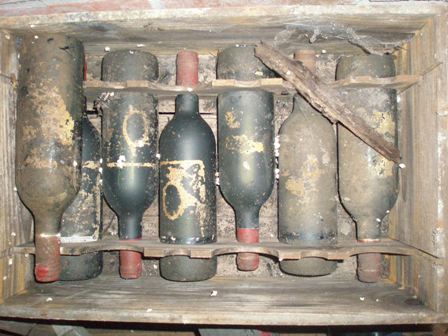
After the white, we longed for some red and went out into the shed where Uli stores his wines. Here we unearthed an old wooden box with red wines from Bordeaux, France.
Rams8

Treasure trove

Rams9

The chosen one

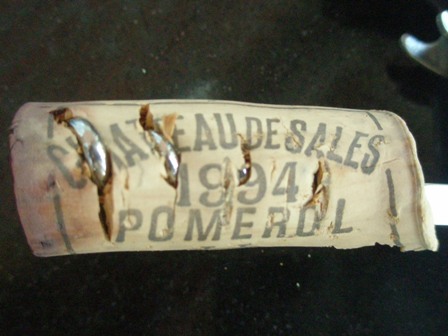
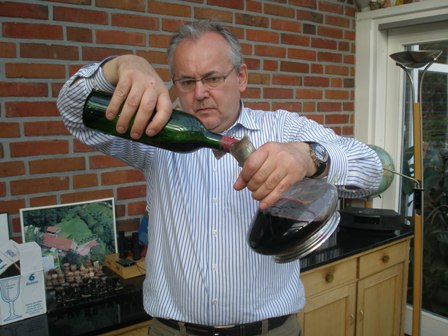
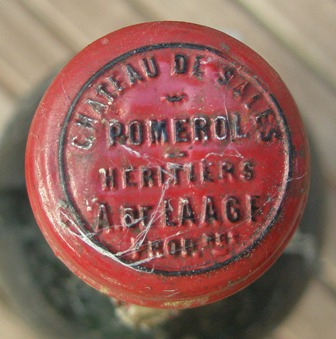
We selected a ‘1994 Château de Sales’, a Bordeaux blend from Pomerol, France. Uli de-cantered the wine, the drop was excellent but needed to be drunk. So we had “discovered” it at the right time. The blend was full flavoured, with structure and harmonious tannins and very enjoyable with our food. The wine sells on the internet in the UK for £ 30-35 and in continental Europe for about the same amount but in €.
Rams10

The top of the capsule

Rams11

The cork

Rams1112

Uli de-cantering the Bordeaux

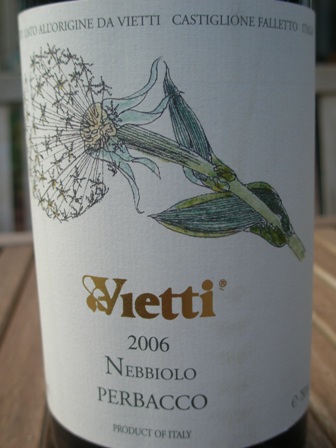
We finished the evening with an Italian wine, a ‘2006 Vietti Nebbiolo Parabacco’ from Langhe, Piedmont in Italy. That was quite a change from the Bordeaux. The wine was rich and complex. It showed well balanced tannins which were chewy at the finish, just great for a red. What a pleasurable wine to end a very pleasurable day with my friends in the Münsterland.
Rams12

The Nebbiolo bottle from Vietti

The people

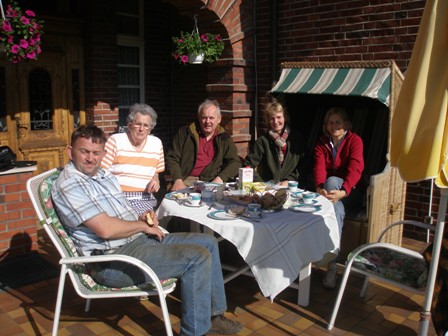
I quickly introduce my friends, the three Hillejan families. Georg and Barbara are the farmers, aunt Doris, the mother of Georg and Ulrich, and Ulrich and Elfriede, my old friends from University days. I used to work on the farm as an intern during my students days when Uli’s father Alfons was running the estate. I loved to work for uncle Alfons. He was a great man. But I did not only work but also play there. We celebrated quite a few events (a few weddings among others) on that farm, had wild parties and a great time playing farmers.
Rams13

Georg, aunt Doris, Ulrich, Barbara and Elfriede on the veranda of the old farm house

Rams14

Three men on a mission, Ulrich, me and Georg


German “Brotzeit”

May 27, 2009

Brotzeit

“Brotzeit” freely translated into English means “Time for a bread”; it is a German custom of a meal between meals, a snack one could say, which was very widespread in German lands when most of the population was doing hard physical labour.

During my recent visit to Germany I had the opportunity to indulge into this old German custom. Today, even small bottles of wine are “custom made” to this effect. Ever since my grandfather introduced me to Franconian “Bocksbeutel-wine”, I am a lover of Silvaner from the Main and the Fraconian wine region.


On the road again

May 21, 2009

Huns2

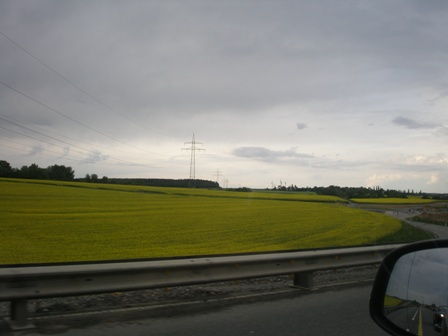
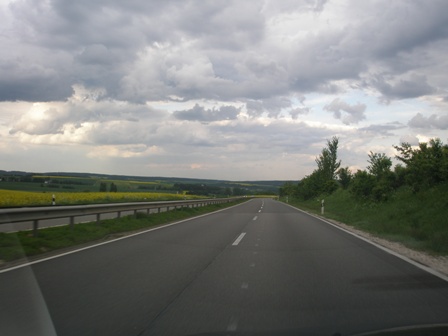
It was a gorgeous day when I drove from my home town Trier at the Mosel to the airport in Frankfurt. I passed through the hilly country called the “Hunsrueck”, a large plateau with deep forests and not-to-infertile plains where grains, maize and rape seed are grown. After a couple of kilometres clouds appeared and it started to rain.

Huns3

The yellow of the rape seed fields contrasted beautifully with the surrounding green of the grains, the grass and the trees. From the moving car I took a couple of shots to capture the contrast. Reality is almost always more beautiful than those quick digital camera shots.

Huns1

I had about two hours for contemplating about life, death and the universe. I love these rare occasions of introspection. I love the short life between the worlds, leaving Germany for the tropics of Thailand. Having left a world behind but not reached the desired destination, leaves me in a kind of vacuum, an emptiness full with feelings.

Huns4

The last leg of my journey led me through parts of the Nahe and the Rheingau wine regions. At this time of the year the vines appear tender and soft, near the flowering stage maybe, but the green of the leaves is still a light green.

The rainy season would wait for me on the other side of the world. Only the long hours in the narrow plane would be between “me in Germany” and “me in Thailand”, the past and the future, the wines of Germany and the wines of Australia and Thailand of course.


Lunch at Lutter and Wegner in Berlin

May 15, 2009

lundwberlin1

Some time ago when in Berlin I had lunch at Lutter and Wegner in Weinhaus Huth, near Potsdamer Platz. I love the atmosphere of this cosy little restaurant. Lutter and Wegner has two more restaurants I know of in Berlin, at “Fischerhuette”, at the very picturesque “Schlachtensee” (a lake within the city boundaries) and “Gendarmenmarkt” in the centre of town (but there is another one in Charlottenburg).

lundwberlin2

I had ‘gnocchi with mushrooms’ which you can see in the picture above and drank a glass of the house wine, a Riesling from the Rheingau wine region. Needless to say the gnocchi were delicious and the wine was too.

lundwberlin5

I sat next to the wall where all kinds of German wines were on display. This is why I show you the pictures below. All the good names of German vintners and wine producers were among them, Diel, Dr. Loosen, Joh. Jos. Pruem to name only a few and many others as you can see.

lundwberlin3

lundwberlin4

Some time later, I learned from a city tour guide, that “Weinhaus Huth” (wine shop) used to be the place where Konrad Adenauer, the first German chancellor after World War II used to buy his wine.

In March 1877 the wine merchant Christian Huth bought the plot of land and built a villa there which housed also his wine business. The present building dates back to 1911/12 and replaced the villa. It consists of s steel-concrete structure so that the weight of the wine bottles could be stored. This structure protected it from the destruction of two major wars.

The building was the last old structure at the Potsdamer Platz and therefore it was called “the last house at Potsdamer Platz”. That was during the time of the cold war and before the wall came down. After 1989 and the reunification of Germany the Potsdamer Platz was again situated at the centre of the city and a building boom started. In 1990 Daimler-Benz AG bought the building. After renovation it was transformed so that again a restaurant could move in again, which is Lutter and Wegner. If you visit Berlin, I highly recommend that you visit “Weinhaus Huth” or any other of the Lutter and Wegner restaurants.

Address:
Lutter and Wegner im Weinhaus Huth
Alte Potsdamer Strasse 5
10785 Berlin
Tel.: +49-30-25294350


Riesling from the Rheingau, Germany: Baltasar Ress “Von Unserem”

May 6, 2009

sole1

Beautiful sole

Another delicious lunch. We had sole, asparagus and potatoes . The wine I had selected to go with the meal, I had found by accident in Tops supermarket in Thonglor, Bangkok. Frankly speaking I had never heard about Balthasar Ress and his wines.

From the website I learned later that the winery is managed by the 5th generation of the Ress family and that it had been founded in 1870. Unbelievable for us Australians. The estate is listed in the 2009 issues of the “800 Best Wineries in Germany” but rated as going donw in quality somewhat. Well, I cannot confirm this.

sole2

As you know, I just love Riesling wines. For someone from the Mosel it is just heavan on a stick, paradise so to say. The dry Riesling which I selected, a bottle ‘2006 “Von Unserem” Balthasar Ress’ (11.5% Vol. Alc.) from the Rheingau, Germany was not cheap.

Thailand’s wine prices are high due to the tax imposed on imported wines. I paid about 1,000 Bath, which is a little more than 20 EURO whereas the same vintage can be bought in Germany for about 5.10 or so Euro. “Von Unserem” roughly translates into English stands for “of our own drop” indicating that the vintner and his family have made this wine to their preferred drink, solely for them, so to say.

sole3

The quality of this dry Riesling is very good; the price in Germany very reasonable. Having access to it here in Bangkok is a treat, a wonderful thing and we enjoyed this bottle tremendously with our seafood meal.

The colour is light straw, the wine is zesty and fresh with beautiful citrus and tropical fruit aromas. It has structure and substance and a nice finish, lingering on for quite some time. Citrus bomb of the noble kind, I would say.

The next day we went back and bought all the bottles left of this wine on the shelf in Tops supermarket. Putting them into my wine fridge was a great satisfaction. More Sunday lunches with a good German Riesling wine are ahead of us. The good life, Epicurus would be proud of me. Life is just so beautiful.

If you visit the Rheingau, please check also out the villeages of Eltville and Hattenheim. It’s so beautiful there along the Rhein river. Indonesian colleagues I once took their thanked me from the bottom of their hearts and tears in their eyes. The term “paradise” comes to mind as the appropriate label.

Address:
Balthasar Ress
OT Hattenheim,
Rheinallee 7
65347 Eltville am Rhein
Tel.: +49-6734-91950
www.balthasar-ress.de


As the river….

October 24, 2008

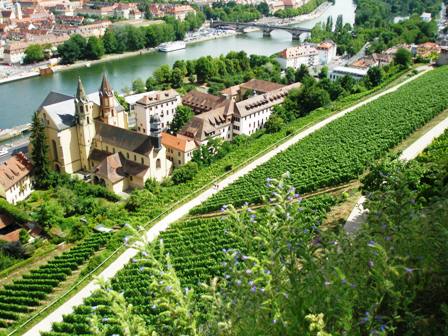
Most German wine regions (not all) take their name from the river which runs through the territory planted with grape vines. This is true for the Mosel, Saar, Ruwer, Rhine, and Nahe to name but a few. Vine growing in my native Germany is intrinsically linked to rivers and river systems which is partly due to the availability of steep slopes catching the last beams of sun.

The village of Schoden at the Saar river, in the background, the location Ayler Kupp (photo taken from the location “Herrenberg”)

Recently my writing style has been characterized as “meandering” (by David Harden, thanks David) and meandering I do. In fact the purpose of my whole blog is meandering. Meandering between the old and the new world and its wines, meandering between my actual live in a big Asian metropolitan city and my desired live in a rural place in Victoria, Australia, meandering between the many identities I have acquired over the years working in Asia and my future as an Australian vintner and wine maker.

Wuerzburg at the Main river and its vineyards

The second part of the title sentence goes as follows: “…so the wine”. This is certainly true for Germany. I have to find a similar “alliteration” for Glenburn and the Upper Goulburn Wine Region.


From North to South

September 28, 2008

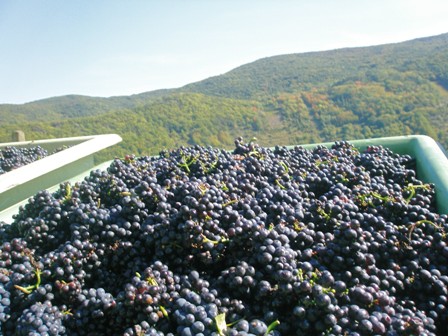
Pinot Noir grapes at the Ahr.

It’s vintage time in my native Germany. Reports I am reading about the harvest conditions seem to indicate that everything is going well. Also my German wine blogger colleagues seem to be content.

Down under in Victoria, we have springtime. Spring is usually Victoria’s wettest season. However, weather reports indicate that this September will be one with the lowest precipitation in history of Victoria.

Melbourne recorded only 16 mm of rain in September, the lowest since recording began in 1855. The long-term average is about 59 mm. Also average day temperature was well above the long-term average (19 instaed of 17 degrees celsius) which make September 2008 the warmest September since 2001. The same trend could be observed regarding night temperatures.

Reservoirs around the state are at a record low as well. That’s no good news for vintners and grape growers.

I wonder how full our two dams at Two Hills Vineyard are. So far we had always had sufficient water to bridge the 4-6 weeks of high summer. Last year we had hoped that the draught would be finally broken. That seems not to be the case.

But as always, we hope for a good harvest.

Lake Eildon low on water (only 23% of capacity, 09/2008)


Augusta Treverorum – home at last

July 24, 2008

My hometown of Trier (lat.: Augusta Treverorum) from the ‘Kockelsberg’

Alas, we made it. Grandparents were very happy to see us. Blue sky and summer sunshine greeted us. A splendid holiday awaited us. In short, Germany at its best. We are so lucky.

The Mosel river

Margit and I, we went to check out our favourite “watering whole”: the wine bar of Reichsgraf von Kesselstatt opposite the cathedral and the church of “Liebfrauen”.

The ‘garden’ of the wine bar

Riesling was our choice. We had a ‘2007 Kaseler Riesling dry’ (subregion: Ruwer) and a ‘2007 Wiltinger Riesling dry’ (subregion: Saar). Both wines were young and fresh, which make them a delicious drink in a hot summers day. We both preferred the wine from Wiltingen, Saar.

Cheers, and “zum Wohl” as the Germans say.

PS: I am loading this up from a small flat in Madrid which we rented. The internet connection is weak and blogging difficult. Please bear with me.