If you want to imagine me happy, imagine me in “Weinsinnig”, my favourite wine bar in Trier, Mosel.
Manuela Schewe and her team are doing a great job. I just love, that the wine bar is also a kind of cellar door for quite a few wineries. Most of them do have a cellar door of their own. However, with Weinsinnig they have a cellar door right in the middle of town.
I love this concept.
Among the wine producers you can find: Winery
Bender
Deutschherrenhof
Heymann-Löwenstein
Jakoby Pur
Lauer
Markus Molitor
Maximin Grünhaus
Nick Köwerich
Pauly
Philipp Kettern
Stephan Steinmetz
Van Volxem
Von Hövel and
von Othegraven
The selection of these, mostly local, wineries guarantees to the wine lover that he or she can choose from a broad range of different wine styles, varieties, terroir and even wine regions.
So far I was not able to try all of them as yet, but believe me I am working on it whenever I visit my lovely Trier. Stay tuned.
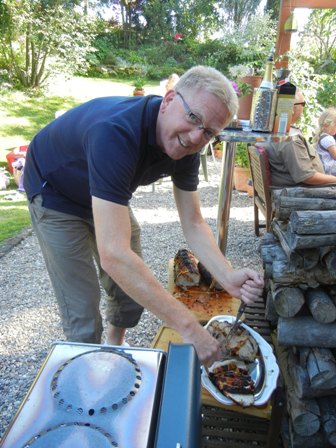
Actually, ‘traditional German ‘Schwenkbraten’ is when the pork is on a movable gridiron which is beeing moved over a coal fire. The above picture is more of a rolled piece of pork on a rotisserie.
However, that may be, the German love to grill as much as the Australians do. And since the summers in Germany tend to be unpredictable, often short, every opportunity to be outside and operate a grill is used to everybodies delight.
What a delicious piece of meat?
The pork is stuffed with onions, bacon, maybe herbs
My friend Juergen doing the carving job
Ready to be served
Note: Let me tell you that the above pictures were taken in Eitelsbach, Ruwer. My old friends Elisabeth and Juergen Olk had organised a family reunion to which we were kindly invited. It was a lovely summers afternoon, with little children darting through the garden, and adults chatting, telling stories, and drinking and eating. Apart from some Ruwer wines, mostly Riesling, the preferred drink was beer. We had a delightful time. What a beautiful day that was.
My readers know that I adore Riesling wines. Here is another one which we had with a delicious pasta (see photo above) the other day. The intensity of the tomatoe sauce was matched by the vivid citrus aromas, the fine balance of the acids and the mineral character of the Riesling from the Rheingau, Germany.
The ‘2011 Steinberger Riesling trocken (dry)’ by the famous estate of Kloster Eberbach is a great drop for every day consumption. It is their basic wine, and at the cost of 8.90 Euro it is quite affordable. The wine has all what it takes to be an excellent Riesling.
Enjoy.
As the name “Steinberger” suggests, the vineyard is a kind of “stone hill” and just located nearby the monastry. For centuries fine wines were produced from this terroir. The short video below gives you an idea about it.
As you know, I like to eat game of all kind. The best wild boar I have eaten in a long time was served to me by my good old friend Ulrich Hillejan and his wife Elfriede when we visited them this summer near Muenster. The so called Muensterland is a very picturesque agricultural region right north of the former industrial heartland of the Ruhr.
Ulrich comes from a tranditional farming family which goes back a couple of hundred years (he keeps very impressive records). He inherited one of the traditional farm houses away from the manor house, just outside the nearby village.
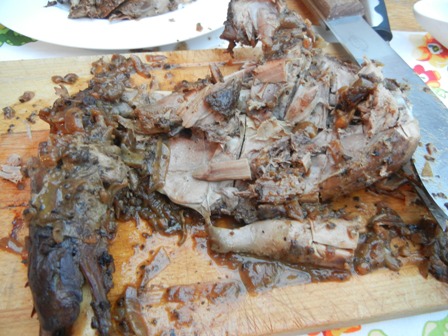
His mother (I call her aunty Doris) prepared for us the leg of a young wild boar, shot by Ulrich’s younger brother Georg. Let me say from the outset that this was the best piece of game I have ever eaten. I asked her to tell me the secret of this delicacy. Her instructions were rather sketchy. I figured that mustard plays a central role. The meat needs to be rubbed carefully with a mustard-pepper-salt potion.
The following photos show what we had for dinner. Of course the side dish with the carbs consisted of good German potatoes.
The potatoes
The young wild boar’s leg
On the plate
And after….
Needless to say that we had various kinds of delicious wines with our meal. We started the extensive tasting with a white wine, a fresh Gruener Veltliner from Weingut Setzer, Austria. The Setzer winery was decoreated with the “winery of the year 2013” award.
The estate has about 30 ha under vines and produces a wide variety of wines. Main grape variety are Gruener Veltliner, and red Veltliner. Recently, Hans Setzer, owner-operater of the estate, was awarded with the “Vinter of the year award” for 2013. With its low (11%) alcohol content, this wine is wonderful for warm summer days. It is refreshing and shows great temperament.
Gruener Veltliner Vesper, Austria
Knipser Riesling, Pfalz
We followed up with a German dry Riesling by the well-known Knipser Estate in Laumersheim, Pfalz.In 2009 the winery was awarded the “vintner-of-the-year” award by Gault Millau.
The ‘2001 Laumersheimer Kapellenberg Riesling Kabinett Trocken’ was just the right wine to complement the meal. I like the minerally note and the tropical fruit aromas.
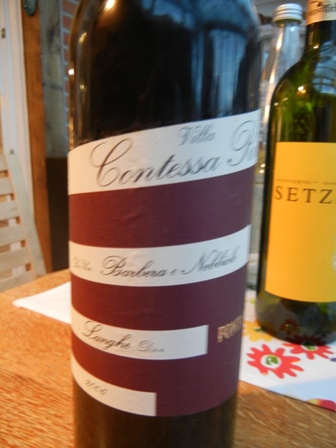
Barbera and Nebbiolo blend by Villa Contessa Rosa
Mid-term through the meal, we changed colour and switched to a red wine from Italy. Villa Contessa Rosa has currently about 70 ha under vines. The blend of Barbera and Nebbiolo, produced in the wine region Langhe, was also a good accompliment to the wild boar.
The meat from the forest animal and the red and Forest berry aromas from the wine went well together. Below you see the colour of the drop from heaven.
From here on I lost track of the wines we sampled in the course of the evening. There were a few more red wines, but honestly I cannot recall what they were and where they came from.
The generosity of our hosts knew no bounds, I might say (thank you again Ulrich and Elfriede). It was a terrific evening of reminiscing about the past and making plans for the future.
About a week ago history was made when the first “wine flash-mob” was conducted in Koblenz, and a much smaller one in my home town Trier. I learned it from facebook, and I wished I were there.
Funny is that the word flash of the term “flash-mob” sounds like “Flasche” which translates into German as “bottle”. So it is a “bottle mob”. Indeed about 200 wine lovers followed the invitation in Koblenz and congregated at the “German corner” (Deutsches Eck), a public square, where Rhine and Mosel river merge.
It was maybe the last warm autumn’s day (according to the organizers 21 Celsius) with blues sky, coloured leaves on trees, soft air with the hint that winter was not far away. Jan Wilhelm Buhrmann and Marco Pusceddu from the wine bar “Gavino” in Koblenz had invited to this un-usual event.
The event was part of an initiative by the German Wine Institute (DWI) to promote German wine. The title of the campaign was “become a wine spotter” (or discoverer) and it was conducted in the third week of October. In more than 400 restaurants all over Germany various events were held to promote German wine.
The bottle flash mob in Koblenz, planned for only 20 minutes, muted into a two hour public tasting and wine sharing where German “Gemuetlichkeit” reigned. Great stuff. I hope I can be there when they do it next time.
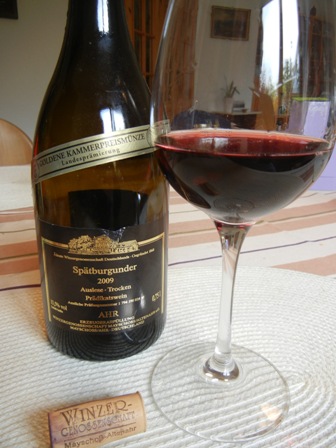
The Ahr wine region is well known for producing outstanding Pinot Noir wines in Germany. During a visit this summer we bought a bottle of ‘2009 Spaetburgunder Auslese dry’ from the Mayschoss Vintner Co-operative.
The co-operative is the oldest in Germany. In 2012 one of it’s wines was awarded the best “Blanc de Noir of Germany” title by the food magazine „Der Feinschmecker“ (5/2012 edition). We visited the cellar door in August and had a guided tour which was very lovely.
Recently I tasted the Mayschoss Pinot Noir together with my friend Juergen. The wine has a beautiful dark red colour. The black fruit aromas with a tiny hint of peach are lovely. The wine is medium-bodied, smooth and shows a fine balance. We drank it on a Sunday morning, just like that without food, what we call in Germany a “Fruehschoppen”, a drink (glass of wine or beer) taken after church, and before going home for lunch.
Thanks Juergen and Elisabeth for the excellent company.
I love the recipes from Jamie Oliver. In his book: “Jamie does…”, the Aegean Kakavia, a Greek fish stew, is presented.
These days, as you know, there is some kind of weariness between Greek and German people because of the currency and bailout issues. So a Greek dish with a German wine seemed the right pairing; hinting at some kind of reconciliation or just because fish and Riesling harmonize so well?
I don’t know.
The recipe is dead simple. The beauty is that any fish will do. We had flounder and prawns. Chop some onions, tomatoes, garlic, celery and potatoes and cook it in some vegetable stock, with olive oil, lemon juice, salt and pepper. At the end add some fresh parsley and dill, and voilà, here we are.
2010 dry Riesling by Emrich-Schoenleber
I love Riesling and hold the wines made by Emrich-Schoenleber Estate in Monzingen, Nahe in high esteem. They remind me of my childhood and the time I spent with my maternal grandfather in Martinstein, just a couple of kilometres to the West.
This low alcohol (11.5%), bone dry Riesling is a fine specimen of what the Nahe wine region can produce. The wine is fresh and zesty, with intense lemon aromas, well balanced acidity and a long finish. I could have a bottle every day…but since I live in Bangkok, this is hardly possible. The more I treasure this fine Riesling wine.
If you happen to pass by the Nahe, visit the winery of the father and son vintner duo and enjoy a 250-year tradition of grape-growing and wine-making. The cellar door of the Emrich-Schoenleber family is a beautiful place to taste fine wines. You will not regret it.
In the last week of September three of my favourite German wineries were honoured by the Wine & Spirits Magazine, and included in the top 100 list of the best wineries of the world in 2012.
The three wineries are the following:
1. Dr. Loosen, Bernkastel, Mosel
The winery has been in the Loosen family for more than 200 years. Ernst Loosen took over in 1988, and, as they say, the rest is history. Dr. Loosen is maybe one of the best known German vintners in the international wine scene. I was so happy when Barrique, my local wine shop in Healesville, Victoria was carrying Dr. Loosen wines.
Address: Winery Dr. Loosen,
St. Johannishof
54470 Bernkastel, Mosel
Tel.: +49-6531-3426
info@drloosen.com www.drloosen.com
2. C. von Schubert, Mertesdorf, Ruwer, Mosel
This winery has also a long tradition. The “Grünhaus”, as the estate is also known, was already mentioned in ancient documents in 966 when it belonged to the Benedictine monastery of Saint Maximin in Trier.
Carl von Schubert, the current owner-operator, belongs to the fifth generation of the von Schubert family. The estate produces outstanding wines and was awarded many national and international prices. I tasted some of the Maximin Grünhäuser 2011 vintage dry Riesling wines during our summer vacation
Address: Dr. Carl von Schubert
Hauptstr. 1
54318 Mertesdorf
Tel.:+49-651-5111
Fax: +49-651-52122
info@vonschubert.de www.vonschubert.com
3. Robert Weil, Kiedrich, Rheingau
The winery was set-up in 1875. The founder was the university professor Robert Weil who taught German at the Sorbonne in Paris. The Franco-Prussian war of 1870/71 forced him to return to his native Germany. He settled down in Kiedrich, Rheingau and extended his vineyards and laid the foundation for today’s estate. In 2010 I found some bottles of the Robert Weil 2008 vintage in a Bangkok wine shop. Delicious.
Address: Winery Robert Weil
Mühlberg 5
65399 Kiedrich, Rheingau
Tel.: +49-6123 2308
Fax: +49-6123 1546
info(at)weingut-robert-weil.com www.weingut-robert-weil.com
I am rapping things up here in Bangkok. Only two more days to go. Friday night I will be on the midnight flight to Germany. After about 11 hours on the plane, I will land in Frankfurt early in the morning. I might have a coffee and breakfast at the train station.
Then I will catch a train to Tier, my home town to see my parents. The train ride will be wonderful regardless of the weather. Autumn might extend its magic with colourful leaves in red, brown and yellow.
First, my trip will lead me along the Rhine river, then I’ll change trains in Koblenz. The next leg of the journey will be along the Mosel river. Some of the views will be spectacular.
I will admire the vineyards of both valleys, the Rhine and the Mosel. On the hilltops will be castles here and there. The slopes are steep, and I will think of all the hard work the vintners put into their vineyards. How can one work these terrible steep slopes? Backbreaking work, done for generations.
Vineyards and wine production have been a feature of the place for more than 2.000 years, incredible. I will have only about 24 hours there before I will move on for a business trip to Berlin.
Saturday night I will patronize my favourite wine bar, Weinsinnig. It will be my cellar door so to speak since I plan to pick up a few bottles of my favourite Mosel wines. There will be certainly a crisp Riesling among them.
I do not think that Australia has already embarked on this path, but Germany certainly has a long tradition of wine queens and wine princesses (since about the 1930s).
The German wine queen is the elected representative of German wine for the duration of one year. The candidates are the 13 regionally elected wine queens from the officially recognized 13 wine regions.
It is tradition that the new wine queen will be crowned in Neustadt, Pfalz. The 64th German wine queen is Julia Bertram from the Ahr win region. She was inaugurated on September 29.
The German wine princesses (allowed are up to three) are the deputies of the German wine queen. Usually the runner-up in the election is appointed wine princess. Currently there are two, Anna Hochdörffer, Pfalz, and Natalie Henninger, Baden.
The electoral college consists of about 70 members. I could neither find out how the selection committee is composed nor how these jury members are selected, though. From the 13 regional wine queens, normally six are nominated as finalists for the contest. The jury elects one as queen and two as her princesses. Of the 64 queens, 11 came from my native Mosel.
The candidates do not need to come from a winery or vineyard but need solid knowledge about German wine and the wine industry, oenology and wine-making. The wine queen and the princesses are representing the wine industry for a year at all major wine festival, fairs, exhibitions, wine tastings, including international events. They need to be eloquent and good ambassadors for the German wine industry.


 Posted by themanfrommoselriver













 The Man from Mosel River