Jakarta Floods

February 12, 2007

You might have seen it already on TV or on the front page of newspapers. This years’ floods in Jakarta were extraordinary. More than 80 people lost their lives, and almost half a million lost their homes.

As mentioned in my description of the Burns Supper, our friends Walter and Liz Casha were flooded too. They had to swim out of their house and housing compound. I enclose herewith some photos which Liz had sent me. Beware of the water!

Floods in Jakarta

The kitchenware floating

In the rain

Leaving by boat

Leaving the housing compound by boat


Two Hills Merlot

February 11, 2007

It was the perfect day for a Merlot. Actually any day is good for Merlot but in the tropics one has to be careful with alcohol of any kind. Nevertheless, we had to do some tasting today. 2001 was our first Merlot vintage. Nobody wanted to buy the fruit. This is why I decided to make all of it into wine. Alan Johns of Yering Farm (www.yeringfarm.com.au) did this for us.

All our wines are hand crafted. They come from a single site vineyard, Two Hills Vineyard in Glenburn, and are hand picked. The fruit was fermented in traditional open fermenters and aged in old French barriques to preserve the Merlot’s elegance and finesse. At 12.8 % alcohol it is not too “heavy”. It is medium bodied, dry with a good acidity and a long finish. Its subtle flavours of ripe forest fruit and its firm tannins give the wine a fine balance.

The Merlot Block

Two Hills Vineyard – Merlot Block, single site (3 1/2/ acres)

We do not have many bottles left of the 2001 vintage here in Jakarta, and in fact not many are left on our vineyard either. It has matured in the bottle and some of our friends like it better then the lighter more elegant 2004 vintage. 2001 was a warm year with a golden autumn to ripen the fruit in perfect conditions. Timo Mayer, our friend and winemaker at Gembrook Hill (www.gembrookhill.com.au), described it as an “umpf” wine, rich and heavy whereas the 2004 Merlot vintage is elegant with great finesse. Anyhow, we enjoyed the drop today far from the place where it was grown. It reduces the homesickness we feel from time to time.

If you want a bottle or two please call in the bottle shop of the Old England Hotel in Heidelberg/Melbourne (www.oldenglandhotel.com.au) and ask for Two Hills Merlot. If you are in Germany please contact Dr. Ulrich Hillejan (ulrich.hillejan@s-h-r.de). Zum Wohl. Salute.

Product Range THW

2001 and 2002 Sauvignon Blanc and 2001 Merlot vintages of Two Hills Vineyard


Burns Supper – Java St. Andrews Society

February 10, 2007

I will write more about Celts and Celtic traditions today. Friends of ours got flooded out and could not attend this year’s Robert Burns (1759 – 1796) Supper and the related celebrations of the Java St. Andrews Society (www.javastandrewsociety.com). They kindly passed the ticket on to us and we were welcomed as replacements by the Scots. Thanks again Liz and Walter for your generosity.

Burns Supper 2007

We sat at the “Holy Willie’s Prayer” table together with four Americans. Most men at the supper were in kilts and every time I see this, I want to buy a traditional Bavarian outfit (with leather trousers and so on) which would at least come a bit closer to this formidable dress for the Scottish men. We used to be members of the society many years ago but when our Scots friends at the time had left Jakarta we did not renew our membership. We had also attended quite a few Burns Suppers so that we knew what we were in for. A very memorable one was the first ever held on Chinese soil in Beijing in 1992.

Robert Burns is the beloved poet and lyricist of the Scots (the national poet). He is regarded as a pioneer of the Romantic movement and his poems and writings became a source of inspiration to the founders of both liberalism and socialism. Burns loved women and drink. Statues of Robert Burns can also be found in Australia (Sydney, Canberra and Adelaide). The celebration of his birthday (25th January) follows a fixed ritual.

The program in Jakarta looked as follows:

● The Selkirk Grace (by Sandy Duncan)

● Address to the Haggis (by Chieftain Scott Thompson)

● The Loyal Toast (by Tony McEwan)

● Songs of Burns (by Barbara and Alastair Speirs)

● The Immortal Memory (Robert Burns Live by Chris Tait)

● The Land we Live in and Absent Friends (by Ross Scholes)

● The Land we Hail From (by Brian Scott)

● To the Lassies (by Tony Milne)

● Holy Willie’s Prayer (by Jim Tait)

● The Reply from the Lassies (by Alex Faulds)

● Poems of Burns (Robert Burns Live by Christ Tait)

As customary at this occasion, the haggis (filled sheep’s stomach) is served. It is brought into the hall accompanied by pipe music and usually a guard of honour sometimes holding bottles of whiskey crossed in front of their chests like swords. The pipers were the Edinburgh Chevaliers flown in for the occasion and they entertained us very well. The speeches were well presented too. In addition a Robert Burns look alike (Chris Tait) gave quite a performance. For non-Scots it is at times difficult to follow but its great fun. I always enjoy listening to these old almost forgotten Celtic languages.

The dinner consisted of green pea soup followed by the customary haggis with neeps and tatties. As the main course, we had angus steak pie with new Ayrshire Potatoes, baby carrots and Iona parsley. The desert, McEwan’s Apple Tart and ice cream, we spiced with the whisky which was generously deposited on each table. This year it consisted of bottles of Johnny Walker (12 years old).

The Scots do not grow vines as we all know. We drank a 2004 Timber Ridge Shiraz, a wine from Western Australia. It showed a very lively, fruity character of black fruit, raspberry mainly. My palate detected cherries but I might have gotten it all wrong. The wine was clean and well balanced and surprised us. I had never heard of the vineyard. The next day I searched it on the internet. Unfortunately, the website of the Timber Ridge Vineyard is not yet operational. There is a vineyard of the same name in the USA but I could not find out more about the Western Australian venture, except tasting notes for the 2004 vintage.

For the Whiskey

The Whisky “Taster”


The Treverer

February 4, 2007

The first time the river Mosel is mentioned in a written document is the account of Gajus Julius Caesar in his De Bello Gallico, IV in 55 B.C. where he describes his battle and the subsequent victory over two German tribes, the Usipeter and Tencterer. Around the same time we also learn about the original settlers in the Mosel river valley and around Trier, the Celtic Treverer.

“The Treverer are cleverer” sounds a line in a popular song of a local rock music group called “Leiendecker Bloas”. But not only that. The Treverer were feared by the Roman invaders as well.

Treviros vites censeo. Audio, “capitales” esse; mallem, auro, argento aeri essent.

This is what Marcus Tullius Cicero wrote to a friend during Caesar’s war against the Treverer in about 55 B.C. In a free translation that reads as “better avoid the Treverer; they go for your throat. I wish those guys would rather work as silver and gold smiths”. The Romans in fact had some troubles in controlling the Celtic population of the Mosel valley. In 69/70 A.D. the Treverer revolted against the imperialists from Rome but were defeated again. The Roman general Petilius Cerealis did not lose his composure in battle despite the fact that his cavalry was already wiped out, his camp fortification destroyed and the walls overrun by the fierce Celtic fighters from the Mosel.

But over the decades that followed the Celtic swineherds were transformed into vintners and the people thanked the god of wine – Sucellus – for this. The Treverer were known to be hungry for fame, quarrelsome and rowdy. They were also known to be big drinkers, more so than even the Germans. The many drinking competitions they held are ample proof of their favourite pastime. The ones who could not drink were despised as weaklings. That people could call themselves lucky if they got away alive from those fierce drinking competitions, was a common notion. That’s how it was: The good old days. These times have long gone and modern man does of course some drinking here and there but we are all more or less domesticated in some way or another. We go to work 5 days a week. We do sports in our free time, watch TV, send sms and e-mail, write blogs and so on.

Joseph Roth in “The Radetzky March” describes the changes at the turn of the 19th to the 20th century but his description can certainly also be applied to earlier times and ages.

Everything that grew took long to grow
and everything that ended took a long time to be forgotten.
Everything that existed left behind traces of itself
and people then lived by their memories,
just as we nowadays live by our capacity to forget,
quickly and comprehensively.

Schale

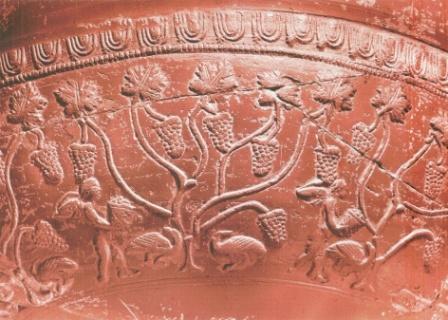
Terra Sigillata bowl found in Trier (Karl-Josef Gilles: Bacchus and Sucellus, Briedel 1999)

Vinum vires is what the Romans said, wine gives power! My suggestion for the day: open a bottle of your favourite wine and enjoy the Sunday.

Bene tibi sit “Wohl bekomms” or To your health, salute, cincin and so on

————————
Reading tip: Edgar Christoffel: “Mosel und Wein – Stimmen aus zwei Jahrtausenden”, Trier 2003


The Upper Goulburn Wine Region

February 1, 2007

Today, after all these Mosel meals, I want to take you back to Australia and write about the wine region in which our vineyard is located: the Upper Goulburn Wine Region. I also would like to inform you a little bit about the activities of the Upper Goulburn Winegrowers Association (UGWA; www.uppergoulburnwine.org.au).

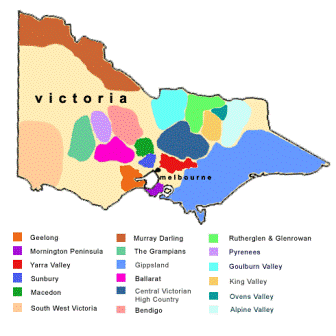
The Upper Goulburn is located in central Victoria. The region derives its name from the Goulburn River which is one of the main features of the area. It is a cool-climate grape growing area setting it apart from most other parts of Victorian. The region has only recently been classified in the geographic indication system. Grapes, however, have been grown in this part of Victoria for almost 40 years. In comparison to the Mosel this is indeed a very young wine region.

The Geographic Indications Committee of the Australian Wine and Brandy Corporation (AWBC; www.awbc.com.au) determines wine zones, regions, sub-regions and their boundaries. The system was introduced after lengthy negotiations with the European Union which did not accept Australian wines unless it complied with European regulations. The Australian Wine and Brandy Corporation Act of 1980 was amended in 1993 to accommodate those requirements.

Map of the Victorian Wine Regions

Wine Regions of Victoria Map Dark blue formerly Central Victorian High Country and now divided in Strathbogie Ranges and Upper Goulburn Wine Region (www.wineaustralia.com/australia

The region is very diverse in terms of altitude, climate, temperature, rainfall, and soils. Site selection is of ultimate importance. Rainfall varies from 700 to 1400 mm. Some vineyards even rise to the snowline at 800 m. Many locations are ideally suited for sparkling wine production consisting of Chardonnay and Pinot Noir grapes. Aromatic varieties such as Riesling, Gewuerztraminer and Sauvignon Blanc can be found but also Cabernet Sauvignon, Merlot, Malbec and Shiraz. (www.greatwinecapitals.com/melbourne/mel_reg_centralvictorianhighcountry.html)

The Upper Goulburn is very picturesque and one of the gems of Victoria. It extends from Tallarook in the west to Mansfield, Lake Eildon and further north Lake Nillacootie. Regional centres like Yea, Alexandra and Eildon are located in the region. Mount Buller and its skiing slopes, the lakes, the small rivers and the high planes are a premium destination for national and international tourism.

Mount Buller

Mount Buller with snow cap

Two Hills Vineyard can be found at the most southern edge of the region on the way to Yarra Glen. Today there are about 25 wine labels and more than 30 vineyards in the region. Recently a branding workshop has identified the key characteristics of the region which include:

● high diversity of vineyards and wines
● climate very suitable for premium cool climate grapes and wines
● aromatic whites/sparkling wines and elegant reds
● hand picked and hand crafted grapes/wines
● family owned businesses
● environmentally aware producers
● low environmental footprint
● shared experience between producers and customers
● good infrastructure
● unknown – Victoria’s secret

From these few words it is clear where you have to spend your next holidays: in Central Victoria. See you there (www.visitvictoria.com/wineries).

Two Hills Vineyard

Two Hills Vineyard


Sunday Lunch with Riesling from the Saar River

January 29, 2007

What a wonderful weekend this was. It goes without saying that I had “to weber” some of our food; to be precise it was my task to barbecue Sunday’s lunch. As our house guest David is vegetarian it meant that I had a lot of “veggies” (as Australians commonly call vegetables) to prepare. But we had also fresh fish, a Pomfret as it is commonly known. There are two varieties, the white and the black pomfret. The Indonesians call the former “Bawal Putih”. White pomfret has an excellent flavour and is commonly used for a dish called Ikan Asam Manis (sweat & sour fish); needless to say that it is very delicious either steamed or grilled.

The White Pomfret

The White Pomfret (from Kaarin Wall “A Jakarta Market”, page 53)

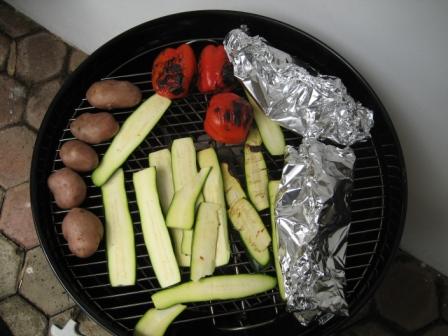
First, I grilled the vegetables: potatoes (after they were boiled), onions, capsicum, green peppers, and zucchini. The fish was marinated with black olives and capers and wrapped in aluminum foil to keep it moist. I put it on for only about 20 minutes. The food was delicious and we had the right wine to go with it.

misha2-097w.jpg

My Weber with the vegetables

We drank one of my last two bottles of Van Volxem Saar Riesling 2003. This wine estate is located in Wiltingen (www.wiltingen.de), a village about 20 km south of Trier at the Saar River, a cool climate region belonging to the Mosel-Saar-Ruwer area. The lower Saar is a very small winegrowing region but has some of the best Grand-Cru locations for Riesling (for instance Schwarzhofberg) on which its reputation is based.

misha2-111w.jpg

The 2003 Van Volxem Riesling

Van Volxem is the oldest estate in the Saar. Formerly a monastery, the estate belonged to the Van Volxem family for four generations. In 1999 it was purchased by Roman Niewodniczanski of the beer brewing Bitburger family. Based on old tax records, many excellent and sometimes forgotten vineyard sites were newly acquired when the estate was expanded. Most of the more than 20 ha are planted with Riesling vines. The first vintage was bottled in 2000 and ever since elegant wines with excellent ratings were produced under a system that avoids the German “Praedikat system”. Unfortunately, the estate’s internet presentation is still under construction. Therefore, we have to wait a while longer until you can visit www.vanvolxem.de.

sa500041w.JPG

A typical Saar vineyard

The soils of the Saar are based on blue-black slates and very stony. The vineyards are located at steep southerly slopes. The key for the Van Volxem Estate’s success are late harvests and low yields, environmental friendly practices (no pesticides) and low input cultivation techniques (no chemical fertilizers), relying in the cellar on natural yeasts fermentations and maturation in oak barrels. The 2003 dry Riesling blend has 12% alcohol. It was the first vintage producing dryer wines. 2003 was a ripper year as regards the weather and this might explain the higher than usual alcohol content of the 2003 vintage. Some of the wines are produced from more than 100 years old vines. The 2003 Riesling is medium bodied, had a buttery aroma and displayed some sweetness. It showed some mineral characteristics, had a fruity nose and a long finish. It is terrible that I have only one more bottle left of this excellent vintage (www.riesling.de). Wines do not age well in the tropics, even if you keep them properly refrigerated. There is always the odd power failure which destroys your well thought through cellaring program.

The drinking of Saar wine reminds me of my youth when my father and his friends used to go hunting in Schoden, a village further upriver. Often groups of hunters would descend on the Saar villages after successful campaigns and dine in one of the old rural inns (Gasthoefe). When at home with my mother in Trier, we often set out for long walks in the forests covering the hills above the Saar. From there one has a magnificent view of the lovely countryside.

From Schoden

Vineyards in a distance

sa500039w.JPG

The Saar Valley, the village of Biebelhausen in front on the left side of the Saar, behind the terroir “Ayler Kupp”, and to the left further back the famous village of Ayl.


Australia Day

January 26, 2007

Today is the National Day of Australia (1788) and our family and friends down under are celebrating. For us in Jakarta it is just a normal working day. Like every morning at 6h I woke up my girls to get ready for breakfast and ultimately school. I enjoy waking them very much because it gives me the chance to hear their first words of the day. And because I frequently work late at night, I often do not see them again in the evening, the mornings are a chance not to be missed.

I followed over the last couple of days the controversy about the flag ban for concertgoers of the Big Day Out music concert in Sydney. The fact that the ban caused such a storm among the public including politicians and scholars, I found interesting.

As a German I personally have still severe emotional reservations about national emblems such as national flags and national anthems which is not surprising for people from my generation born after the war. While travelling as a young man I would always answer questions about my origin with “European” and only later admit to my German nationality. However, I was very happy to see during last year’s soccer world cup that many Germans have developed a more normal relationship with their national flag and were proud to display it at the games. The only national flag I possess is the one of my host country Indonesia which we fly on 17 August, the Indonesian National Day, celebrating the freedom Indonesians gained on that day in 1945.

My children also like to sing the Australian National Anthem. They sang it every Monday morning at the Dixons Creek Primary School which they attended during extended holidays over a couple of years every June/July. I like to join in when they sing the anthem. In fact I would rather sing other national anthems than the German one, for instance the French one (La Marseillaise) or even the American one (The Star Spangled Banner). Startled by these thoughts I did some research on the internet to find out more about national anthems. Many of them are a celebration of freedom which for me as a modern-classical liberal is worth being celebrated. In the Australian case, the second line says “for we are young and free” and in the German case the anthem opens with “Unity and right and freedom”.

Many of them originate from the mid 19th century when feudal overlords were defeated and modern nations were born. It often took some time until a specific song was accepted as the national anthem. It took the Australians until 1984 when on 19 April “Advance Australia Fair” was declared the national anthem (www.dfat.gov.au) though it was composed in the 19th century and fist performed in 1878 in Sydney. The composer was a Scott, Peter Dodds McCormick. Extensive opinion surveys were conducted before it was adopted. The “Deutschlandlied” (Song of the Germans) was officially played for the first time in 1890 and only adopted as a national anthem on 11 August 1922 by the first president Friedrich Ebert. It does not praise or even mention war or victory which might explain why it was retained after the Second World War.(http://German.about.com)

I knew that the German National Anthem was composed by Franz Joseph Haydn and that the text came from August Heinrich Hoffmann von Fallersleben (das Deutschlandlied). I also knew that the third stanza was selected after the Second World War as the official anthem and that the first one was dropped. What I did not know was that in about 1840 when it was written the introductory line, which I always found so repulsive, “Germany, Germany more then all, more then all in the world”, had of course a very different meaning. At that time Germany did not exist, we had only a large number of German monarchies and some republican free cities. Instead the song was an appeal to all Germans to finally unite. I only identified it with the Nazi’s quest for German superiority.

Today I feel a little bit wiser. I might even be on my way to a more natural relationship with the German emblems of nationhood such as the flag and the anthem. I might become maybe a bit like my children who can sing away to their heart’s content “Advance Australia Fair”. For me the wine drinker the second stanza of the Song of the Germans is of interest. Unfortunately, this stanza was never very popular. It reads as follows:

German women, German loyalty
German wine and German song,
Shall retain in the world,
Their old lovely ring
To inspire us to noble deeds
Our whole life long.
German women, German loyalty,
German wine and German song.

The stanza depicts to some extent the lighter, more joyous and life embracing character of the German people. Von Fallersleben had intended the text to be used as a simple drinking song. And of wine drinking songs we can never have enough.
Happy Australia Day


Sunday Lunch the Mosel Way

January 22, 2007

The weekend came and went like a storm, exhausted I am sitting on my desk at Monday lunchtime and contemplate about the good times gone by. As always, we had great food on Sunday. My wife Margit prepared a “Wehlener Specksalat”, which translates into English as “Wehlener potato salad”. With it we had a wonderful fresh water trout. The wine we enjoyed with the food was a Riesling of course, a 2003 Kaseler Riesling from the Reichsgraf von Kesselstatt Estate.

The settlement of Wehlen/Mosel is part of the district of Bernkastel-Kues, a small but famous town in the Mosel valley, about 50 km downriver from Trier. Wehlen has one of the best vineyard sites among the Middle Mosel producing outstanding Riesling wines. The world renowned site is called “Wehlener Sonnenuhr” (Wehlener sundial). The vines are cultivated on steep slopes (50%) on an altitude between 110 and 190 meters above sea level. The soils are very stony and are classified as Devonian slate soils. The wines produced are elegant and deep, full-bodied and fruity.

Wehlen goes back to Roman times when Celts established this village. The settlement has a tradition of more than 1100 years of vineyard cultivation and wine production. In a historical document of 874 the Arch Bishop of Trier requires the vintners of Wehlen to deliver 10% of their produce to the local church. Only the vineyards allocated to local monks were excluded from this tax. Unfortunately, the website of Wehlen is only in German but you might still visit and enjoy the impressive pictures (www.wehlen.de).

Back to the food. The “Cookbook of the Mosel” (Author Gisela Allkemper, published by Wolfgang Hoelker) was given to my wife many years ago as a Christmas present by my mother. And ever since, Margit has referred to it and experimented with its recipes. Wehlener Specksalat has become our favourite potato salad. Here is how you prepare it:

Wehlener Specksalat

Ingredients: 1 kg of potatos, 2 table spoons of oil, 5 ts of vinager, 2 onions, salt, pepper, a pinch of sugar, 75-100 grams of smoked streaked bacon

Peel the potatoes and cook them, still warm, cut them into cubes and mix them with the dressing; cut the beacon also into cubes, fry it in a pan and add it with the fat to the salad; keep the salad warm, mix it from time to time. Serve it with backed or fried fish, and/or sausages or other fried meats.

We drank one of my last bottles of ‘2003 Kaseler Riesling’, Reichsgraf von Kesselstatt – The Riesling Estate (www.kesselstatt.com). Kasel is a small village at the Ruwer River, some 10km from Trier on the right hand side. When we were at high school my brother Wolfgang used to earn some pocket money by working for family vineyards during harvesting season. That’s hard work because the slopes are steep, the weather often wet and unfriendly. He reported about the great hospitality of the vintners and the fun he had with the co-workers of the labour crews employed for picking during vintage time. I never got to it and regret this now at the tender age of 52. Another lost opportunity.
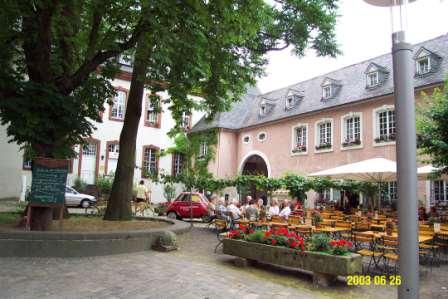
Wine Pub and Garden of Reichsgraf von Kesselstatt in Trier

The Wine Bar and Garden of Reichsgraf von Kesselstatt in Trier

Reichsgraf von Kesselstatt maintains a beautiful website (www.kesselstatt.com) in three languages; German, English and Chinese. The latter made me very happy. Having lived in China and Chinese speaking cultures for more than eight years, it is always a pleasure to see Chinese characters. I guess that many of the Chinese tourists visiting Trier, the birth place of Karl Marx, also belong to the customers of the estate. Let us hope that many visitors from the Far East become lovers of wine from the Mosel river and its many vineyards, wineries and wine estates. Kesselstatt, by the way, owns also a vineyard in Wehlen (according to the website 0.3 ha) in the location “Sonnenuhr”.
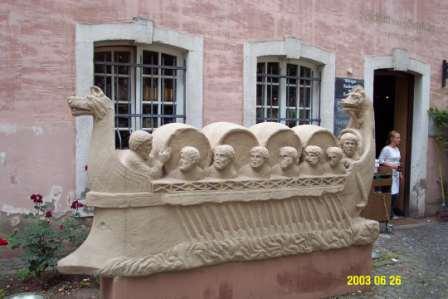
“Neumagener Wineship” replica in front of the Kesselstatt wine bar

The “Neumagener Wineship”, replica in front of the Kesselstatt Wine Bar.

Similar to the “village-system” of Burgundy, Kesselstatt produces regional wines. The fruit for this Riesling is sourced from around Kasel. Kesselstatt itself owns two holdings there (top locations Nies’chen 4.4. ha on a 60% slope and Kehrnagel 1.8 ha on the valleys finest sites). Some of the vineyards belonged to the St Irminen monastery. By the way, I grew up at Irminenfreihof 5 in Trier (the neighbourhood was locally also knows as Brittany), next to the monastery located in the middle of the city of Trier.

The Wine: 2003 Kaseler Riesling dry
This full-bodied fine Riesling shows all the characteristics of the typical Mosel Rieslings. It’s very minerally (because of the slate soil) and fruity, depicting pineapple, peach, apple and lemongrass characteristics. It’s is also well balanced, dry with a lingering finish. The alcohol level is rather high for a Mosel Riesling (12.5%). But 2003 was a most astonishing year. Throughout the year temperatures were higher then normal; the year was also much drier. Because of these favourable conditions growth was exuberant. When temperatures hit the 40° Celsius in August sunburns were widespread. The grapes ripened quickly and picking started much earlier along the Mosel river and its tributaries then in most years. The fruit picked was usually healthy and showed aromas which were not depicted in other years. Unfortunately, I have only another two or three bottles left of this treasure. I will reserve it for special occasions with more Wehlener potato salad and fresh trout.


Barbecueing – The Australian Pastime

January 19, 2007

My wife gave me as Christmas present the Mercedes Benz of the grills. a Weber. The Weber, a Canadian product, is the most sophisticated among a wide range of grills (www.weber.com). I have already one with gas but now the round, shiny Weber is decorating my backyard. It was easy to assemble the thing, even for a man with two left hands like me.

In Australia, the mother country of my wife, grilling is a men’s affair, no work for women. I am a lousy cook, I admit this. When we are back on the vineyard usually my brother in law, Michael, (or any other Australian male nearby) is doing the grilling, but in Jakarta there is no Michael. Now I ran out of excuses, and the Weber is there calling for me.

The second impediment for me becoming a master griller is that I do not appreciate meat very much. Not that I am a vegetarian, no, I am rather a selective meat consumer. There are days I cannot swallow the flesh of animals and stick to green stuff exclusively. The biggest challange for me is to find out when the meat “is done”.

I knew long before Christmas Day that I would get a Weber. The packaging gave it away. It was just to bulky under the Christmas tree. So mentally I was somehow prepared for it. I also knew that Margit had bought a Turkey to be prepared for Christmas lunch. And Tukey it was, my first grilled masterpiece.

The photo below depicts me doing my job as an Australian man. Sorry for the outfit (no Akubra; www.akubra.com.au; another icon of Australian identity), but it’s hot in the tropics. The Turkey tasted wonderful. I am sorry for the winedrinkers. When I stand next to a grill I can only drink beer. A case of Tooheys Red, the favourite hops drink of my brother in law, was consumed in the battle with the grill and later with the meal I drank the last supply of my Bitburger Beer from my hometown. Margit drank sparkling and the girls had water.

Adam and the Weber


Of Droughts and Bushfires

January 12, 2007

Today, I climbed from the heavans and my meetings with the celtic gods (remember Sucellus?) down to earth again. And a hot earth it is. From The Age (www.theage.com.au) I learned about the progress of the bushfires in Victoria. 950.000 ha of forest have already burnt down, which according to The Age is almost as large as Jamaica (it has a bobsled team). Mt Buller where it burns is only about two hours away from our vineyard in Glenburn.

Some years ago I went skiing with my friend, Timo Meyer, Australian of Swabian origin, and his and our children for a day of racing down the hills. Timo is a vintner and a very sought after winemaker at Gembrook Hill Vineyard (www.gembrookhill.com.au). He is famous for his very fine palate. Timo made our second vintage of Sauvignon Blanc which in the end got us the bronze medal at the Singapore Wine Show. He has also his own vineyard at a very steep slope which is called “Bloody Hill”. His wines can be bought at Yarra Valley Dairy (www.yvd.com.au).

The picture below has been taken by Andrew de la Rue and it shows the fire raging near Mt. Bulller village.

buller_smoke_wideweb__470×2930.jpg

We are suffering under the drought for some years already. Because of the higher altitude of our vineyard loaction in Glenburn, we normally receive sufficient rain. Years ago we enlarged the old dam and built a new 13 megalitre storage. This kept us going. It did not rain much this winter (June to August on the southern hemisphere). I have never seen our big dam as low as in July/August 2006. Margit and I, we are of course a bit scared that some fires might break out in the nearby forests. Many of the fires are deliberatly lit by arsonists, others are ignited by lightning. The temperatures are high at the moment and together with the strong northerly winds, they make firefighting dangerous.

It has been a strange year so far. First, many vineyards were hit by two waves of late frost which destroyed in some places all the fruit at the vines. We at Two Hills were lucky. According to Steve Sadlier our friend, who manages our vineyard, we lost about 20% of the Sauvignon Blanc, 60% of the Pinot and about 40-50% of the Merlot. Some vineyards in the neighbourhood lost up to 60-70 % of their fruit, others lost everything. As a consequence the Victorian wine industry is suffering tremendous damages. Demand for fruit is strong. If we had only more of it. The old agricultural law prevails, that the economic value of a bumper harvest is usually lower then the one of a meager year. The frost damage will have lasting effects. Also the 2008 harvest will be lower because of the frost damage last year. Second, comes the drought and the fires. If Kinglake National Park start to burn, we will be in trouble.

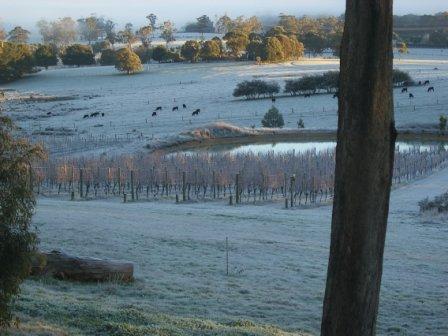
Below some pictures of Two Hills in winter 2006. Isn’t the place beautiful?

Winter on Two Hills 1

Two Hills Vineyard

Winter on Two Hills 2

Winter on Two Hills 3

Sauvignon Blanc in winter