DAGERNOVA: wine co-operative at the Ahr

November 18, 2007

I have already written about my visits to the Ahr wine region. Vine cultivation has a long tradition in the Ahr valley going back to about 770 AD.

d1000176dagernova4.jpg

The above sign reads as follows: “Happy humans and good wine should always be united together”. I found it on the wall of the cellar door of the DAGERNOVA Wine Co-operative in Dernau, Ahr valley. DAGERNOVA is the latin name of Dernau, a quaint little village in the Ahr valley and the seat of the co-operative.

One of the interesting phenomena in the German wine economy is the ‘wine co-operative’, usually the association of grape and wine producers to jointly make and sell their wines or some of their produce.

Co-operatives are very common in German agriculture and have a long and winding history as an institution. Today some of the most powerful and efficient wine producers in the wine sector are of this type. The economic advantages of co-operatives are obvious: the larger scale of purchases of inputs and the sale of produce allows a much better bargaining position in the market. One of the few downsides might be that top individual producers might find higher prices for their top wines outside the co-operative umbrella but cannot dispose of their minor qualities without it. This conflict of interest might severely damage the prospects of co-operatives’ business success.

Therefore true support and a certain discipline on the part of the members of the co-operative is necessary to make it successful. Competing strategic goals are to be avoided, instead synergies need to be developed. Professional wine making and marketing are a precondition for the making of high quality wines, wines which can also enter into the premium and high price segments of the market.

d1000172dagernova2.jpg

The cellar door of DAGERNOVA in Dernau

An excellent example for this segment of the German wine industry is ‘DAGERNOVA Wine Manufactory’, a co-operative of the Ahr vintners. On its webpage the co-operatives (www.ahrwinzer-eg.de and www.dagernova.de) motto is cited. It reads “tradition without dust”; and in fact the co-operative has a long tradition but is modern in nature. Its was founded in 1970 when two of the local vinters associations merged and created this new entity. In the years following many more vintners and their associations joined. From 1993 onwards the co-operative was operating under “Ahr Winzer eG” which translates into ‘Ahr Vintners registered co-operative’. Today the members of the co-operative cultivate about 170 ha of vineyards. Needless to say that the co-operative won many awards and medals for its wines. In 2006 for instance the German magazine ‘Weinwelt’ (wine world) awarded DAGERNOVA ‘the best Riesling producer of the Ahr’ title. Gault Millau awarded ‘one bunch’ (eine Traube).

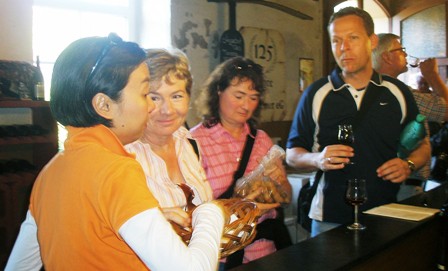
When we visited the co-operatives cellar door it was buzzing with customers. Every sunny autumn weekend is seen by many in the surrounding towns of the Rhineland and the Ruhr as an excellent opportunity to take a long Sunday walk along the Ahr river and to visit wineries and cellar doors. Although Ahr wines are more pricy than wines from many other regions, the Ahr has successfully succeeded by justifying this by rigorous emphasis on quality.

d1000173dagernova3.jpg

The Ahr valley is German red wine territory. Here a bottle of Regent, a “new” red variety.

Needless to say we tasted quite a few bottles of excellent red wines of the base (up to 7 €/bottle) and primium segements (up to 9.5 €/bottle). What they call ‘cult wines’ starts at 11.85 €/bottle. I acquired a “2006 Pinot Noir Spätlese” which I gave to my friend Ulrich Hillejan and where I anxiously await the “tasting results”.

ahrtastingcrew.jpg

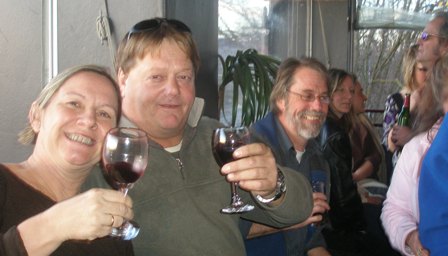
Joyce, Ulla, Claudia and Rainer, DAGERNOVA cellat door


German wine regions: Franconia- a visit to Würzburg

November 16, 2007

Together with my mother and my brother Wolfgang, we visited the hometown of my maternal grandfather for a family reunion. The small village of Reichenberg, near the city of Würzburg was our destination. My mothers father, Hans Heinrich Schüssler, was the one who introduced me to wine and wine drinking. When I was about 16 years old he took me to the Juliusspital (one of the three big wineries in the city and winner of this years ‘Riesling of the World’ Challenge in Canberra) in Würzburg where I had my first ‘official’ glas of Franconian wine.

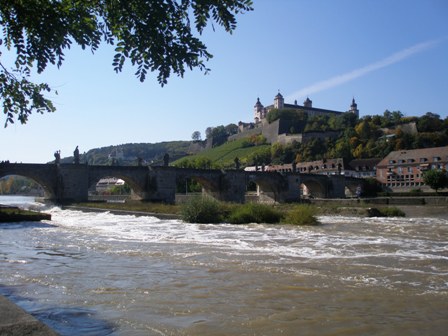
Würzburg is another ancient city where the Catholic church and its archbishops reigned. Needless to say that vineyards and wine production are an old and beloved feature of the local culture and the economy influencing its specific social habits and customs. The castle of Würzburg is one of the main features. On its slopes vines are grown as well.
p9300039w.jpg

The castle in Würzburg, with the historic bridge and the vineyards on the castle slopes

Franconia is the name of the wine region. It currently has about 6,000 ha under vines. The proportion of red varieties is low (19 %). Main varieties are white grape varieties such as Müller-Thurgau (32 %), Silvaner (21 %) and Bacchus (12 %). But, as along the Mosel river, red varieties are on the increase. ‘Franken’ (Franconia) produces some excellent Pinot Noir wines as well. Nowhere in Germany does Silvaner produce such stunning wines as in Franconia.

The shape of the local wine bottles ‘Franconian style’ is very special too. It’s called “Bocksbeutel” in German and usually reserved for higher quality Franconian wines.

p9300012boxbeutel.jpg

The “Bocksbeutel” bottle, trademark of Franconia

The above bottle from “Staatlicher Hofkeller”, the second of the three big wineries in Würzburg (the third one is “Bürgerspital”), was the first I drank with a glas enclosure in my life. It was a “2005 Hammelburg Trautlestal, Silvaner Kabinett, dry” which displayed all the characteristics of an excellent Franconian Silvaner wine. For newcomers to Franconian wine I can highly recommend this drop.

The next day after the family reunion, we visited Würzburg and had lunch at ‘Juliusspital’ (www.juliusspital.de). ‘Juliusspital’ does not only own vineyards, a winery, a historic cellar door and restaurants but also a hospital, a retirement home, an academy, a conference centre and other facilities. “Spital” also means ‘hospital’.

Juliusspital Foundation was founded in 1576 by the prince bishop Julius Echter of Mespelbrunn (a wonderful little castle in the Spessart, a beautiful region full of forests nearby). Today Juliusspital is a modern service company providing mainly health care and related services to the public but traditionally is also involved in agriculture, forestry and wine making. the Juliusspital Wine Estate is as old as the hospice.

The Franconian wine region covered in the 16th century more than 40,000 ha of vineyards and was the largest coherent wine-growing area in Europe. The decline of Franconian viticulture started with the ‘thirty Years” War which destroyed most of the vineyards in Upper and Central Franconia. After a short revival in the 18th century a second decline reduced the region to about 10,000 ha and the thrid decline was accompanied by peronospera and phyloxera outbreaks at the end of the 19th and the beginning of the 20th century. After World War II only about 2,300 ha under vines remained. Today, about 7,000 vintners cultivate the 6,000 ha under vines which produce roughly 50 million bottles and an annual turnover of about 200 million EUROs.

The soils in Franconia consist either of soils based on red sandstone, shell limestone and what the Germans call ‘Keuper’ (clay rocks), all emerging during different geological epochs some going back more than 200 million years.

Today Juliusspital Wine Estate cultivates about 168 ha of vineyards and produces more than 85,000 cases of wine. The composition of its vine varieties is about 35 % Silvaner, 22 % Riesling, 20 % Müller-Thurgau and 5 % Pinot Noir. the rest (18 %) includes Pinot Gris, Pinot Blanc, Baccus, Scheurebe, Traminer, Muskateller, and Rieslaner (a regional variety). the average yield is given with 60 hl/ha. the top locations (terroir) are ‘Würzbuger Stein’, ‘Iphoefer Julius-Echter-Berg’, ‘Randersackerer Pfülben’ and ‘Eschendorfer Lump’.

At the recently held 2007 Canberra International Riesling Challenge, the Juliusspital Wine Estate won the overall award for best Riesling of the World with its “2006 Julius-Echter-Berger Beerenauslese”. By the way, the webpage of Juliusspital shows this wine with a price tag of 47.60 EURO only.

According to the October-November issue of ‘Weinwelt’ (World of wine), a German wine magazine, the top producers in Franconia are:

♦♦♦♦ (four stars)
– Fürstlich Castellisches Domaenenamt, Castell
– Rudolf Fürst, Bürgstadt
– Horst Sauer, Eschendorf

Horst Sauer also participated in the 2007 Canberra International Riesling Challenge and won a gold medal in the ‘current vintage 2006 sweet category’ for his “2006 Eschendorfer Lump Riesling TBA” and a bronze medal for “2006 Eschendorfer Lump Riesling dry”.

♦♦♦ (three stars)
– Juliusspital, Würzburg
– Fürst Löwenstein, Kreuzwertheim
– Hans Wirsching, Iphofen
– Brennfleck, Sulzfeld (significantly improved in 2006 and newly listed with three stars)
– Hofmann, Röttingen (as above)

♦♦ (two stars)
– Walter Erhard, Volkach (improved in 2006 and newly listed as two stars)
– Rudolf Max, Retzstadt (as above)
– Max Müller I, Volkach (as above)
– Trockene Schmitts, Randersacker (as above)
– Graf Schoenborn, Volkach (as above)

♦ (one star for discoveries of the year)
– Burrlein, Mainstockheim
– Felshof. Sommershausen
– Gebr. Geiger Jun., Thüngersheim
– Max Merkert, Eibelstadt
– Reiss, Würzburg
– Markus Schneider, Volkach

Unfortunately, I have only one bottle of Bocksbeutel left in my wine fridge. Empty bottles I have in abundance (for instance “2002 Würzburger Stein, Silvaner, Kabinett, dry” of Staatlicher Hofkeller which won a gold medal, “2003 Baccus, dry” of Schloss Castell and “2003 Würzburger Stein Sivaner, dry” of Juliusspital). The bottle to be enjoyed soon is a “2005 Kitzinger Hofrat, Silvaner, dry” of Bernhard Völker. What a pity that Franconian wines are not available in my local duty free shop in Jakarta.

The red wine “pope” of Franconia is Paul Fürst (Winery Rudolp Fürst in Bürgstadt. He won “German vintner of the year” award in 2003 and “best vintner of Franconia” in 2004. His webpage is very interesting too (www.weingut-rudolf-fuerst.de).
At the wine webpage www.finewinepress.com you will find an interesting interview with Paul Fürst in English. His “2003 Spätburgunder” (Pinot Noir) is a well acclaimed and award winning wine. I will introduce you to the winery at another time.

While in Würzburg we lunched at Juliusspital Restaurant which is what Germans call “gut bürgerliche Küche”, which I freely translate as “good quality, local food” (robust and harty in nature but also with delicate and fragrant elements). We drank from the open wine list (we had to drive home). My brother had a “2006 Juliusspital Schwarzriesling (Pinot meunier), dry” and I drank a “2006 Würzburger Abtsleite, Silvaner, Kabinett, dry”, both solid wines. It was unfortunate that we could not participate in any tasting since we had to get home the same day.

The design of the restaurant, by the way, is typical for historic German country inns. When I visited the restrooms I found to my great suprise wonderful cartoons on tiles. I had to take pictures, one of which you see below.

p9300049kar.jpg

The texts freely translates as “Guess darling whom I am holding in my arm”.

Unfortunately, I do not have good photos of the family reunion. Needless to say that the three of us were overwhelmed by the hospitaly extende to us. Tables were bending under the food and wine on offer. We were talking and talking. It was so exciting that I forgot to take “intelligent” pictures with the result that I have some good ones of some of the participants but not of others. This is the reason why I will not show any of them because it would be unfair vis-a-vis the people whom I did not catch in a good enough pose. Since I have planned to take my wife and children there when we visit Germany next year, I promise to be more careful and present you with some good shots in the future.

The address of the restaurant cum wine bar is

Weinstuben Juliusspital
Familie Frank & Edith Kulinna
Juliuspromenade 19
97070 Würzburg
Tel.: 0931-54080
http://www.juliusspital.de


The Blöser winery

November 11, 2007

d1000307bloeser6.jpg

The Bloeser vineyard and the “wine walk” (a vineyard and wine appreciation path) at the Suelzenberg

When I wrote about the ‘Weingut Suelz’ wine bar some time ago, I also referred to the Bloeser family (www.weingutbloeser.de) and its vineyards at the Suelzenberg (the most northerly vineyard along the Rhine) in Oberdollendorf, near Koenigswinter along the Rhine river. Winemaking is an old tradition in the Bloeser family (since 1696!). Today the family cultivates 7.2 ha of vineyards.

The main varieties are Riesling and Mueller-Thurgau, furthermore Portugieser, Dornfelder, Scheurebe, Kerner, Optima, Traminer, Pinot Noir and Regent are grown. The cellar door and the tasting shed (an old barn) are worth visiting. Tastings are to be held for groups of 15 and more persons but you can also visit the cellar door and taste some wines there.

The Bloeser webpage shows some very interesting pictures of the historic buildings in the vicinity of the winery and the picturesque village of Oberdollendorf.

Prices start from 3.3 EURO/0.75 l. bottle. Reds are a bit dearer (6.3 EURO for Dornfelder, Regent and Pinot Noir). Riesling Auslese and Beerenauslese cost between 9.0 and 15.5 EURO per bottle.

d1000308bloeser5.jpg

A new planting at the Suelzenberg

d1000344bloeser3.jpg

Two generations of Bloeser vintners in the vineyard

Address:

Weingut Bloeser
Bachstrasse 112
53639 Koenigswinter-Oberdollendorf
Tel.: (+49) 02223-3322 and 3634
info@weingutbloeser.de
http://www.weingutbloeser.de


Country Australia – Music for old folks

November 10, 2007

While in Australia in July this year, we went to a couple of live music events in country pubs, which was great fun. We listened to various singers and bands while downing a glass of beer and/or wine. The quality of the music was usually excellent. In the Toolangi Tavern for instance, we were very surprised when on a Wednesday we went for dinner and were netertained by a jazz band. I also loved to listen to the young singers in the St. Andrews pub after the closure of the St. Andrews market, but equally enjoyed the seasoned band named “The Heartstarters” playing on a Sunday afternoon on the balcony of the Grand Hotel in Healesville. Here the grandchildren of the band members danced enthusiatically as did the many old folks present. It’s also a great diversion for working people who have sufficient time to get ready for their Monday jobs, since this is an afternoon affair. I can only recommend these kind of events, especially since nowadays many pubs carry an excellent selection of local Australian wines.

p8080059web.jpg

The jazz band at the Toolangi Tavern

p8040052web.jpg

Life music at the St. Andrews pub

p7220171w.jpg

The ‘Heartstarters’ at the terrace of the Grand Hotel

p7220170web.jpg

Legends in their own lifetime: Margit Adam, Brett Travis, Michael Meinhold enjoying the music at The Grand Hotel in Healesville


Vintage time along Rhine, Ahr and Mosel

November 9, 2007

I had the great fortune to witness vintage time in some of the German wine regions. During my first walk through vineyards at the Rhine (Middle Rhine) near Bad Honnef, I talked to some grape pickers. My first innocent (and maybe ignorant) question “what grapes they were harvesting”, was answered in heavy accented German: “I have to ask the boss”. Most of these picking crews seemed to come from the Middle East, Turkey and Poland.

d1000289web.jpg

Picking crew at the foot of ‘Drachenfels’

d1000025web.jpg

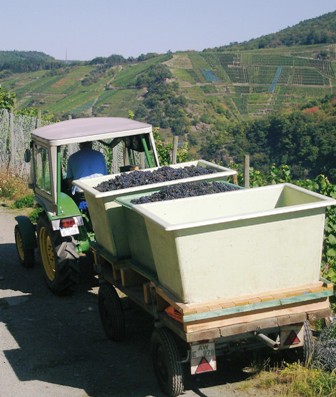
Empty fruit bins on trailers in the Ahr valley

In the Ahr valley I mostly ran into family-member picking-crews. On the steep slopes, it is realy hard physical work to get the grapes. Buckets are carried up or downhill and emptied into bins. Tripping and losing one’s balance can result in severe falls. Most of the family-managed vineyards are small but also cheap foreign labour is employed to cope with the harvest during vintage time.

d1000132web.jpg

The slopes are very steep. Family members were doing the picking work

d1000136web.jpg

Tractors transport the fruit to the wineries

d1000133web.jpg

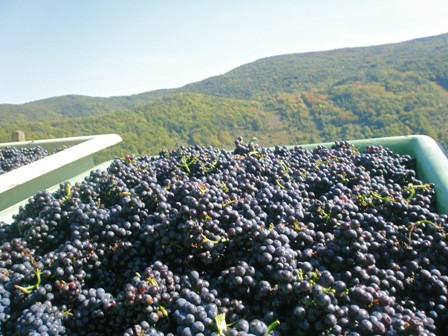
Pinot Noir fruit at the Ahr

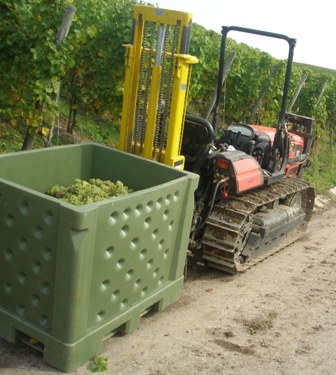
Harvesters cannot be used on the slopes. Near Trier I found caterpillar tractors were used to transport the fruit out of the vineyards. A precondition is that the rows are spaced accordingly. Sometimes two rows of vines are planted close together and a middle row between such double rows is wider so that the caterpillars can drive through. In any case picking grapes is hard work that deserves our respect and appreciation. We wine drinkers know it and are thankful that people are still willing to collect the grapes from such steep vineyards.

pa020103web.jpg

Picking crew in Olewig vineyards, a location along the Mosel near Trier

pa020101web2.jpg

Caterpillar tractors for the steep slopes

pa020135web.jpg

pa020100web.jpg

Mosel Riesling fruit

‘Zum Wohl’ (freely translated as ‘to your health’) as the Germans toast when drinking wine.


And the winner is ? – 2007 Canberra International Riesling Challenge

November 4, 2007

whitegrapes1.jpg

You might remember that I wrote about the 2007 Canberra International Riesling Challenge? The 8th Challenge has seen a new record of 486 entries (wines) from 249 wineries and six countries. What I have not done yet is to also inform you about the outcome of the event. This is the more enjoyable since the overall winner comes from a German winery which I visted recently in Würzburg, Franconia. The newly added category trophy of ‘Best in the World’ was won by “Weingut Juliusspital Iphofer Julius-Echter-Berger Riesling Beerenauslese 2006”.

As last year the ‘Challenge Winner’ came from Australia. The 2006 winner was a “Tim Adams 2006 Riesling” and the 2007 award was won by “Orlando Wines St. Helga Eden Valley Riesling 2002”.

The history of the event is a success story of new world wine, in this case Riesling wine, promotion. Under www.rieslingchallenge.com you can find the full story and the long list of entries and winners. Although I cannot do justice to all the many award winners from the different countries, I would like to selectively take out and refer to some of the participating wineries and their wines.

It came as no surprise that the German Riesling winner of the ‘Best in the World’ came from Franconia, one of the wine regions famous for its ‘Bocksbeutel’, wine filled in ellipsoid shaped bottles. Franconia (area under wines in 2007: 6072 ha) had a ripper of a vintage in 2006, ranked by the German wine magazine ‘Weinwelt’ as 4 to 5 star quality, the best since 1997.

Because of the cool August of 2006, the wines show high acidity which together with the excellent extraction values provides a high storage potential. The growing period, however, ended after a beautifully warm (almost hot) September, in a very wet October (50 to 140 liter precipitation) and for many vintners this meant a run against the clock to avoid the fruit rotting on the vines.

Weingut Juliusspital is one of the top German wineries. Horst Kolesch, the head of the winery (which is one of the three big wineries in Wuerzburg), can be very happy with the outcome of the event. Apart from winning the main trophy, his wines did very well in the competition and won various other medals. Another of the top Franconian wine producers, Horst Sauer Winery, won among others a gold medal in the ‘current vintage 2006 sweet category’ for his “2006 Eschendorfer Lump Riesling TBA” and a bronze medal for “2006 Eschendorfer Lump Riesling trocken”.

From the vicinity of my hometown Trier, the ‘Bischoefliche Weingueter’ won a silver medal for their “2006 Kaseler Nies’chen Spaetlese” (sweet category), a famous terroir from the Ruwer river. The “2006 Scharzhofberg Spaetlese” won a bronze medal in the ‘current vintage dry category’. The location of the vineyard is the prime terroir for Riesling wines in Wiltingen, a small village at the Saar river. From the Mosel vineyards of the Bischoefliche Weingueter the “2006 Dhroner Hofberg Spaetlese” won a bronze medal in the ‘semi-dry category’.

Let me turn to some of the Australian wineries. From the Yarra Valley the Long Gully Winery (the owners are of German origin)won a gold medal for their “2007 Long Gully Estate Riesling” (current vintage dry category).

From our own region, the Upper Goulburn Wine Region, only Delatite Winery (www.delatitewinery.com.au) had (three) entries. The “2006 Barwite Riesling” and the “2005 Delatite Riesling” won bronze medals each. The “2006 Delatite Riesling” won a silver medal. These awards are a great success and a further addition to the many national and international awards Riesling wines from Delatite have won recently.

The 2007 Judges were:
– Louisa Rose (Chairman of Judges), Chief Winemaker, Yalumba
– John Belsham, Foxes Island, Marlborough, New Zealand
– Ken Gargett, Wine Writer, Queensland
– Alexander Kohnen, Director of the German Wine School
– David O’Leary, Director/Winemaker, O’Leary Walker Wines
– Sally Harper, The Bathers Pavillion/Sommerlier, Sydney

PS: It was interesting to learn that Sevenhill Cellars from Southern Australia won a bronze medal for their “2007 Sevenhill Riesling” and a gold medal in the ‘museum class 2004 and prior vintages’ category for their “2001 Sevenhill Riesling”. My friend Neville Rowe has recently taken up the general managers position at this winery which is the oldest in the Clare Valley.


German Food delights

October 23, 2007

I would like to share with you some of my culinary experiences in Germany. Below you find a select few of the dishes which I had the great fortune to enjoy recently. Some of the wines I had with the food are less memorable than others, therefore don’t worry about it. I have prepared some photos.

d1000033essen2.JPG

Fish wrapped in bacon/ham

This is a very special combination. When I tasted such dishes for the first time I was quite puzzled. Germans living near the sea know them quite well but since I am a native of the deep South-West, I was rather a novice when it comes to German fish eating habits.

I would like to share an anecdote with you. I once accompanied a group of Muslim politicians to the most northerly state of Germany (Schleswig-Holstein). In Kiel, the state capital, we had ordered a filet of plaice (a local flat fish) “Finkenwerder Art”, me not knowing that this white fish is sprinkled with bacon/ham crumbs when served. The order was utterly inappropriate for pious Muslim adhering to halal food prescriptions. That’s when I learned that Germans do eat fish dishes with pork.

d1000267pasta.JPG

Pasta with scrimps (at Rolandseck Restaurant near Bonn)

d1000305suelz3.JPG

Alsacian “Flammkuchen” the German way (Weingut Sülz in Oberdollendorf)

pa150174rotebeete.jpg

Beetroot soup (Feuerbach Inn in Berlin)

In Berlin I tasted beetroot soup with goats cheese and orange slices in an inn called “Feuerbach”. Unfortunately, I started to eat before realising that I should have taken a picture of the delishes meal before digging my spoon into it. I apologize for that but the soup was so delicious that only immortals could have gotten it right. I promise to visit “Feuerbach” again and replace the picture with a “proper” one.

So far so good you might say but what did he drink with all these dishes? Well, mostly white wines from Germany but not entirely. I drank an Ahr Riesling of the winehouse Meyer-Näkel with the fish in bacon, had an 2005 Heimersheimer Pinot Noir with the seafood pasta, and since at vintage time Germans love to drink “Federweisser”, freshly fermented grape juice (see photo below), I tried some of this rather young and sweatish drink with the Alsacian Flammkuchen.

d1000346rauscher1.JPG

A bottle of “Federweisser”, not a drink common in Australia.


Wine production in the capital city of Berlin

October 18, 2007

I spent the second month of my stay in Germany in Berlin, the capital city of the Federal Republic. Berlin is not located in the centre of the country but rather to the east, only about 70 kilometers from the border with Poland. It’s far away from my own homeland, the Mosel banks. I always joke, my hometown Trier is closer to Paris than to Berlin. In history the Treverer and the Mosel where they settled belonged to both countries or to put it the other way: we were ruled by both.

p4190267.JPG

Wine shop in Berlin where wine consumption is ‘en vogue’ (in Lichterfelde)

But can you imagine that grapes are also grown on the soils of the national capital? A curiosity, one might think; indeed so it is. Recently I learned from local newspaper articles that today vines are grown in five city districts (for instance Wilmersdorf, Prenzlauer Berg, Wedding, Kreuzberg-Friedrichshain). Because the region is not certified as a wine producing area, the wines produced from the local grapes are not allowed to be sold commercially.

This is not neceassarily an impediment to wine being ,though in small, in fact very small, quantities. The district councils use the bottled local wines as gifts for public anniversaries and award ceremonies. In some cases citizens can obtain these wines against a small fee. Usually the grapes are transported to a proper winery in a wine region where the wines are made. Many of the grapes are turned into sparkling wines. Apart from Riesling red varieties are also grown. Depending on the weather and disease conditions, between 200 and 400 bottles are produced in each of the districts. For us ‘normal’ wine consumers a tasting might be out of the question but it is good for the promotion of the divine drink.

p4190268.JPG

Advertisement for wine and invitation for wine appreciation classes


2007 Canberra International Riesling Challenge

October 16, 2007

I would love to be in Canberra right now. The 2007 Canberra International Riesling Challenge is going to start tomorrow at the Hyatt Hotel. Now, that my tastebuds have been extensively exposed to German and especially Mosel Rieslings during the last two months travelling in Germany it would be extremely interesting to compare the different wines and styles on offer from the Old and the New World.

d1000319riesling1.JPG

German Riesling grapes, fall 2007

The event is the biggest Riesling competition in the southern hemisphere. This year a record number of wines were registered, 482 wines in comparison to 458 last year and 328 in 2005. The bulk of the wines comes from Australia (293), 73 are from Germany, 58 from New Zealand and 45 from the USA but only three from France.

For more information please visit the website especially created for the event (www.rieslingchallenge.com).

As we know Riesling is all the vogue. Dr. Ernst Loosen from Bernkastel/Mosel (www.drloosen.com), one of the prime producers of Mosel Riesling was very modest and polite when he suggested earlier this year during the “Riesling Rendezvous” at Chateau Ste Michelle estate in Washington State (24-26 June) that “it is up to the New World to help raise the reputation of Riesling and create a Riesling renaissance”. In fact the wine consumers have done it all alone and the world is witnessing a boom in Riesling demand.

Talking Riesling is very important. Australia is a leading Riesling producer. Ever since the Pewsey Vale Riesling from the Eden Valley won a gold medal in London in 1854 Australia has been on the international Riesling map. Many wine regions in the Old World,with the exception of the Mosel of course, where elector Clemens Wenzeslaus had instructed its administrators in 1768 to grow only “white riesling”, did not grow much Riesling in those days.

I hope the event can also contribute to a better understanding of the confusing labelling of German Rieslings. Here more needs to be done to educate international consumers.

Rieslings from our own wine region, the Upper Goulburn Wine Region, have done well in Australian wine shows in recent years. At the 2005 Small Vignerons Awards a 2004 Barwite Riesling won the trophy for best Riesling and in 2006 this trophy was won by the 2005 Delatite Riesling. At the recent Alexandra Food and Wine Expo (please see my earlier blog entry) I had the opportunity to taste the 2005 Barwite Riesling, which showed beautiful floral characters and was a citrus bomb in my mouth. Of course I am curious how the UGWA member wineries will do at the event.


Excursion along the Rhine: Weingut Sülz in Oberdollendorf

October 12, 2007

Carpe diem, ‘enjoy the day’ was the motto my wife suggested I should adhere to, while away from home for the two-month long stay in Germany. I try to follow this advice and make the best out of the separation from my family. Recently I visited a place of my youth, so to speak, from my student times at Bonn University. We used to visit a wine garden-paradise called “Weingut Sülz” (Sülz Estate) in Oberdollendorf near the Seven Peak Mountains (in German, Siebengebirge) on the south side of the Rhine river near Königswinter.

d1000352drachenf1.JPG

The Dragon Rock Mountains seen from the Rhine river

The cultivation of grapes and the production of wine have a long tradition here, dating back to the 10th century. In the 14th century ‘Gut Sülz’ (the Sülz Estate) belonged to the nearby monastry of Heisterbach. A country inn was established in 1656. The estate changed hands a few times. Today Weingut Sülz is neither a vineyard nor a winery, but a lovely country inn with a large open-space garden for its many visitors.

d1000318suelz8.JPG

Sülzenberg vineyards

The location is splendid, featuring a beautiful view of the surrounding vineyards. The inn is to be found at the foot of the Sülzenberg, a vineyard location in the form of a theatre at the edge of the Seven Peak Mountains, south of Bonn. The vineyards might be the most northerly ones along the Rhine. Since land consolidation in 1973 and 1979 all vineyards in the theatre have been cultivated by the Blöser family (more about them in a separate later blog entry).

d1000306suelz7.JPG

The Sülz Country Inn

Since 1999 Andreas Lelke has been running the Weinhaus Weingut Sülz (www.weinhaus-gutsuelz.de). His list consists of more than 500 wines and has received multiple awards. His white wine list is dominated by Riesling wines. In 2000 the Riesling Society awarded Andreas Lelke its Riesling award. The German Wine Institute ranked his wine list as “very good” and the Wine Guide Gault Milau awarded its “best wine list” in 2007 to the country inn. It goes without saying that delicious food is served with the wines at Weingut Sülz.

d1000296suelz1.JPG

“What did I drink?” you might ask. Well, during my first visit I sat outside on the terrace and felt like drinking what the hill behind the inn (the Sülzenberg) had to offer. I had a choice between a Sülzenberg Riesling and a Sülzenberg Blue Portugese (Blauer Portugieser in German). I choose the latter. ‘Blue Portugese’ is an old vine variety grown mainly along the Danube river and in South-Eastern Europe. The variety has many different names in the various places it is grown. However, it has nothing to do with Portugal. I cannot recollect ever having drunk the variety before, so the tasting was a ‘maiden affair’. The picture below shows me with a glass of this dark red, but light and fruity wine in my hand. I took the picture myself, which might explain the strange posture.

d1000300suelz2.JPG