Merry Christmas 2007 and a Happy New Year

December 14, 2007

thsbdrinking.jpg

It’s almost a year since I started this blog. I had a wonderful time writing and researching the topics I wrote about. Through the blogging I also met new people and made new friends.

While you are reading this, I will be in Glenburn, Victoria on my small boutique vineyard. I will enjoy the summer scenery sitting on my porch and looking down into the valley.

I will certainly be drinking a Two Hills Merlot, maybe from the 2001, the 2004 or the 2006 vintage. I might also sample some of our old Sauvignon Blanc 2002 and see how this wine, which is not sold commercially any more, is doing.

We will see our friends and family and we will have a couple of large barbecues on our lawn with visitors from Australia and Asia.

I wish to thank all my readers and friends for their interest and their support, especially for their valuable comments and suggestions which made me dig deeper into the world of wines.

Have a wonderful and joyous Christmas with your family and friends, enjoy the pleasures of the company, your meals and have some glases of wine.

Salute, cheers, zum Wohl, seasons greetings from Two Hills Vineyard. See you again next year on this blog.

Rainer and family


A memorable visit to Villány in Hungary

December 13, 2007

Two years ago we visited our former Jakarta neighbours, Tibor Vidos and Andrea Domjan and their family in Budapest. They were extraordinarily good hosts and took us around their beautiful country.

One of the day trips had as destination a wine region near the Croatian border. Villány (or Wieland in German, Vilanj in Serbian and Croatian) is a small town in Baranya county, famous for its wines. Villány is also the name of the region (for more information visit www.borut.hu in English and www.villany.hu in German and Hungarian). The wine route of the same name was established in 1994 and it was the first of its kind in Hungary.

Before the fall of the iron curtain Hungary produced mainly cheap wines for the Soviet market. That changed with the end of authoritarian one-party rule and the advent of democracy. In the Villány wine region the joint effort of eigth settlements and its vignerons, vintners and wine-makers has born rich and abundant harvest. Some of the inhabitants are of German origin and one finds German names all over the place. Today the region produces excellent wines and many of them have won international acclaim and multiple awards.

Its a while that I wanted to write about this visit but I had forgotten where I stored the pictures and because of the complicated Hungarian language I had also forgotten the names of the places we were taken to. While rearranging my PC I found some wonderful shots and was able to put together the pieces or at least some of them.

sa500111w.jpg

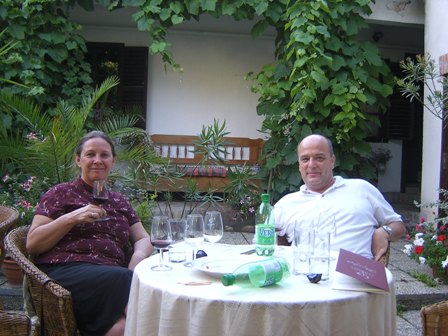
Margit and Tibor at the Polgár Pincészet cellar door.

From the menu on the table which I enlarged on my computer I could identify the name of the place were we drank wine and after some research on the net I found the winery and restaurant and everything fell into place. Unfortunately, I do not master Hungarian but the webpage of Polgár is entirely in this very difficult European language (www.polgarpince.hu). However, I know one thing: their wines were outstanding and I highly recommend to visit the place.

sa500114w.jpg

The region is very picturesque, though flat, and intensively used by mixed agriculture.

sa500125w.jpg

On some of the houses one finds nests of white storks a reminder of bygone times.

sa500129w.jpg

This is the picture from which I identified the village and the region. My daugthers Lucy and Charlotte in front of the gate of a winery. Some of the script on the sign advertising it is even in German.

sa500112w.jpg

Margit and I sampling the excellent wines of Polgár.

At the Polgár Pincészet restaurant cum cellar door the waitress even spoke German which somehow made the place even more familiar. We did not have sufficient time to visit any other winery becaused we had to return the very day to Budapest. So poor Tibor could not enjoy any of the wines, he was the driver. Unfortunately, i had not taken any tasting notes and even do not remember which wines we tasted. I guess the white was a Riesling or Rizling as it is written in Hungarian and the red must have been a merlot because as Merlot producers we are keen on tasting any other Merlot we can lay our hands on.

We took only six bottles with us (and we should have taken more). Half of them we left with Tibor in Budapest as a thank you for the wonderful experience but than drank some of them together at the last evening. The other three we took with us to Berlin, the next stop of our European trip in summer 2005, where we drank them with my friends Ulrike, Rodrigo, Ulrich and Elfriede. Away from their land of origin the wines tasted even finer and more delicate. unfortunately, I do not remember which wines we drank, I only know that we had a white, a rose and a red wine, all from Polgár Pincészet.

This is my last blorg entry before leaving for Australia. If you should happen to visit Hungary on Christmas or any other time, please include this lovely little wine region into your travel plans. I can only urge you to also visiting Polgár, a winery and a degustative experience you should under any circumstances not miss.


The other Trier

December 9, 2007

ohneb.jpg

Its hard to believe but its true as well, my otherwsie beautiful hometown Trier has some rather ugly parts as well which I do not want to hide from you. Through my many walks through town I detected some of these eyesores and thanks to digital cameras one can document progress (or the lack of it) as well.

First of all it seems to me that the ‘fathers of the city’, as the council members are usually called, and/or the administration in general do not possess an eye for green, particularly trees. Though I must admit that recently the administration of the new major has started to plant at last some allee trees along some of the wide roads entering the city. But in the centre of town, where my mother lives and where I grew up, trees have become less and less in numbers.

Especially along the roads surrounding the pedestrian zone it seems that everything has been done to accomodate the traffic and the many cars. This means trees have been felled where they were ‘in the way, dangerous or a nuisance’ to car drivers. Consequently many of these roads are bare of any natural shade. When its windy, these streets turn into wind channels and for pedestrians it is very unpleasant to walk these city streets.

ohnebaum.jpg

The above two photos are from the newly refurbished square near the Archbishops Museum. The square looks bare and empty. The few trees planted will of course grow and occupy more space. But this minimalist type of greening is not what I think would be appropriate.

Other cities I lived in, for instance Bonn, the town of my alma mater, is much more progressive when it comes to greening the city. There is hardly any street without shade trees. Old trees are regularly replanted and pruned. Poeple there seem not to be scared by the many leaves the trees drop in autumn.

One of the really bad eyesores of Trier is a place very close to my home where I grew up at Irminenfreihof 5 in Britannia. It is the St. Paul’s Square in front of St. Paul’s church were we used to attend mass and met our mates afterwards.

paulusplatz.jpg

St. Paul’s Square (the church is to the right, to the left are the various vocational schools)

The square is neither used as a parking lot nor for anything else. The trees which once stood there have been cut down but not replaced. We can safely assume that there is a plan in place for the future beautification of the square. Most likely the money is not there yet to put this plan into practice.

I find the state of affairs of this square very sad. I also believe that not much funds would be needed to get it into shape if modesty would prevail. I would love the city administration to do something useful with the place, maybe establish a small park where the students of the nearby vocational schools could hang out after classes?


The other day in Kuala Lumpur

December 8, 2007

The other day I joined some colleagues and recent acquaintances of mine for a test eating at a small but very renown restaurant in downtown Kuala Lumpur, Malaysia. Top Hat Restaurant is the name of this very charming place (www.top-hat-restaurants.com).

It is housed in a building of the 1930ies which used to be a school. Its old colonial architecture with high ceilings, broad verandas and porches radiates a unique atmosphere. Its interior is a fusion of as many different Asian styles as one can imagine, some very colourful elements among them, teak furniture and some antiques complementing the exotix mixture. We were tasted a set menu for a function later that week.

p1020118.jpg

The reception hall of Top Hat restaurant in Kuala Lumpur

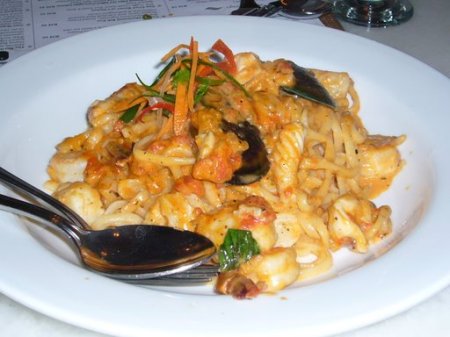
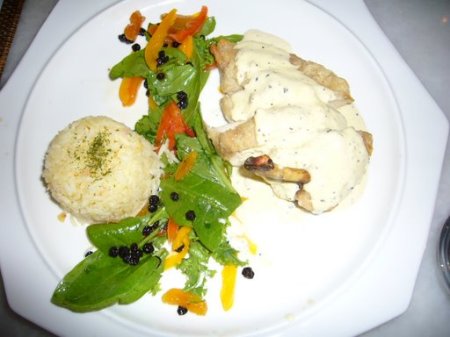
The cuisine is presenting a mixture of various Asian cooking styles, including Nonya, Malacca Portuguese and traditional Malay recipes, here and there with the sprinkle of some European inspired dishes. Since I had already eaten, I did not join the tasting except for the desserts and had a glass of house red instead. The pictures below show some of the dishes presented to the test eaters.

p1020016.jpg

Various starters and entrees

p1020023.jpg

A main dish: Seafood pasta

p1020026.jpg

A chicken dish

I joined the eating for the desserts. We could choose among four dishes, a tiramisu cake, a chocolate delight, a fruit crumble with cream and a vanilla creme brullee I could not decide which one if favour most. I liked the apple crumble with vanilla ice cream but loved the even better the pudding cream below.

p1020029.jpg

My favourite dessert

The wine list is impressive too. It includes big names, mainly from France and Australia. Below I show you a glimpse of it. Excellent stuff for sure.

Champagne

Rose

Lanson, Rose N.V, Reims

Laurent Perrier, L.P. Brut Rose N.V., Tours-Sur-Marne

Vintage

Krug, 88 Clos de Mesnil, Reims

Lanson, 95 Noble Cuvee Blanc de Blanc, Reims

Laurent Perrier, 95 Grand Seicle, Tours-Sur-Marne

Laurent Perrier, 90 Grand Seicle, Tours-Sur-Marne

Moet et Chandon, 95 Dom Perignon, Epernay

M, et et Chandon, 96 Dom Perignon, Epernay

Veuve Clicqout Ponsardin, 95 La Grand Dame, Reims

Whites

Sauvignon Blanc

Cloudy Bay, 03, Marlborough, New Zealand

Tekoko, Cloudy Bay, 01, Marlborough, New Zealand

Villa Maria, Reserve, Wairau Valley, New Zealand

Chardonnay

Cullen, 00, Margaret River, Western Australia

Pierro, 00, Margaret River, Western Australia

William Fevre, Premier Cru Fourchaume, 01, Chablis, Burgundy, France

Red

Pinot Noir

Domaine Antonin Guyon, Regis de Valliere, 00, Gevrey Chambertin, Cotes de Nuit, Burgundy, France

Bouchard Pere & Fils, 98/99, Vosne Romance, Cotes de Nuit, Burgundy, France

Merlot & Pomerol

Chateau LaFleur Petrus, 99, Pomerol, Bordeaux, France

Chateau LaFleur Petrus, 00, Pomerol, Bordeaux, France

Chateau Latour A Pomerol, 99, Pomerol, Bordeaux, France

Chateau Latour A Pomerol, 00, Pomerol, Bordeaux, France

I skip the Cabernet Sauvignon and blends section. There is also a section with Italian and Spanish wines made from Sangiovese, Tempranillo and Nebbiolo which I skip.

Shiraz

Barossa Valley Estate, E & E Black Pepper, 99, Barossa Valley, South Australia

Eileen Hardy, 97, McLaren Vale, South Australia

Henschke, Mount Edelstone, 99, Eden Valley, South Australia

Leasingham, Classic Clare, 98, Clare Valley, South Australia

M. Chapoutier, Les Becasses, 98, Cote Rotie, Rhone, France

M. Chapoutier, Ermitage L’Pavillon, 96, Goulburn Valley, Victoria, Australia

Chateau Thabilk, 1860 Vines, 88, Cote Rotie, Rhone, France

Yalumba, Octavius, 97, Barossa Valley, South Australia

Top Hat Restaurant is also a hot tip for cigar afficionados like me. They offer a separate room where you can enjoy your smoke without a bad conscience that your enjoyment might negatively affect other eaters.

p1020017.jpg

Enjoying the times

All photos were made available courtesy to my colleague from Bangkok, Dr. Busarin Dusadeeisariyawong (Mary).
Thank you Mary.

Where to go in Kuala Lumpur:

Top Hat Restaurant
No. 7, Jalan Kia Peng
Kuala Lumpur
Tel.: 03-2141-8611
Reservations recommended
Hours: lunch Mon-Fri noon-2:30pm and dinner daily 6-10:30pm

Wines from Canada – the Niagara Wine Region

December 5, 2007

Today, I will take you to Ontario in Canada.

My old friend and former flat mate Dominik Franken with whom I studied agricultural economics at Bonn University and who now lives in Ontario (he is in the investment business but is also a musician) pointed me to the Niagara Wine Region on the Niagara peninsula in Ontario. (http://niagarawineregion.com)

When we hear ‘Canada’ what comes to mind is anything but wine. We think about wilderness, moose, endless prairies, cold winters, the Rocky Mountains, black bears, maple syrup, maybe squabbles’ between French and English speakers, St Laurence stream, and so on. But Canada has also its fair share of the worlds wine regions, one of them the Niagara Wine Region.

Its located only a short drive (about 20 to 40 minutes) from the Niagara Falls, to the West of the border between Ontario and New York State, USA (on a peninsula between Lake Ontario and lake Erie). Actually on both sides of the border you will find vineyards and wineries, in total about 60 plus wine businesses.

In 1982, about 25 years ago I went by train from New York City to Montreal and on my way back, I visited Niagara Falls. It was spectacular to see the falls. I would love to visit the region again, this time maybe with my family. That was the time when I worked for two month on a cash crop farm near Thedford and explored Ontario and Quebec.

Well, instead of me visiting again, my winelover friend Dominik (please visit his website for more information about his music at www.cowandsow.com) went their recently. His suggestions for a tour go as follows:

Start with visiting a large producer of an industrial type, for instance Jackson-Triggs Vintners and their Niagara Estate Winery. Both proprietors and co-founders, Don Triggs and Allan Jackson, are both icons, promoters and champions of the Canadian wine industry. They won many prestigious national and international awards. The grapes come from two estates, the Niagara Estate in Ontario and the Okanagan Estate in British Columbia. An international team of winemakers brings all kinds of influences to their wines.

2145 Niagara Stone Road
Niagara-on-the-lake
905-468-4637
www.jacksontriggswinery.com

Then move on to Marynisson Estate, a family-owned winery. John Marynissen, the owner-winemaker is a Canadian who migrated from Holland in 1952 and grew grapes with his wife Nanny. Even before establishing his own winery John was well known as an excellent winemaker and received multiple awards. Dominik loved the Rieslings (the 1999 won a bronze medal) and the Sauvignon Blanc wines. On the webpage only wines from 2000 till 2002 are on offer, no Riesling among them.

RR#6 Concession 1
Niagara-on-the-lake
905-468-7270
www.marynissen.com

Dominik ended his tasting tour at the Reif Estate Winery. The Reif family are migrants from Neustadt, Germany and the Pfalz wine region. Ewald Greif established the first vineyards in 1977. The family has a more than 12 generation lasting tradition of growing grapes and making wines. In 1987 his nephew Klaus, a graduate in oenology and viticulture from the famous Geisenheim Institute in Germany, took over the reigns from his uncle. This year they Reif family commemorates the 25 anniversary of the winery. They went also online with their brand new Reif Shop. The wine club is called “Reif for Life”. Dominik loved their Riesling wines where he detected the German roots of the winemakers. The most amazing wines, however, were the ice wines, the Vidal Ice Wine (an award winning wine of the highest quality).

15608 Niagara Parkway
Niagara-on-the-lake, Ontario
905-468-7738
www.reifwinery.com

You might want to follow Dominks route and visit the above wineries. However, there is even more to see and taste.

A fellow blogger of mine, Canadian Sommelier Lorie O’Sullivan (http://lorieloveswine.wordpress.com), a native of the Niagara Wine Region, suggested to me the following list (in no particular order) of great wineries. I quote from her e-mail:

1. Stratus – very modern facility and wine making…they are making
some great blends both white and red. This winery is located in
Niagara on the Lake. www.stratus.com

2. Flat Rock Cellars (great Pinot Noir, Chardonnay & Riesling, this
winery is growing grapes that do well with their microclimate and
soil). Winery is located in Jordan, right on top of the escarpment.
www.flatrockcellars.com

3. Tawse Winery – (amazing Chardonnay and Cabernet Franc wines) –
Another modern winery located on the Beamsville Bench. www.tawse.com

4. Henry of Pelham – They make the best hybrid wine, Baco Noir in
Niagara. They also make a great Gewurztraminer too. They also have
some older vines too. www.henryofpelham.com

5. Peninsula Ridge or Thirty Bench – both of these wineries are
close to each other on the Beamsville Bench. Thirty Bench is smaller
and has an excellent Pinot Noir and Riesling. Peninsula Ridge does a
great Sauvignon Blanc and Merlot. www.thirtybench.com or
www.peninsularidge.com

I met Lorie in cyberspace only but she kindly parted with her knowledge of the region. She suggested another winery as well. Its name is le Clos Jordanne but it has not established a public winery and cellar door as yet, Lorie says. The wine is sold through LCBO and restaurants.

Well, if you should happen to be in Canada for Christmas, the above might be your visiting program. My thanks go to Lorie and Dominik for these interesting suggestions.


Trier: “You’re so beautiful”

November 29, 2007

With some imagination (and abstractions and maybe omissions) James Blunts song could be easily interpreted as a hymn to a town. Of course I then think of my hometown Trier.

p9020034w.jpg

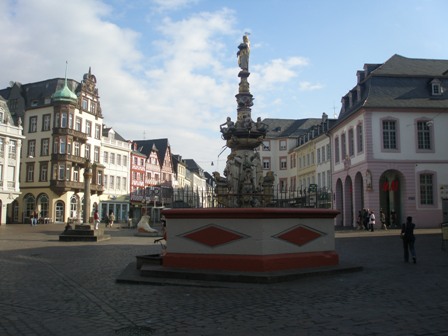
St. Peter Fountain

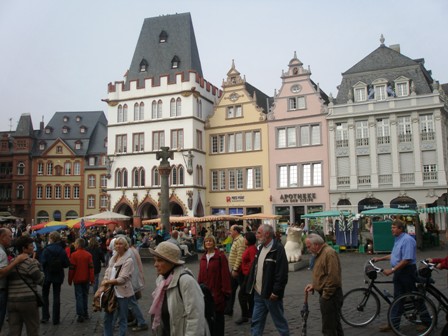
I enjoyed the time I could spend in its confines during my two month stay in Germany tremendously and I tried to be there as often as possible. “Augusta Treverorum”, a more than 2,000 year old jewel of the wine cities in Europe, is increasingly attractive to me, the older I get. The main market square (Hauptmarkt) is what I would like to introduce to you today. Its a splendid location. Some call it one of Germany’s most beautiful town squares. It is located at the centre of the city only a few blocks south from the Porta Nigra on Simeonstrasse, the pedestrian shopping street. The city received the market rights in 958 AD from Archbishop Heinrich I and a market cross on a granite pedestal from Roman times was erected to this effect. In about 3 m height an inscription says “Henricus archiepiscopus Treverensis me erexit”, which loosely translates as something like ‘Archbishop Heinrich erected me’.

Another jewel on the square is the St Peter Market Fountain. It was created in the 1595 and shows St. Peter with the key of the city on top and it incorporates statues that symbolize justice, fortitude, temperance, and prudence. The surrounding houses date from different architectural periods among them renaissance, baroque, classicism and late historicism. The old main police station and the former Domhotel are built in a neo-renaissance style. The gate to the market church St. Gangolf shows baroque features.
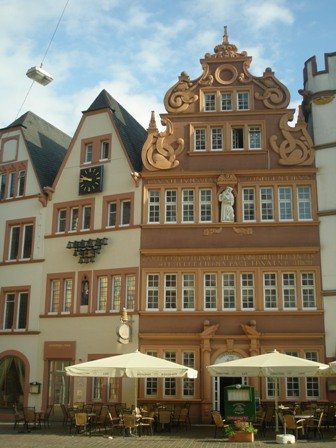
Another architectural marvel is the old citizens house, called ‘Steipe’ dating back to 1430 and the ‘Red House’.

pa020062w.jpg

Main market square (Hauptmarkt) with market cross and ‘Steipe’ building and droves of tourists

Frequently, I visit the many wine bars and country inns. But I also take long strolls to look around town. My curiosity is endless. Moreover, I also admit to following to a certain extent the traits of my childhood and youth. Then all kinds of things come to mind, sounds, smells, faces, moves, music, short encounters, and many more. Human memory is such a fickle thing but stimulated in the right way it sometimes yields interesting results.

p9020033w.jpg

Replica of the buildings of the ‘Steipe’/’Red House’ ensemble in Trier

Hope to see you soon in Trier.


Sucellus – Wine aperitif from Kinheim, Mosel

November 28, 2007

When doing my research on the internet for my entry on Sucellus and Nantosuelta, I came across a webpage which advertised a very different kind of ‘Sucellus’. On www.sucellus.de Dr. Willi Rieth from Kinheim, Mosel produces a ‘Mosel Sherry’ called Sucellus. Dr. Rieth is by profession a food analyst. In his spare time he is hobby vintner. Because the name ‘sherry’ is protected by law, the drink has to be called a wine aperitif. Kinheim is the location where a statue of Sucellus dating back to the 3rd century AD was found in 1976 during land consolidation works. Dr. Rieth decided to call his wine aperitif Sucellus after the Celtic god of vintners and coopers.

2007_0908sucellus0025web.jpg

Dr. Willi Rieth and a statue of ‘Sucellus’, the Celtic god of vintners and coopers, in Kinheim, Mosel

Some claim that sherry production is one of the most complex of all winemaking methods. In the South of Spain where Sherry originates from three main grape varieties are used ofr Sherry production: Palomino, Pedro Jimenex and Moscatel. Along the Mosel, its of course Riesling grapes on which the ‘wine aperitif’ is based. The mature Riesling grapes are hand-harvested and carefully pressed. The must is fermented in large oak barrels (barrique). After the wine is made and the conditions are right, a specific yeast, called the flor, forms on top of the wine and mellows the flavour. After that the wine is fortified usually with clear wine alcohol which preserves and protects the sherry against microbiological influences. The aging and blending of Sherry is quite a complex procedure where various systems are employed (for instance the Solera system).

bild5sucellussherry.gif

The wine aperitif ‘Sucellus’ from Kinheim

The above bottle has travelled the world and made more than 800,000 km in the air (about 18 times around the aquator) which brought an entry into the Guinness Book of Records. Even Indonesia was on the list of the countries, where the bottle touched down some 10 years ago.

PS: Both photos were made available by Dr. Rieth


Wine Bars in Jakarta – Connoisseur in Citos

November 26, 2007

Given the traffic chaos in the capital city of Indonesia, it is important to have a ‘watering hole’ somewhere nearby. Today I would like to invite you to the Connoisseur, a small wine bar in a shopping centre in South Jakarta near to my home in Lebak Bulus.

I have lived for more than nine years in Jakarta. Many of my friends assume that Indonesia is a Muslim country and that alcohol must be hard to get. Well, the majority of Indonesian people (about 85% of the population of about 220 million people) are Muslim but in fact Indonesia is a secular state as most other states in the region. Despite the terrorist attacks in Bali and other locations, the Indonesian archipelago is a very peaceful, pluralistic and tolerant place. Wine lovers have the freedom to pursue their hobby and sample fine wines. Various wine societies and circles exist with not only expats as members but with a heavy local contingent.

In 2007, however, it’s been more difficult to get hold of fine wine than in previous years. Rumour has it that there was a problem with the import licenses and that therefore only the duty free outlets have stocks left whereas other wine sellers have run out of the liquid.

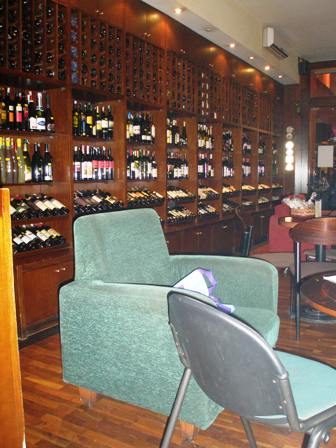
However that may be only about 10 minutes from our home is a shopping mall for the lower middle-class called ‘Citos’. This is a place bubbling with people. There are many small shops and many more little restaurants, most of them of the fast food type. On the ground floor is a small wine bar, named ‘Connoisseur’. Though the place could benefit from a renovation (some of the chairs show cigarette holes and other stains), it’s quite cosy and has a very relaxed atmosphere. The range of wines on offer is amazing. Many of the bottles on display do look a bit ‘worn’ tough with some dust accumulated and some of the labels torn. Prices seem to be reasonable. Nibbles and finger food can be ordered from the neighbouring shops and food courts.

pb230094w.jpg

The Connoisseur with wine racks

We went for some ‘save’ Australian red, a ‘2002 Wynns Coonawarra Estate Shiraz’ (www.wynns.com.au). The estate is located in the famous “terra rossa” strip which produces intensely concentrated flavours. The 2002 vintage was cooler than other years therefore the wines are elegant and show good structure. They are barrel aged (old and new oak) for about 11 months. The bottle looked a bit ‘battered’. Because of the tropical climate conditions in Jakarta one is never sure how wine was handled (sometimes one can find ‘cooked’ wine when containers or bottles spend too much time in the sun and the moist heat). The bottle was reasonably priced for Jakarta conditions (about 320,000 INR which is about 26 EURO). For comparison I tried to find some current Australian prices but I only found the 2003 vintage Shiraz on the internet for about 60 A$.

pb230095w.jpg

The wine was deep red. It showed a nose of black peppers and dark berry fruit flavours. It has a good mid palate weight and a strong finish. Margit and I enjoyed a relaxed Friday evening with a good drop of Australian wine. Come and visit us, we’ll take you there.


Nantosuelta! – Who’s that?

November 21, 2007

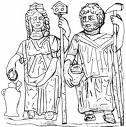
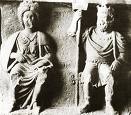
You might have seen my blog entry about the Celtic god of the vintners, Sucellus. Guess what? He’s got a ‘wife’ or should I better say, a companion? A consort seems to be the right word.

I do not know how gods treat their wifes/consorts and how it all works out but according to Gaulish religion, Nantosuelta is the goddess of nature, earth, fire and fertility.

She is usually depicted with holding a pole with a model of a house to indicate a domestic function (sometimes a bee hive). Also in Lusitanian mythology she is the goddess of nature.

Her symbol is the raven which links her to the dead and the underworld. Often she is depicted holding a ‘cornucopia’, a hollow, horn shaped wicker basket (also called ‘horn of plenty’ or ‘horn of Amalthea’) and a symbol of food and abundance. The ‘cornucopia’ is often associated with the harvest season and, suprise surprise, with Thanksgiving.

A couple of reliefs and statues have been found near Metz/France and in Alsace. They usually show her with Sucellus. Whereas there are many images of Sucellus found on the internet, there are only very few available for Natosuelta.

180px-nantosuelta-sucellus.jpg

Nantosuelta and Sucellus (source: wikipedia)

imagesnands.jpg

Nantosuelta and Sucellus (Source: http://www.cetnet.org.uk)

imagesnus.jpg

Nantosuelta and Sucellus (Source: http://www.crdp-strasbourg.fr)

concerto-1-nantosuelta.jpg

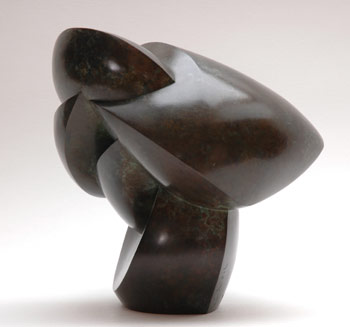
This is the ‘modern’ Nantosuelta in bronze.

Source: “Nantosuelta”, bronze H 40 cm by Claudine Leroy-Weil (born 1950 at Neuilly-sur-Seine), at http://www.galeriedessablons.com


Wine and vineyards in Trier-Olewig

November 19, 2007

pa020110w.jpg

The wine village of Olewig near the city centre of Trier

Olewig is one of four villages within the city boundaries of Trier were vines are grown till today (the others are St. Matthias-Feyen, Krüenz and Pallien) since Roman times. Vines, wine production and wine trade were basic features of city life, its culture and its economy. Many famous poets eulegized the beauty of the town (among them Goethe of course). In the drinking song of Carmina Burana of the 13th century one verse praises the city of Trier and its comforts, the dedication of its citizens to “the vines and the wines” and the culture of enjoying the fruits of the vintners labour.

One of my many walks around the town brought me to Olewig, a village nestled between two steep hills in the South-East of the town. Early in the morning I sat out from the banks of the Mosel river, from my parental home in “Britannia” (Britannien), as our neighbourhood is called. Its the area where the old city harbour had been, roughly between the two cranes to unload barges moored on the river.

pa020090w.jpg

The view of the city from Petrisberg (left: Roman Basilica, Cathedral, and in the background the red sandstone cliffs)

I climbed the gentle slopes of the Petrisberg and turned South where the wine appreciation path (Weinlehrpfad) starts. This walk leads the wine interested rambler along ruins of Roman tombs through vine gardens and vineyards to the village of Olewig. I did not enter the village but instead walked in a long circle through the vineyards and returned to the Petrisberg where one has a wonderful view of the old city. It was vintage time and crews of grape pickers were busy harvesting.

pa020083w.jpg

The start of the path/walk: Between Sucellus (left) and Bacchus (right), the Celtic and Roman gods of wine respectively

The poster says that the wine appreciation path is about 1500 m long. It leads through the open fields of the Trier wine district and ends in Olewig. Along the way large posters are displayed educating and informing the wanderer of the various historical, cultural and technical aspects related to the vineyards and the production of grapes. One of the signs gives the total area under vines as 373 ha. The number of full-time vintners is about 100 family farms. Main grapes grown are Riesling (86 %), Rivaner (8 %), Pinot Blanc (4 %) and Pinot Noir (2 %).

pa020088w.jpg

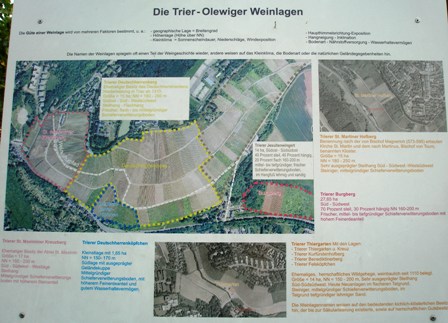
The map of the Olewig “Terroir”

The main locations of Trier-Olewig are

– St. Maximiner Kreuzberg
– Deutschherrenberg
– Deutschherrenköpfchen
– Burgberg
– Jesuitenwingert
– Thiergarten unterm Kreuz
– Thiergarten Felsenkoepfchen
– Benediktinerberg
– Kurfürstenhofberg
– St. Martiner Hofberg

pa020102w.jpg

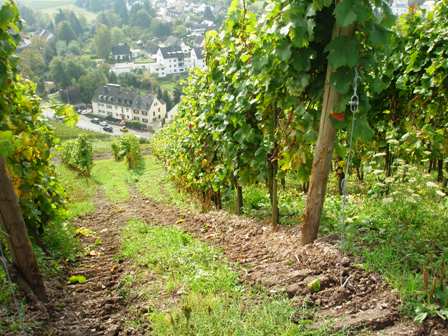
The slopes are steep, only caterpillar tractors are able to scale them (in the background Olewig)