Sunday lunch in March

March 14, 2010

Since the beginning of this year, we have a new rule as regards the family cooking: every Sunday another member of our family is preparing the family feast. It was my turn last Sunday (more about this another time) and today my daughter Lucy (15) took on the role of the chef.

She presented us with salmon with salsa and a guacamole. In addition we had a fresh salad which is very nice in 35 Celsius heat. Mama helped a little but not much. It was delicious, as you can see from the photos below. What a great lunch this was.

The recipe came from the delicious magazine (December 2005/January 2006): Cajun salmon with corn salsa.

One mixes a table spoon each of coriander, dried tyme and oregano, cumin, and dried garlic, adds two table spoons of pimento (sweet smoked paprika) and olive oil and mixes this in high heat in a pan. The salmon fillets are rubbed with the mix, then cooked for about two minutes on one side and one minute on the other. After that you transfer them to a heated oven of about 180 Celsius where they are cooked for about 3-5 minutes. Serve with the salsa and guacamole.

The salad

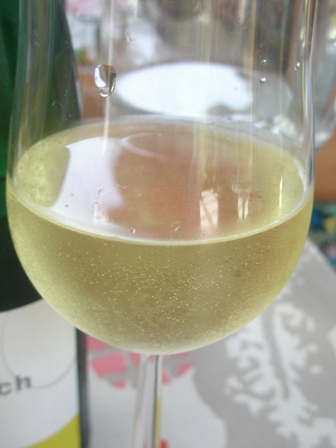
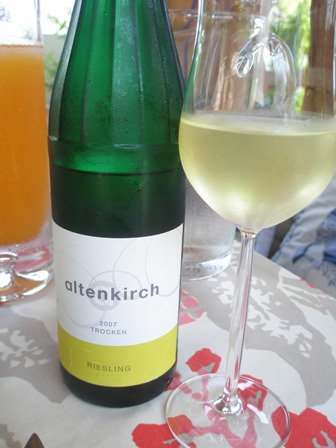
The wine, however, was my department. Thanks to Mathias and Beatrix we still had a bottle of ‘2007 altenkirch Rieling, trocken’ by Friedrich Altenkirch in Lorch, Rheingau, Germany.

The wine is German Riesling at its best. With only 12% alc. vol. it has zest and finesse and the typical citrus flavours. It is a blend from different locations and made to be enjoyed young. The single vineyard wines from very steep slopes the winery produces are regularly awarded all kinds of medals. Altenkirch is worth a visit if you are visiting the Rhine river.
Address:
Winery Friedrich Altenkirch
Binger Weg 2
D-65391 Lorch /Rheingau
Germany
Tel: +49 67 26 / 83 00 12
Fax: +49 67 26 / 24 83
www.weingut-altenkirch.de
www.altenkirch-winery.com


Wine tasting at the Lake House in Bangkok

March 7, 2010

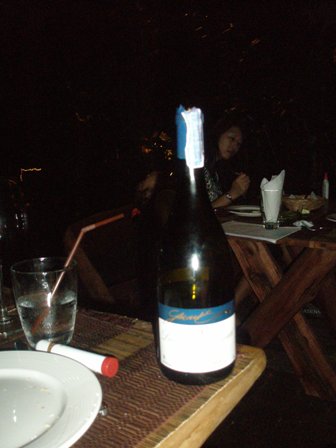
The bottle of red by Domaine de Rapatel at Lake House

In the morning when we drove past Lake House on our way into town, we decided spontaneously that we should go there for dinner. Margit had seen a review about the place in the Bangkok Post. Of course we had to check the place out ourselves.

It was already dark when we arrived but the surroundings of the lake were very romantic. My camera, however, could not cope with the conditions. We choose a small table in the garden and had just ordered our food when an excited waitress came and invited us to a wine tasting. Surprise surprise, we thought, why not taste some wines.

In a small room in the main building, we met the winemaker, Gérard Eyraud, his daughter and grandson, and some more French people from the wine importer. We tasted four wines, three from Gérard, one from another producer from Southern France (Domaine Bouche Red, Cote du Rhone). I had nothing to write with, took no notes and also forgot completely to take a picture of the winemaker and his family.

The white from Domaine de Rapatel was a blend of Roussanne with Bourboulenc with a taste of apricots, one red was a blend of Grenache with Syrah and the third one was a blend of Syrah, Grenache and Mourvèdre (14.5% vol. alc.). The last one I know for sure, because we could not continue to drink the wine I had ordered earlier, after we had tasted these wonderful fruity wines made by Gérard. In the process we got to know Matt, one of the three co-owners of the restaurant, from Melbourne and established that his brother Dan is an old mate of my nephew Nik Meinhold. How small the world is.

Gérard and Christine Eyraud have about 15 ha under vines southwest of the city of Nîmes. Gérard sells most of his wine as Vin du Pays du Gard, the grand cru wines are labeled “Costières de Nîmes”, a wine region in the Carmargue, in the South of France. I have visited the city and its surroundings but had never tasted wines from there before. I loved the fruitiness which reminded me of Australian wines and not necessarily typical for French wines.

We had a jolly good evening. The tapas we had ordered were delicious, the wine was just superb. The staff was very friendly. We went home with the sincere intention to come back and taste some more wines. By the way the wine list of Lake House is quite extensive, and the prices are the best I have seen in Bangkok so far.
Needless to say that we ordered a couple of dozens of the wines the next morning by e-mail. More soon about these wines maybe with proper tasting notes.

PS: During the wine tasting we also learned that the house used to belong to Tiziano Terzani (14.09.1938 – 28.07.2004), an Italian journalist and writer, and a native of Florence. He stayed there for about two years. The house was called “the turtle house”. He also had lived in Beijing, China for a while where he was the correspondent for the German magazine Der Spiegel, until he was thrown out. I red his book “Behind the forbidden door: travels in unknown China” in 1986.

Address:
Lake House
http://www.lakehousebkk.com
18 Soi Prommitr, Sukhumvit 39
Bangkok, กรุงเทพมหานคร 10110, Thailand
+66-2-662 6349


A wine blogger’s weekend

March 6, 2010

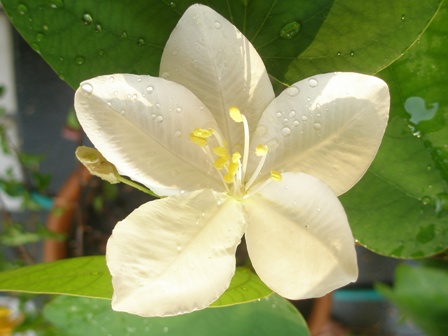
Flower on my terrace garden in Bangkok

Finally, the weekend has arrived. I am stuffed today: boy what a week that was. I have not produced a single blog entry, which has not happened for a long time in my three years as a wine and food blogger. I thought of myself as having developed the discipline and technique of writing and uploading a piece every two/three days. I was always full of stories, which waited in my head to be written down. But not this week, this week my tank was empty. During the last week I felt chased. Not even the few bottles of wine I drank with my meals could relight my desire to write a blog entry. But today is Saturday, the sun is shining and my terrace is laughing at me.

Of course I have a few draft stories on my computer, but most of them require some further research, and somehow one has to be in the right state of mind to write them up and load them on. And the prospects for having enough time are not too good. Next week I am off to Vietnam and Cambodia. After that I have some intensive workshops in Thailand. The two-week holiday for Songkran, the water festival of the Thais, I will spend on my vineyard in Glenburn, Victoria. I will be busy doing post-harvest stuff, working the land on my new tractor, celebrating with family and friends, therefore, no time for writing. And after that I am off to Germany for 10 days meetings and consultations. March and April will be two lean months as far as blogging is concerned, I guess. And sure enough, this will give me a vast cornucopia to draw on, and the energy to regale you with stories from the vineyard.

I hope you stay tuned and continue to visit the “Man from Mosel River”. Cheers!


The top German Vintners or the VIP club of German wineries: VDP

March 1, 2010

The logo of the VDP

VDP stands for “Verband Deutscher Praedikatsweingueter”. The German can be freely translated as “Association of German Wineries of Excellence”. The VDP is a club-like organisation with 196 member wineries.

It was founded in 1910 and celebrates this year its 100th anniversary. According to its website, VDP is the oldest association of the top quality wine estates. membership requirement is to adhere to the standards of the association which includes among others the strict limitation of yields. There is an inspection and certification process in place which members must submit to in oder to not loose the membership status. It is supposed to uphold the high quality of the produce.

The sign of quality are the eagle (no surprise for Germans who have made it part of their national insignia) and the cluster of grapes, usually embossed on the bottles of their “Erstes Gewaechs” comparable to France’s “premier cru”, wine made from grapes from the best terroir or locations.

The members of the association sell about 35 million bottles per year, for an average price of about 9 Euro /bottle. 80% of their production is sold on the domestic market, 20% is exported. Almost half of the bottles are sold directly to consumers.

The members come from all German wine regions. More than half of them (acounting for about 6% of all Riesling plantings worldwide) produce the finest Riesling wines Germany has to offer. In 1990 it had 161 members. Since then 73 wineries have left and 108 have joined the association.

According to www.riesling.de it’s newest three members are:

Klaus Zimmerling, Saxonia
Konrad Schloer, Taubertal
Thomas Seeger, Baden

Some of my favourite producers are members of the association, for instance Van Volxem Wine Estate in Wiltingen at the Saar.


Vineyards of Thailand Part 3: PB Valley Khao Yai Winery

February 25, 2010

Wine tastings at PB Valley

PB Valley is the largest of the Khao Yai vineyards and wineries. It’s total production is about 600,000 bottles a year. It is also the oldest vineyard in the region. It was started in 1989 on a large plot of land. It took a couple of years to identify the most suitable grape varieties for the climate.

PB Valley wines have won a number of international wine awards (mostly at AWC in Vienna). Apart from vineyard and winery, it also has a restaurant, the Great Hornbill with about 200+ seats, and holiday accommodation. I like their reserve Shiraz and Tempranillo wines best.

Unfortunately, we had no time for a winery tour or any organised tasting. We just dashed to the cellar door and bought a couple of bottles. As in other wineries, the product range includes all kinds- of non-wine products from health care, cosmetics to nutrition.

The entrance to the sales room

The cellar door

Wide product range

If you visit Bangkok, rent a car with driver for the day and visit the wineries and vineyards of PB Valley and Gran Monte. This gives you a perfect start for the exploration of new latitude wines. The area is beautiful and the national park offers some unique experiences of Thailand.

If you have no time, visit their sales offices in Bangkok and stock up on their wines.


Getting ready for the 2010 vintage

February 22, 2010

Two Hills Pinot Noir shortly before the nets went on

The nets are on now, and we are expecting a good harvest at Two Hills Vineyard for 2010. After the total loss of last year the prospects are not too bad.

Estimates are:

– Sauvignon Blanc: about 8 tonnes of fruit, and already sold
– Pinot Noir: about 5 tonnes of fruit and still looking for a home

The Merlot grapes look good too, but we are not making any wine this year. This will make the bird in the vicinity very happy, what a feast. That’s the price we have to pay for the grape glut. It’s sad but cannot be helped at this point in time.

Our new tractor will come into action for the vintage. This will make things easier, I hope.
Let us hope no unexpected disaster occurs before the grapes are in safely.

The plan for 2011 is to mothball the vineyard for a couple of years and see if the market recovers.


Wine of the day: Climbing Merlot by Cumulus Wines

February 20, 2010

Cumulus Climbing Merlot

I do not drink much wine from New South Wales, except maybe Semillon wines from the Hunter Valley. The other day some wines from Cumulus Wines, the largest producer (about 500 ha under vines, not a boutique producer), located in the Orange Region, appeared in our supermarket in Thonglor, Bangkok.

I bought a couple of bottles from the Climbing Series (Shiraz and Merlot). My children liked the label. The ‘2007 Climbing Merlot’ won gold, silver and plenty of bronze medals. It’s a cool climate (grown above 600 m), fruity wine, elegant with a good structure, a delight of a wine, even if one has to fork out about 20 Euro/30 A$ for the bottle here in Bangkok.


Wine of the day: 2008 Yering Chardonnay

February 18, 2010

After a hot day in the tropics nothing is better than a nice glass of white wine. We selected a ‘2008 Yering Station Chardonnay’ from the Yarra Valley. Yering Station is the oldest vineyard in Victoria. The winery is a must visit if you are touring the Yarra Valley. It’s located just outside Yarra Glen.

Only very recently had this wine arrived in our supermarket in Thonglor, Bangkok. It’s moderately priced for Thai conditions (less than 10 EURO or A$ 15) and a very lovely drink.

Wine on the terrace: 2008 Yering Station Chardonnay

Yering Station has still ‘grape growers with contracts’ and our friend Steve Sadlier is one of them. If we want to drink wine from his grapes, Yering Station is the winery to buy it from. Steve produces excellent cool climate fruit in the Yarra Valley.

We were a bit homesick and needed a reminder that Australia can be very near. Cheers folks


Who destroyed the Australian wine industry? …and the culprit is….

February 15, 2010

I have not been reading the Daily Wine News for a couple of days. After coming home last night, I browsed through the accumulated news. And, Eureka, I found for the first time someone who points his finger in the direction of the big corporate producers.

So far the tenor of most critics has been that there is just too much wine around (surplus of 20-40 million cases of wine each year) and that mostly greedy investors, money trusts and lifestyle (hobby) vintners, loaded with money made in construction or as medical doctors are the ones to blame. They are the ones who single handedly destroyed the wine sector; they produced the “wine lake”, and planted unsustainable hectares of new vineyards. The remedy was also clear: the small ones have to go. Instead wine production had better be left to the professionals (i.e. the corporates).

In comes Brian Croser, the founder and former owner of Adelaide Hills based Petaluma winery, with his view of the problem. He believes that the 2,000-odd Australian vintners are the originators of first-class Australian wine and have been the creators of the outstanding international image of their produce. The large companies, the corporates, have benefited from this positive image and “sailed on it”. However they mainly produce commodity wines of inferior quality which they dump on world markets, thereby destroying the reputation of fine Australian wines.

Whether this is true or not is certainly debatable. Everyone who extended their plantings in the hope of a larger marketshare is somehow to blame. However, finally we can hear another tune, not heard before and the public conversation has not only become more colourful but also more pluralistic, which is good for everyone.

If we have to pull out 40,000 ha of grape vines, they should come from various sources. If one of the four big companies would go and leave the sector, a lot could be gained for the remaining producers. Alternatively, small producers could pull out. What would be better for the country? this is a question not easily answered.

We will see small, medium as well as big companies leaving the industry. Many small family businesses will have their niche and will thrive regardless of the downturn of the sector. Others will close down, especially fruit producers who are at the end of the value chain (actually they are at the start of it). Also some of the investor and dividend driven schemes will come to an end. Vineyards and wineries will be hard to sell for some time to come. The big corporates will clean up their portfolios, they might de-invest in wine production and move into other segments of the beverage industry. Lower average profits in wine making will make other investments relatively more profitable. The wine sector will remain unattactive for young professionals for a while until the pendulum swings back, and the cycle of boom and bust will start all over again.

We at Two Hills Vineyard came too late to the party, and were caught out, so to say. I guess, we will go into hibernation and see what the prospects are in a couple of years time. I hope we can afford this strategy and that it will pay off some day when we can reduce costs and better market our produce. I remain optimistic and we will hang in there. Cheers to Two Hills wines!

Two Hills Vineyard, Glenburn


And here comes the year of the mighty tiger

February 13, 2010

It started with fire crackers this morning. They made a hell of a noise in our Soi, as the Thais call the back lanes and side streets. Amazing, I thought, if this goes on, we will be deaf by night.

In the end we decided to go out, do some shopping of groceries and decided spontaneously to go for lunch to the dumpling place called the Royal Kitchen on Thonglor. At the entrance, right on the pavement, large trestle tables were laid out with all kinds of food, some drink and incense, all offerings in honour of the gods. And I had not brought my camera, what a shame. The restaurant was packed. We ordered all kinds of dumplings and the four of us consumed a sumptuous Chinese meal. It felt so great. This is our start into the year of the tiger. We drank of course beer.

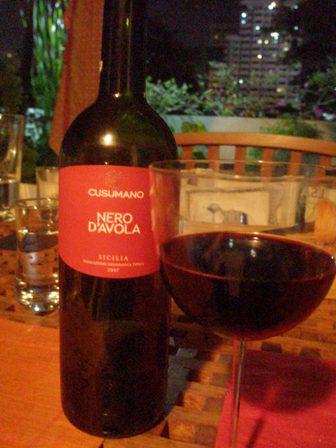
But I have a wine suggestion for the tiger year. ‘2007 Nero D’Avola’ by Cusumano. Have you heard of the brothers Cusumano, Alberto and Diego? I had not. The bottle has a glass enclosure (yippieh). The colour is most beautiful.

2007 Nero d’Avola by Cusumano, Sicily

I find their website a bit cumbersome, the wine is not. Sicily’s most important indigenous red variety produces wonderful wines with soft tannins and plum, berry and spicy flavours. They compare to our Shiraz wines for instance the ones from Heathcote, Victoria. I can only highly recommend this wine from Sicily. It matches the power of the tiger.

Gong xi fa cai – Happy New Year