Wild pig from Schoden, Saar

September 15, 2010

I am afraid some of you might not like this post and the pictures which I present today. But meat comes from animals and they have to die so that we can enjoy the meals we make from it. Wild pigs are a real pest in Germany theses days, and very difficult to hunt and kill. My friend Heinz shot the little boar in Schoden, Saar.

My mother prepared a wonderful Sunday lunch with the best parts of the meat. We enjoyed it together with a bottle of our Merlot (2004 Two Hills Merlot), and I tell you that was just heaven on a stick, as we say in Australia.

Wild piglet hide

The carcass

…from a different side.

The butchered boar meat

…and in the pan

…and finally on the plate

How tender is this?

My favorite Australian Merlot


Restaurant review: Sjoebaren in Gothenburg, Sweden

September 13, 2010

While walking the streets of Gothenburg, Sweden (which is a very lovely city) where I attended an international conference, I noticed the many Japanese sushi restaurants. Well, I thought the Swedes love to eat fish; why not Japanese?

For dinner, however, my colleague Jules and I, we wanted to check out the original, a Swedish fish restaurant. The receptionist at the hotel pointed us to a couple of interesting places. We decided on a restaurant nearby, the Sjoebaren as it was called (freely translated as “seal” or “sea bear”). We were told that there are two restaurants with that name. We went to the one in Lorensberg.

The entrance of the restaurant

We had not made a booking and the place was full when we arrived. Fortunately, the waiters were very kind and accepted a booking for 20 h. We had an hour and a half of additional time to kill but that was not a problem for us (more about this later).

Kuentz-Bas, 2007 Pinot Gris Tradition from Alsace, France

It was clear, we wanted to eat fish. The first thing I selected was the wine. I opted for a ‘2007 Pinot Gris Tradition’ by Kuentz-Bas from Alsace, France. Decanter awarded 87 points to this wine.

The vintner of Kuentz-Bas is Jean-Baptiste Adam, an icon of the Alsatian wine industry. He runs his vineyards following biodynamic production methods. I am not related to Jean-Baptiste despite the coincidence with the family name.

Wine prices in Sweden are a bit on the high side. We went for only a glass. I loved the Pinot Gris. It was not overpowering, but fine and firm with a complex acidity and an impressive finish.

The starter

The herring was just too good to not order it. We did not expect what was put in front of us by the cheerful waiter. Look at that. This beautiful arrangement was just amazing. One piece of herring was marinated in a cinnamon heavy marinade, the other piece came with fish eggs on top in a white sauce. In addition we were given potatoes, onions, cream cheese and some other delicacies. I t,ell you this starter is to die for. My taste buds went ballistic. What a wonderful start to an Swedish meal.

Two kinds of herring

Fish of the day

My friend Jules ordered the fish of the day. Very tasty.

Graved lachs

I went for “graved lachs” (marinated salmon), my favourite dish from Sweden. Ever since a Swedish friend of ours had introduced us to this delicacy and ever since my wife makes her own version of it, I just cannot resist this fish. The portion was huge. And for the first time ever, I could not finish my plate. It was just to much. Unbelievable. I had to apologize to the waiter with a compliment to the kitchen.

Potatoes in dill-cream sauce

The painting in the middle of the restaurant.

Sjoebaren Lorensberg, when we left it

Sjoebaren is a hot tip if you are in Gothenburg. Do yourself a favor and treat you to something very special. The service is great, prices affordable and the quality extraordinary.


Emrich-Schönleber Riesling Sekt, Nahe. Germany

August 31, 2010

One of the best wineries along the Nahe river is Weingut Emrich-Schönleber in the village of Monzingen. The family vineyards (about 33 acres) produce great wines, mostly Riesling.

In 2010 the Gault Millau Wine Guide gave 10 of the 17 wines of the Emrich-Schönleber Estate 90 or more points. The wine writer Jancis Robinson was extremely impressed by the ‘2009 Halenberg Auslese’. 19.5 of 20 points was her verdict which is truly awesome.

Recently we visited the winery. Coming straight from Frankfurt Airport, we drove along the Nahe wine route, passed Bad Kreuznach, and spontaneously dropped in to pick up some bottles of wine.

In the yard, we bumped into Mr. Emrich-Schönleber senior, who was on his way out. In passing he referred us to his wife who was so kind to introduce us to the wines of the estate. Since it was early in the morning, we did not feel like tasting wine (we just came from breakfast in the small town of Sobernheim). Moreover, after many hours of flight, we had just gotten off the plane.

Our selection was quick but firm. I knew some of the ‘grand cru’ locations of Monzingen. After all, I had spent most of my school holidays in the neighbouring village of Martinstein where my maternal grandfather (Hans-Heinrich Schuessler) had introduced me to the amazing world of Nahe wines at a rather tender age.

We chose a nice cross section of Emrich-Schönleber’s wines including two sparkling ones. Ms. Emrich-Schönleber was so kind to add a small bottle of sweet desert wine as a gift. We were flabbergasted.

The bottle of Riesling Sekt (Sekt is German for ‘sparkling’) below did not last long. Only after a couple of hours, when the bottle was sufficiently cold, we opened it to celebrate the start of our holidays in Trier. What an auspicious start to a summer holiday in Europe?

Emrich-Schönleber Riesling Sekt

The Riesling Sekt is produced using the classical method of bottle fermentation. Everything is done by hand. Due to the acidity of the Riesling fruit, the wine displays a beautiful spectrum of fine acids. Moreover, it is dry and fruity with lots of fizz. The magnificent minerality of the wine is another characteristic.

Emrich-Schönleber Riesling Sekt

Nahe wines, especially the Rieslings, are one of the best kept secrets in Germany. You should visit this internationally little known wine region. It’s just about an hours drive west of Frankfurt Airport. I promise you: you will not regret it.

Address:
Weingut Emrich-Schönleber
Soonwaldstraße 10a
D-55569 Monzingen
Tel.: +49-67 51-27 33
Fax: +49-67 51-48 64
www.emrich-schoenleber.de


2007 Pongelli – Villa Bucci, Le Marche, Italy

August 30, 2010

2007 Pongelli, Villa Bucci

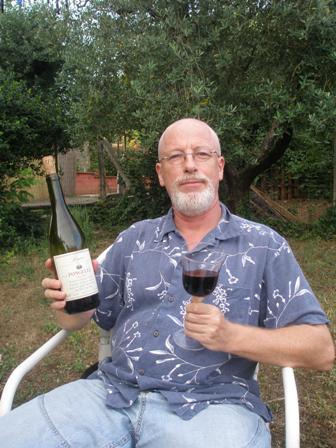
I have written about a wine from Villa Bucci some time ago (it’s Verdicchio). When I bought wines from Il Grappolo Divino and Alessandro Mauceri in Frascati, I also choose a red wine from Villa Bucci, the ‘2007 Pongelli’. This wine is a blend of 50/50 Montepulciano and Sangiovese grapes with 13.5% alcohol.

I served it slightly cooler than normal. Well, it was one of these hot days in Rome where you come out only in the evening. We had it without food, just like that, while sitting under the olive trees. It was a great experience to taste it.

The colour is a strong ruby red. Raspberry aromas were there with some hints of vanilla and leather. The tannins are soft and mellow. The wine has a good structure, is full bodied and has a strong finish. The Parker-point-fans give him 86-88 of 100. My verdict: if I only could get my hands on some bottles of this wine here in Bangkok.

If you are in Rome you are in a better position. Just go and visit the Castelli Romani; stop by in Frascati and see Alessandro Mauceri and his new wine shop: Il Grappolo Divino. There you can also buy the ‘Pongelli’ (among many other treasures).

Address:
Il Grappolo Divino
Via dell’Olmo, 37
00044 Frascati
Italy
Tel.: +39-6-89026061


San Gimignano, Tuscany – Poderi del Paradiso

August 29, 2010

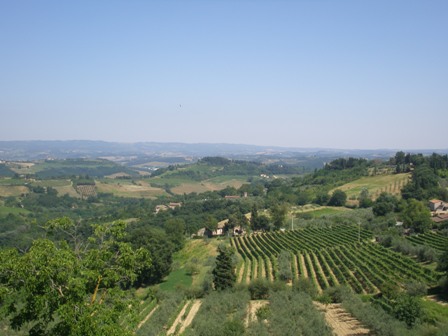
On our way from Rome to Florence we visited the small town of San Gimignano in Tuscany. It was a beautiful day with blue sky and lots of sunshine. We were not the only people to visit this picturesque jewel of Tuscany.

The view from San Gimignano into the surrounding hills

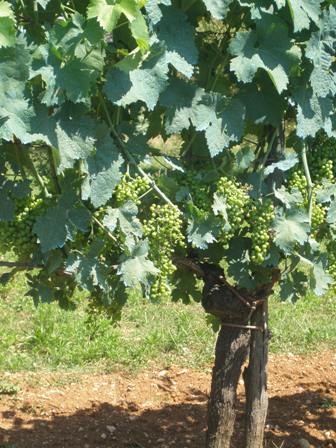
Grapes for the new vintage

The gate to enter San Gimignano

The town if famous for its medieval architecture and especially its towers. There are also many shops in San Gimignano catering to the many tourists. I could not resits the wine shops, but there is also plenty of prosciutto and beautiful local crockery on offer.

Wine shop

Prosciutto

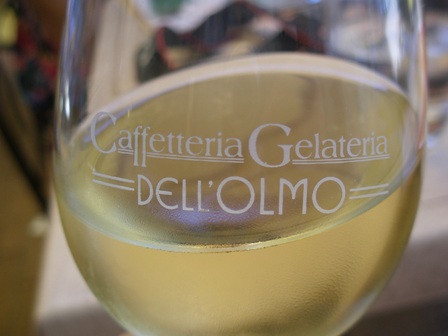
Vernaccia di San Gimignano

I had also to taste some of the wines. The Caffetteria dell’Olmo was just the right place to enjoy a cold drink located on the main square of the town. I ordered a glass of ‘Vernaccia di San Gimignano’ considered one of the finest Italian whites. This was a crisp wine with a fine acidity.

My spoil

On our way back to the car, I had to buy at least some wine. I bought a white and a red wine, both not very expensive. I asked for products of a typical local producer. The lady in the shop suggested Poderi del Paradiso which sounded just fine. You will learn more about the wines of Poderi del Paradiso in another blog entry.

I very much regretted that we did not have more time, but even these 2-3 hours were absolutely worth it. San Gimignano is a place I have to come back to.


Hunter’s breakfast: roe deer liver

August 28, 2010

Roe deer liver

While in Germany I ate a lot of “bush meat”. This is because some of my friends practice hunting as a hobby.
Hunting in Germany is very much steered by tradition. One of these traditions is that when a roe deer was shot, the liver needs to be eaten the same evening or right after the kill. There is nothing better than a fresh liver.
This is what we had at the home of my friend Uli in the “Muensterland”, a German agricultural region north and west of the Ruhr, the old industrial heartland of Germany. Uli’s mother Doris prepared such a fresh roe liver for us for breakfast. It is usually served with onions (and some people add optional apple). Unfortunately, my photo of the dish with the onions did not work out. Above you’ll find just the liver in the pan. I can only say: super delicious.

Since we consumed the liver in the morning, we did not have wine with it. A characterful Riesling wine would always go with it, but also a Pinot Noir could be a good choice of wine. Thank you aunt Doris for this delicious meal.


Restaurant review: Taverna Cestia, Rome, Italy

August 25, 2010

While working at FAO and living in Rome at the end of the 1980ies, our main restaurant was Taverna Cestia, near Piramide, just a couple of blocks from the United Nations. We went often and all the waiters knew us very well. Usually that meant that we did not have to look at the menu (they knew what we liked to eat), and if we stayed longer than the opening hours permitted, we were somehow accommodated (usually the offering of burning ‘Sambuca’ signaled that it was time to go home).

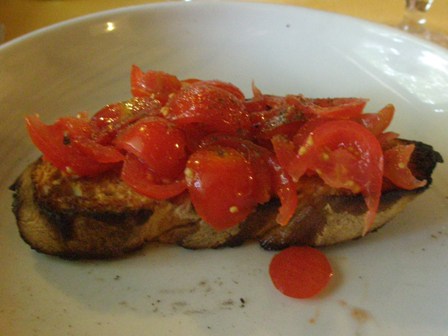
So it was clear that when in Rome, we would go and eat there. And that’s what we did during our summer vacation 2010 as well. It was a very hot day. We had shown our daughters the Terme di Caracalla. We were thirsty and needed refreshment. ‘Melon with prosciutto’ and ‘bruschetta di pomodori’ are just the right stuff to start a meal.

Ham and melon

Tomatoes on grilled bread

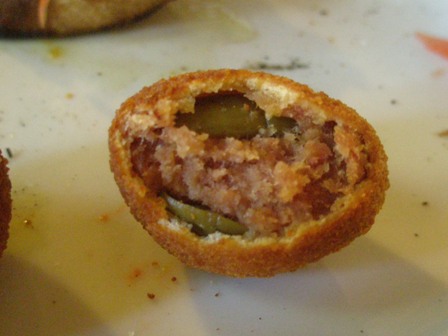
Olives in a coat

Taverna Cestia is famous for it’s ‘spaghetti alle vongole’, but I always liked also the ‘penne al arrabiata’.

Penne al ragu

Spaghetti alle vongole

In the past we always ordered a liter of house wine, usually a white wine in summer (a refreshing Frascati) and a red one in winter. Also this time we had a bottle of this divine liquid. We did not regret our choice.

Frascati wine by Casalgentile

The back label of the Frascati by Casalgentile

That the food at Taverna Cestia is very good is proven by the next picture. Tripadvisor awards four out of five stars.

Address:
Taverna Cestia Di Salvi Gioacchino C.
Viale della Piramide Cestia, 67
00153 Roma, Italia
Tel.: +39-6-5743754
Subway: Piramide


Venison from a roe deer for Sunday lunch in Trier

August 24, 2010

My stories from July and August do not come in any particular order. When arrived in early July in Trier at my mother’s place we were greated by a feats, as always. And beecause her partner Heinz is a hunter we often eat game. This time it was venison from a German roe deer (in German: Reh) he had just shot. Needless to say that my mothers cooking is just delicious as you can see from the pcitures below.

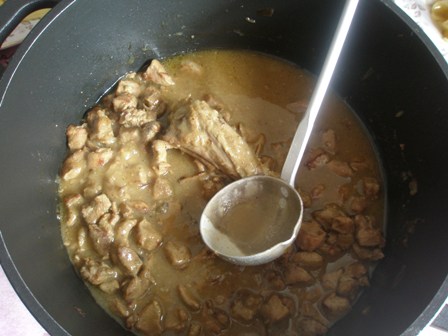
Tender venison, a meal in the making

With noodles of course

2008 Saar Riesling Van Volxem Estate

The wine I choose for this meal was a Riesling from Van Volxem Estate in Wiltingen, near Schoden (where the venison was from), one of my favourite producers from the Saar. Tough this is just a “simple” wine, it deplays all the character of a Saar Riesling, fine and delicate which machted the tender venison just perfectly.

Address
Weinmanufaktur Van Volxem
Roman Niewodniczanski
Dehnstrasse 2
54459 Wiltingen, Saar
Ph.: +49-6501-16510
e-mail: vanvolxem@t-online.de


Garbatella highlights: Pizzeria ‘Er Panonto’, Rome, Italy

August 23, 2010

Address Pizzeria ‘Er Panonto’ in Garbatella

I have told you about Garbatella, the neighbourhood in Rome where I once lived. I have also mentioned our old pizzeria, Er Panonto. Frankly speaking I have no clue what ‘Er Panonto’ stands for. But the place is just great, a traditional family affair, a Roman pizzeria at its best.

We had dinner there when we visited Rome in July this year. The following pictures give you an idea of the food which is very traditional and needless to say: super delicious.

Antipasti buffet

Bruscetta di pomodori

What a delicious pizza

Frascati wine from Colli Albani near Rome

I love the wines from the Colli Albani, the Albanian hills, as they are called around Rome. ‘Er Panonto’ buys the ready made wine and bottles it for its pizzeria. Some people claim that Frascati wine has been made in this region for more than two thousand years. I guess that’s true.

Frascati wines are usually blends of two-three varieties. According to the DOC laws about 50% of the wine needs to come from Malvasia biance di Candia grapes. The rest is from Trebbiano, Malvasia del Lazio, Greco, Bellone and other local white varieties. I like the wines because they are fresh and light with high acidity; in short they are ideal summer wines.


2008 Big Betty Shiraz, Mayer Vineyard, Yarra Valley

August 22, 2010

It is my birthday today and I am not in a blogging mood. But I had a great day starting with a birthday cake (Schwarzwaelder), some prosecco, followed by a meal prepared by my daughter Charlotte with red wine from my friend Timo Mayer from the Yarra Valley.

His ‘2008 Big Betty Shiraz’ is a ripper of a wine. The colour was an almost deep purple red. The fruit is big with lots of forest fruit. The wine has a great structure, good mid palate weight and a long finish (alc. vol. 14%).

You can read more about the Mayer Vineyard at James Halliday’s website ‘wine companion’. I also wrote about the South Pack, a group of young, funky wine-makers from Victoria to which Timo belongs.

Timo gave me this bottle to take home to Bangkok. My birthday was just the right occasion. Unfortunately, there was only one bottle. Well, that’s just tough luck.

2008 Big Betty Shiraz, Mayer Vineyard, Yarra Valley

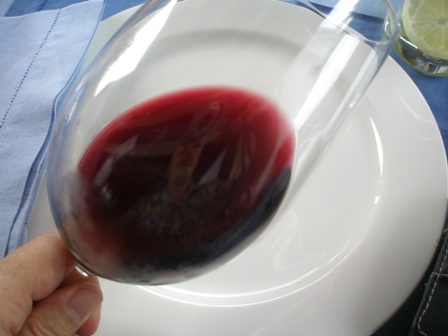
What a beautiful colour

Since I had a ripper of a day (with lots of good music, for instance from the Sky hooks), here is some funky music for you: Spider Bait and Black Betty. Enjoy.