Mount Nelson Sauvignon Blanc

June 24, 2010

Our fish

I just love to eat fish, all kinds of fish. And there is good fish on offer in the markets of Bangkok. Often we do not have carbohydrates with it. But veggies are a must. They are a great complement for the protein.

What you need in addition is, if possible: a superb wine, preferably white.

A plate of fish and veg

Very delicious veggies

I admit that sometimes I drink red wine with fish but most of the time I select a white. Since I love to drink Riesling wines, that’s often my preferred choice. Another option I like is Sauvignon Blanc. But it needs to be a really good one. I like Sancerre style wines and the ‘2007 Mount Nelson Sauvignon Blanc’, from the Marlborough wine region of New Zealand seemed to be the right stuff.

But I did not buy the bottle because SB wines from New Zealand are in fashion right now. I bought it because the Mount Nelson brand is a project of a famous Italian wine dynasty, the Antinori’s from Tuscany.

Piero and Lodovico Antinori are the 26th generation of Italy’s most famous wine family. I wanted to know how their interpretation of New Zealand SB fruit would turn out. I should not be disappointed as it turned out later.

2007 Mount Nelson Sauvignon Blanc

In 2004 the Antinori brothers bought for US$ 1.8 million a 32 acres vineyard on the banks of the Taylor River near the mouth of Cloudy Bay not far from the Wither Hill Vineyard. To make the Mount Nelson SB additional fruit (about 40%) is purchased from the adjoining Meadowbank vineyard.

The 2007 vintage is just the best ever. This is the unanimous verdict of the wine critics (91 Parker points). I can only confirm this. My recommendation: buy buy buy.

The wine has zest, is fragrant with lime and lemon flavours and some mineral notes. The colour is beautiful straw-like. The finish is lasting. I forgot the alcohol content and the price. But rest assured if I see it in my local market again, I will buy all the bottles on the shelve.

Beautiful colour in the glass

In early July, we will be in Italy. There I will taste some more of the Antinori wines. This time Italian wines.


Winery Review: Vereinigte Hospitien, Trier, Mosel

June 2, 2010

vereinigtehospitien1

The St Jacob of United Hospices wine label

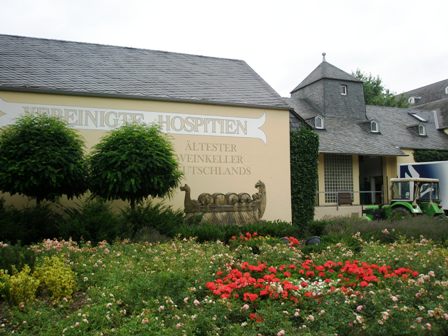
I grew up just next to the convent of St. Irminen at Irminenfreihof No. 5 in Trier, Mosel. The convent belongs to Vereinigte Hopitien, a foundation which also ownes a well known winery with the same name. Their English name is “United Hopices Wine Cellars“. The patron saint of United Hospices is St Jacob, an image of which is also used on the wineries labels.

As a kid I played in the cellars and warehouses of the convent. I also remember them sending their vats and barrels for controlling purposes to the Eichamt, the local Weights and Measures Office, which my father was heading. We played around the barrels and I vividly remember the smell emitted by the oak and the moist wood.

vereinigtehospitien3

The winery

United Hospices owns vineyards along the Mosel (locations: Piesporter Goldtroepfchen and Triere Augenscheiner) and the Saar (locations in Wiltingen, for instance Hoelle, Scharzhofberg and Kupp, Kanzem and Serrig). Most of the vineyard originally belonged to monastries and convents. Today about 25 ha are under vines, 90% of which are planted with Riesling grapes (my favourite grape variety), the rest consists of Pinot Gris, Blanc and Noir.

As many of the wineries in Trier, also United Hospices has a large traditional wine cellar (some parts of it dating from the 3. century) which you should have a look at. Wine tasting in ths historic atmoshere are unforgettable events. United Hospices top wines are the dry and sweet (Trockenbeerenauslese) Scharzhofberger Riesling wines from the Saar some of which sell for up to 100 Euro/bottle. The ordinary Riesling wines cost about 6.20 Euro/1 l. bottle.

I hope you are going to visit Trier this summer and drop in for a wine tasting. Cheers

vereinigtehospitien4

The main hospice building along the Mosel

vereinigtehospitien2

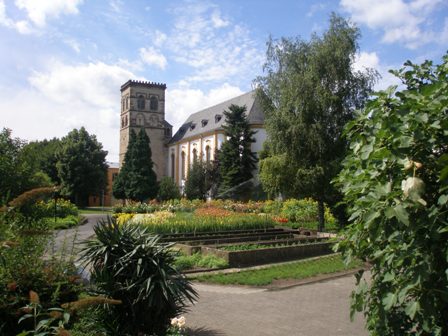
Church St Irminen

Address:
Vereinigte Hospitien
Krahnenufer 19
54290 Trier
Tel.: +49-651/945-1210 o. 0651/945-1211
Fax: +49-651/945-2060
Opening hours: Mo. – Thu. 08-12:30 and 13:30 to 17h; Friday closing at 16h, Saturday 10-14h


Riesling – Domaines Schlumberger, Alsace

May 25, 2010

Mussels

These days mussels are inexpensive in Bangkok. So why not having a large pot of mussels of Sunday lunch? Done. I like them cooked with chorizo sausages. In this combination of flavours the mussels are amazing. The pork sausage with the red paprika somehow bring the shells from the sea “to land”, so to say. The dish has bite.

Mussels with chorizo

What to drink with it, was the question? White, OK. But I could not think of any better wine than a Riesling from Alsace. Fortunately, such a Riesling was just at hand. The ‘2006 Les Princes Abbés Riesling’ from Domaines Schlumberger in Guebwiller, about 20 km south of Colmar, Alsace, France, was the ideal wine to go with our food.

Front label

Since 1810 this estate is in the hands of the Schlumberger family. That’s lot’s of tradition in an Australian context. It started with 20 ha under vines. Today the family farms (in sixth generation) about 140 ha of vines of which about half is classified as “Grand Cru”, best locations.

The location (terroir), “The Princes Abbés” ,originally belonged to the monastery in Murbach. Monks always knew what was good for body and spirit. Today “The Princes Abbés” label offers seven Alsatian wine varieties. It is does not belong to the Grand Cru locations of the estate (4 “terroirs” : Kitterlé, Kessler, Saering, Spiegel).

The back label

The Schlumberger’s grow all the fruit for their wines themselves. Yields are kept low. Many vineyards are very very steep. The Schlumberger’s also use drought horses to work their vineyard. This is also one of my dreams when finally settling in Glenburn, Victoria. I intend to buy a pair of Percheron horses for farm work.

The Schlumberger’s farm more land in the vicinity of their vineyards according to organic and bio dynamic principles. Total wine production per year is about 70,000 cases. Well, I should acquire some more of their bottles.

Light golden coulor, gorgeous liquid

“The Princes Abbés” Riesling has great character. It has zest and structure and is a citrus bomb with the oily characteristic of the Alsatian Riesling.

A cork to close the bottle

I should visit the Alsace again. It’s such a wonderful region, easy to reach, just about a two to three hours drive south from Frankfurt. See you there, maybe?

Address:
Domaines Schlumberger
100 rue Théodore Deck
68501 Guebwiller Cedex –
France
Téléphone: +33 3 89 74 27 00,
Fax : +33 3 89 74 85 75


The wines of China

May 23, 2010

Soon, I will go the China again, and I very much look forward to this visit. When we moved to China in 1990 we were so happy that wine made from grapes was available at all. That was the time of the first French- or Italian-Chinese joint ventures. Ever since the Chinese wine industry has made great progress.

However, if you look for boutique vineyards, China is the wrong place. China after all was and is a beer drinking place. In the countryside it is “bai jiu” (high percentage white liquor or Schnaps) made from maize or sorghum (gao liang) which is consumed in large quantities.

Most of the grape wines on sale in shops and supermarkets in big Chinese cities come from the corporate wine producers such as Dynasty Wines or Great Wall Wines. In 1990 Dynasty, a joint venture of Remy Martin set up in Tianjin in 1980 (only the second joint venture in China at the time), was already 10 years old.

Dynasty Dry Red Wine

Back label

Great Wall Red Wine

Back label

As everything, wine-making goes back a long way in China. However, after the end of the cultural revolution and the start of the economic reform era, there was hardly any expertise left. With the help of wine-makers from France, Italy and Australia, Chinese vintners have made remarkable advances. The product range of the large corporate producers is quite impressive.

Today grape wines are gaining popularity. Especially red wine is popular among male consumers and a kind of status symbol as well. For Western wine connoisseurs some of the consumption habits of the Chinese are strange (or disgusting). For instance the custom of drinking first class Bordeaux wine mixed with soft drinks, called “Red wine set menu” (one bottle of red, ice and two cans of sprite or coke).

The largest producing region is Yantai-Penglai in Shandong province with about 40% of total production in China. It is estimated that China will match the quality of Bordeaux wines in about 50 years time.

I will check it out next week. I’ll keep you posted.


Australia: WFA Vintage Report 2010

May 17, 2010

Two Hills Vineyard Merlot grapes 2010

The new figures are out. Today the Daily Wine News presented the Winemakers Federation of Australia (WFA) vintage report 2010. About 360 wineries participated in the survey, representing about 89% of total production.

The basic findings are well known to grape growers, vintners and wine makers. 2010 was a dreadful year especially for grape growers. The 2010 vintage of about 1.53 million tonnes (did they count my grapes as well?) was lower than 2009 (-12%) and 2008 (-5%).

The decline in white wine grapes was sharper (-14%) than the red ones (-8%), but I sold my white though almost nobody bought my Merlot and the Pinot Noir). My own experiences do not conform to the trend, I guess. Especially regarding my Pinot I must have missed something (+26% increase to 35,ooo tonnes). Or was it the other way round: because of the increased intake I could not sell my Pinot Noir?

Well the real reason is that my buyer walked out on me after a perfectly beautiful fruit which my buyer wanted to have some more days of sun was subsequently hit by rain and with it the destruction rain might bring at this time of the year.

Australia’s Sauvignon Blanc crush increased by 15%. OK, I sold all of mine. SB is still Australia’s third most important white variety after Chardonnay and Semillon.

Good that I ripped out my Cabernet (total production 213,000 tonnes), it further decreased in intake (by 14%) as did Merlot (total tonnage 109,000 tonnes), The big winner seems to be Shiraz which we unfortunately do not produce at Two Hills Vineyard. I love Australian Shiraz wines.

What does the enthusiastic Riesling drinker from the Mosel think of the Australia’s Riesling vintage: incredible, there is a 11% decrease in the crush of Riesling. Can you believe this? My most favoured wine available in much less quantity? I hope the quality shows just the opposite trend.


Wine of the day: The Wanderer, Yarra Valley

May 16, 2010

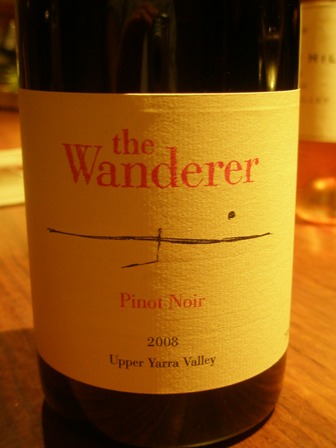
2008 Pinot Noir The Wanderer, Yarra Valley

My wine tip of the day is the Pinot Noir made by wine maker Andrew Marks of Gembrook Hills in the Yarra Valley. The wine is very light in colour with 13% alcohol and has a lot of cherries on the nose. It has some oak and is made from grapes grown from a single vineyard near Tarrawarra in the Yarra Valley.

I know that you have to be in Australia to get hold of this wine. But never mind, visiting Victoria is a bonus anyway. Have a nice Sunday, wherever you are.


Crazy bridges – how to destroy the Mosel

May 15, 2010

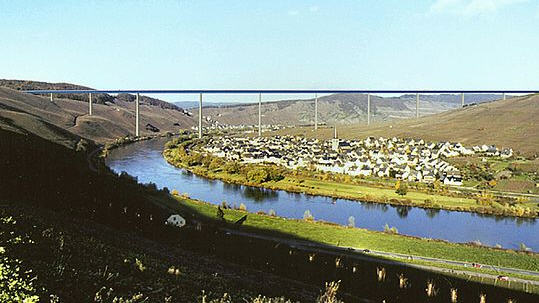
Planned bridge near Uerzig, Mosel

Two days ago the deadline for the petition ended. I confess that I did not make it in time. But I have joined the facebook group called “Stop the new B 50 and save the Mosel vineyards from devastating damage” opposing the building of this bridge.

The planned bridge is massive. It is about 160 meters high and 1.7 km long. It will probably cost about 270 million EURO which is equivalent to about US $ 400 million. On the facebook site above you can find more photos and animations showing you what the bridge will do to the Mosel valley.

The issue made it even into the New York Times which carried an article about it contrasting pro and contra views. Because the cost and benefits of such a massive undertaking are not clear cut. If you asked me to which camp I would belong, well, I asked myself two simple question: 1. would I give up my vineyard land for the venture? and 2. Would I like to look at this bridge from my window when I wake up in the morning?

My recent Australian experience with the North-South pipeline suggests that there is very little hope that such mega projects can be stopped by citizens protest. The Plug the Pipe campaign could not stop the project but it surely raised the political costs to Victorian the labour government. And election time is near.

Topher analyses the political economy of the North-South Pipeline. Unfortunately, there are no elections in my home state of Rheinland-Pfalz this year. So we are less lucky than the Victorians. The only thing which might save us is the empty state coffers.


Les Ormes de Cambras – Merlot from France

May 9, 2010

I grabbed the bottle from the supermarket shelve. Just like that. Again, I liked the label. This time a traditional one, with some trees, an alley. Later I learned that they were elm trees. I also liked the price, below 450 Bath (about 11 EURO) which is cheap for Thai conditions. That of course also meant that this wine was a “cheap” one, considered the many import duties and the exorbitantly high Thai alcohol taxes.

‘Les Ormes de Cambras Merlot’, the wine is called (2008 vintage). It’s alcohol content is quite low (12.5%), the colour is a beautiful dark red. Since we produce Merlot ourselves, I am often intrigued to buy other peoples Merlot to see what it is like.

The website of Les Ormes de Cambras told me that the Merlot could be had for 2.30 EURO/bottle in France if you also buy the three other wines produced by this enterprise (a Cabernet Sauvignon, a Sauvignon Blanc and a Cinsault).

2.3 versus 11 EURO for the bottle. I wonder how much the producer of the wine gets from this? What is his profit? 20 cents? 30 cents?

Since the website does not say anything about a vineyard, I assume this is a mass wine of industrial dimensions. But it tasted much nicer than expected. I might consider to get some more bottles.

‘2008 Les Ormes de Cambras Merlot’, Vin de pays d’Oc, France

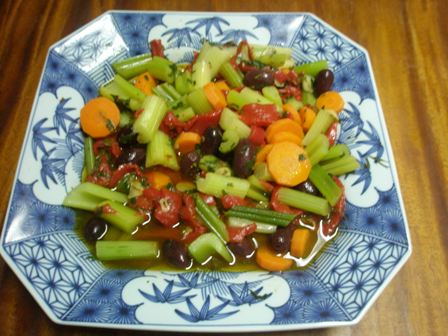
We always have food with our wine. It was a light dinner, just the celery salad with olives, carrots, peppers and garlic and some self-baked white bread. Delicious, and so healthy.

The Merlot was sufficiently well balanced, not heavy, a fruity almost elegant wine which went well with the salad.

A salad for dinner

The celery salad

By the way, Les Ormes de Cambras is located near the city of Béziers in Languedoc in the South-west of France.


Pierre Sparr Riesling, Alsace

May 8, 2010

Pomfret con alceitunas y alcaparras

We had fish for dinner. Following a Spanish recipe, we had “Bonito con Aceitunas y Alcaparras” (tuna with olives and capers) from the “Culinaria Spain – Spanish Specialities” cookery book by Koenemann, 1998, Cologne, which is a wonderful book. It has not only breathtaking recipes but great pictures, stories about the food and the people, the various regions of Spain and, of course on Spanish wines.

We deviated from the original recipe by replacing the tuna fillets by whole pomfret fish but used all the other ingredients for the preparation of the dish. Needless to say, it was delicious. The recipe worked also with pomfret, one of my favourite fishes here in Asia.

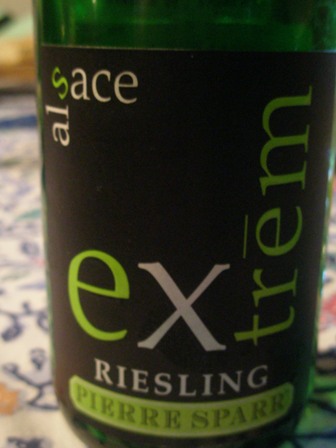
2008 Pierre Sparr Riesling, extreme, Alsace

I had no Spanish wine in my wine fridge, but a Riesling from Alsace which I had bought a couple of days earlier because of its funky modern label. Pierre Sparr is the name of the estate. The 2008 vintage Riesling is still young and exuberant, just the right stuff for pairing it with the strong taste of the olives and the capers. The acidity made all the difference.

Pierre Sparr Riesling extreme

2008 Pierre Sparr Riesling, extreme, Alsace

I tried to find the same label on the Pierre Sparr website but could not. It must have been a special label for the export market. Back home in Alsace the same wines have more traditional wine labels. The Sparr family winery goes back to 1680. Pierre Sparr is representing the ninth (!!!) generation of Sparr family wine-makers and vignerons. The winery is located in Sigolsheim at the heart of the Alsace region. The family owns and operates 34 ha under vines and contracts fruit from about another 150 ha, usually small growers.

I love this wine region and have visited many times, especially during my student days. Alsace has a outstanding gastronomy, spread over the most picturesque region, right at the foot of the Vosges mountains down to the Rhine river. Vines have been cultivated since Roman times.

Pierre Sparr offers a wide range of wines (and also grappa). I guess the wine we had belongs to the lowest quality segment which you can buy in France for about 8.25-9.50 EURO/bottle. I paid much more for it here in Bangkok. It displays rose petal aromas, citrus, peach and honey. The wine is sprizzy and has zest, a good structure and a long finish. Its’ perfectly made and will last for some more years (12% alc/vol).

I hope we have the chance to visit Alsace again this year. And meanwhile I look out for Pierre Sparr wines here in Bangkok.


And out they go: The exodus of vintners in Australia

April 29, 2010

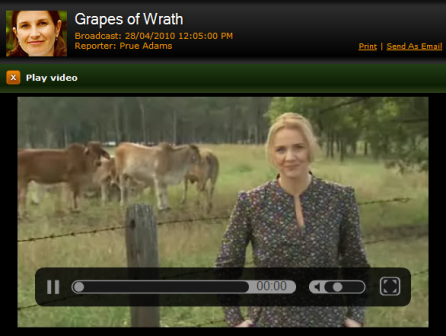
The recent ABC Landline report nicely summarizes the predicament of the Australian winegrowers. A$ 250 per tonne for your fruit is just not covering costs. Grape growing has no future, it seems. I find it quite shocking somehow. The documentary depicts the individual detiny in a very touching way.

Click on the link below and watch this very informative film.

ABC Landline