Vintage time: Schodener Herrenberg

October 6, 2009

Schoden1

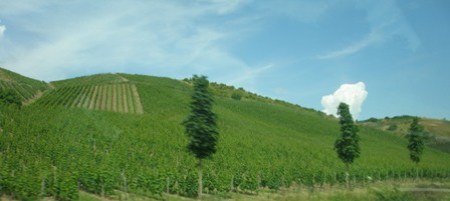
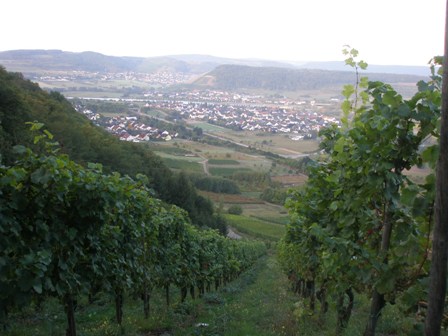
Schodener Herrenberg, in the background the village of Schioden with the Saar

One of my favourite places along the Saar river is Schoden, a small hamlet about 30 minutes southwest of Trier, my hometown. I visit regularly, because my friend Heinz together with some friends has rented the local hunting territory and when I visit Trier, we often go together on the hunt.

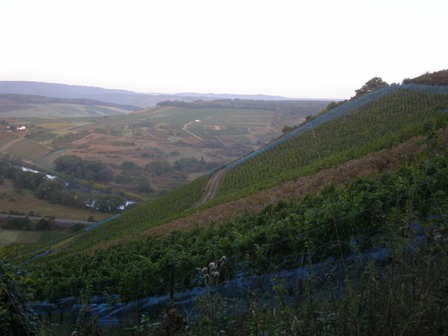
Schoden has also some vineyards and wineries. The location (terroir) “Herrenberg” is one of them. The vineyards are quite steep, which is difficult to depict in a photograph as you can see from the comparison of the two pictures above and below. It is realy a steep site, and the best location for producing Saar Riesling wines of superior quality.

Schoden2

Schodener Herrenberg: vineyards from the South

Schoden3

Schodener Herrenberg: the vineyards from below

Schoden4

A promising vintage?

Schoden5

Beautiful Riesling fruit

The fruit on the vines looked very healthy. In a couple of days or weeks, depending on the weather, the pickers will come to harvest. Needless to say that no machinery can be used, all the work will be done by hand. The vineyards workers will have to navigate the steep hills and balance on the slate pebbels which can be tricky when they are wet.

Needless to say that Schodener Herrenberg produces outstanding Riesling wines. Learn more about these Saar wines on my blog soon. Cheers


A Sunday at Bloody Hill

September 21, 2009

TimoM0

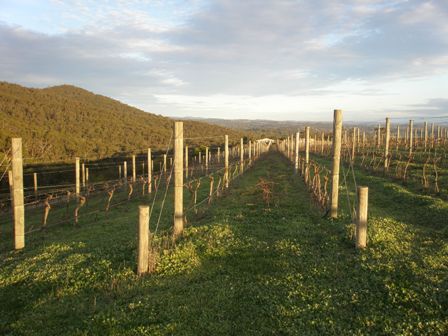
Great Yarra Valley views from the Mayer Vineyard (left to the dam)

On a beautiful Sunday in early August, we were in for a surprise visit to the Mayer’s. We bought some “nibblies” (Australian for cold meats, sausages, cheeses, condiments, etc.) and some wine in Healesville and drove up the steep drive to Bloody Hill on top of which their beautiful house (rammed earth) is situated. Alas, they were in and happy to welcome their unannounced intruders.
TimoM00

The vineyard at the crest of the hill is very neat

TimoM1

Some of the wines on “offer” (f.l.t.r.: a Silvaner from Franconia, Dr. Buerklin-Wolf, a Riesling from the Pfalz and a Dr. Mayer Pinot Noir from the Yarra Valley)

We came at the right time. A shipment of Riesling wine (about 60 cases) which Timo had made on a visit to Germany last year had just arrived and was ready for tasting. Moreover, as a member of the South Pack, Timo was in the preparation of a wine tasting tour to three Australian cities (Melbourne, Sydney and Brisbane). The South Pack is a group of eight innovative young Australian wine-makers who have raised the bar for the selling of premium and super-premium wines in sluggish markets.

TimoM3

The German Brotzeit

A quick “Brotzeit” was thrown up and the wine tasting could start. We did not drink in any kind of order but rather according to gusto and enthusiasm. First cap of the rank was the German Riesling Timo had made, Dr. Mayer Riesling of which I have no picture which speaks for itself. This was not a time for tasting notes but for joy and nourishment of body and soul, for Australian and Swabian story telling and song.

TimoM2

Bloody Hill Pinot Noir

Timo is a native of a small hamlet, called “Grossheppach” (about 4,500 inhabitants), today part of the small town called Weinstadt (translated: wine city) in the Rems valley (the Rems is a small river), Wuerttemberg, about 15 km east of Stuttgart. As everything in Germany, Grossheppach has a long history.

Grossheppach

Coat of arms of Grossheppach showing the river Rems and four grapes on a vine

Furthermore, the village has a long tradition of vine cultivation and wine making. Timo comes from a family of small vintners (and farmers).

In 1279 a historical deed is the earliest written testament of the flourishing wine production in Grossheppach. Magister Rudolf, a local doctor, had bequeathed his house in Esslingen and three vineyards in Grossheppach to the Abbey of Bebenhausen which was witnessed by knight ‘Fridericus miles de Heggebach’.

Timo showed as a historical chronicle of Grossheppach with black and white photos which also depicted his family in the 18th and 19th century. Here we are, thousands of kilometres away from the old land and talking grape production, wine traditions and wine styles. To cut a long story short, Timo had made his first ever Riesling wine in Grossheppach and shipped it for sale to Australia.

It was not the time for tasting notes, I guess. We opened one bottle after the next. First the Riesling wines, then Chardonnay and finally Pinot Noir and Shiraz, all Mayer Vineyard wines and Timo Mayer creations.

TimoM6

Mayer and Dr. Mayer Pinot Noir and a traditional German wine label with the coat of arms of Grossheppach

The Mayer Vineyard is only a small operation (2.5 ha under vines). All wines are hand crafted and from a single vineyard. Timo believes that wine is made in the vineyard, therefore there is minimal interference. The reds are unfined and unfiltered. Timo makes wines with a difference, with great character and individuality. As he says “he wants to bring back the funk”, and funky these drops are. James Halliday, “the wine pope of Australia”, has awarded his highest rating, a 5 stars, to the Mayer Vineyard.

The Dr. Mayer Pinot Noir is one of the newest creations from the masters hands; a great wine, elegant, whole bunch fermented if I am not mistaken. Timo assumed that all of it would be sold during the South Pack promotion tour together with the Riesling. By now there should be nothing left, I guess.

Needless to say that the day extended to the night and ended with a pasta feast for 9 hungry mouths.
TimoM5

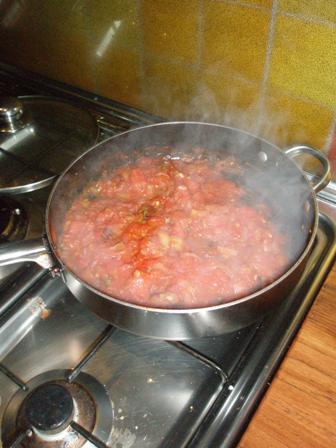
The pasta sauce in the making

TimoM4

TimoMM

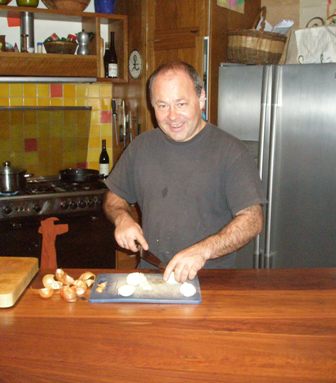
The magician at work, this time in the kitchen and not in the wine cellar

We had a great time. The children played all afternoon. We walked the vineyard and Timo showed me where he shot a deer. Then we went to get some of that venison for us to take home. The “Brotzeit” led to dinner and then it was time to drive home to our own vineyard in Glenburn. Good news is that Timo is planning to make Riesling again in 2009 and maybe the following years.

For sales and enquiries contact:
timomayer@bigpond.com.au

The following wines are for sale:
Bloody Hill Chardonnay
Bloody Hill Pinot Noir
Big Betty Shiraz
Mayer Close Planted Pinot Noir (also as the Dr. Mayer Pinot Noir)
German wine regions: the Nahe

September 17, 2009

Nahe2

The Nahe wine region has a great significance for me and my family. It was here that I got first into contact with vine cultivation and wine appreciation at a rather tender age.

Why you might ask? Were you not from Trier, Mosel?
Well, my maternal grandfather, Hans Heinrich Schüssler, a native of Reichenberg, a village near Würzburg, used to live in Martinstein. Being from Franconia, another famous German wine region, he was the only wine drinker in the immediate family (my father preferred beer). He used to be the station master in Martinstein (today 322 inhabitants), a hamlet along the left bank of the Nahe river. The village was founded in the middle ages at a ford crossing the Nahe river. In 1340 it got a castle and even market (city) rights.

My brother and I, we used to spend the long summer holidays (and many other holidays) at my grandparents house in Martinstein. My grandfather used to take us on long walks in the forest and villages nearby. During these walks we always found a country inn where we could refresh ourselves, enjoy a drink or a “Brotzeit” (a typical German snack). He would drink a “Schoppen” (0.25 litre glass) of the local Nahe wine. He loved dry white wines. We would have a lemonade.

He was associated with a “hiking brotherhood” (called “Hunsrückhöhenverein”) whose members would walk in large groups on weekends to various destinations. Usually a country inn was the designated object of the hikers. Here the group converged for a hearty meal and some drinks. Shortly after vintage, “Federweisser” (freshly made but still half-fermented wine) was a popular drink.

But boys being boys, we would sip at his glass from time to time. He being deeply involved in conversation with fellow hikers, did not notice. Neither did we. The sweetness of the fresh wine veiled its dangers. To cut a long story short, we had the experience of a first inebriation of our young lives and could hardly walk strait on our long way home.

After my grandfathers retirement he moved out of the train station into a newly built home right in the middle of vineyards at the outskirts of the village towards the east. Vineyards stretched right to the door. Just a short walk up the hill and endless vineyards lay at your footsteps. Occasionally we would help during vintage time (more play than serious helping). But we would often taste fully ripened grapes and enjoy the fruit. I treasure these wonderful memories of my youth at my grandfathers house in Martinstein.

Map Nahe wine region

The Nahe wine region (photo source: wikipedia)

As you can see from the above map, the Nahe wine region stretches from Martinstein to the West along the river eastward, later north towards the estuary at Bingen where it flows into the Rhine river. The largest city in the region is Bad Kreuznach, a small town of about 45,000 inhabitants.

Nahe1

With about 4,200 ha under vines, the Nahe region is one of the smaller wine growing areas in Germany. It is still larger than, for instance the Yarra Valley in Victoria (with about 3,800 ha, about 2% of Australia’s total). The Nahe region is dominated by white grape varieties (about 74% of the total area under vines). The main variety is Riesling (26%) followed by Mueller-Thurgau (14%) and Dornfelder (13%).

Fifty years ago the variety distribution was very different. Silvaner used to be the most planted variety with about 50% of the total area but has ever since been replaced by the Burgundy varieties (Pinot White, Gris and Noir) as well as by Riesling, Dornfelder, Blauer Portugieser and Müller-Thurgau plantings.

The Nahe is divided into seven collective sites (Grosslagen) and 328 individual sites (Einzellagen). Due to its volcanic origins, the soils of the nahe show a great diversity. The wines reflect this. Only in 1971, the German wine law defined the nahe region. before that time, its wines were sold as “Rhine wines”. However, some of the best Riesling wines of germany originate from the Nahe and today Nahe wine can rival the best from Mosel and Rheingau or any other German wine region.

Nahe3

The Nahe can be divided into the upper (west) and lower (north-east) Nahe and the region around Bad Kreuznach. In Martinstein and the neighbouring village of Monzingen (first mentioned in 778) the oldest vineyards of the Upper Nahe are to be found. The soils of the Nahe range from sandstone to quartzite and slate. The region shows a temperate climate and some of the southern slopes enjoy a micro climate comparable to the Mediterranean. Elevations range from 100 to 300 meters altitude.

Nahe4

Who are the top producers of the Nahe wine region?

Well, the name Herrmann Doenhoff comes to mind. He is the leading vintner of the Nahe and his wines are ranked among the top Rieslings in Germany. Herrmann Dönnhoff has about 20 ha under vines and produces about 140,000 bottles a year. His winery is located in Oberhausen/Nahe. The 2007 vintage produced outstanding wines; the 2008 Riesling wines did not quite reach that quality level during recent tastings. But his ‘2008 Niederhäuser Hermannshöhle Riesling Gran Cru’ earned 93 Parker points.

Other top producers are Emrich-Schönleber in Monzingen (about 15 ha under vines, yearly production about 110,000 bottles), Schlossgut Diel (17.5 ha and 120,000 bottles) in Rümmelsheim and Schäfer-Fröhlich (14 ha under vines and 75,000 bottles annually) in Bockenau.

Wines and vintners I like very much are Sascha Montigny in Laubenheim and Weingut Edelberg at Gonratherhof 3 in Weiler just on the other side of Martinstein. The former I like because of the high quality of his red wines, especially the 2006 vintage; the latter produces solid country wines which remind me of my youth in Martinstein and the long hikes with my grandfather. The country inn at Gonratherhof was often our destination when the three of us set out from our little house in the vineyards.


Reichsrat von Buhl: ‘2007 Forster Ungeheuer Grand Cru dry Riesling’

August 31, 2009

UngeheuerGG1

Embossed on the bottle the sign for ‘Grosses Gewaechs’

I had not had a Grand Cru (or as the Germans say: Grosses Gewaechs) wine for a while. Fortunately, I had participated in a wine quiz of the German wine magazine “Weinwelt” some time ago and won a bottle of Riesling. Not any Riesling, it turned out, but a ‘2007 GG Forster Ungeheuer dry Riesling’ produced by Reichrat von Buhl, Pfalz.

I was completely taken aback when my mother handed me the packet. I could not believe my luck: first time participate, first time win a price. I carried my treasure back to Bangkok and stored it carefully for a special occasion.

UngeheuerGG2

The freshly opened bottle

The occasion came faster than expected. Although the cellaring potential of this wine is 12 to 18 years (!), it only lasted a couple of months in my care. Sunday family lunch was just the right time and place for a treat.

UngeheuerGG3

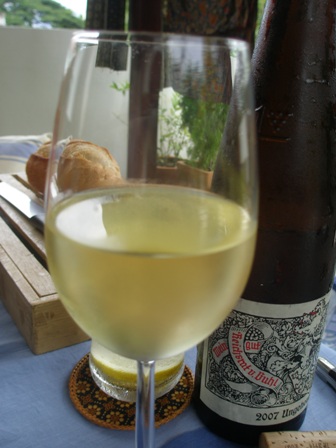
A beautiful straw colour in the glass

This is a beautiful wine, powerful, complex and dense, with citrus and mineral characters. It did not overpower the food, though it could just stand on its own, enjoyed just as a glass of wine. The peccorino Sardo on the fish was the right match for the dry Riesling (12.6%).

UngeheuerGG4

Flounder with Peccorino Sardo

UngeheuerGG5

The salad

Needless to say, one bottle was not enough. That’s why I recommend if you have the opportunity stock up on this noble drop, buy a crate, a dozen or whatever, in any case more than one bottle. The whole Sunday the taste lingered on my palate and could not be deleted from my mind.

Reichsrat von Buhl has a long tradition of excellence, family-owned since more than 150 years, it was leased in 1989 to an operating company owned by two Japanese businessmen. I found this fact quite remarkable, I must say. Another remarkable fact is that it was also owned for some time by the family of the grandfather of the current German Economics Minister, Dr. Karl-Theodor Freiher zu Guttenberg.

The commitment to excellence, however, has remained the same or is even stronger than ever, I guess.

Address:
ReichsratvonBuhl
Source: from the website www.reichsrat-von-buhl.de/english/kontakt.htm


A new tractor for Two Hills Vineyard

August 26, 2009

During our family vacation, we were also looking for a new tractor. Our old FIAT tractor had broken down some time ago. We were searching the internet for a while for a used tractor but we were either too late or the right machine did not come up.

Therefore, we looked for new equipment. First we had our eyes on a Kubota from Japan but then fellow vintners suggested to have a look at a Korean brand: Daedong. I had never heard of Daedong before. At Rees Miller Estate we had the opportunity to inspect a one-year old 55 hp Daedong cabin tractor with a frontloader.

We asked for a couple of quotation, and to cut a long story short, decided to go with the Korean Daedong. The photos below show the vineyard tractor with 55 hp plus frontloader.

Daedong2

Daedong1

Until it is beeing delivered, we have to sort out the finances but I am confident that we will get our Daedong tractor so that I can work with it during our next visit.


The South Pack: Young Australian winemakers on a mission

August 15, 2009

The wine glut in Australia makes wine marketing a true challenge. Many vignerons and wineries have to knock on endless doors of wine outlets, restaurants and retail shops. You get sick of it. Among others, that’s one of the reaosns why eight young independent winemakers from Victoria have created “their own thing”. They call themselves “The South Pack”.

SouthPack1

Three years ago they started their own roadshow to Melbourne and Sydney. Instead of going out and selling wine, they decided that people should come to them. They look for a suitable location, a restaurant, a hotel or any other suitable facility and invite the top trades and restaurant people to come for a tasting: meet the maker and his wines. Usually it’s accompanyied by food and music and great fun.

SouthPack2web

The eight young winemakers (actually they are nine people) knew each other through the wine business and are friends and mates. This year the roadshow will be conducted for the third time. Last year, also Brisbane was included. Attendence is by invitation only but numbers at the shows have multiplied every year. This year will be no different. There is a great interest to meet the originators, the magicans, the winemakers and have them talk about their products: hand carfted artisan fine wines of ourstanding qualities. These wines are not like the industrial liquids, technically well made wines but a bit ordinary, normal, faceless.

SouthPack3

Meet the unusual. I only know one of the eight personally, Timo Mayer, a longtime friend. Timo is the winemaker of Gembrook Hills in the Yarra Valley and has his own vineyard and label. He made our award winning ‘2002 Two Hills Sauvignon Blanc’. He told me all about South Pack. I was exited to learn about this initiative and its immediate success.

Even if you have not been invited, just pick up some of their wines. Most of them you can buy online. Here is where to find and contact them:

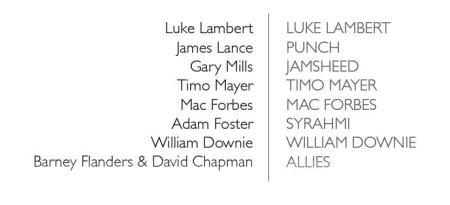
Luke Lambert: mainly Syrah from St. Andrews, Yarra Valley and Nebbiolo from Heathcote.
www.lukelambertwines.com.au

James Lance – Punch: The winery in the Yarra Valley was severely affected by the bushfires, produces Chardonnay, Pinot Noir and Cabernet Sauvignon
www.punched.com.au

Gary Mills – Jamsheed (named after a famous Persian king): Shiraz and Gewuerztraminer
www.jamsheed.com.au

Timo Mayer: Bloddy Hill he calls his vineyard on the top of a windy peak overlooking the Yarra Valley, most of his 2.5 ha are under Pinot Noir, some Chardonnay and some Shiraz
www.timomayer.com.au

Mac Forbes: wines come from the Yarra Valley (lots of Pinot Noir and Chardonnay) but also the Strathboogie Ranges (Riesling). The so called “alternative wines” are made from fruit from other wine regions in Victoria. Here you’ll find varieties such as Barbera, Gruener Veltliner, and Blaufraenkisch
www.macforbes.com.au

Adam Foster -Syrahmi: another winery from Heathcote with beautiful Shiraz wines
I could only find references ot his wines but not a proper website.

William Downie: solely Pinot Noir wines are made by William, the fruit comes from the yarra Valley, Mornington Peninsula and Gippsland
www.williamdownie.com.au

Barney Flanders and David Chapman – Allies: Allies is a collaboration between Barney and David. They produce a variety of wines (one label is called “Garagiste”, implying garage wines of made of excellent fruit; there must be a lot of French influence!?). Their Pinot and Chardonnay wines come from the Mornington Peninsula, the Shiraz comes from Heathcote (no surprise).
www.allies.com.au


On the farm

July 31, 2009

K1

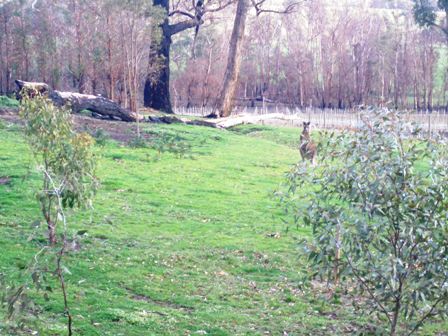
Morning visitor: a kangaroo

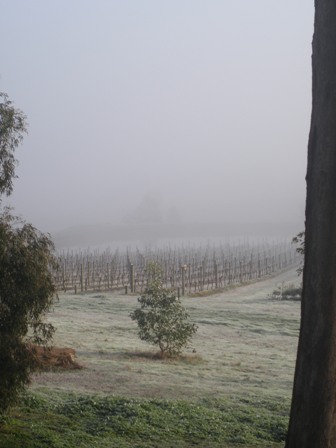
Life on the farm is just wonderful. Mornings are misty, sometimes cold with frost. Groups of kangaroos graze on our paddocks and come very closed to our house. The little joeys following their mothers.

It is so quiet, the air so clean. Winter in Victoria is like an Irish summer. Everything is green which nurtures the illusion that everything is fine. It is not. We are in the middle of a draught.

K2

Our dams are at their lowest ever

Finally, we got a reasonable amount of rain. Last night according to the rain gauge we got 10 mm, the most since early July. The other times it was between 2 and 3 mm, and once we had 7.5 mm. Fact is that the draught is still on. The soil is dry. You just need to dig, and you will know.

K3

Wombat wholes are big

I am still busy chasing the Wombat from his home which it made in one of our dam walls. Not a good idea. Every day I carry some rock down and fill in the whole. It has to go. The beast will dig until it gets through. Then of course it is going to be flushed out but I will have lost a dam.

We applied organic fertilizers to the Sauvignon Blanc and the Pinot Noir. 10 more rows need to be done but because of the rain yesterday, we had to stop. The wire dropping is finished too.

I plan to roll up the barbed wires of my burned out windbreak. The second windbreak has its fence almost intact. Many trees, all local varieties, look dead. Only the larger gums seem to have survived. I have given up on the windbreak near the house but plan to replant the one on our second hill. Also our little wood needs replanting. I will have to wait a bit longer for the assessment of what has survived.

The weekend, my last one for this visit, will be full as usual with socialising, and wine drinking. Heaven on a stick, paradise pure.


The good life – country living in Glenburn

July 25, 2009

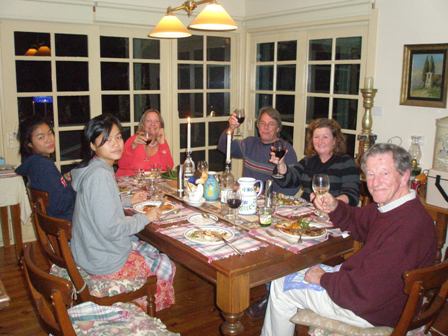
We are having such a wonderful time in Glenburn, on our small vineyard cum farm. One of the highlights are the meals with friends and family. Ken Mountain, our neighbour and friend (we bought our land from him 15 years ago) invited us and Michael and Helen for a country dinner in his Adjinbilly home in Glenburn, just a stone through from Two Hills Vineyard.

CountryMeals1

vltr.: Lucy, Charlotte, Margit, Michael, Helen and Ken

We had a wonderful time and great food. Winter is ideal for any kind of roasts. In this case it was lamb and the “usual” vegetables: potatoes, parsnips, broccoli, carrots and onions. The fireplace provided warmth and heat, and the cosy atmosphere of a country home.

CountryMeals3

Ken does not drink red wines, only whites. So he had Giessen Sauvignon Blanc. For us, he choose a Shiraz. Ken selected a ‘2006 Mount Langi Ghiran Billi Billi Shiraz’. This is a beautiful wine, with fine tannins, lots of fruit (mainly blackberry) and a spicy character.

The Mount Langi Ghiran Shiraz was a great choice and it went very well with the hearty country food, Ken had cooked for us.

CountryMeals2

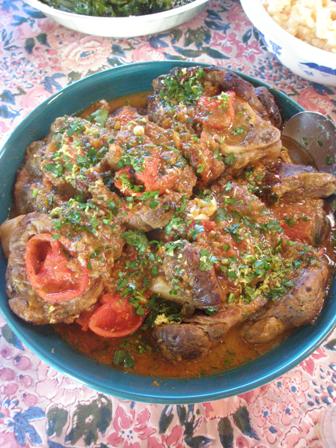
The next day we had Brett, Eve and Shea for lunch up the vineyard. Michael and Helen were also there. Family complete, so to say. Margit had cooked ‘Ossobucco’. The recipe came from Francine Segan’s book “Opera Lover’s Cookbook”, which is a magnificent book.

CountryMeals4

The dinner table is set and various “anitpasti” are ready for consumption

CountryMeals5

Shea, Eve, Brett, Margit and Michael

CountryMeals6

The ‘ossobucco’

CountryMeals7

Also dessert was provided: chocolate mousse, strawberries and cream

The entrées were consumed with a ‘2007 Windy Peak Cabernet Rosé’ by De Bortoli, a ‘2005 Murrindindi Family Reserve Chardonnay’, and a ‘2007 Allira Sauvignon Blanc’ by Elgo Estate Winery (they are not yet members of our Upper Goulburn Winegrowers Association).

This time we drank with the main course various vintages of Two Hills Vineyard Merlot wines and a bottle of Brett’s home made Cabernet Sauvignon. The lunch lasted until about 10 p.m. (nobody wanted to go home) and I did not count the bottles consumed, but for sure we all loved the company, the atmosphere and of course the Two Hills wines.

Recipe
The recipe for the “Ossobucco” can be found on page 105 of Francine Segan’s “Opera Lover’s Cookbook”. You need the following ingredients:

– 4 to 6 (or more) bone-in veal shanks (about 3-4 cm thick)
– salt and freshly milled black pepper, two bay leaves
– all purpose flour
– 2-3 tablespoons extra-virgin olive oil
– 2 small carrots, one stalk of celery and one large onion, all finely minced
– garlic (as much as you like but a minimum of 5, also finely minced)
– marjoram, either dried or fresh
– 1/4 cup of white wine
– 3/4 cup best-quality beef stock
– 8-9 tomatoes, peeled and halved
– lemon juice
– one or two anchovy fillets, finely mashed
– fresh rosemary leaves

The oven should be pre-heated to 180 degrees Celsius. The shanks should dreadged in flour and seasoned with salt and pepper. Sear the shanks in a casserole with medium heat filled with olive oil until browned. Remove them after 2 to 3 minutes and let them rest. Then prepare the sauce.

Add the minced vegetables to the above casserole and cook them in medium heat for about 6 minutes until tender. Add the garlic, and the other herbs for about one minute. Then add the wine and simmer for a couple of minutes. Now you add the stock and bring it to a boil, then remove it from the fire.

Put the shanks in a large casserole in one layer, top with the sauce and the tomatoes, cover and bake. After about 2 hours you add some more tomatoes and cook for another 30 minutes. Turn the shanks during the cooking regularly after about 30 minutes. You can serve rice or potatoes with the beef shanks as well as green vegetables. It’s a great traditional Milanese dish. What a wonderful hearty-rustic dish this is. Enjoy


Impressions from Two Hills Vineyard

July 24, 2009

THVwinter0902

The vineyard this morning covered in frost

We had the coldest night so far here on the vineyard. The land was and still is covered in white frost this morning. The sun tries to get through. It will take a while.

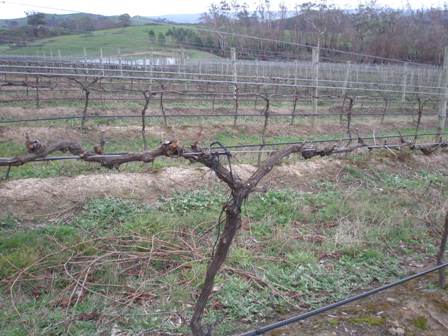
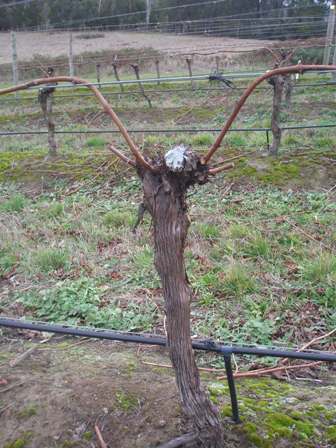
But the vines are pruned, so most of the important winter work has been completed.

THVwinter0903

Two Hills Pinot Noir spur pruned

THVwinter0904

Two Hills Sauvignon Blanc cane pruned

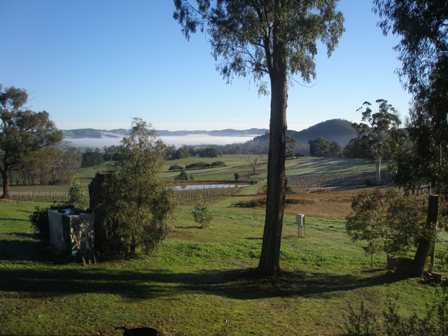
We hope that the sun will come through later today and look forward to a panorama like the one below. Fingers crossed.

THVwinter0901

Splendid winter days at Two Hills

The weekend promises to keep us busy with all kinds of social events. Should anybody say that rural live is dull and boring. Cheers


Night sky over the vineyard

July 21, 2009

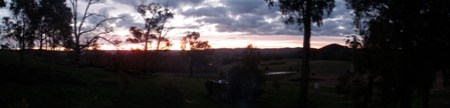
Nightfall

Some of the last evenings at Two Hills Vineyard were just stunning.

Today we had the warmest July day in 15 years.

The earth is very dry. I look forward to lots of rain.

Needless to say, we are having a great time.