Roman Villa Urbana in Longuich, Mosel

August 27, 2012

Vineyards near Longuich – Opposite the steep slopes of the Mosel

The cultivation of grapes along the Mosel river and its tributaries Saar and Ruwer is more than 2,000 years old. For the Romans wine was an important commodity. All along the Mosel river one can find traces of the Roman wine industry, among them wine presses and fermentation tanks, vineyard implements, residues of grapes, statues of gods and godesses etc.

Among the treasures are the ruins and foundations of many Roman rural villas. One of them can be found in Longuich-Kirsch, just a few kilometers downstream from my hometown Trier. Various types of these villas can be distinguished. Some of them contain large mosaics as the villa in Nennig.

The villa in Longuich is a “villa urbana”, the seat of a retired high official. It is very large (110 x 28 meters). It was built in the 2nd century after Christ and includes an extensive Roman bath consisting of a Caldarium (hot bath), Tepidarium (warm bath), Sudatorium (sauna), Frigidarium (cold bath) and Praefurnium (fire and heating system).

The foundations of the villa were accidentally discovered during land consolidation and reconstruction work in 1984. Next to the villa some agricultural buildings we found as well.

The villa urbana was restored and is today open to the public. Various billboards inform the casual visitor about various aspects of roman life including the two thousand years of grape and wine production.

Imagine that so long ago people were working in vineyards and wineries in the very same places where also todays wine is produced. Amazing. The work was even harder than today, I guess.

The production techniques of the Romans are well researched. The billbords explain todays challenges and how they were mastered recently. I loved the way ancient history was linked to contemporary modern life. I highly recommend visiting these villas. The view over the valley and its vineyards is another great experience.

Fortunately, the vineyards in the vicinity of the villa are still productive, and many wineries and vintners are happy to welcome visitors and introduce them to their excellent Riesling wines.


The beers of Belgium

June 9, 2012

After a recent business trip to Brussels, I had the chance to visit the old trading city of Antwerp, the capital of the province of Flanders, just about 45 minutes away from the Belgian capital.

It was a rainy day with some sunny parts. I made the best of it. The city on the right hand side of the river Scheldt has a long history and one of the largest seaports in Europe. The old guild houses in the centre are just a marvel.

Mosselhui 1888

But I will have to come back to have lunch in one of the “Mousselhuis”, and eat mussels. The place above was so inviting. It made my mouth watering. Unfortunately, I did not have sufficient time. Well, such is life.

Belgium is among others famous for its beer.

The many beers of Belgium

Here of course Germans have their problems. Everything not brewed according to their “Reinheitsgebot” – according to German purity standards only hops, malt and water are allowed in the brew – cannot be called beer.

But here we are in Belgium, right, so other rules apply. The labels promising cherries and other fruit in the beer are not very inviting to my taste. However, I had quite a few nice beers during my short stay.

The best was maybe the dark Trappiste beer (10.2 % alc.) which was offered to me by my friends parents. It came from a bottle without a label, only a rim which had the name of the monastic order engraved. I found out later that this beer comes from the Westvleteren Brewery.

Hmm, very delicious stuff.


The little French thing with Spanish wine

May 29, 2012

9.69 EURO worth of food and wine

When I arrived yesterday morning here in Brussels I found myself caught out. It was a public holiday (Pentecost Monday) and everything seemed to be closed.

It was a beautiful sunny and warm day and I walked around a bit and explored the area around the hotel. Lots of tourist were doing the same thing. Fortunately, I found an open Carrefour express so that I could buy some groceries.

I was reminded of my glorious day as a student, and in reminiscing about the past, I bought some cheese, bread and red wine. Today, I know of course that red wine is not necessarily the best accompaniment with cheese. But I bought it nonetheless.

Normally, I always pack my Swiss army wife but this time I had left it behind in Bangkok. I knew this while browsing through the supermarket shelf with all the many wine bottles.

And that was the main reason why I settled for the bottle of Tempranillo: it had a screw cap, whereas most other bottles had a cork enclosure. I only paid 5.99 EURO for it which is cheap considering wine prices in Thailand.

2010 Tempranillo – REALCE by Union Campesina Iniestense

By sheer coincidence, I had found a treasure. This wine comes from the relatively new and unknown wine region of Manchuela which is located in the larger La Mancha wine region.

So it’s a Don Quixote wine, one could say.

One of the Spanish indigenous grape varieties grown in Manchuela is Bobal, a red grape, which comes originally from Valencia and is the third most planted variety in Spain (after Airén and Tempranillo).

If you want to learn more about the wines from Manchuela have a look at the video clip by Simon Woods.

Manchuela got its appellation status only in 2000. Of course vintners have grown grapes there since Roman times.

I was very happy.

It has intense red berry aromas, beautifully structured tannins, great resilience and character just like the old Don Quixote. I sipped along after I had finished my frugal peasant meal.

When I saw that the wine was made by a wine cooperative, the Union Campesina Intestense, I thought I have to find out more. Today the vintners cooperative has more than 1200 members and about 7,000 ha under vines. So this is a big undertaking.

The Tempranillo I had bought is one of their simpler wines. The reserva wines they produce cost more than 30.- EURO. Most of their wines are around 10 EURO/bottle.


Grand Khaan in Ulaan Baatar, Mongolia

May 25, 2012

Grand Khaan front with the terrace

My favourite watering whole in Ulaan Baatar is the Grand Khaan Irish Pub. I love the place where half of the city seems to congregate. The end of May has chilly nights (still with minus temperatures) but glorious days with up to 25-28 Celsius.

It was exactly such a day, almost summer for the Mongolians. Many men were already in short sleeves and the women in summer dresses. I love to watch the stylish young Mongols dressed up for a Friday night out.

The days are already long, and the work to put up the structure for the summer tent in the parking lot in front of the pub was in full swing when I got there.

Busy at work

I was by myself and was seated at a small table inside. I felt a bit chilly, I admit. Coming from the tropics does not help. Many customers sat outside. I could not bring myself to that.

My beef burger

I was craving for a burger and a Chinggis beer which I ordered after a short glance at the menu. Boy I was hungry. The burger was big and solid with Mongolian beef. The side salad is more decoration, but the fries are good.

Ghinggis beer

I cannot bring myself to have a glass of wine with a burger. The Chinggis beer was just right to quench my thirst.

A pub is not a place for fine wines. However, I decided to ordered a glass of red as dessert so to say. There were quite a few wines on the menu. I settled for a French Syrah.

I will not reveal what it was. I choose one of the priciest ones though. It was what we call in Australia an “umpf” wine, big and heavy with lots of alcohol. I guess that’s what pub goers expect from a red.

I had a great time watching the coming and going of the people. Friday night is a busy time. I “cleared my brain”, the pub acted as a cleansing ale so to speak after a busy and eventful week here in Ulaan Baatar. It was my last evening and I am sad to leave. I just love Mongolia and its people.

I highly recommend to visit the place. It’s great fun.


Restaurant review: Weintor, Palatinate, Germany

May 12, 2012

My parents in front of the German “Weintor”

My parents came to see me when I was in Karlsruhe for a business meeting a couple of weeks ago. They took me for a drive around the southern Pfalz region, which is a major wine producing area in Germany.

It was a beautiful day in spring with mild temperatures and fast moving clouds. After a short rain, the sun came out for a while.

We ended up at a small village called Schweigen-Rechtenbach to have a look at the German “Weintor”, literally translated as the “German wine gate”.

It was built in 1936 and marks the starts of the German wine route which ends in about 85 km further north in a village called Bockenheim.

The terrace

We planned to have lunch in the restaurant at the “Weintor”. The large terrace was very inviting but it was still too cold to sit outside.

The foyer

The stone building looks very traditional from the outside. However, the foyer of the restaurant has a kind of post-modern funky look, “retro” one could also call it.

The entrance to the restaurant

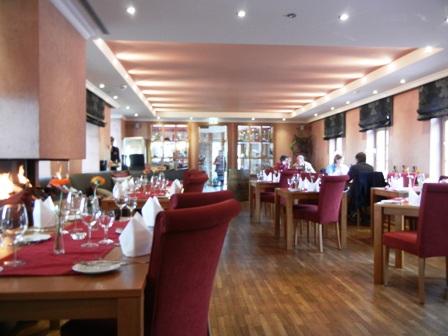
The inside of the restaurant

We sat near the fire place. The staff was very friendly, and convinced us to get started with a sparkling Pinot Meunier, or in German “Schwarzriesling”.

Sparkling Schwarzriesling – Pinot Meunier

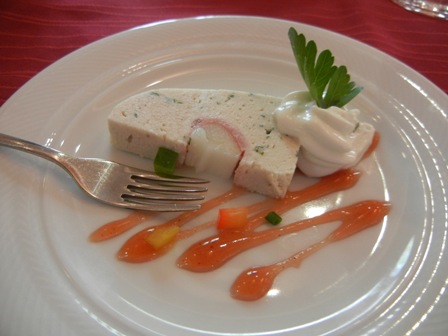
This was followed by “greetings from the cook”: a delicious pate, which was just the right starter. It wetted our appetite.

Courtesy of the cook

I could not resist and ordered the house Riesling, a dry wine from the Pfalz region.

Dry Riesling from the Pfalz

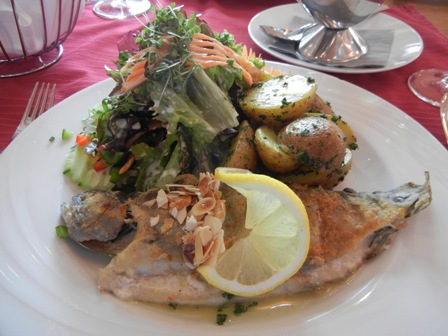
My main dish was a trout with almonds, with potatoes and salad. Just wonderfully delicious. It was the right hearty meal which made me forget my jet-lag. I had arrived the very same morning from Bangkok and needed some stimulation to stay awake. That’s why I could not resist the ice cream either.

Trout with almonds

Dessert

Espresso

We had a jolly good time. The food was delicious, the staff extremely friendly, the spring outside inspiring and the company just great. I could not imagine a better welcome to Germany.

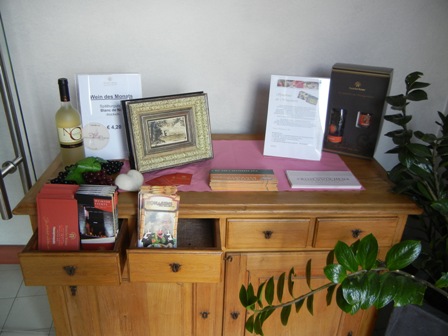
On our way out, I noticed the table with the informations about wine events and other local festivities. It was a pity that I could not stay a couple of days longer. The wine route through the Pfalz/Palatinate has so much to offer.

Address:
Deutsches Weintor Restaurant
Weinstraße 4
D-76889 Schweigen-Rechtenbach
T +49 (0) 6342 – 922 788 8
F +49 (0) 6342 – 922 788 9
www.weintor.de/restaurant.html


Wissembourg, jewel of northern Alsace

May 10, 2012

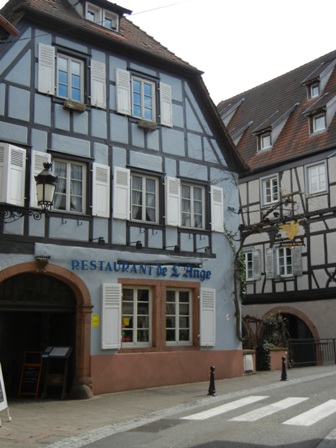
Half-timbered houses in Wissembourg opposite the cathedral of St Pierre and Paul

One of the loveliest little towns in northern Alsace is Wissembourg. During my recent visit to the Palatinate (Pfalz), the German wine region just north of Alsace, we did a side trip to see this picturesque place.

We had come after lunch just to have a little walk around town. It was a pleasant spring day with mild temperatures and some sunshine although heavy rain clowds graced the sky.

Wissembourg has about 8,000 inhabitents and was the location of various battles fought in the French revolutionary wars in 1793 between French and Austrian, Prussian, Bavarian, Hessian and other German forces. After the second battle of Wissembourg, France was able to take over the whole of Alsace. In 1870 the tables were turned. This time the Prussian forces won and made their way to Paris.

I remember that during my student days at Bonn University I once attended a play by a theatre group from Alsace. The play depicted the history of the region and how it moved from being indpendent to becoming a part of France and Germany, but that the people remained the same.

The following pictures will give you a rough idea about Wissembourg, but I suggest you go and see for yourself, stay a couple of days to also indulge in the food and wines of Alsace.
Another well preserved half-timbered house

About twenty years ago when I came to Wissembourg for the first time with my wife Margit, we almost bought a half-timbered house. We were so enchanted by these houses, that we almost could not resist to invest in such a house. They were not expensive at the time, 80-90.000 Deutschmark only. Since my brother lived and worked jsut a little north of France in southern Palatinate, we thought he and his family could live in the house. But it did not work out and we discarded the idea.

The stream crossing the town is called the “Lauter”

I would have loved to enter this restaurant but we just came from lunch

Medieval music was presented by these two bards

“Winstub” is what the sign says in the local dialect. It means wine bar

The wine bar wedged between two houses

Spring invites everybody to buy fresh flowers

Various types of bread and cake were on offer

Wine for sale

Of course wine was everywhere. I did not buy any since I had to travel and drag my suitcae around. And wine is, unfortunately, very heavy.

But I will come back to Wissembourg, that’s for sure. Maybe next July when I spend some time in my home town Trier. Not far from Wissembourg is my favourite restaurant, “Auberge du Cheval Blanc” in Lembach in the Vosges mountains.

Spring blossoms all over the place


My first whisky tasting (single malts only)

May 7, 2012

The evening program with the first single malt

The Goethe Institute in Bangkok invited me to an interesting new format: “a literary whisky tasting”, which I admit I could not resist. About 20 selected invitees followed the invitation and had assembled in the Institutes library for this innovative event.

Mr Johannes Scherer from the German stock exchange association of the German book traders (Boersenverein des deutschen Buchhandels) who was in Bangkok for the German photo-book price award exhibition, was the presenter.

Johannes Scherer

He read five short stories in German from a collection of stories about whisky. For the ones of you who read German, I write them down in chronological order:

– Elke Schleich: Begegnung mit Whisky
– Markus Niebios: Der perfekte Augenblick
– Reinhart Hummel: Miese Zeiten
– Angelika Brox: Teufelszeug
– Fenna Williams: Goldenes Versprechen

They all came from a book titled “Aqua Vitae – a literary whisky tasting”.

The sequence was as follows: First the art (production process etc.) of making single malts was explained. Then the story was red to us. And finally the specific single malt, his history, the making, and the tasting notes were presented. We tasted the single malts together, and exchanged the experience. Questions could be asked, comments shared. Often the specific whisky was part of the short story.

A slide from the presentation

The five single malts were:

– Lowlands – Auchentoshan 10 years old

– Highlands – Dalmore 12 years old

– Speyside – Craggenmore 12 years old

– Isle of Skye – Talisker 10 years old

– Islay – Caol Ila 12 years old

I had drunk the last three before (especially Caol Ila). Dalmore I had heard of, and Auchentoshan was completely new to me.

We moved from a no-peat content (the first three) to a higher peat content (the last two) so to say. Lots of interesting information about the history of the production of single malts was imparted on us. I loved the tasting notes, I must say – maybe because they reminded me of fine wines?

I usually prefer the malts with peat aromas. However, this tasting brought the more subtle ones closer to my heart.

The five single malts we tasted in the library

Conclusions
This was a great evening. I loved the wonderful atmosphere and the playfulness in the exploration of new “taste territories”. I also enjoyed the stories, some of them funny, some sad, others sombre but always with the bit of wit, some detachment, which allowed them to touch the heart.

Thank you Dr. Spitz for inviting me.

I am contemplating to copy the format and to set something up on “liberalism and the art of drinking whisky and/or wine”.

PS: It turned out that Mr Scherer was a wine connoisseur with a large knowledge about fine wines and an even larger wine cellar.


Culture, food and music in Shanghai, China

April 15, 2012

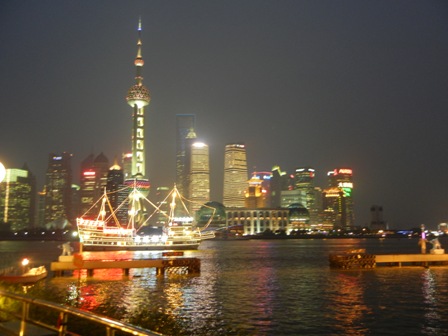
Pudong skyline at night

I used my recent business trip to Shanghai, China to also indulge in some cultural activities. First, I participated in a new program of “Shanghai Flaneur”, a walking think-tank founded by one of my friends, Katja Hellkoetter.

The topic of this newly designed walk was “Shanghai’s historical ballrooms and it’s ballroom culture”. Katja had invited me to join and get an idea what her Shanghai Flaneur initiative was all about.

But before I take you any further, let us start with a re-union dinner on the river-terrace of The Seagull on the Bund Hotel – 海鸥饭店. From here, one has a wonderful view of the river, the Pudong skyline and the Bund. The hotel is in a perfect spot, at the confluence of the Suzhou and the Hungpu river.

View of the Bund from the Seagull Hotel

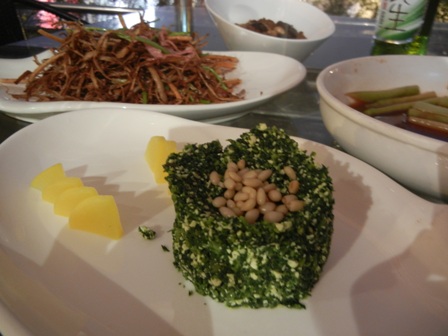
Re-union dinners are never perfect as far as the quality of the photo extraction is concerned. In fact I show you only three of the many dishes the two of us consumed. The first is a composition of doufu with leach and pine nuts, the second is shredded mushrooms with dried pork strips, and the third a puff-rice filled with various colourful vegetables and shrimps. These dishes did not only look good, they were super-delicious.

The doufu with pine nuts

Dried pork and mushrooms

The “veggie rolls”

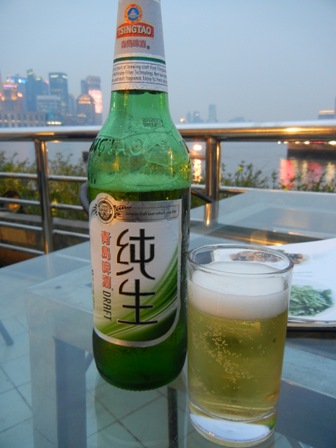
Needless to say, we drank beer with the meal.

The Tsingtao beer

Unfortunately, it started to rain and we had to look for shelter. This did not bode well for the walk later that evening which was about to start in the Astor Hotel nearby.

I will not give you an account of the walk proper, just of its beginning and the end. The walk was conducted by Andrew Field, a university teacher of Chinese history.

From the Astor Hotel we walked along the Bund (fortunately, some of the participants had brought umbrellas otherwise I would have been drenched). And we ended the very interesting and entertaining culture-walk about two hours later at The House of Blues and Jazz.

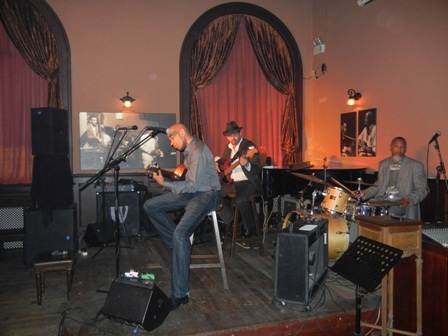
The House of Blues and Jazz is a great place. that very night the Greg Lattrell Band from Boston, USA played blues and soul music, what a treat.

The Greg Lattrell Band

I just loved the music, especially the blues pieces they played, and stayed until the very end. This was a perfect day, re-union dinner with Katja at the banks of the Huangpu river, the walk with the Shanghai Flaneur along the Bund, and the blues music of Greg and his band.

Come and see, feel and experience Shanghai, the Paris of the Far East.


One of these days – food by phone

April 9, 2012

During the holidays there is always the odd day out where nobody wants to cook and/or prepare a meal but people are still hungry. The natural solution to such a challenge is: yes, right – food by phone.

We all know it, we all experienced it. Here in Bangkok, food by phone is well organized. We all craved for pizza, and pizza it was. Needless to say, it was a delicious pizza.

Pizza Margeritha, my favourite

From the super market, we brought home a bottle of ‘2009 Jacob’s Creek Shiraz’. According to the bottle, it had won a gold (in 2011) and a bronze medal (in 2010) at some wine competition. However, ever since our days in China (1990-96), my wife hates Jacob’s Creek wines, regardless what medals the wine has won.

Jacob’s Creek Shiraz

I did not let it breathe enough, I guess. But after “warming up” it was a very nice wine, with supple plum aromas, a good structure and a reasonable long finish.

I was very pleased with myself, that I had bought this wine despite the strong negative feelings my wife holds towards this brand, and anyway we needed a bottle of wine to go with the pizza.

Hurrah, we had a great dinner, and all four of us went to bed duly satisfied.


Restaurants in Hanoi: Madame Hien

March 31, 2012

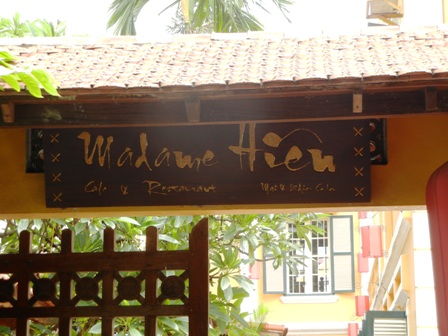
In a beautiful French colonial building you will find Madame Hien, a restaurant offering traditional Vietnamese food in Hanoi.

We had a business lunch there (May 2011). Therefore, I could not take many photos of the surroundings and the food. Please forgive me. I promised myself that I would come back to the place when I’m in Hanoi next time.

The gate to Madame Hien

Madame Hien is owned by the celebrated French chef Didier Corlou. He comes from Brittany and owns another restaurant in Hanoi called La Verticale.

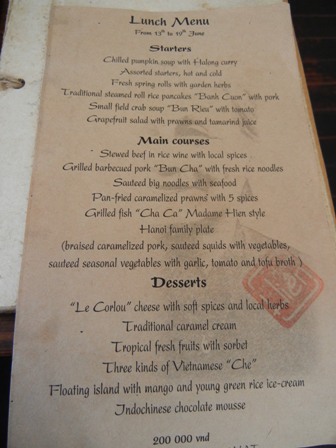
The lunch menu

As you can see from the menu above, a three course meal costs about 200,000 Dong only. The dishes one can select offer a wide variety of Vietnamese delicacies.

My main course

I took something light and enticing. As starter I selected the grapefruit salad with prawns, followed by the grilled fish “Cha ca” Madame Hien style. I finished with the cheese “Le Corlou” to honour the chef. All of the dishes were delicious, excellent.

Trip advisor gives 4 of 5 stars to the restaurant. There you will find as of today 210 reviews, 90 of which rank the place as “excellent” and 72 as “very good”.

Unfortunately, the most recent reviewers seem not to have had a good time at the restaurant. No idea what happened. Sure is, that I will come back, next time with a bit more time on my hands, and so that I can have a glass of wine with the food. See you there, maybe.

Address:
Madame Hien
15 Chan Cam, Hoan Kiem District, Hanoi
Between Ly Quoc Su and Phu Doan, just south of Hang Gai
Tel.: +84439381588,