The year of living baldly

December 20, 2010

It is now about exactly one year that I cut what was left of my hair and adopted the new hairstyle which has become so prominent especially among celebrities but also among many ordinary men like me.

From Bruce Willis to Kelly Slater hairlessness has rarely been that cool. I remember of course Yul Brunner from my youth. He was not my role model, though, I was rather orienting myself towards the hairy hunks such as Frank Zappa, Ian Anderson, Neil Young or Robert Plant and Jimmy Page.

Opinion is divided about the outcome. My children just love it and my mother just hates it. She is reminiscing about the good old days when I belonged to the post-hippy or flower-power generation and my long red curls touched my shoulders. My mum treasures the memories of that time.

Well, I am not the same. About 40 odd years older, one has to think about re-inventing oneself. The central questions for some is: Is bald beautiful? To others the main question is: Is bald practical? And the third category of people might ask if it is beautiful and practical at the same time?

I of course cannot answer the first and the last question. I find practical that I do not have to dry my hair after washing them in the morning. I wet flannel is actually sufficient to clean myself now. But I have also some more work, because I have to shave my scull regularly.

But what is most important to me is that I feel good about myself. And that’s what I do. I might stay bald for a while.

Cheers, have a sip of wine and enjoy the coming festive season.


November ambience in a Saar vineyard

November 29, 2010

Vineyard near Schoden, Saar

When I recently visited my home town Trier, I also had the chance to explore mother nature in nearby Schoden, Saar.

It was a grey and rainy November day as we like it. The weather makes you wish for a hot tea in a warm place, maybe near a window with a view. Or a walk through the steep vineyards in the Saar valley.

Individual vines trained on a “stick”

Some of the vineyards were already pruned. One could spot pruners here and there, alone or in small groups. Please note the pruning style of these vines. November is a good time to visit wine regions. It is less crowded and people have time for a yarn.


Where to eat in Seoul – Restaurant Review: Min’s Club

November 11, 2010

Tradition and…

Today Seoul, the capital of South Korea, is the host of the G-20 summit. Thousands of government officials from 20 major countries and journalists have converged on the city. The place is crowded, and very busy.

This summit is maybe one of the most contentious so far. South Korea, an OECD country, is the 13th largest economy of the world but was embedded in poverty only 50 years ago. Then per-capita income in South Korea was lower than in Nigeria, the Philippines and even North Korea. All together a different story today.

When I visited Seoul about two weeks ago, I had the chance to look around and get a feeling for this East Asian capital city. Of cause I also explored it’s culinary sides (as far as I could and my schedule allowed).

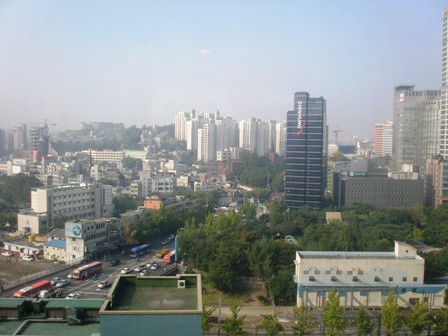
..the modern city

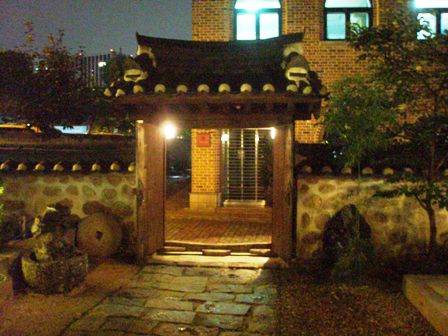
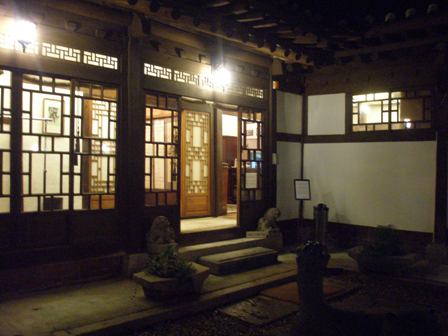
Seoul is a fabulous place, a modern city with many restaurants and eateries. Korean food is amazing; and distinct from other Asian cuisines. We were invited by our South Korean hosts to have dinner at Min’s Club, a Western style fusion restaurant housed in a traditional style Korean compound (the residence of Queen Min), the most beautiful surrounding one can imagine under such circumstances.

The gate

The main hall of the restaurant

The menu of the Min’s Club

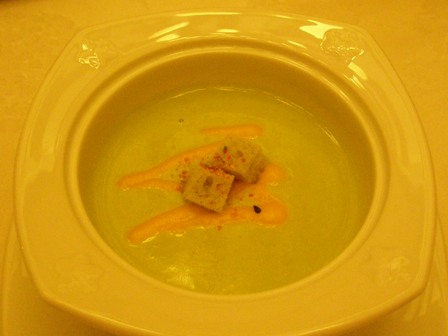
Our hosts had ordered a set-menu. It started with a fabulous tuna fish – incredible, the texture and the flavours -, followed by a pea soup (also with a very intense taste), reminding me of winter days in my native Trier, Mosel.

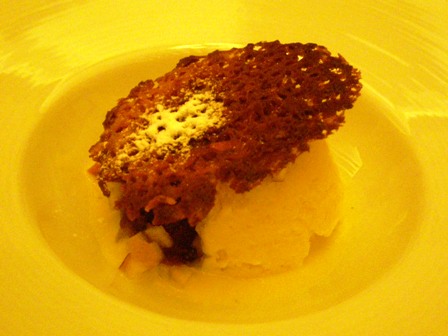
The next dish was a mussel decorated “fine cuisine style”, followed by a white fish with lemon on a bed of vegetables. I even did not say no to the dessert, vanilla ice cream with a crusty waffle cover.

The tuna carpaccio

The pea soup

An artisan’s mussel

White fish with lemon on vegetables

Dessert: ice cream with a hat

The rice water to conclude the meal

I might have missed to photograph a couple of dishes.

Interesting was that at the end of meal, a kind of sweet rice-water was served. It balanced the stomach acids which were heavily tilted towards acidity by the many fermented vegetables consumed as side dishes.

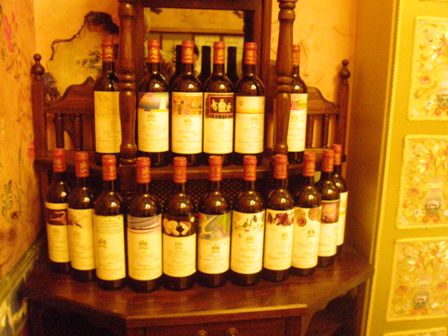
We drank French red wine with the meal, wine from one of the many Mouton Cadet Bordeaux lines. I could not find out which one. It would have been impolite towards out hosts to ask, I guess. My picture-taking was already embarrassing enough.

Red wine cabinet

The décor

The décor of our dining room was just beautiful with lots of Chinese calligraphy, wall paper made out of fabric with flowery motives, and antique European furniture.

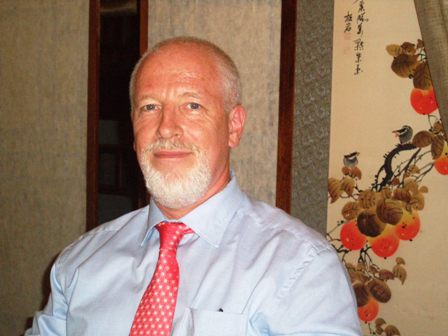
A very happy camper

Our dinner was very lovely with lots of interesting and stimulating discussions and conversations. What a wonderful evening. If you are in Seoul look out of Min’s Club; it’s worth it.

Address:
Min’s Club – Fusion restaurant
66-7 Kyungun-Dong Jongno-Gu (Insadong),
Seoul, South Korea
Tel.: +82-2-733-2967 begin_of_the_skype_highlighting              +82-2-733-2967      end_of_the_skype_highlighting
http://www.minsclub.co.kr (Korean only)


Korean food – a discovery

November 10, 2010

My recent trip to Korea was a kind of revelation as regards the discovery of Korean food. I was ignorant for too long about the intricacies of this type of Asian cuisine.

This is the first of a series of blog entries dealing with my recent experience in Seoul and on Jeju island.

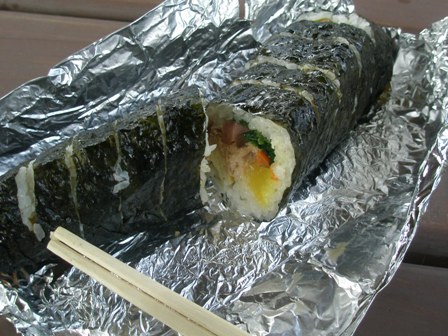
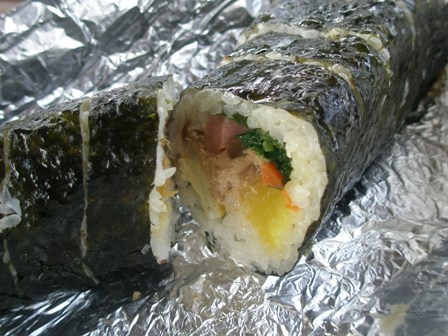
Even Korean fast food, such as “tuna kimbap” (김밥) as shown on the photos below, can be extremely tasty.

It consists of a filling (here tuna with some salted or preserved vegetables) surrounded by rice and wrapped in seaweed. Delicious.

Tuna kimbap

Tasty Korean fast food

What to drink with it, you might ask? Well, I would suggest a beer. But one could also drink some of the many varieties of rice wine, for instance “makgeoli” (막걸리), a fermented Korean milky drink on a rice-wheat basis with about 6-7% alcohol. More about this later.


Another wine experience in China

November 7, 2010

One of the privileges of a frequent traveller, even if exclusively travelling on economy class, is the use of the lounge. As a “wino” this is great territory to sense and experience some of the global trends in the wine industry and/or the airline service providers.

One such trend seems to be the use of paper cups instead of proper glasses. That’s at least what my recent experience in the business class lounge (star alliance) at Shanghai Pudong International Airport suggests.

I found the “wine ensemble” below. Isn’t it cute?

Wine at your service

I could not resist a tasting of the two wines on offer, a white from China and a red wine from France. Unfortunately I could not find any trace of the French wine in the internet. I had noted down “Tour Gouvercin” as the name of the wine (a Cabernet Sauvignon) which was quite pleasant to drink, fruity with body and structure.

The second wine, a ‘Clos des Chenes, dry white wine’ by Imperial Court, a brand re-designed and re-established by Shenma Winery. The wine was a bit “thin” but since the cooler (as seen in the picture above) guaranteed a pleasant temperature, I found it not so bad, light but technically well made.

My wine tasting at Shanghai Airport

China is not only an emerging world power but also a booming market for oversees wines. Chinese grape wine consumption increased from 554 million bottles in 2004 to 899 million bottles in 2008. However, per capita consumption is still very low, about 0.4 litres per person per year.

That’s all good news for wine producers and distributors. Also that imported wines account doe only about 11.8 % (2008) of total domestic consumption is “music in the ears” of the non-Chinese wine industry.

Wine educators have their tasks outlined for them as well. Chinese consumers do not like tannins and acids, often perceive grape wines as “sour” only. This is why the mixing of red Bordeaux wines with coke and spite is quite common consumption habit. This needs to be changes, I guess. Since Chinese people have very complex taste buds, it should not be too difficult to make them appreciate the wonders of fine wines.


Shanghai: on the run

November 6, 2010

I had not much time for food and drink while on a business trip to Shanghai this week. But it is always interesting to visit the “Paris of the East”. Now that the World Expo is over, it was a bit more quiet than the last six months but the controversy of the award of the Nobel peace prize to Liu Xioabo kept the blood of CCP officials boiling.

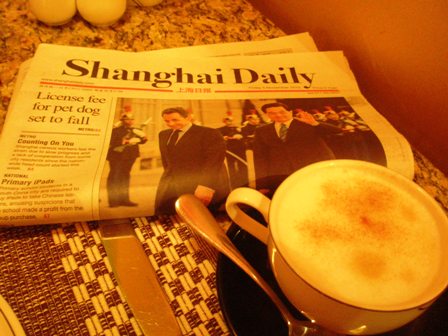
What did the Shanghai Daily say? Hu’s visit to France which has become a good old friend again and the order of 100 airbus planes made the front page. This contrasted well with issues the Shanghai people are concerned with: the high tax/licence fees for their pet dogs. Nice mix of local and global.

My breakfast: coffee and the Shanghai Daily

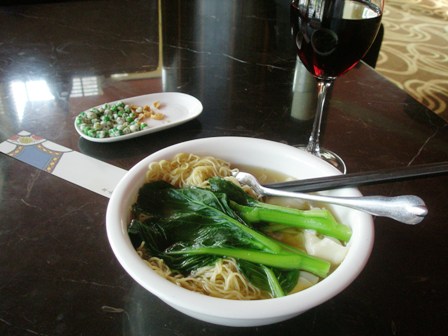
After my talk which I gave to German students I had some time for a quick lunch snack: dumplings in a broth with noodles, and a glass of the house red, of cause a Chinese wine. Delicious. Nice mix of East and West.

Lunch snack with red wine


Giuseppe’s map of Firenze – God must have been a Florentine

October 23, 2010

The map of Firenze according to Giuseppe Seppe

When we announced to our Italian friend Giuseppe who lived for a long time in Florence, that we intended to visit his town, he was ecstatic. There are many things to see in Florence but we had only a weekend. How to make informed choices about the places to visit?

Here comes Giuseppe. He drew us a map, on it six places he considers a “must see”. In my subsequent blog entries I will introduce some of these places, especially the “foody” ones.

Of the six entries, four were related to food and drink, two were historic (Palazzo Medici Riccardi and Museo Nazionale del Bargello). They were:

1. I Due Fratellini: Tuscan sandwiches and wine shop
2. Boccanegra: restaurant with Tuscan specialities
3. Baldovino: Antipasti, pizza and fine wines
4. Pasticceria Artigianale Cobi: Florentine cakes and other local sweets

We did not have sufficient time to check out the “pasticceria” but patronized the other three places. I tell you that they were all worth the visit.

Thank you Giuseppe for these insider tips. We just loved your recommendations.


Viña Tondonia White Reserva 1987, Rioja, Spain

October 18, 2010

A couple of weeks ago, we drank a very special type of wine, a white Rioja, vintage 1987, called Viña Tondonia White Reserva! Our wine-making friend, Timo Mayer from the Yarra Valley had brought the bottle all the way from Europe to Bangkok.

The winery is owned and managed by the third generation of the López de Heredia family. For a hundred and thirty one years this enterprise is producing exceptional and unique wines. The founder of the company, Rafael López de Heredia y Landeta, defined in the late nineteenth century what a “Supreme Rioja” wine could be. Viña Tondonia White Reserva 1987 bears witness to this philosophy.

Timo Mayer opening the bottle in our kitchen

The wine is made from Viura (about 70%, also called Macabeu in France) and Malvasia grapes. It was kept for 10 years on the yeast in old, large oak barrels and for 13 years in the bottle before the wine is finally released.

1987 is the current vintage! Who can afford to leave wine for 23 years in the cellar?

The wine is a unique experience. It is completely dry, has a fine bouquet with a hint of dried fruit. First, we did not know what to make of it but with each sip it dawned on us that we held something very special in our glasses. Awesome stuff, indeed. One can taste the passion which went into this wine.

Cheers mate

The wine can be bought in Germany from “Weinhalle“. It is not cheap but worth to be explored if you long for a unique and amazing wine experience.


The best Mongolian hotpot ever

October 15, 2010

The Bull Brauhaus, Mongolian Hotpot restaurant in Ulaan Bataar

I was invited by my Mongolian friends to dine at “The Bull Brauhaus”, a Mongolian Hotpot restaurant in Ulaan Bataar, the capital city of Mongolia. The restaurant was packed with customers when we arrived, among them a large group of young Tibetan monks. The time of my visit coincided with an international conference on Mongolian Buddhism; even Richard Geere was in town.

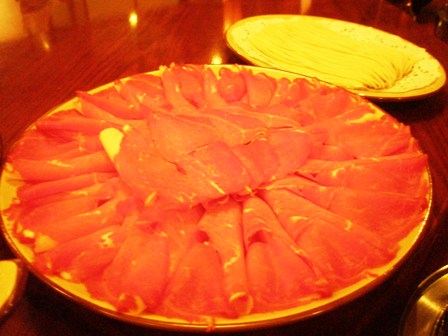
I had hotpot before, in places as diverse as Japan, Korea, Thailand, China and Indonesia. However, the hotpot experience at “The Bull Brauhaus” was another matter. I guess it was the best hotpot ever. The quality of the meat was outstanding. A great variety of condiments was on offer. Each of us had its own little hotpot stove. Unfortunately, I did not take a photo of them.

Look at the condiments

Look at the meat

We drank ‘Mongol’ beer with the food which was a good choice.

Mongol beer

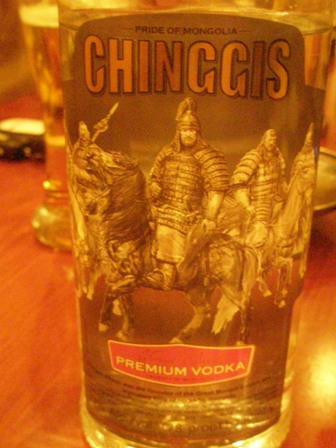
The Mongolian quality vodka: Chenggis Khan

At the end of the meal the obligatory vodka was served. Chenggis Khan vodka seemed to be the preferred brand by my host. In the following day s of my visit I should have more of it. Needless to say that we had a jolly good time. If in Mongolia do as the Mongolian do, is a famous saying. The Bull Brauhaus in Ulaan Bataar is definitely worth a visit.


To cork or not to cork – the problem of wine closures

September 10, 2010

Book cover

Recently, I finished reading the above book by George W. Taber. It is an excellent work. I was amazaed that one could write so much about the different aspects of this little think: the stopper in a bottle. Nowadays, quite a few different materials and techniques are available and every poor vintner needs to make up his mind what to chose.

At Two Hills Vineyard we went for the DIAM solution (technical cork) for our Merlot wines. Our German customers want a cork to pull and DIAM has never let us down. We have experimented with other corks but found that DIAM suits us best.

Moreover, I hate plastic. It does not do the job. I love glass. It is elegant and suggests superior quality of the wine because of its high price. In Australia screw caps are very widespreach. Almost 100% of white wines and maybe 80 % of all bottles are now under screw caps.

I learned from “To cork or not to cork”, that the last word is not yet spoken. It will be interesting to see how wine ages under screw cap and glass stoppers. If we make white wine again, I would chose screw caps for our Sauvignon Blanc, but maybe DIAM for Chardonnay. Our Merlot will definetely stay under DIAM. For Pinot Noir I would remain undecided. Hmm, I wonder what would be the best solution?