Restaurant Review: Capital M, Beijing, China

June 7, 2011

I am reading “Justice for hedgehogs” by Ronald Dworkin at the moment. The book makes the point that one of our cardinal interests, ambitions and responsibilities is to make our lives good lives.

“We must find the value of living – the meaning of life – in living well”, says Dworking. He also states that dignity and self-respect are “indispensable conditions of living well”.

So what does that mean if you are sitting in Beijing, China at a beautiful Sunday morning with time on your hands? Well get up early and go to the National Museum to see the German sponsored exhibition “The enlightenment”, a unique show of a selection of art pieces from that era of our history which mattered so much for the freedom of the individual and rationality.

After that it’s downhill all the way. More of Dworking’s good life is to come. After fine art, one needs fine food and drink.

I suggest you stroll down to the South end of the Tian-an-men Square and have lunch at Capital M, one of my favourite restaurants in Beijing.

Capital M in Beijing, view from the terrace

One has a wonderful view from the restaurant. It is located at the third floor of a newly reconstructed building, a kind of replica so to speak, of an older house. Capital M has a wonderful terrace with a grand view of the square.

I got there much too early; the kitchen was still closed. The kind waiter offered me a table at the window, and I ordered a glass of house white, a Sauvignon Blanc by the South Australian family winery Angoves. Newspapers were brought to me and I indulged in the pleasure of reading in quiet. I was the only customer at that early hour.

Tasteful crockery for morning tea

I was still full from breakfast and unsure if I should lunch at Capital M. Then I though of Dworkin and my responsibility towards the good life in dignity and decided to move to the table the kind waiter had reserved for me. in the meantime the first guests had arrived, casually dressed most of them. In this relaxing atmosphere, I felt at ease.

I read through the menu and decided on a two course meal. My choice of entrée was white asparagus which is just in season in Beijing. What a good choice that was. The asparagus was firm and succulent, it melted in my mouth.

I also had another glass of the house wine, the SB by the Angove Family winery.

Asparagus with a poached egg on top and olive oil

For my main course, a white snapper on a bed of vegetables, I selected a ‘2008 Dry Riesling’ by Dr. Buerklin-Wolf, in Wachenheim, Palatinate in South-West Germany. Riesling is one of my favourite white. Although just one of their starting wines, this Riesling was exactly what I needed, a beautiful accomplishment with my meal.

2008 Dr. Buerklin-Wolf dry Riesling shows an intense colour

The main course was so jummy, I could not believe it. I took it bite by bite, slowly exposing my taste buds to the food. I wanted it to last as long as possible. The veggie selection interspersed with flower petals and a nut mix, was just amazing, awesome stuff.

The main course

Unfortunately, the battery of my camera did not last and gave up her service right in the middle of my meal so that I cannot show you more pictures from the restaurant, the view and the people.

The service at Capital M is exceptional, hard to find in China this kind of concern for the customer. Prices are also decent. I paid for three glasses of wine and a two course meal 42 EURO, which is not bad.

Apart from the Forbidden City and the Great Wall lunch or dinner at Capital M in Beijing is a must if you visit China.

Address:
Capital M Beijing
3/F, No.2 Qianmen Pedestrian Street
(just south of Tian’anmen Square)
Beijing 100051 China
中国北京市前门步行街2号3层
邮编 100051
Tel: +86-10- 6702-2727
Fax: +86-10- 6702-3737


Feasting on Japanese delicacies at Ba Tiao Shou Si – 八條壽司

May 31, 2011

八條壽司 Ba Tiao Shou Si

Let me take you to a very special place, 八條壽司 a Japanese restaurant near Taoyuan. Before we enter the place and indulge in the photos I took of the various dishes served to us, let me explain a bit the background.

Every year when I teach my course on good governance in land administration at the International Center of Land Policy Studies and Training in Taoyuan (ICLPST), Taiwan, a good old friend of mine, Prof. Lin Kuoching, professor of economics and agricultural policy, invites me and Prof. James Riddell, an even older friend of mine from my days at the Food and Agriculture Organisation of the United Nations, out for an evening in the hot springs.

It is the annual reunion of three men united by their passion for agriculture, the land and the people cultivating the land. They also share a passion for politics, geo-politics and political developments in Asia. After our long conversations in hot and warm and cold water basins, we move on and have dinner together.

Ms. Lin, Prof. Lin’s wife, is usually the one selecting the meal and the dishes. However, this time we were too late for the Chinese restaurant at the spa, so we went back to town. A Japanese restaurant called 八條壽司 was our aim.

The entrance of 八條壽司

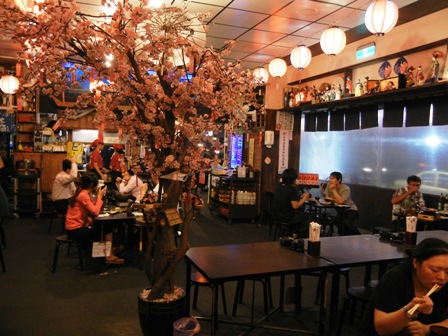
The place is down to earth, nothing fancy. When we arrived it rained cats and dogs, and the restaurant was packed with people. The photos were taken when we left late in the evening.

The common dining room 八條壽司

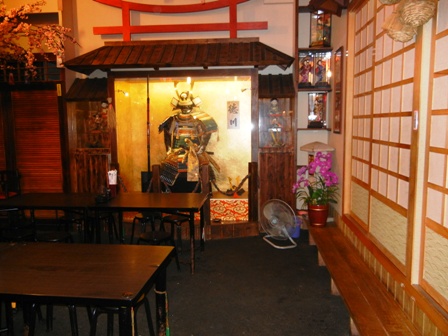
The shogun’s armour in a glass vitrine was the heirloom of the place. To the right from the common dining area are individual rooms in the Japanese style.

The Shogun’s armour

Now just follow me from picture to picture of the delicacies we were offered. I do not know the names of the dishes, often I even cannot say what the dish was composed of, but trust me, this was amazing, awesome, super delicious, in short: heaven on a stick, as we say in Australia.

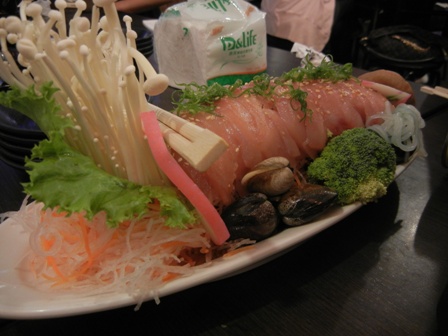
Beautiful raw fish

A salad with fruit to clean the palate

Fish eggs

More raw fish

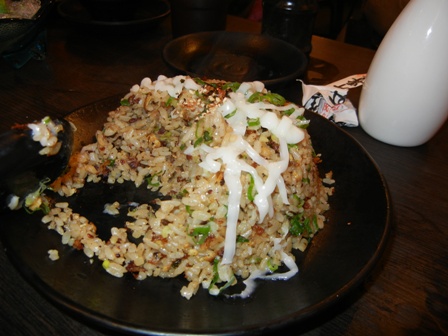
Brown rice selection

Beautiful creations

Soup

Some more raw fish

And a flat fish

Chicken

I am not much of a chicken lover, but this chicken skewer was just delicious, unbelievabel. It converted me: good chicken dishes do exist.

Sake

We drank tea and warm sake with our meal. I love sake but are utterly ignorant about the various types and qualities. This is something to explore in the near future.

The three men and the Shogun’s armour: Prof. Lin, Prof. Riddell, and me.

Needless to say that this was a fantastic evening. Thank you fellow diners for the company, the hospitality of the Lin family should be praised and rewarded in the other world, last but not least I wish to thank the cook of the 八條壽司 restaurant: you did a great job. Arigato


Lunch on the Mekong river

May 21, 2011

Welcome to my Saturday post. Behind me is a sign in Thai indicating that we are at the Mekong river.

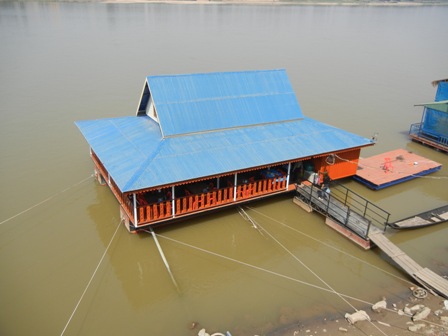
Lunch at a “swimming restaurant” on the Mekong

Let me take you today to an exotic place on this majestic stream, where I had lunch with a couple of colleagues when I visited Udon Thani some time ago. I had to try some Isan cuisine which is not for everybody.

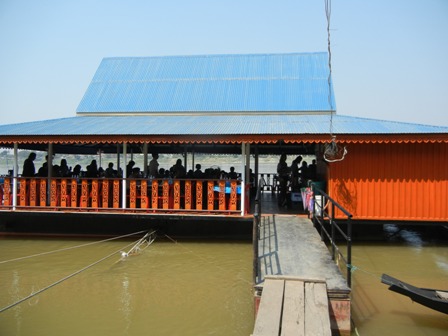
Come on to my boat

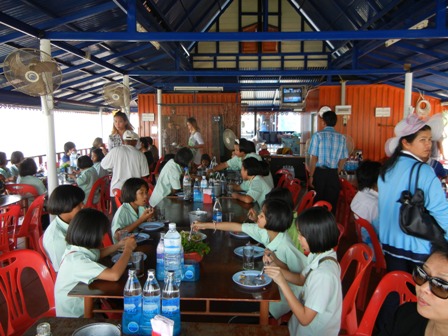
On the boat restaurant a large group of school children where having their lunch. They seemed to be on an outing together with their teachers.

The children were delightful

As I said before, 22 years living and working in Asia exposes you to interesting cuisines. I have eaten all kinds of food in my life but not one of the foremost delicacies of Thailand’s North-East: ants eggs.

In fact this cuisine tested my resilience.

An assortment of typical dishes

On the river you eat fish

Also soup is healthy

What would we do in Thailand without “som da,”?

So far so good

Almost all dishes contained the ants eggs sprinkled over them

They look well cooked, don’t they?

The ants eggs have a strong chitinous taste when you bite into them. It’s a strange feeling between the teeth too. In my body the chitinous inside of the eggs produced a tremendous amount of heat. I guess one has to be used to this kind of dish in order to fully enjoy it. My companions, almost all from the Udon Thani region, just loved the food.
By the way, we drank water with our meal, just clear water.
And the river flew.
Come to the Mekong.


Some other wines – Taiwan treasures

May 14, 2011

At Friday night’s birthday party of the International Center for Land Policy Studies and Training in Taoyuan, Taiwan two bottles of wine made from millet were presented to us.

Wines not made from grape vines taste of course very different from fermented grape juice. I liked the fragrance and aromas of a grain based brew. The sweetness is of course deceiving and the rest sugar might give you headaches the next day. But I was positively surprised by the freshness and the fine balance of the liquid.

Beautiful millet wine

The milky liquid with the delicate fragrance

PS: I was careful and had only one glass from each bottle.


From time to time I need a beer

May 7, 2011

Wine is a wonderful drink but many of my winemaker friends drink beer to clean their palates.

So do I.

And some foods cry out for a cool brew made of hops and malt.

Tooheys Red is one of my favourite beers when in Glenburn.

I am off to China today where facebook and blogging are stricktly controlled by the authorities. The Man from Mosel River will disappear from the bloggosshere for a couple of days.

See ya later, hopefully.


The freedom to grow grapes

May 4, 2011

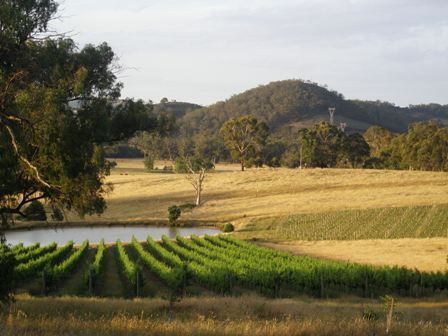
Two Hills Vineyard – Sauvignon Blanc Block

For us Australians in Victoria it is somehow unthinkable that we would consider to ask government for permission to plant a vineyard or to plant vines. My native Germany, however, is very different in this regard.

Recently I found a news story about a village in Saxonia, named Grosspoensa, which had planted about 1,000 vines near a re-naturalised open coal mine, now flooded and used as a lake.

In 2006 the village government had requested the planting rights for 26 ha from the higher level government. But because the village is not located inside the classified Saxonian wine region therefore this request was denied and planting rights were not granted.

Two Hills Chardonnay

Nonetheless the village planted 0.3 ha with vines disregarding the higher governments rejection in 2008. The plan was to rent out the small vineyard parcels to hobby vintners. Now the vines had to be removed again. The state ministry of environment and agriculture ordered the removal. Also a fine was imposed (3,700 EURO). The village tried to negotiate and a second fine of 4,800 EURO followed.

The villagers were outraged that they had to pay twice and to pull out their young vines. The European Wine Market Regulation, however, specifies what punishment illegally planted vineyards entail for the planters.

Well, European bureaucrats seem to manage the wine industry along the lines of an old fashinoned Leninist central planning scheme. Why do they not trust the market and the people exchanging goods through voluntary transactions?

Pip’s Paddock Chardonnay


Trier a love story: come on a walk with me

April 24, 2011

Let me take you on a walk through my home-town Trier today.

I am sure that if you follow this route on Easter Sunday or Monday it will be even lovelier since nature will be greener and the sun will shine on you.

Let us start with what I call the “public” city.

The public city

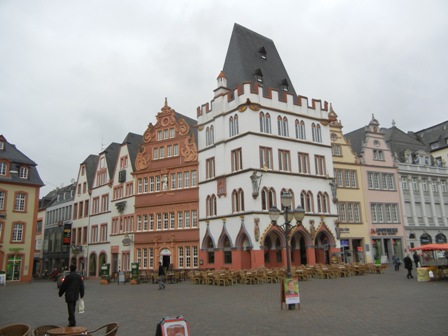
The “Porta Nigra”, English the Black Gate, is the landmark of Trier.

“Dreikoenigshaus”, please notice the door on the first floor

The “Steipe” and the red House, where the guilds used to congregate

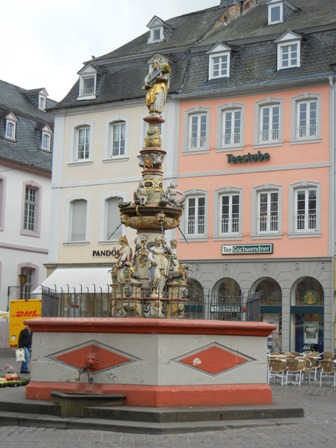
The fountain of St Peter, the city patron

The market cross

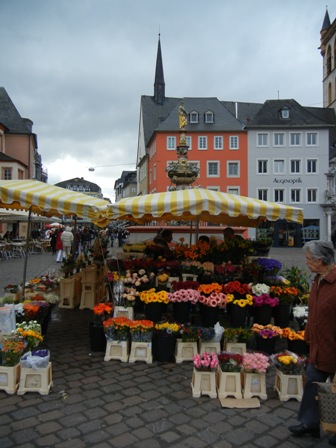
The main market square

The cathedral or “Dom”

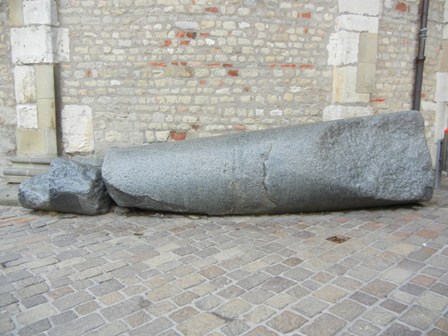
The “Domstein”, a column with a folk story attached to it

The Roman basilica of Emperor Constantine

Here I will end the public walk through the city and take you to some more “private” places, places I am attached to.

My private Trier

The “Maerklin-shop-Theisen” in Metzelstrasse, where we spent zillions of hours looking at the various miniature toys

Chinese restaurant, one of many catering to the needs of the more than 30,000 tourists from China visiting the birthplace of Karl Marx

Renovated patrician house in Nagelstrasse, formerly owned by friends of ours, the Fey family, where we spent many hours as little kids

My old watering whole: “Die Glocke”, a rather traditional tavern which attracted the young when I was young

Of course there is much more to see than that above. I could have uploaded many more pictures of my beautiful home town. Why don’t you come and visit?

This is actually a must-do for any Riesling lover. There are so many wine bars, and cellar doors to explore in Trier that you might need some time.

In the meantime please explore the virtual map which I like quite a bit.


“Yoga for wine lovers” by Harold’s Planet

April 12, 2011

I found this video clip through my good friend Walter Klitz from Luxembourg.

Isn’t it a wonderfull animation?

I will try to enjoy wine the Harold way.


Spring in Trier, Mosel

April 11, 2011

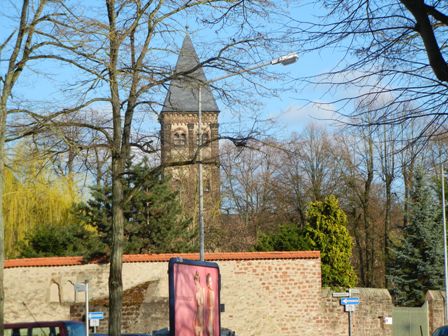
Church of St. Paul’s seen from my home in Trier at Irminenfreihof

When I visited Trier at the end of March, I was very lucky because the weather just turned a little more to spring. The pcitures below of the spring flowers are wittness of the beauty spring carries with it.

Flowers of the hazel bushes

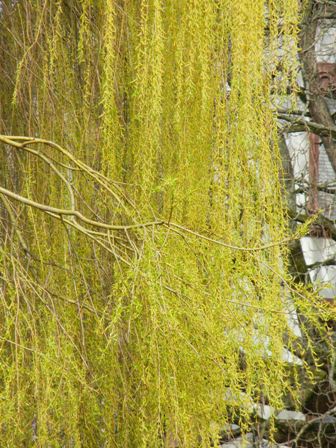
Flowers of the willow tree

Forsythia bush in yellow flowers

Cherry blossoms

Vineyards at Petrisberg. In the background you see the Roman amphitheatre and the Constantin basilica with its red roof


Wine bars in Trier: Weinstube Kesselstatt

April 10, 2011

Wine bar Kesselstatt in Trier

A place I just love to visit while in my home town Trier, Mosel is a cosy wine bar-cum-restaurant near the cathedral, called Weinstube (wine bar) Kesselstatt.

It is housed in the historic administrative building of the Estate Reichsgraf von Kesselstatt, a well known winery with a long tradition (more than 600 years – difficult for us Australians to comprehend).

In front of the building is a replica of a tomb stone called the “Roman wine ship” found in Neumagen-Drohn, a village at the Mosel river, in 1878. In 220 it used to be one of two stones marking the grave of a Roman wine merchant. Honestly, I would love to get such a tombstone set on my own grave. What a hoot.

Today the winery is owned by the Reh family. Annegret Reh-Gartner manages the 36 ha of prime vineyards located along the rivers: Mosel (12 ha), Saar (12 ha) and Ruwer (12) ha. 98% of the area is under Riesling. The estate calls itself “the Riesling winery”.

When I strolled through the town at the end of March, I could not resist its magnetism and dropped in for a quick glass of wine.

The inside of wine bar Kesselstatt

Because the Kesselstatt estate owns vineyards along the three rivers constituting the former wine region of Mosel-Saar-Ruwer, one has a great choice of different Riesling wines.

I ordered a semi-dry Riesling from Scharzhofberg, a grand-cru of the outstanding Saar Riesling wines. Normally I avoid semi-dry wines but because of the early hours of my visit I just could not go for a dry Riesling.

2010 Scharzhofberger Riesling semi-dry, Reichsgraf von Kesselstatt

What a delight this wine is! I dissolved, so to say, this is Riesling at its best, and I tend to argue that none in the world is better. Lush and full, round but with zest, a titillating pleasure for the palate.

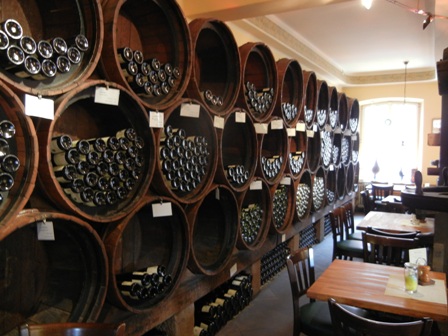
Below you will find pictures of the inside of the bar. There are old barrels filled with bottles, a old wooden press, and a side room with a map of the estates’ vineyard locations and other interesting wine paraphernalia.

Wine bottles in old barrels

A huge wooden wine press with a church bench in front

The function room

When I left the Kesselstatt wine bar revitalized and in high spirits, I walked out to a cherry tree in full blossom with a splendid view of the adjacent church of St. Liebfrauen and the cathedral (Dom, left).