Jean-Paul’s Vineyard, Yea

January 30, 2009

Recently I had the opportunity to taste wines from Jean-Paul’s Vineyard in Yea, Victoria, a boutique vineyard owned and operated by Will de Castella. The de Castella philosophy is, “it’s all about the fruit”. The vineyard is organic/biodynamic certified. Will produces hand crafted, award winning wines of excellent quality. Jean-Paul’s Vineyard also recently joined our association, the Upper Goulburn Winegrowers Association.

jean-pauls12

‘2006 Jean-Paul’s Vineyard Shiraz’

I bought a bottle of ‘2006 Jean-Paul’s Shiraz’ and a bottle of ‘2004 Jean-Paul’s Bold Colonial Red’ from the Yea super market. Recently the ‘2005 vintage Shiraz’ was awarded 94 and the ‘2005 Bold Colonial Red’ 88 points by James Halliday. I guess that the different vintages might not have been significant as regards the quality of the wine. Who can taste a one or two point difference anyway.

Both wines were consumed together with friends over hearty Australian country meals. To say it from the outset, I loved both wines; they were delicious. Since I am more of a Shiraz than a CabSav drinker, I personally prefer the Shiraz.

If you are in the vicinity of Yea, grab some bottles of these wines, it’s a bargain. I also recommend to visit the Jean-Paul’s Vineyard website and order from there directly.

jean-paulss11

‘2004 Jean-Paul’s Vineyard Bold Colonial Red’

By the way: Will de Castella’s great grandfather was Hubert de Castella, the pioneer of the wine industry in the Yarra Valley establishing vineyards such as St Hubert’s near Yarra Glen.

Will and his wife Heather live since 1988 near Yea and produce small quantities of fruit from which distinct wines are made which won accolades for their outstanding quality.

Address:
Jean-Paul’s Vineyard
Post: RMB 6173
YEA VICTORIA 3717
AUSTRALIA
Phone: 03 57972235
Email: william@jeanpaulsvineyard.com.au
http://www.jeanpaulsvineyard.com.au


Jewels of the Upper Goulburn Wine Region Part I

October 25, 2008

Today, I want to start a new series and introduce to you some wine and grape producers from our wine growers association, the Upper Goulburn Winegrowers Association. I plan to feature three to four wineries and vineyards at the time. The selection is random. I will start with the wineries with open cellar doors. Of the 30 odd members of our association, about 9 belong to this category. Another 12 are vineyards which also produce some wine under their labels but conduct wine tastings only by appointment. All the others are fruit producers only and do not sell wines commercially.

The first cohort of wineries to be presented consists of Kinloch Wines, Rees Miller Estate and, a small boutique winery, called Rocky Passes Estate. I want to be honest with you. I have tasted wines made by Malcolm Kinloch (Kinloch Wines) and David Miller (Rees Miller Estate) but not the ones made by Victor Oles (Rocky Passes Estate). I have visited the two former wineries (and I know Malcolm and David) but not the latter.

But this is no impediment to write about all three of them. Anyway, we are going to visit Australia for Christmas and we might take this opportunity to get to know the Rocky Passes people.

I am starting with Kinloch Wines. Malcolm and Susan Kinloch have established a wonderful wine business. The vineyard is located in the Booroolite Valley, about 15 minutes by car from Mansfield (almost next to another famous winery of our region: Delatite Winery).

This year at the Federation Sq Showcase Series the Kinlochs were rewarded two gold medals, one for their “2004 Mary Friend Cabernets-Merlot Blend” and another for their “2006 Don Kinloch Sparkling white”. Moreover, the “Mary Friend” red was judged the Overall Best Red Blend in its class at the Award presentation for the Victorian Wine Awards.
2008 was a most unusual year in the Upper Goulburn. Kinloch Wines harvested a record 34 tons of fruit of outstanding quality. From the 2008 vintage three wines have been released so far (cellar door prices in brackets):
-Unwooded Chardonnay (A$ 18)
-Sauvignon Blanc, and (A$ 22)
-a first rosè (A$ 18) made from Pinot Meunier grapes.

I have tasted earlier vintages of the two white wines and they are delicious. When we visited Kinloch Wines in winter, one could see Mount Buller in a not so distant distance, all in white with a beautiful snow cap.

How to find them:
Kinloch Wines
In the Booroolite Valley, the cellar door is warm and friendly and offers gourmet luncheon platters on weekends and public holidays.
Address: 221 Wairere Rd, Boorolite – 15 minutes from Mansfield
Open: 10.00 am to 4.00 pm daily
Tel: 5777 3447
Email: info@kinlochwines.com.au
Web: www.kinlochwines.com.au
Contact: Susan and Malcolm Kinloch
Rees Miller Estate is the next winery in my cohort. Located near Yea – about 15 minutes drive on the highway to Alexandra/Mansfield – Sylke Rees and David Miller own and operate a fully certified biodynamic vineyard and winery. Today about 7 ha are under vines, the farm has a total of about 64 ha. Sylke and David are both very much committed to the protection of the environment, and the organic production of food. They intend to produce pure products for consumption in a way that supports the land and its people.

We got to know Sylke and David when our wine stall was just adjacent to theirs at the 2007 Alexandra Food and Wine Expo. David conducted a very interesting wine tasting, actually my first wine tasting at such an event, and Sylke sold the wines. When we visited their cellar door some time later, they were both on Christmas holidays. To my great surprise Rees Miller wines were available at our duty free wine store in Jakarta, and we did not have to suffer any shortages of their beautiful reds.

How to find them:
Rees Miller Estate
Fully certified biodynamic vineyard situated on the Goulburn Valley Highway, just east of Yea.
Address: 5355 Goulburn Valley Highway, Yea
Open: 10.00 am to 4.00 pm daily
Tel: 5797 2101
Email: info@reesmiller.com
Web: www.reesmiller.com
Contact: David Miller or Sylke Rees

The last vineyard in this first cohort of Upper Goulburn wineries with cellar doors is Rocky Passes Estate, a small boutique vineyard of about 6 acres (5 acres Shiraz and 1 acre Viognier) located in Whiteheads Creek, near Seymour. I only know their one-page website and their listing in our membership directory. Rocky Passes Estate is another vineyard dedicated to organic grape growing and wine making (there are quite a few in our region). Cropping levels are kept low (about 2 tonnes per acre). The cellar door was opened in 2006. The wines can be ordered by mail, phone or e-mail.

How to find them:
Rocky Passes Estate
Situated at the southern end of the Strathbogie Ranges, the wines are made using organic practices and biodynamic preparations.
Address: 1590 Highlands Rd,
Whiteheads Creek, Seymour
Open: Sundays 11.00 am to 4.00pm or by appointment
Tel: 5796 9366
Email: rockypasses@activ8.net.au
Web: www.rockypassesestate.com.au
Contact: Victor Oles or Candy Westney

I hope I could stimulate your curiosity. The Upper Goulburn Wine Region is a rural place with real people who love what they are doing, have passion for their wines and commitment to the environment.


Eating out in Yea, Victoria

June 24, 2008

When we are on our vineyard in Glenburn, Victoria, we love to visit wineries and vineyards in the vicinity but we also love to tour the small country towns, villages and hamlets in rural Victoria. One of our favourite destinations, and just about 32 km northwards of Two Hills Vineyard is the small town of Yea.

Yea is about 100 km north of Melbourne and has a population of about 1000 souls. In 1837 the first settlers arrived in the district – the Shire of Murrindindi – from New South Wales (under the leadership of the explorers William Hovell and Hamilton Hume) and ever since the area along the Goulburn River was settled as farmland. It was originally known as Muddy Creek settlement and later named after Colonel Lacy Yea, who was killed in the Crimean War. Before white settlement, the Woiwurung people of the Kulin nation occupied the area. Unfortunately, they had to bear the brunt of the effects of British settlement policy and were frequently and forcibly resettled and never obtained titles of their native lands.

Today Yea is a pleasant country town and centre for agriculture, forestry and tourism. Needless to say, quite a few wineries are located in the area, most of them members of the Upper Goulburn Winegrowers Association.

There are quite a few eating places to choose from. Depending on your time and your budget, the whole range of country food is available at your finger tips. We usually frequent three places which I would like to introduce to you today briefly.

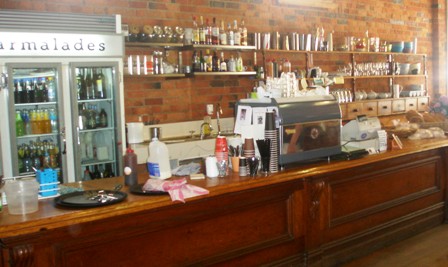
1. Marmalades

Marmalades is a cafe, tea house, local produce and wine store cum gallery and offers all kinds of local and international food. It has a very pleasant atmosphere. There is a library and a reading groom.

marmalades.jpg

You can park right in front of the place.

The counter

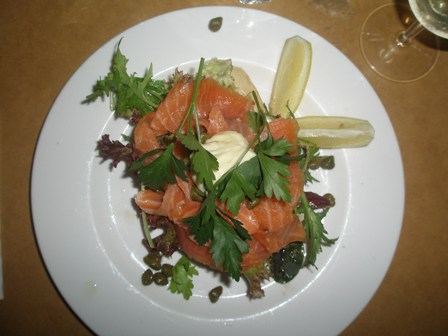
Below you can see some of our most preferred dishes.

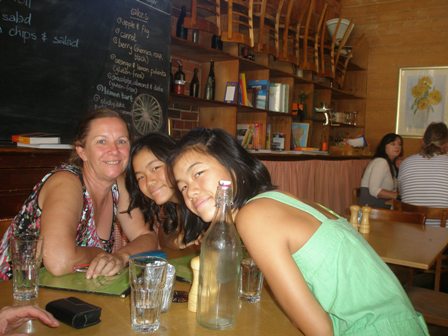
Margit, Charlotte and Lucy around the table

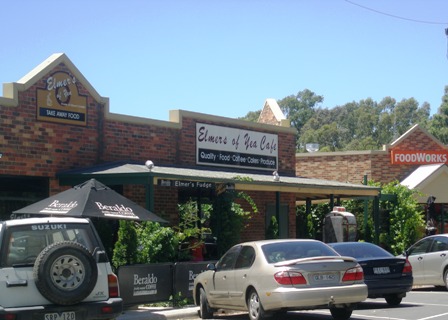
2. Elmers

A little bit further down the main road, near the Foodworks supermarket, you will find Elmers, another cafe cum restaurant. At times you need to book because it is so crowded. As the occasional tourist just try you luck.

Behind the counter at Elmers, people are very busy.

3. The Country Club Hotel

Located about between the two, is the Country Club Hotel. It has, as most Australian pubs or hotels, a public bar and a restaurant. There is usually some kind of life music in the restaurant on the weekends. This is a good place for the evenings to go out and/or meet with friends and family.

I somehow do not have pictures of the inside of the Hotel and of the food served. However, let me assure you that I ate there the best Kangaroo steak I had ever consumed in Australia.

Mind you my first Kangaroo meat I tasted during my university years in Bonn. The ‘mensa’, as it is called in German, the university eating place, a ‘cantina’ so to say, had offered it as a novum to its hungry young men and women some 30 years ago.

Also the other dishes on the menu are worth trying. The Country Club Hotel also offers local wines with their meals. So if you are in the vicinity and you want to try solid, modern and traditional country style food please drop in and give a couple of hours of your time to Yea and its eateries. You will be pleasantly surprised. You will also have the opportunity to sample some of the finest locally produced wines from the Upper Goulburn Wine Region since all three restaurants have a variety of locally produced wines on offer.


Sauvignon Blanc

July 10, 2007

My morning newspaper, the International Herald Tribune, carried the other day an article summarising the tasting of 25 Sauvignon Blanc wines from New Zealand. Sauvignon Blanc is one of my most favourite white wines. The results were interesting. Only about 10 of the 25 wines found the approval of the tasting panel (it was a New York Times event of the dining section). For the judges, the tasting was a disappointment. They were looking for the bold, pungent refreshing SB but found that too many wines were dull, too sweet or simply wishy-washy or as Eric Asimov put it “commercially inoffensive”. My favourite SB from New Zealand, Cloudy Bay came up third (behind “Villa Maria” in number one position), described as “quieter than the top wines” but still “bold, zesty and delicious”. In my bottle shop in Jakarta it retailed for 40 US$ the bottle last week. Gone are the days when I had to pay only 18 US$ for this most delicious white.

Mr. Asimov is of the opinion that many producers have decided to push quantity at the expense of quality and that they are over cropping (too high yields per acre). I learned something else from the article: that in New Zealand wine producers are allowed to add sugar or acid to make up for “green” (not fully ripened) grapes, as we say. In Australia, we are not allowed to engage in this technique or should I say “manipulation”. Next time in the bottle shop it will be much easier for me to walk away from the dear SB from Marlborough and turn to some cool climate Sauvignon Blanc of Australian provenance. I might be enticed to make some Two Hills Sauvignon Blanc again in 2008. Kinloch Wines (www.kinlochwines.com.au) Sauvignon Blanc of 2006 is sold out, as I learn from their website. Guess who provided some of the fruit for this most delicious wine from the Upper Goulburn River (www.uppergoulburnwine.org.au)?


Murrindindi

February 15, 2007

What is “Murrindindi”, you might ask? This is a location in central Victoria along the Murrindindi River. It is also the name of the shire where Two Hills Vineyard is located (www.murrindindi.vic.gov.au).

According to Wikipedia the Woiwurrung people lived in these parts of the Upper Goulburn when the first white settlers arrived in 1837. In the Woiwurrung language Murrindindi means “living in the mountains” and indeed this part of the Upper Goulburn Wine Region (www.uppergoulburnwine.org.au) is quite hilly and mountainous. It was all covered by forests.

There has never been a Murrindindi town. The first settlers (squatters as they are called in Australia) cleared the forests and farming and timber became the main industries in this region. A short lived gold rush began in 1868.

Murrindindi

Mountain view in Murrindindi

Although most of the area was deforested by the early 20th century, systematic protection and re-planting of trees has occurred and today the eastern part of the Melba Highway from Glenburn to Yea is in some parts quite densely forested again with Mountain Ash and other gum varieties.

Tourism is on the rise (www.murrindinditourism.com.au). Accommodation is easily available. There are good opportunities for trail riding, fishing, trail biking, and bush walking, specially along the Wilhelmina Falls and along the Murrindindi River.

Also the wine industry has made Murrindindi its home. Since the late 1980ies and the early 1990ies some vineyards were established in the Murrindindi area. In comparison with my native Mosel River, this might seem a rather short history of wine production. Indeed, vintners and winemaker here are true pioneers. There are fours vineyards in the vicinity:

▪ Penbro Estate
▪ Murrindindi Vineyards
▪ Yea Valley Vineyards and
▪ Two Hills Vineyard

All are members of the Upper Goulburn Wine Growers Association but only Penbro Estate has a website (www.penbroestate.com.au). There cellar door used to be the Glenburn Pub in Glenburn. Murrindindi Vineyard’s cellar door is at Marmelades Café in Yea, a small country town about 25 km to the north along the Melba Highway.

Whereas the Celtic Treverer had hundreds of years of site and varietals’ selection opportunities, so that today a rich and extensive knowledge base exists in the Mosel wine industry with well established vineyards and wineries.

The vintners in Murrindindi had only a couple of years of trial and error and are still searching.

We at Two Hills had to pull all our Cabernet grapes out because they would not ripen in the cool and harsh climate with its short autumns. They were replaced with Pinot Noir.

Last year was our first but promising Pinot vintage. The variety seems to be better suited to our conditions then the long ripening Cabernet. We plan to extend our vineyard and plant 0.4 ha of Chardonnay this year.

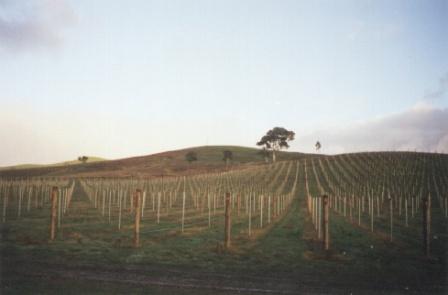
Vineyard in Murrindindi

Vineyard in Murrindindi


The Upper Goulburn Wine Region

February 1, 2007

Today, after all these Mosel meals, I want to take you back to Australia and write about the wine region in which our vineyard is located: the Upper Goulburn Wine Region. I also would like to inform you a little bit about the activities of the Upper Goulburn Winegrowers Association (UGWA; www.uppergoulburnwine.org.au).

The Upper Goulburn is located in central Victoria. The region derives its name from the Goulburn River which is one of the main features of the area. It is a cool-climate grape growing area setting it apart from most other parts of Victorian. The region has only recently been classified in the geographic indication system. Grapes, however, have been grown in this part of Victoria for almost 40 years. In comparison to the Mosel this is indeed a very young wine region.

The Geographic Indications Committee of the Australian Wine and Brandy Corporation (AWBC; www.awbc.com.au) determines wine zones, regions, sub-regions and their boundaries. The system was introduced after lengthy negotiations with the European Union which did not accept Australian wines unless it complied with European regulations. The Australian Wine and Brandy Corporation Act of 1980 was amended in 1993 to accommodate those requirements.

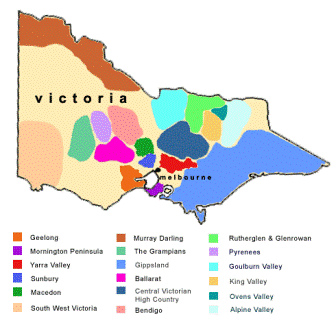
Map of the Victorian Wine Regions

Wine Regions of Victoria Map Dark blue formerly Central Victorian High Country and now divided in Strathbogie Ranges and Upper Goulburn Wine Region (www.wineaustralia.com/australia

The region is very diverse in terms of altitude, climate, temperature, rainfall, and soils. Site selection is of ultimate importance. Rainfall varies from 700 to 1400 mm. Some vineyards even rise to the snowline at 800 m. Many locations are ideally suited for sparkling wine production consisting of Chardonnay and Pinot Noir grapes. Aromatic varieties such as Riesling, Gewuerztraminer and Sauvignon Blanc can be found but also Cabernet Sauvignon, Merlot, Malbec and Shiraz. (www.greatwinecapitals.com/melbourne/mel_reg_centralvictorianhighcountry.html)

The Upper Goulburn is very picturesque and one of the gems of Victoria. It extends from Tallarook in the west to Mansfield, Lake Eildon and further north Lake Nillacootie. Regional centres like Yea, Alexandra and Eildon are located in the region. Mount Buller and its skiing slopes, the lakes, the small rivers and the high planes are a premium destination for national and international tourism.

Mount Buller

Mount Buller with snow cap

Two Hills Vineyard can be found at the most southern edge of the region on the way to Yarra Glen. Today there are about 25 wine labels and more than 30 vineyards in the region. Recently a branding workshop has identified the key characteristics of the region which include:

● high diversity of vineyards and wines
● climate very suitable for premium cool climate grapes and wines
● aromatic whites/sparkling wines and elegant reds
● hand picked and hand crafted grapes/wines
● family owned businesses
● environmentally aware producers
● low environmental footprint
● shared experience between producers and customers
● good infrastructure
● unknown – Victoria’s secret

From these few words it is clear where you have to spend your next holidays: in Central Victoria. See you there (www.visitvictoria.com/wineries).

Two Hills Vineyard

Two Hills Vineyard