Luxembourg and its wines – “wine study path” in Wasserbillig

September 4, 2012

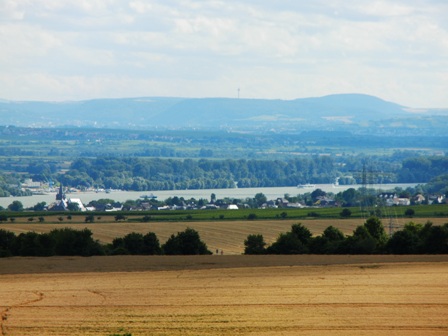
The Mosel view towards Trier which is further donwstream

I have written about Luxembourg and its wines before. When I visit my home town Trier I almost always include also an excursion to the Gand Duchy. I love the place, its people and its wines

The vineyards of Wasserbillig in Luxembourg

When I visited in July, I discovered a so called “wine-study path” (Weinlehrpfad in German) right on top of the hills above Wasserbillig, a small town right across the border from Germany and very popular for its cheap petrol and the petrol stations selling coffee and also wines.

The ‘wine-study path’ from Wasserbillig to Mertert

The path leads from Wasserbillig to the neighbouring hamlet of Mertert. The walk through the vineyards is just magnificient. A multi-faced billboard at the start of the walk informs the casual visitor about the vineyards and the wine industry of this part of Luxembourg.

Map of the Mosel river and the mouth of the Sauer, a tributary

Billboard about the wines of Luxembourg

Luxembourg mainly produces dry white wines and sparkling wines called Crémant de Luxembourg. Since the soils are so different here from the soils further donwstream (where we find mostly Devon slate), also the wines are different. The keuper marl soils of Remich and the calcareous soils of Grevenmacher produce distinct whites reflecting the “taste” of these soils.

Wines and gastronomy in Luxembourg

The main grape varieties are Mueller-Thurgau (Rivaner), Auxerrois Blanc, Pinot Gris, Riesling, Pinot Blanc, Elbling, Gewuerztraminer and Chardonnay. Some Pinot Noir is grown as well. All the wines are cold climate and usually dry. Very little semi-dry and sweet wines are produced.

Vines in “full swing”

I highly recommend this walk, and , of course, a tasting of wines made in Luxembourg.


My Dukan experience

September 2, 2012

You might be interested how I go with my Dukan diet. Well, let me update you on my progress.

“I started out in early February with about 90 kg life weight (recorded in the morning, right after getting out of bed). Today, I have reached 82 kg. My goal, however, is 80 kg, so I have still a bit to go”.

Well, this is what I wrote on March 15, 2012. I never reached the 80 kg. Life was just too busy for me given my frequent travels, business dinners, etc.

Until the sumer holidays, about mid July, however, it was not too bad. I had about 83 kg. But during the four weeks in Germany, I regained about 5 kg.

My aim – Drawing by Lucy Adam

From tomorrow onwards I will start again with a Dukan diet. I am very confident that I will reach my aim. Moreover, I also visit the gym regularly. My prospects are bright.

Alas, Pierre Dukan is French. This means that he is a product of French culture to which inevitably wines made from the noble grape is an integral part. Therefore, wine drinking is not forbidden.


Weinhaus Gut Suelz revisited

August 22, 2012

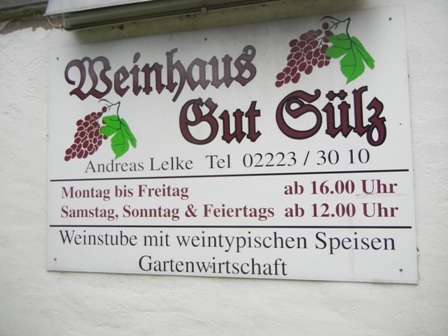
Weinhaus Gut Suelz

When I was a student at Bonn Univerity and I lived at the right hand side of the Rhein river (they call it the “schael Sick”, the shoddy side of the river), I visited this place in Oberdollendorf regularly.

The building

Sometime we would just walk from Niederdollendorf through the forest to get there, sometimes we would cycle along the Rhain river. It was one of our preferred destinations. We would relax in the garden and enjoy some bottles of local wine.

The garden with the vineyards on the hillside

We came there recently to end our visit to Koeln and Bonn (including a visit to the house of german history). It was the highlight of the day so to speak because my wife and the children had never been there before. I wanted to share with them some of my past.

The weather was a bit cloudy, and it was a Thursday, consequently only young and not so young lovers and retirees where there when we arrived.

The vineyards in a theater facing the South

The Weinhaus Gut Suelz is located at the bottom of a kind of natural theater, sourrounded by vineyards with the forests on top of the hills, at the edge of the village. The vineyards, however, do not belong to the ‘Weinhaus’, Suelz does not have it’s own production. But I knew one of the vinteners of these vineyards, the Bloeser family. Indeed I have written about them years ago on the Man from Mosel River.

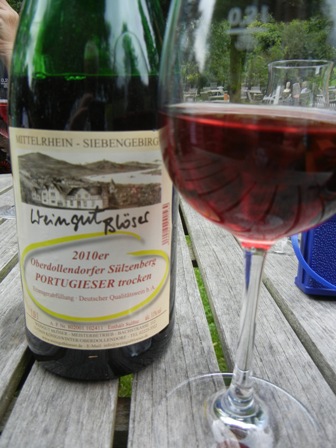
Blauer/Blue Portugieser by the Bloeser winery

I did not fancy a Riesling but instead wanted something special, something local. The Blauer Portugieser (in France known as Portugais bleu), a traditional grape variety from Austria (yes, Austria and not Portugal) wine seemed just the right stuff.

It is a light, but dark red wine, with a medium to light body, soft tannins and low acidity, an uncomplicated wine one could say. very good for a sensitive stomach. It meant home to me somehow, or as we Germans call it “Heimat”.

Apple juice from ‘Streuobstwiesen’, a traditional biotop under threat

The service was very good. We ordered “Flammkuchen” (a traditional dish from the German Southwest and the French East -Alsace) which seems to have gained the upper hand when it comes to dishes one orders together with wine these days.

Flammkuchen

You can see from the photo above that this was truly worth it.
My tip: if you are in the vicinity, drop in. There is a great choice of wines, not only local ones but many more from around Europe. And enjoy.

Address:
Weinhaus Gut Sülz GmbH.
Bachstraße 157
53639 Königswinter – Oberdollendorf.
Tel.: +49-22 23 – 30 10.


Mosel Riesling: Versuchungen (temptations)

August 21, 2012

What a beautiful Riesling: Versuchungen = temptations

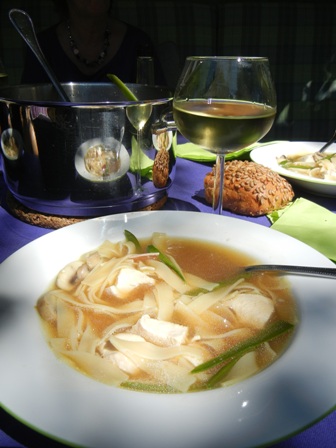
The wine is made by Andreas Bender, a contrarian of the German wine scene, of Weingut Bender. It is a semi-dry Riesling, usually not a wine style I very much like. But it perfectly machted the spicy Asian soup we had it with. Lovely buquet, fine acidity and a sweetness which was round and compassionate, like a kiss.

The wine is named in allusion to two quotes by Oscar Wilde, who must have said that “I can resist everything, except temptation” and “The only way to get rid of a temptation is to yield to it”.

I yielded to it as well. It was modestly priced at Euro 7.50 when I bought it at Weinsinnig, one of my preferred wine barS in My home town Trier.

Versuchungen and the spicy Asian soup

I have not made up my mind about this wine. I need to taste some of the dry wines Andreas Bender produces before I can come to a conclusion. But for the many off-dry wine lovers, this wine is a true temptation.


Sparkle sparkling Crémant de Loire !

August 16, 2012


Crémant de Loire

When visiting in Germany lots of reunions with family and friends await us, usually accompanied by some sort of joyous celebration; and summer is as good as it gets if it comes to sparkling wine.


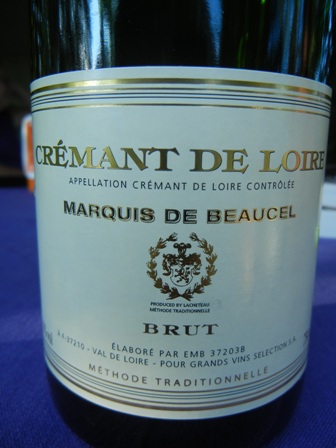
Crémant de Loire

The other day in Bottrop we had a ‘Crémant de Loire Marquis de Beaucel Brut’ which is available at the discounter Aldi. In fact some good wines are carried by this food chain. For less than 6 EURO you can have a bottle of Crémant de Loire, which makes a refreshing and reinvigorating drink.

The wine is made from Chenin Blanc grapes sourced from the Loire Valley in France. This valley is hiding many great discoveries as regards wine. My last visit was when I was still a student and toured France with my friend Ulrich. I guess I should go again and explore this wonderful part of France.

Here in Thailand Chenin Blanc is also produced as one of the white varieties which grow well in the tropical climate.


Kloster Eberbach, Rheingau

August 7, 2012

The Rheingau wine region

Because of a flight delay we had a couple of hours on our hands with nothing to do. This provided us with an unexpected but welcome opportunity to visit the Rheingau wine region. So where to go and what to do?

Some years ago I had been to Eltville, one of the many small and pretty settlements with extensive wine culture and history. Last year in November I met a couple of professors from the famous wine institute in Geisenheim, Rheingau at the 3rd International Symposium on Tropical Wine in Chiang Mai, which further nurtured my curiosity in the Rheingau wine region.

So I typed “Kloster Eberbach” into the navigation system of the hired car and off we went to this place near Eltville which I had always wanted to visit. We were looking for some mix of culture and wine. In no time we were cruising the country roads of the Rheingau.

Vineyards and farm buildings

The region on the right side of the Rhein river between Wiesbaden and Assmannshausen is like a Garden Eden of the modern world. The slopes of prime vineyard land descend gently towards the Rhein river. The land is very fertile and the climate very suitable for the production of first class wines, mainly Riesling.

The top of the mountain ridges of the southern Taunus are crowned with deep forests. Many of the villages and settlements are very beautiful. Every year millions of tourist flock to places like Ruedesheim, Geisenheim, Erbach and Eltville.

The Eberbach monastery

Our destination, the Eberbach Monastery, formerly a Cistercian Abbey, is a kind of museum today. We had a look at the old church, the cloister and the various rooms used by its monks from the 12th century until the French revolution and the secularization of church property under Napoleon.

Fortunately, the grape-growing and wine-making tradition of the monks has been preserved. Today the state of Hessia is the owner of the vineyards and winery “Kloster Eberbach”. The monastery offers a range of programs related to wine, special tastings for instance in the historic wine cellar, and has a “vinothek”, a kind of cellar door or wine shop.

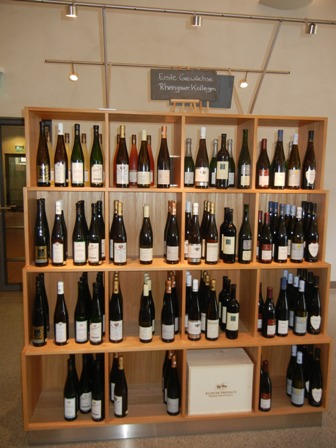
The wine shop of Kloster Eberbach

The “vinothek” wine shop does not only offer the wines of Kloster Eberbach but also of vintners and wineries of the surrounding villages and terroirs. The shop was packed with buyers on this Sunday afternoon. I browsed through the various shelves with wines from different locations and of different quality categories. I tried to stick to a certain budget which did not allow for grand cru wines.

My selection

In the end I settled for three wines only, one Riesling and two Pinot Noir wines. The Riesling came from the most famous and oldest terroir called “Steinberg” (stone mountain) right behind the monastery. The Pinot Noir Spaetlese from Assmannshausen was a bit pricier (17.40 EURO). It should turn out to be the best Pinot Noir I drank while holidaying in good old Germany.

Address:
Kloster Eberbach Winery
65346 Eltville am Rhein
Tel.: +49-6723-6046-0
www.kloster-eberbach.de

PS: When I studied agricultural economics at Bonn University, my master thesis was (among others) also dealing with the farming activities of the Cistercian monasteries and how they influenced land markets. I had visited Himmerod Abbey, a Cistercian monastery near Trier, but had never visited the equally famous Eberbach Abbey.


Rheingau Riesling

July 31, 2012

When traveling through Frankfurt, I always try to pick up a bottle of German wine on the airport. This time it was a ‘2011 Riesling Classic dry’ by the Kloster Eberbach winery in the Rheingau.

Little did I know at the time that I would be visiting this place during my holidays a few weeks later. In fact I would return to this wine region twice within two weeks time.

To say it in a nutshell, Kloster Eberbach is a fabulous place.

It used to be a Cistercian Monastry (by the way in my master thesis I wrote about Cistercian monastries and their farming enterprises which were quite modern as regards organization and management).

Grape production and wine-making have a long tradition in this place. Today it is owned and operated by the state of Hessia.

This is their “normal” Riesling wine brand, nothing fancy but just a solid German Riesling, the way I like it. The wine is crisp and fresh with great aromas and a good body.

I will tell you more about Kloster Eberbach soon,


The art of blogging and wine from Caves Alianca Dao, Portugal

July 11, 2012

No blog entry for two weeks, goodness me. Why I am so busy? It seems this is a terible time. No time for my blog. Moroever, I am going on an extended trip to my hometown Trier, Germany (this time on vacation), where I have very ittle access to the internet. Therefore the prospects are grim. Please bear with me. I plan to continue my blog despite the odds.

Today I have a last entry before the blog-free seasons starts. The good news is that I will be visiting the Mosel and its tributaries. This also means that I will probably visit some wineries and taste some delicious wines. I should come back to Bangkok with many more stories to tell and share.

A beautiful dark red colour

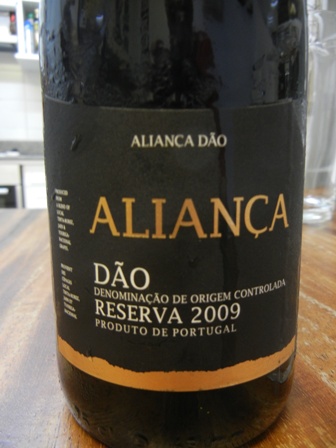
Last night, we had with our meal a beautiful red. It was a ‘2009 Caves Alianca Dao Reserva’, a blend of various Portuguese grape varieties (the label says: Tinta Roriz, Alfrocheiro, Jaén, Touriga Nacional).

The Dao wine region is consistently producing outstanding wines. Ever since our holiday along the Douro river, I am a big fan of Portuguese wines.

Caves Alianca Dao Reserva

With 14% alcohol this wine is big and mighty. It is also very smooth with lots of forest fruit. There is some hint of vanilla (from the oak). The wine has a good mid-pallet weight and a long finish.

The back label of the Alianca Dao

In Europe the wine retails for about 7 Pounds.

We had this beautiful and delectable wine with very spicy green beans and a beef fillet. Woh, that meal was super delicious and the wine was just a perfect match. I wish we had more of it. Well.

Soon we will be at the shores of the Mosel river and ive into the tasting of Riesling. What a consolation.


Buying wine online in Bangkok

June 26, 2012

Last Saturday I did what I have never done before: I bought wine through the internet. Through facebook I found Bacchusonline. I ordered three bottles, some random selection basically, so that the total value was above Bath 2,000.

In that case, Bacchusonline said that they would deliver for free. This was done at 10 in the morning and at 16 h we had our three bottles deliverd. We paid cash and that was it. Fantastic. What great service.

In another post I will tell you what I bought.


Buddha Enlightenment day – what a lovely lunch

June 7, 2012

It was the first day with the family after an extended absence from Bangkok, and we all enjoyed a hearty meal together. The wine I had brought with me from Brussels. We were looking forward to it. As you know, I am not very knowledgable as regards French wines. But first, let us see about the food.

The main dish

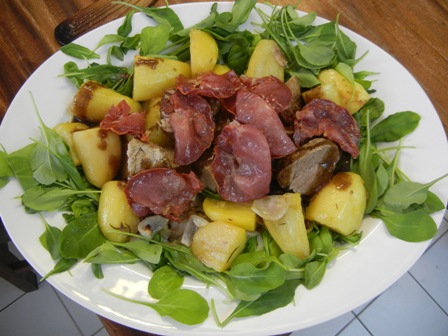
We had some pork loin on a bed of rocket sald and potatoes topped with some bacon. This was super delicious. As side dish we had some assorted vegatables consisting of zucchini, carrots and cualiflower.

The vegetables

On the plate

As mentioned above, the wine came from a supermarket next to my hotel in central Brussels. I choose the most expensive bottle on the shelf, and voila it was a ‘2007 Union des Producteurs de Saint-Émilion Grande Sommellerie’, a blend of the five traditional Bordeaux varieties (Cabernet Sauvignon, Merlot, Cabernet Franc, Petit Verdot and Malbec).

I had no idea who the “Union De Producteurs De Saint-Emilion” was. However, the wine was dark and full, a bit like jam, full of red fruit flavours. It has a good body and a reasobale long finish. In short, it was no disappointment.

The colour of wine

Conclusion: I do not sample sufficient French wines, and should drink more of it.