The Gourmet Garage, Jakarta III – Jolly Farewell

September 15, 2008

It was another farewell but one of those were time seems to have stopped. We enjoyed the moment, the pleasure of being together for a memorable meal and we did not think much about parting or not living in the same city again. Any future starts in the present moment, and we were sure we would have lots of it. We were not doubting that we would meet again, as friends do.

Well, were did we go? And who is “we” in the first place? To answer the first question, we met at the Gourmet Garage in Kemang, Jakarta, a very fashionable place. It was also easy to reach for all of us.
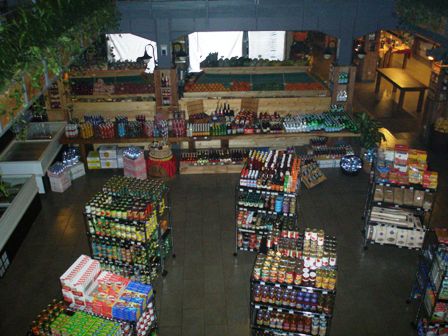
The inside of the Gourmet Garage in Jakarta with various shops on the ground floor and the restaurants upstairs.

The answer to the second question is, there were the five of us: Flo (Florian) and Nelly, Jasmin, Margit and me.
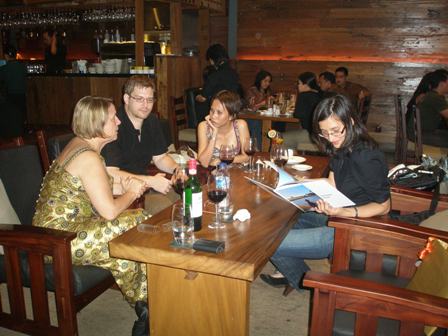
Margit, Florian, Nelly and Jasmin

The three had invited us to spend our last Friday night in Jakarta among friends. They talked us into ordering the four-course Japanese meal. Depending on the day, the chef changes the composition of the dishes of the four courses. Surprise, surprise but since we like adventures, we were eager to wait for things to come. Flo and Nelly ordered other dishes from the Japanese menu. There are two more menus to choose from at Gourmet Garage, a Western menu and an Indonesian menu.

Flo started with an oyster.
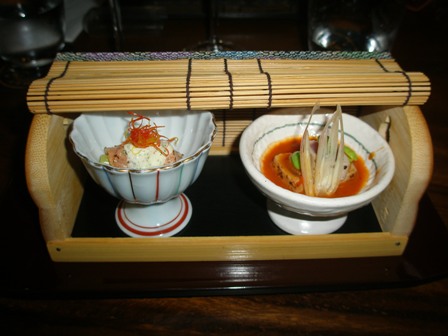
The starters for the four-course menu were beautifully decorated.
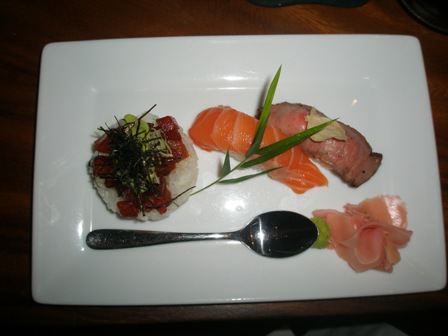
So were other dishes from the menu.

This soup was just delicious.
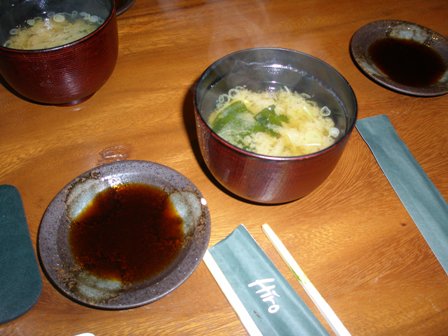
The miso soup came with the four-course meal.

This was part of Nelly’s dish.

And Flo had a similarly decorated meat dish.
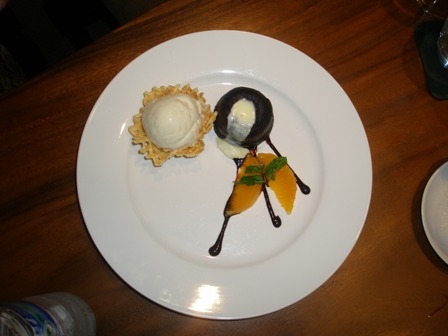
This is one of the desserts we had.

In short, the food was delicious. According to some expat Japanese, Gourmet Garage offers the best Japanese food in town.

You might like to know what wine we drank. Nothing special, I can tell you. Well, we opted for a simple, red wine from Australia. With ‘Penfolds Rawson’s Retreat Shiraz-Cabernet’ you cannot go wrong if you need a wine for every day which is easy to understand and to drink. Gourmet Garage prices these wines very reasonably. The choice was a compromise, of course, but I did not fancy the whites from the wine list. A Mosel or Saar Riesling would have been my preferred choice.

But we had a great time and that was what mattered most. Farewell gifts changed hands (I do not reveal what they were) and at about midnight we parted company as on many other occasions before. See you guys in Bangkok, or on our farm in Glenburn. As you know, you are always welcome; ‘sampai jumpah’ as we say in Indonesia.


Vinho Verde – Portuguese delight

September 11, 2008

Vinho Verde wines are unique among the blended white wines of Portugal (and the world) attempting to harmonize delicate aromas and flavours. The name, Vinho Verde, is somehow misleading. Vinho Verde wines are not made of “unripe” grapes as some people say, but are rather “young” wines in contrast to “aged” wines. There are red and white Vinho Verde wines available. The red ones are often a challenge to our culturally determined palates. During my recent trip to Porto, Portugal I had ample opportunity to taste and explore the wines of Northern Portugal. Among them the famous Vinho Verde wines of the Minho wine region.

It is not easy to find a “pure”, varietal wine in the Minho wine region of Portugal. Traditionally Vinho Verde is a blend consisting of several grape varieties (www.vinhoverde.pt) such as Alvarinho, Arinto, Azal, Avesso, Trajadura and Loureiro.

However, with a bit of luck I found some bottles in the café next to the cathedral in Amarante, a small town at the (Rio) Tamega river, about 50 km east of Porto. The wines came from Quinta da Lixa (www.quintadelixa.pt), a well known producer located in the village of Vila da Lixa about 20 minutes northwest of Amarante.

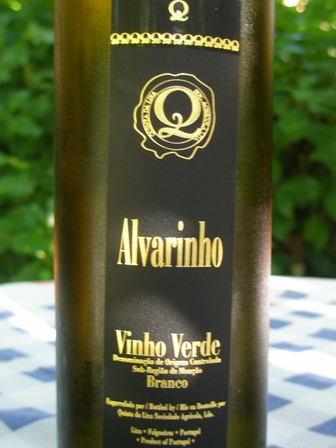
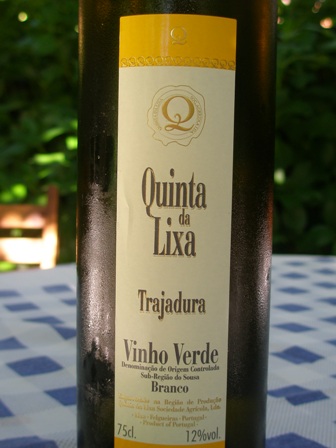
From left to right: 2007 Quinta da Lixa Loureiro, Alvarinho and Trajadura

The tasting notes for the three wines you can find on the websites which I mentioned above. Average production for the three varieties at Quinta da Lixa is bout 7 tons per hectare. The wines are low in alcohol (10 to 11.5%) and show an acidity of about 6.5 g/l.

The Trajadura grape has, in contrast to Alvarinho and Loureiro, a rather plush character and is less acidic than the other two varieties. It is often used to soften the blended Vinho Verde wines.

The Loureiro grape provides the fragrant character of the blended Vinho Verde wines. The single varietal wine of Quinta da Lixa which I tasted was slightly “sparkling” and very aromatic (more aromatic than the other two single varietal wines of Quinta da Lixa). All three wines showed citrus, lime and green apple aromas. They were very fresh and clean, served at the right temperature they are wonderful summer wines. Earlier vintages of Quinta da Lixa Loureiro and Trajadura received 89 and 90 points by some tasters. I loved them as single varietals as well as in the blended incarnation.


Bye bye Europe – welcome home in Jakarta

August 15, 2008

It was the last time that we should return to our home in Jakarta after a summer holiday in Europe. We are moving countries. After ten years in beautiful Indonesia we are packing up all our belongings. A new beginning awaits us in Bangkok/Thailand.

You can imagine that the emotions of our various family members are on a roller coaster, it ranges from one extreme to the other, varies between the sadness of leaving everything behind to the euphoria of a new beginning in another place.

The hectic of the preparations related to administrative and organizational matters pertaining to the move will not allow me to share with you all the exciting things I experienced in German and Portuguese wineries. I will try to slip in here and there some short notes and some of the many pictures we took on the way. More might come somehow someday.

Please bear with me.

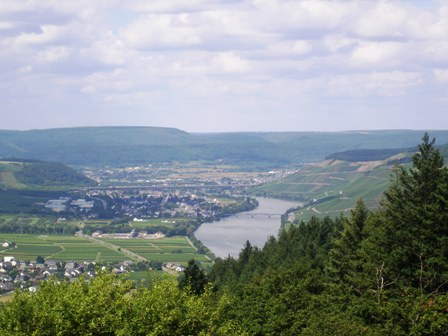
The Mosel valley and its vineyards near Schweich with the “wine villages” of Riol (left) and Longuich, photo taken from the freeway opposite Mehring in August 2008


Augusta Treverorum – home at last

July 24, 2008

My hometown of Trier (lat.: Augusta Treverorum) from the ‘Kockelsberg’

Alas, we made it. Grandparents were very happy to see us. Blue sky and summer sunshine greeted us. A splendid holiday awaited us. In short, Germany at its best. We are so lucky.

The Mosel river

Margit and I, we went to check out our favourite “watering whole”: the wine bar of Reichsgraf von Kesselstatt opposite the cathedral and the church of “Liebfrauen”.

The ‘garden’ of the wine bar

Riesling was our choice. We had a ‘2007 Kaseler Riesling dry’ (subregion: Ruwer) and a ‘2007 Wiltinger Riesling dry’ (subregion: Saar). Both wines were young and fresh, which make them a delicious drink in a hot summers day. We both preferred the wine from Wiltingen, Saar.

Cheers, and “zum Wohl” as the Germans say.

PS: I am loading this up from a small flat in Madrid which we rented. The internet connection is weak and blogging difficult. Please bear with me.


Berlin – Auerbachs Bookshop

June 26, 2008

Auerbachs Bookshop from the outside

A very good friend of mine made me aware of this little marvel of a bookshop. Its owner, Gabriele Seeboden, is a very friendly and helpful person. But the shop does not only offer books, also a rather interesting selection of fine wines is on offer, all from small, family-owned vineyards and wineries. Gabriele’s passion is book and wines, that’s for sure. The clients love her for the excellence of the service; they also love the flair of the bookshop.

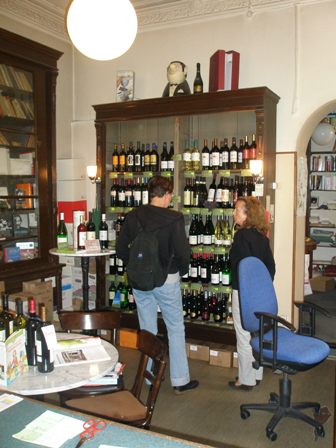
Gabriele Seeboden with a customer in front of the wine rack

This year the bookshop celebrates its 125 anniversary. It was opened by Richard Auerbach in 1882. Gabriele Seeboden is the third successor of Mr. Auerbach. It is not easy these days for such small ventures to economically survive. This was one of the reasons to add a product which goes well with books and reading. Wine is the natural choice, I would say. Wine tasting are also organised at the bookshop from time to time. Give it a go and visit when in Berlin. You will not find such combination anywhere else.

Address:
Auerbachs Buchhandlung
Albrechtstr. 10
12165 Berlin
(near Rathaus Steglitz underground station)
Te.: +49-30-7913125


Restaurants in Germany – Hotel Prinzregent, Munich-Riem

June 25, 2008

Bavaria is just such a beautiful place. I just cannot get enough of it. Especially at this time of the year travelling around Upper Bavaria is truly enjoyable. Even sub-urban places such as Riem have their charm. I stayed in a small hotel at the outskirts of Munich to attend a conference at the Messe Zentrum (the fair).

The very first evening, I asked the receptionist where one could have a decent bite of food, preferable Bavarian style and I was pointed into the direction of the Hotel Prinzregent (www.prinzregent.de), in fact a country inn style place along the main street in Riem. The ‘guest room’ of the public bar part was fairly busy at a Friday evening.

The Bavarian country inn – Hotel Prinzregent

As it was my first evening back in Germany I could not resist ordering a pork roast Bavarian style with ‘Semmelknoedeln’, a kind of cooked carbohydrates made from leftover bread crumbs. It was so delicious I completely forgot to take pictures for my blog. I drank wheat beer with the meal though the Prinzregent has a nice wine list available. For dessert, which I usually do not have, I had ‘Apfelkuechle’, a kind of apple backed in a doe and seasoned with raisin. After that mighty meal I was exhausted and went to bed early.

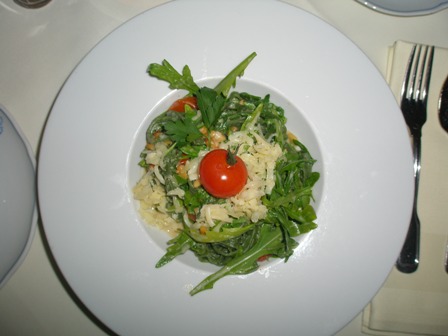
The pasta

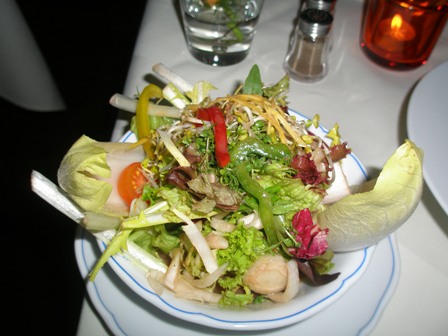
The very next day I came back to enjoy some more of the delicious food at the Prinzregent. Unfortunately, I did not order the roasted pork again (I should have) but went for a vegetarian pasta dish. It was ok but could not match the pork. The side salad was fresh and tasty.

The salad

This time I tried some of the white wines with my food. First I ordered a Riesling from, of course, the Mosel. A ‘2006 Weingut Schmitges dry Riesling from grey slates’ was my choice. It is a young but very enjoyable wine, typical for the region, elegant, displaying aromas of citrus and green apples, a fruity, minerally kind of wine.

For my second glass I choose a Sylvaner from the native lands of my mother, Franconia (the most northerly part of Bavaria). Horst Sauer is one of the icons of the vintners and winemakers from Franconia. His ‘2006 Eschendorfer Lump’ is just divine. The Germans like to describe a wine as “filigran”, which my dictionary says means “lacy” or “filigree”. I do not know if that makes sense to you. Anyway, the wine shows the typical Franconian character, is complex and fine, well balanced, has a good structure and a lingering finish. The prices for the wines were not on the cheap. The fellow at the next table turfed the idea of having a glass of wine after he saw the prices. Well, I was in a festive mood that day and did not bother.

White sausages Bavarian style, isn’t this beautiful?

My last meal at this wonderful place I enjoyed sitting in the large beer garden under very old chestnut trees reminiscing about the wonderful time I had in Bavaria. It was rather a late breakfast than lunch and therefore I ordered the typical Bavarian “white sausages” which is eaten with sweat mustard. A wheat beer matches that perfectly. Sorry you wine folks.

Address:
Hotel Prinzregent an der Messe
Riemer Strasse 350
81829 Munich
Te.: +49-89-94539-0
http://www.prinzregent.de


Eating out in Yea, Victoria

June 24, 2008

When we are on our vineyard in Glenburn, Victoria, we love to visit wineries and vineyards in the vicinity but we also love to tour the small country towns, villages and hamlets in rural Victoria. One of our favourite destinations, and just about 32 km northwards of Two Hills Vineyard is the small town of Yea.

Yea is about 100 km north of Melbourne and has a population of about 1000 souls. In 1837 the first settlers arrived in the district – the Shire of Murrindindi – from New South Wales (under the leadership of the explorers William Hovell and Hamilton Hume) and ever since the area along the Goulburn River was settled as farmland. It was originally known as Muddy Creek settlement and later named after Colonel Lacy Yea, who was killed in the Crimean War. Before white settlement, the Woiwurung people of the Kulin nation occupied the area. Unfortunately, they had to bear the brunt of the effects of British settlement policy and were frequently and forcibly resettled and never obtained titles of their native lands.
Today Yea is a pleasant country town and centre for agriculture, forestry and tourism. Needless to say, quite a few wineries are located in the area, most of them members of the Upper Goulburn Winegrowers Association.

There are quite a few eating places to choose from. Depending on your time and your budget, the whole range of country food is available at your finger tips. We usually frequent three places which I would like to introduce to you today briefly.

1. Marmalades

Marmalades is a cafe, tea house, local produce and wine store cum gallery and offers all kinds of local and international food. It has a very pleasant atmosphere. There is a library and a reading groom.

marmalades.jpg

You can park right in front of the place.

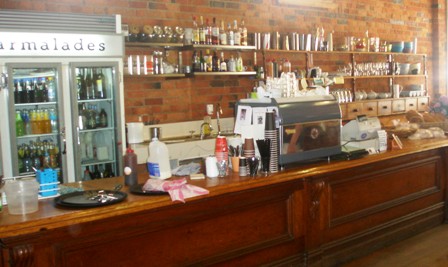
The counter

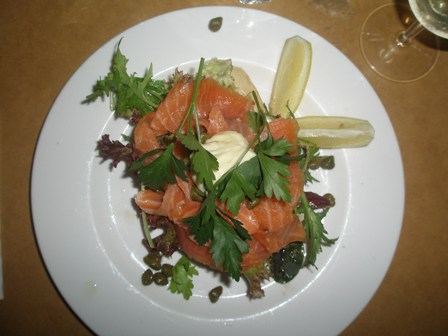
Below you can see some of our most preferred dishes.

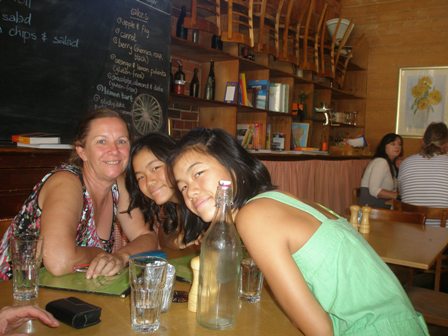
Margit, Charlotte and Lucy around the table

2. Elmers

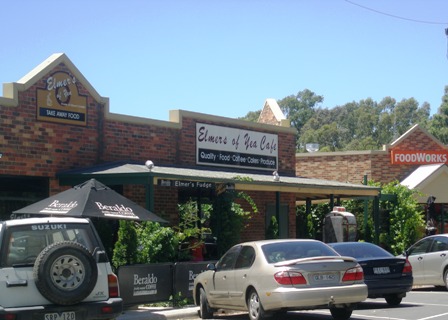
A little bit further down the main road, near the Foodworks supermarket, you will find Elmers, another cafe cum restaurant. At times you need to book because it is so crowded. As the occasional tourist just try you luck.

Behind the counter at Elmers, people are very busy.

3. The Country Club Hotel

Located about between the two, is the Country Club Hotel. It has, as most Australian pubs or hotels, a public bar and a restaurant. There is usually some kind of life music in the restaurant on the weekends. This is a good place for the evenings to go out and/or meet with friends and family.

I somehow do not have pictures of the inside of the Hotel and of the food served. However, let me assure you that I ate there the best Kangaroo steak I had ever consumed in Australia.

Mind you my first Kangaroo meat I tasted during my university years in Bonn. The ‘mensa’, as it is called in German, the university eating place, a ‘cantina’ so to say, had offered it as a novum to its hungry young men and women some 30 years ago.

Also the other dishes on the menu are worth trying. The Country Club Hotel also offers local wines with their meals. So if you are in the vicinity and you want to try solid, modern and traditional country style food please drop in and give a couple of hours of your time to Yea and its eateries. You will be pleasantly surprised. You will also have the opportunity to sample some of the finest locally produced wines from the Upper Goulburn Wine Region since all three restaurants have a variety of locally produced wines on offer.


Drowning in wine?

June 14, 2008

In todays Daily Wine news“, I found an article describing the recent changes in the Australian wine industry.

It starts with saying that “between 1997 and 1999 an unprecedented 40,000 hectares of grapevines were thrust into the soil across the nation”. Uff, I am one of those lunatics who put in vines during that time. Only a little, though, 3.5 ha to be precise. Now it (the land, our land) contributes as Two Hills Vineyard to the grape heap and/or wine lake. The increase in area under vines led to a 40% increase in output. Such growth was never seen in the history of the Australian wine industry before.

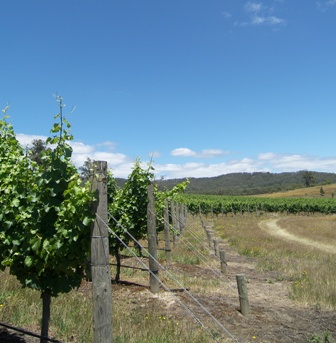
Two Hills Vineyard with the two hills in the background

Well, but I am actually exaggerating. There is no wine glut any more one could argue. Although it was not easy to find a market for our fruit, the very fact that there was fruit in abundance forced us to add value to the operation, e.i. make wine and sell it in Germany. We have survived so far. Of the last 8 vintages, two were to our full satisfaction, and the trend is positive. There is reason for optimism.

We are mainly growers and sell most of our fruit. The remaining part is turned into wine, mostly our Merlot grapes fall into this category. It allows me breathing space. I do not need to sell as fast as possible but rather on a pace we can stomach.

In the good old days growers had long-term contracts with wineries. Paradise has been lost ever since and the “spot market” is a true hassle. Some wineries are not relay reliable partners and it takes a while to sort out the ‘jewels’ from the ‘chaff’. That is costly for small vineyards. To run after small amounts of money and unpaid bills can be a hazard and it is a hassle. But some wineries treat their growers well. I know it from our friend Steve Sadlier, viticulturist (who tends our small property) and supplier of prime fruit to Yering Station in the Yarra Valley/Victoria.

Good to learn from the Daily Wine News article that the grower-producer relationship is about to change in response to the international market place and the flexibility required there. If that relationship, one of asymmetry in the past, would be more balanced, what a good news. Last vintage we had many cases of wineries retracting from earlier price offers. When they realised that the expected shortage of grapes was not to come and that they got sufficient fruit, they lowered fruit prices.

Another trend the Daily Wine News detected is that big companies shift away from developing their own vineyards. Well in the mid 1990s when the growers had no problem with selling any amount of fruit, wineries wanted to be on the save side and therefore invested in the establishments of their own vineyards. This is not only expensive, it also prevents the wineries from investing in other aspects of their business, for instance cellar technology, etc.. Some large wineries, it is said, rely on about 25-30% of their own vineyards, the bulk of their fruit intake is bought from growers.

Another welcome trend is that the industry is moving away from cheap fruit from warm and irrigated wine regions. That sounds nice to a small vintner from a cool climate region (the Upper Goulburn Wine Region). The rising water costs have hit growers hard and the change of demand does the rest: turn this land to other crops, maybe water saving food crops. The rising worldwide demand for food might be the incentive needed for that tectonic shift.

However, for small vineyards the development of boutique style wines and their own labels is a sine qua non for survival. And survive we will. Cheers


Yering Farm Wines

June 13, 2008

Enough of Europe and Indonesia, today I will take you to my future home country, Australia. This might be a sign of homesickness. Usually during the months of June-July-August we go back to our farm and spend splendid winter days in Glenburn, work a bit in the vineyard, plant trees, watch the kangaroos, have friends and family over for lunches on the grass (it’s not a lawn) and visit neighboring wineries and pubs.

As you probably know from earlier blog entries, the owner-winemaker of Yering Farm Wines (www.yeringfarm.com.au), Alan Johns, is also the person making our Merlot wines. In his huge shed thousands of bottles of Two Hills Wines wait to be consumed and in a dozen or so barrels our 2008 Merlot is doing what young wines do.

Yering Farm is beautifully located. When you turn off the Maroondah highway (also known as Whitehorse Road taking the name from White Horse Hotel in Box Hill) in Coldstream on the way to Yarra Glen, you will find it on the right hand side long before you see the town. The cellar door is an old hay shed with a very rustique character and great views of the Yarra Valley. Since I have posted pictures with these beautiful views before, I present today photos from the inside of the cellar door.

yeringfarm-2.jpg

The cellar door and tasting room

yeringfarm1.jpg

Many medals on the wall

yeringfarm-3.jpg

yeringfarm-4.jpg

Alan introducing his wines to a group of wine tourists

My hot tip of the day: when you are in the neighborhood visiting Yering Farm should be on your to do list. Have a good time there and say hello to Alan.


The mighty wine bloggers

June 10, 2008

Two Hills Vineyard: newly planted Chardonnay

Blogging is all in vogue these days. Millions of people write in their free time entries into their electronic diaries or online journals as they are called.

The founder of “Vinography” a reward winning wine blog, Alder Yarrow is the pioneer of wine blogging. His blog won various awards over the last years. In 2008 it received the American Wine Blog Awards for ‘best overall wine blog’ and ‘best writing’; in 2007 the same award was bestowed on him for ‘best wine reviews’. Vinography won accolades by the Salon des Vins de la Loire Wine Blog (2007) and Food Blogging Awards (2006, 2005, 2004).

Vinography is more than a private blog (www.vinography.com), it is a professional undertaking with various distinguished contributors. But apart from very interesting information about wine, wineries and vineyards, food and everything related to wine, Alder also collects blogs and he assembled a list of wine blogs, which you can find on his website. This list is of course not complete. An undertaking like this is never completed, there are always new people starting their blogs out there, and it is tedious to find them.

The list of about 600 or so odd blogs and wine podcasts is a very interesting piece of information.

There are about 65 winery blogs and 43 wine podcasts, some of them quite entertaining. The remainder are blogs in various languages. English is of course the most common language used by wine bloggers; the next most prominent is Italian followed by French. There are even wine bloggers writing in Japanese, Chinese and Indonesian.

As I mentioned in an earlier blog entry that some of these bloggers are pretty organised and that they do things together. For instance the German wine blogger organise so called “wine rallys”, where they write about a common theme selected by the members and hosted by one of the bloggers where all pieces produced about this theme are collected, analyzed and propagated.

The Vinography list of wine blogs according to language goes as follows:

404 English
41 Italian
36 French
29 German
22 Spanish
11 Portuguese
5 Chinese
4 Dutch
2 Japanese
2 Hungarian
2 Norwegian
1 Indonesian
1 Slovak

There is a wealth of information to be found about wine, wine regions, wine-making, etc. Some of these blog are humble private tools for enjoyment and distraction, others are professional instruments for marketing, information, analysis, presentation and sale.

Check it out yourself and have fun. It’s worth it.