Restaurant review: La Villa – Il Ristorante, Bangkok

June 27, 2009

LaVilla

We are so blessed. Living in Thonglor, Bangkok, we have quite a number of first class restaurants just in walking distance from our flat. The other day, we explored La Villa – The restaurant, a classic Italian place at the corner of some smaller lanes right in the heart of Thonglor.

The building is a 1930 architectural style modern replica villa with a large parking lot in front. After one has entered the restaurant, the hassle of the corner block traffic, is left behind and the cozy atmosphere of a true Italian family restaurant engulfs the eager dinner guests.

After an entree of bruscette, we went right for the main course. It was a Friday night and the four of us were hungry and tired. I went for my favorite pizza, a pizza margherita. the girls had some ravioli and Margit ordered a seafood pasta. To cut a long story short, the food is superb.

LaVilla2

The pizza margherita

LaVilla3

The ravioli

LaVilla4

Seafood pasta in aluminum foil

My knowledge of Italian wine is negligible. Having lived in Italy for almost three years but so little expertise, I am ashamed. Ordering the wine therefore, was a challenge. I choose a bottle of red, despite Margit’s seafood dish but with her consent (I admit of not caring much for the traditional tenet of having white wine with fish and seafood dishes).

LaVilla1

My choice was a ‘2006 Castello di Farnetella – Chianti di Colli Senesi’, a wine from the lower price range of the restaurants extensive wine list. As I learned later from my research, this was an excellent choice. Colli Senesi is a sub zone of Chianti which does not have the “classico” designation. As a consequence prices are ridiculously low for the quality. Whereas just across the road the classico wines sell for about US$ 30-40, they are only about about half at non designated side.

LaVilla5

The wine is medium bodied and has a good structure. It feels silky in the mouth and shows aromas of raspberry, prune, floral notes and licorice.

We had a great evening at La Villa. With its very competent and friendly service, this classic Italian restaurant is an excellent choice for a family meal in a homely environment. Check it out when next in Bangkok.

Address:
La Villa Wine Lounge and Restaurant
Bangkok
131 Thonglor, Soi 9
Sukhumvit 53
Bangkok 10110
Tel.: +66-2-7129991
www.lavillabangkok.com
Opening hours: 11:00-14:00 AM/PM and 18:00-23:00 PM


Thailand’s Best Restaurant – Patara

June 18, 2009

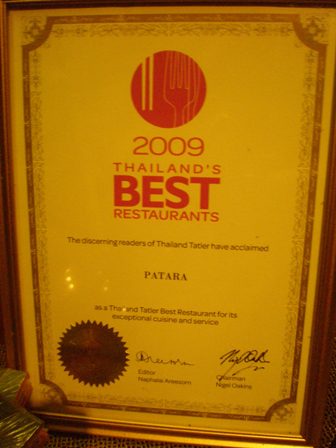
We are so lucky in Bangkok. Our humble home in Thonglor is just around the corner from some major eateries. One of them is Patara Restaurant which we patronize from time to time. During a recent visit we discovered that Patara was bestowed with the Best Restaurant of Thailand award. They deserve it. I tell you, the food is delicious as the following pictures suggest.

PPatara1

PPatara3

When Jasmin from Jakarta visited us recently, we took her out to Patara and had a wonderful meal. The two entrees below are fabulous. We drank beer with the Thai food. The Phuket beer is not bad. But Patara has also a fine wine list, we just did not feel like wine.

PPatara6

Fltr: Charlotte, Margit, Rainer, Jasmin, and Lucy

PPatara4

PPatara5

PPatara55

PPatara2

Finally, we discovered that Patara restaurant is also offering a cooking book. If in Bangkok next time Patara is a must for you and any gourmet traveler.


The best Australian dessert

June 13, 2009

Pavlovl

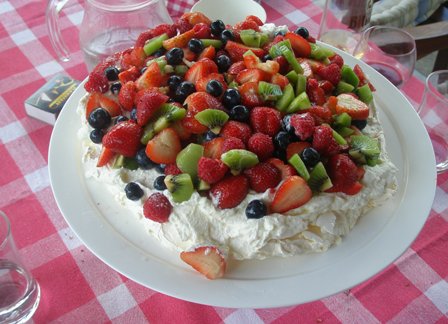
The Australian Pavlova

Have you heard of Pavlova? Well, for Australians that’s the stuff you want for dessert. It is wonderfully refreshing, smooth, fruity and just a delight.

Pavlova, you might think does not sound very Australian. And in fact it is not. The dessert is named to honour a Russian ballet dancer, Ánna Pávlova (Russian: А́нна Па́влова) touring Australia and New Zealand in the 1920.

Commonly referred to as “pav”, it is a cake of meringue with a crispy crust and soft inner part topped with red and blue forest fruit and some kiwis. The name is pronounced “pævˈloʊvə” unlike the name of the dancer which is pronounced “pɑːvləvə”.

The dessert is a very popular dish. It is also an important part of the Australian national cuisine. Isn’t this mazing.

However, research suggests that the Pavlova originated from New Zealand. Well, that’s no deterrent for a culinary delight.

Pavlovl2

Among friends

We had the above Pavlova on our terrace in Bangkok after a barbecue lunch with some friends. Lots of meat, salads and vegetables were consumed. Lashings of beer and wine made this consumption all the easier. But best was the company.

A recipe for Pavlova you can find on: http://en.wikipedia.org/wiki/Pavlova_(food)


Restaurant review: Chopin, Berlin

June 8, 2009

chopin1

The Chopin restaurant

Last year I had the chance to dine twice at Chopin restaurant which is located between Wannsee and Griebnitzsee in the South west of Berlin. The cuisine the restaurant specialises in is Silesian food. Today Silesia is a region of Poland smaller parts of which, however, are belonging to the Czech Republic and to Germany.

chopin3

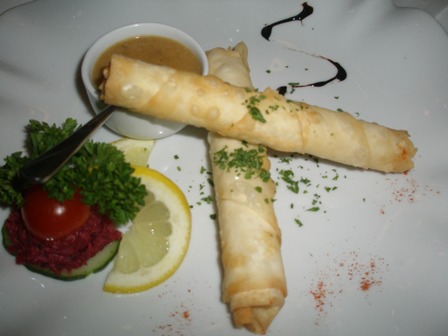
The entrée “Schlesische Zigarren

We had a fixed menu which was ordered for the occasion. The entrée consisted of “Schlesische „Zigarren“, Silesian cigars (price Euro 3,90), a puff pastry filled with sheep feta and a mustard sauce.

chopin2

The beef dish “Schlesischer Sauerbraten”

We could choose between two main dishes: a “Schlesischer Sauerbraten”, a marinated pot roast (price Euro 11,90) with red cabbage and apples, peaches and cranberries served with German dumplings, ….

chopin51

The pike perch (German: Zander)

…and a fish dish, consisting of a pike perch roasted in a sauce of dill and with zucchini (price Euro 13,90). Potatoes and vegetables were also presented.

Since we dined at the restaurant twice within a week, I had the opportunity to taste each of the main dishes.

Needless to say (you can see it from the pictures) the food at Chopin restaurant is delicious; it’s a splendid example of German country cuisine at its best.

chopin4

Pinot Gris

There were two wines served with the food: a white (Grauer Burgunder/Pinot Gris) from Baden, Germany and a red (Nero d’Avola) from Sicily (which is not on the wine list any more).

I had the white, a ‘2004 Oberbergener Bassgeige, Grauer Burgunder, Kabinett, dry’, from the Kaiserstuhl wine region in Baden.

It’s a massive white wine (13% alc.) not something light for the summer. It has substance and structure which make it an ideal partner for pairing with Silesian food.

The producer of the wine is a “wine-co-operative”. The Gault Millau as well as the Eichelmann Wine Guide award the co-operative “one bunch of grapes” (Gault Millau: reliable) respectively “two stars” (Eichelmann: good producer).

I very much like this cosy family restaurant. If you are in Berlin next time, please do not miss to pay it a visit.

Address:
Restaurant Chopin
Wilhelmplatz 4
14109 Berlin, Germany
+49-30-8053033


We, the small people of wine

June 5, 2009

Today, I came across a quotation by Frances Ann (Fran) Lebowitz, an American social commentator, which reads like this:

“Great people talk about ideas, average people talk about things, and small people talk about wine”.

I am glad that there are so many of us, “small people” around, thinking, talking, sharing, writing and blogging about wine. The world would be a much poorer place without us. Ideas we have too, and a few things as well, I guess.

My friend Siggi Herzog sent me a youtube video which depicts a lovely German “drinking song”.

With this, I wish you a wonderful weekend, a time of food and wine, with song and laughter. Cheers


Country living: The good life in Ramsdorf, Westphalia

May 31, 2009

The land

Rams16

The Münsterland, Westphalia is not exactly a wine region. People in this rather flat but beautiful rural part of Germany, just an hours drive from the Industrial heartland of the Ruhr (the drive can be as short as 30 minutes only), prefer to drink beer and “Korn”, a spirit also called “Schnaps” distilled from wheat and other grains.

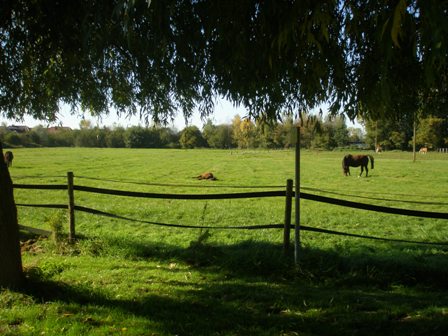
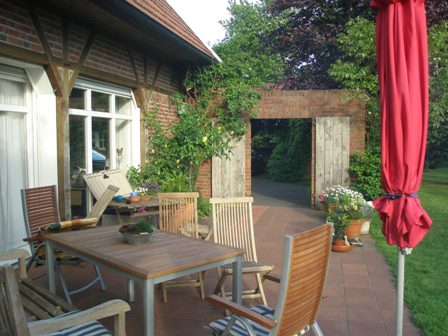
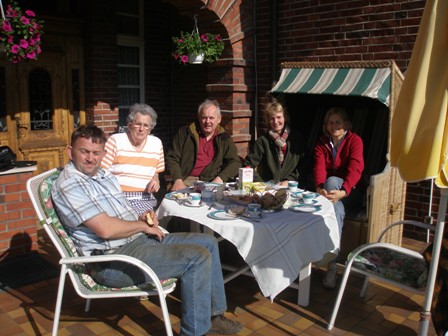
The farm houses are made of red bricks, have large wooden doors, usually green, high gables and are just magnificent. They stand alone within the land belonging to them, accompanied by large stables and barns, all erected in the same style, a wonderful sight. I went there to visit my friends Uli and Elfriede in a small hamlet called Ramsdorf.

Rams15

My friends Uli and Elfriede’s house, formerly a cottage of the estate (from the back)

Rams00

The backside with the outdoor furniture

The Food

As the people so the food, one could say. Rural people everywhere developed healthy, nutritional type of foods; no-nonsense stuff, usually based on the raw materials the land has to offer. So the Münsterlaender cuisine has a lot of sausages, ham and various kinds of meats, served with potatoes, and green vegetables.

Rams0

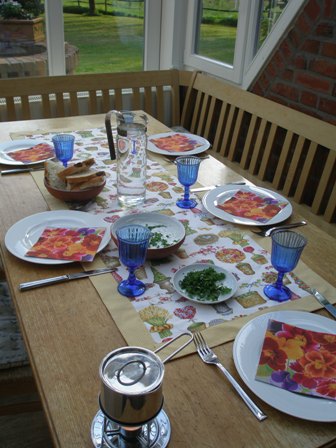
The table in the patio

Rams1

Beautiful beef

Rams2

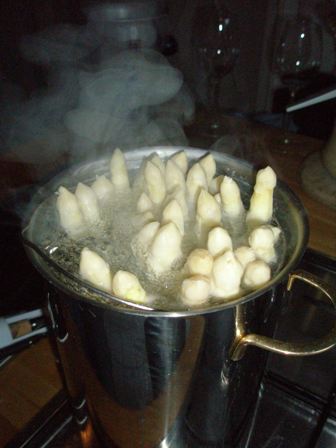
Fresh asparagus in a special asparagus cooker

Rams3

The finished product: asparagus

Rams4

The finished product: the steaks

Rams5

Our meal of asparagus, potatoes, ham and a steak with melted butter

The wines

We did of course also drink wine with this delicious meal. We started while the asparagus was still cooking with a ‘2008 Knipser Sauvignon Blanc dry’ by Weingut Knipser, Pfalz, a wonderful wine, fresh, fruity with structure and depth.

The brothers Volker and Werner Knipser (and since 2005 Stephan, Werner’s son) are the owners of this vineyard and winery in Laumersheim, Pfalz. The family operates the estate since 1876. Today about 40 ha are under vines. The brothers were the first in this part of the Pfalz to use small barriques barrels to mature their wines. They also increased the area under red varieties and replanted with high quality rootlings. In 2009 the were awarded “Vintner of 2009” by Gault Millau for their innovative ways and their high quality wines. My first Knipser wine, I drank many years ago when living in Beijing. My friend Norbert Finkel, a journalist from the Pfalz, introduced me to the Knipser wines long before they became fashionable.

Rams6

‘2008 Knipser Sauvignon Blan dry’ in the bottle

Rams7

..and in the glass

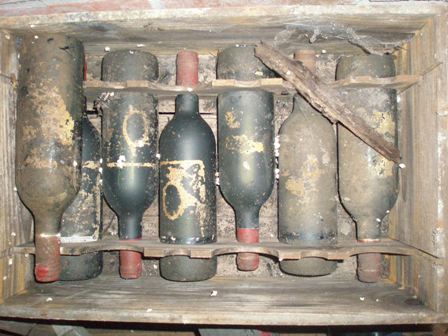
After the white, we longed for some red and went out into the shed where Uli stores his wines. Here we unearthed an old wooden box with red wines from Bordeaux, France.

Rams8

Treasure trove

Rams9

The chosen one

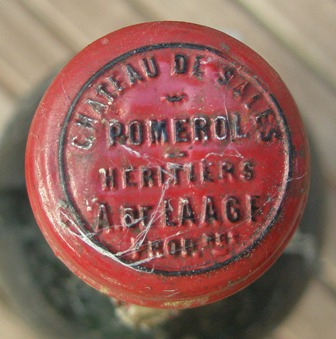
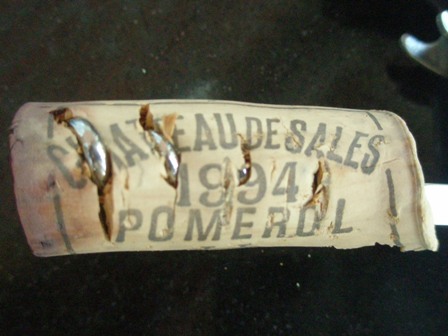
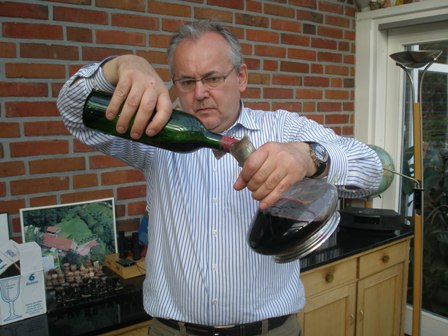
We selected a ‘1994 Château de Sales’, a Bordeaux blend from Pomerol, France. Uli de-cantered the wine, the drop was excellent but needed to be drunk. So we had “discovered” it at the right time. The blend was full flavoured, with structure and harmonious tannins and very enjoyable with our food. The wine sells on the internet in the UK for £ 30-35 and in continental Europe for about the same amount but in €.

Rams10

The top of the capsule

Rams11

The cork

Rams1112

Uli de-cantering the Bordeaux

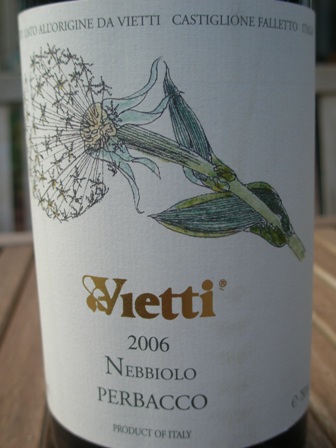
We finished the evening with an Italian wine, a ‘2006 Vietti Nebbiolo Parabacco’ from Langhe, Piedmont in Italy. That was quite a change from the Bordeaux. The wine was rich and complex. It showed well balanced tannins which were chewy at the finish, just great for a red. What a pleasurable wine to end a very pleasurable day with my friends in the Münsterland.

Rams12

The Nebbiolo bottle from Vietti

The people

I quickly introduce my friends, the three Hillejan families. Georg and Barbara are the farmers, aunt Doris, the mother of Georg and Ulrich, and Ulrich and Elfriede, my old friends from University days. I used to work on the farm as an intern during my students days when Uli’s father Alfons was running the estate. I loved to work for uncle Alfons. He was a great man. But I did not only work but also play there. We celebrated quite a few events (a few weddings among others) on that farm, had wild parties and a great time playing farmers.

Rams13

Georg, aunt Doris, Ulrich, Barbara and Elfriede on the veranda of the old farm house

Rams14

Three men on a mission, Ulrich, me and Georg


Germany: Asparagus season

May 26, 2009

Asparagus1

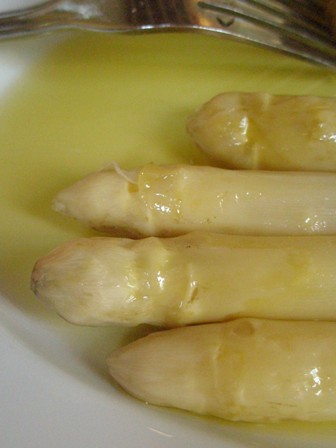
A spring delicacy in Germany

It is the asparagus season in Germany and I had the opportunity to indulge myself into quite a few “asparagus orgies”. Fresh white asparagus is so delicious. I like it with just some melted butter, a few potatoes, and maybe some fresh German ham.

Asparagus2

Tender asparagus tops

Asparagus3

Delicious potatoes

What wine do you drink with asparagus? Well, I had a simple Riesling from the Rheingau. But almost all white wines pair well with white asparagus. Germany is a Mecca for white wines. The recent edition of the “Weinwelt” (wine world) magazine identified four best buy whites to consume with asparagus. All were of different grape varieties (Vinho Verde, Silvaner, Sauvignon Blanc and Grüner Veltliner but no Riesling), and all can be purchased for under € 7.-, what a bargain. They were:

‘2008 Quinta de Azevedo Vinho Verde’ by Sogrape Vinhos, Portugal;

‘2008 Grüner Silvaner, dry’ by Weingut Manz, Rheinhessen;

‘2008 Tour de Pocé Sauvignon Blanc Réserve’ by Pierre Chainier, Touraine, France;

‘2008 Grüner Veltliner Hundschupfen, dry’ by Weingut Hagn, Mailberg, Austria.

I have not tried any of them as yet but reading the review brought tears to my eyes, my nose was hallucinating, and my taste buds seemed to feel the crispness of the wines.

Asparagus4

My “simple” Rheingau Riesling


The “good” Lehmann and not the Lehmann brothers

May 23, 2009

While we were working on Thursday, May 21st. in Bangkok, our German colleagues were celebrating Ascension Day, also known as “Fathers Day” in my native Germany. “Father’s Day” is usually celebrated in the following way: young fathers, some older ones among them, and many other men, usually the ones who have not fathered any child they are aware of but eager to celebrate whatever comes their way, gather in the morning around a handcart loaded with all kinds of drinks and food. Then they set out and walk into the surrounding countryside to drink with their mates and have a jolly good, all-male time. Sometime they have a specific destination or they walk around a circuit. I will refrain from describing the usual end of these walks.
In short, the occasion warrants a special treat.

On this Father’s Day in Bangkok, I had the great pleasure of enjoying some hearty Italian meals, delicious pastas and insalata caprese and other delicacies. The rather colder nights in Bangkok, due to the beginning of the rainy season somehow incited in me the desire for some good reds; Australian was the natural choice.

Swirling College Wine

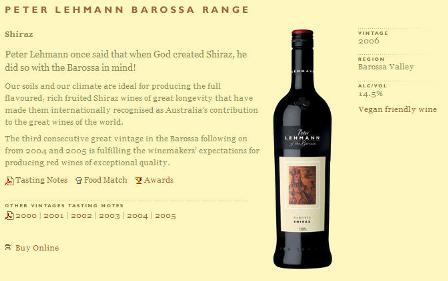
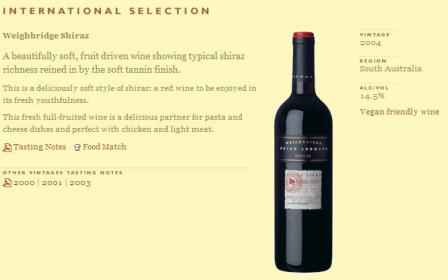
Peter Lehmann and his Shiraz wines seemed to be just the right stuff. Since wine prices are dear in Thailand we have to be careful with our choices.

Peter Lehmann is one of the few Australian vintners who became a legend in his own lifetime. Today, Peter Lehmann Wines in the Barossa Valley, South Australia is part of the Hess Family Estates with wineries in the Napa Valley, South Africa and Argentina.

Peter Lehmann Wines was established in 1979 as a response to the serious grape overproduction at the time (sounds terribly familiar in 2009 too). Most of the grapes come from about 185 contract growers. Only about 3% of the total wine output is derived from the self-owned vineyard (73 ha which is not small for a boutique vintner like me).

The Shiraz wines are the flagships of Peter Lehmann which assured me that nothing could go wrong.

We bought the following wines:

1. A ‘2006 Peter Lehmann Weighbridge Shiraz’
Peter Lehmann 2006 web

2. A ‘2005 Peter Lehmann Barossa Shiraz’
Peter Lehmann 2005 web

Both were “reasonably” priced for Thai conditions. The price for the bottle of Weighbridge Shiraz was about 700 Thai Bath (US$ 20 or € 14.6) and for the Barossa Shiraz about 1,000 Thai Bath (US$ 29 or € 20.8). Retail prices in Europe range from € 8-12 resp. € 15-17 or £ 6.50 and £ 7.50 in the UK. Interesting these price differentials. That’s the price of protectionism. Long live free trade.

Both wines went well with the Italian food. They had a beautiful dark red colour, were spicy and full of black fruit, plum in the case of the Weighbridge Shiraz. The 2005 Barossa Shiraz was “heavier” with lots of chalky tannins, a wine to be chewed so to say. We started with the 2006er bottle and went on to the older, in my view better, wine, which was absolutely the right choice.

I have not visited the Peter Lehmann winery in South Australia myself. The website is beautiful, informative and very enticing. I conclude: one should visit the place.

It takes about one to one and a half hours to drive to the winery from Adelaide Airport.

Address:
Peter Lehmann Wines LTD
off Para Road
Tanunda SA 5352
South Australia


On the road again

May 21, 2009

Huns2

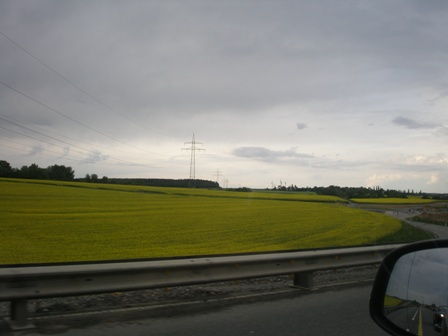
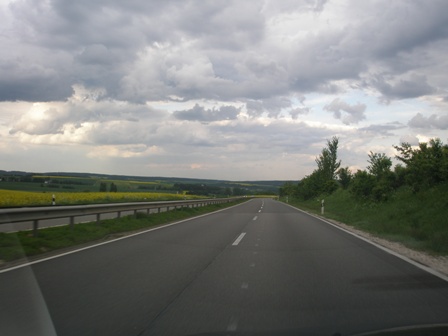
It was a gorgeous day when I drove from my home town Trier at the Mosel to the airport in Frankfurt. I passed through the hilly country called the “Hunsrueck”, a large plateau with deep forests and not-to-infertile plains where grains, maize and rape seed are grown. After a couple of kilometres clouds appeared and it started to rain.

Huns3

The yellow of the rape seed fields contrasted beautifully with the surrounding green of the grains, the grass and the trees. From the moving car I took a couple of shots to capture the contrast. Reality is almost always more beautiful than those quick digital camera shots.

Huns1

I had about two hours for contemplating about life, death and the universe. I love these rare occasions of introspection. I love the short life between the worlds, leaving Germany for the tropics of Thailand. Having left a world behind but not reached the desired destination, leaves me in a kind of vacuum, an emptiness full with feelings.

Huns4

The last leg of my journey led me through parts of the Nahe and the Rheingau wine regions. At this time of the year the vines appear tender and soft, near the flowering stage maybe, but the green of the leaves is still a light green.

The rainy season would wait for me on the other side of the world. Only the long hours in the narrow plane would be between “me in Germany” and “me in Thailand”, the past and the future, the wines of Germany and the wines of Australia and Thailand of course.


Wine heaven – my visit to Berlin

May 16, 2009

Wineandcigar

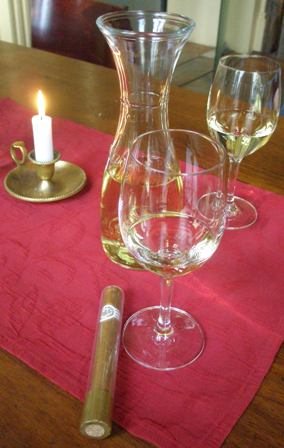
During my brief visit to Berlin, I tasted quite a few fine wines. I do not want to bore you with long stories. The following three wines are, according to my taste buds, highly commendable.

‘2007 Sauvignon Blanc Baron de Philippe de Rothschild, Languedoc-Roussillion, France

I do not know much about French wines, but this SB is just perfect. I loved it with the fresh asparagus dish. It had all the varietal character of an SB and a crispness which blew me away. Very dry with wonderful passion and kiwi fruit aromas with a formidable minerality.

‘2006 Merlot Weingut Leopold Aumann, Tribuswinkel-Thermenregion, Austria

Austrian wines are the vogue in Germany (highest increase in exports to Germany this year). This Merlot by Leopold Aumann was an excellent example of the high art of wine making by our Austrian neighbours. I could not get enough of it, soft and full blown fruitiness.

‘2007 Künstler Kirchenstück Dry Riesling’, Rheingau, Germany

“Kirchenstück” is one of the oldest (1271 !!!!) and best “terroirs” of the Rheingau. This young and very dry Riesling is a wine with great finesse, filigree and a wonderful lingering finish. I am sure it will ripen well in the bottle and in your cellar. If you can get hold of some bottles: buy, buy, buy.

Soon more about fine wines. Germany is just a Mecca for wine lovers (so are France and Austria).