News from Glenburn, Victoria

February 4, 2008

I usually do not hide my liking of globalization. While strolling through my hometown Trier in fall last year, I discovered on one of my long walks around town an Australian restaurant. Greetings from ‘down under’ in this 2000-year-old town of Trier. Isn’t it wonderful? Emperor Constantine would have been very pleased.

emu-bar-in-trier.jpg

The Emu restaurant in Trier

I also found a cafe just next to the Karl Marx house (the birthplace of the great philosopher) opposite one of my favourite wine bars, the ‘Das Weinhaus’, where you could enjoy the smoke of a shisha (or water pipe). If Karl would have known, he would have been delighted, I hope.

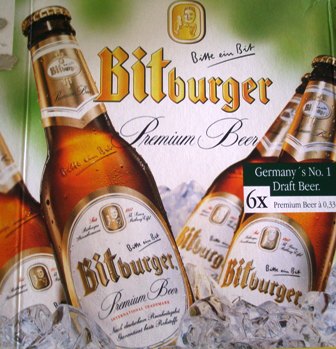
Michael my brother-in-law, who lives in Healesville, a beautiful little country town in Victoria about 3/4 of an hour northeast of Melbourne, used to buy Bitburger Beer for me. He knows that I love this brew from my home region. During his recent wedding I could enjoy some more of it. Great feeling to be so far from my birthplace, and to be able to drink the same beer thousands of kilometers away, far south on the other side of the earth. Goodness me.
bitburger-ad.jpg

bit-bier.jpg

Country folks need a drink from time to time, and vintners do not always drink wine!

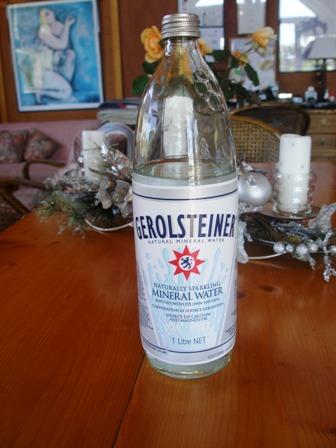
Another product from my home region has found its way to Australia, Gerolsteiner mineral water. The name ‘Gerolsteiner’ was made famous in sport enthusiastic Australia through the sponsorship of the cycling team with the same name. But now you can buy this wonderful drink (good after a hangover or in case of gastroenteritis).
gerolsteiner.jpg

The sparkling water from Germany

Let me follow this up with some ‘news’ or observations of what has changed since we last visited Glenburn and its surroundings.

● The Yarra Glen Grand Hotel had been finally sold by John Lithgow and we found the pub full of people enjoying the new atmosphere created by the new owners.

● The old Henkel Vineyards (descendents of the German sparkling producers) cellar door was sold and is now called Mandala Wines which is owned by the Smedly family (www.mandalawines.com.au). Henkel is erecting its signpost a couple of kilometers further north of the old place near Dixon’s Creek.

mandala.jpg

Mandala Wines, the new cellar door in the making

● The Wine Hub at the Yarra Valley Dairy (www.yvd.com.au) has gone out of business and with it we lost one of our retail outlets.

● Cheese Freaks in Yarra Glen is gone and has become a nice little restaurant.

● David left the local Healesville band the “Heartstarters”.

Giant Steps Winery (www.giants-steps.com.au) in Healesville, owned by Phil Sexton and his family, is in full operation (bar, coffee house, restaurant, bakery, winery, etc.) and has been also adopted by the locals who patronize it in great numbers.

Steve Webber of ‘De Bortoli Wines’ in Dixon’s Creek (www.debortoli.com.au) was awarded the very prestigious “Winemaker of the Year” by the wine magazine ‘Gourmet Traveller’ (www.gourmettravellerwine.com.au). Congratulations!

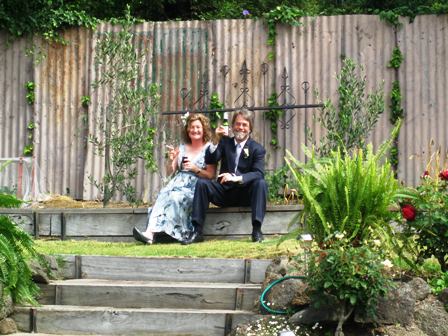
Michael and Helen got married of course. Congratulations again. Cheers.
pc160326.jpg

There are of course more news to report, but the above is what jumped into my eye while touring the beautiful Victorian countryside. Needless to say, we sampled quite a few local wines from the Upper Goulburn and the Yarra Valley.


The other Trier

December 9, 2007

ohneb.jpg

Its hard to believe but its true as well, my otherwsie beautiful hometown Trier has some rather ugly parts as well which I do not want to hide from you. Through my many walks through town I detected some of these eyesores and thanks to digital cameras one can document progress (or the lack of it) as well.

First of all it seems to me that the ‘fathers of the city’, as the council members are usually called, and/or the administration in general do not possess an eye for green, particularly trees. Though I must admit that recently the administration of the new major has started to plant at last some allee trees along some of the wide roads entering the city. But in the centre of town, where my mother lives and where I grew up, trees have become less and less in numbers.

Especially along the roads surrounding the pedestrian zone it seems that everything has been done to accomodate the traffic and the many cars. This means trees have been felled where they were ‘in the way, dangerous or a nuisance’ to car drivers. Consequently many of these roads are bare of any natural shade. When its windy, these streets turn into wind channels and for pedestrians it is very unpleasant to walk these city streets.

ohnebaum.jpg

The above two photos are from the newly refurbished square near the Archbishops Museum. The square looks bare and empty. The few trees planted will of course grow and occupy more space. But this minimalist type of greening is not what I think would be appropriate.

Other cities I lived in, for instance Bonn, the town of my alma mater, is much more progressive when it comes to greening the city. There is hardly any street without shade trees. Old trees are regularly replanted and pruned. Poeple there seem not to be scared by the many leaves the trees drop in autumn.

One of the really bad eyesores of Trier is a place very close to my home where I grew up at Irminenfreihof 5 in Britannia. It is the St. Paul’s Square in front of St. Paul’s church were we used to attend mass and met our mates afterwards.

paulusplatz.jpg

St. Paul’s Square (the church is to the right, to the left are the various vocational schools)

The square is neither used as a parking lot nor for anything else. The trees which once stood there have been cut down but not replaced. We can safely assume that there is a plan in place for the future beautification of the square. Most likely the money is not there yet to put this plan into practice.

I find the state of affairs of this square very sad. I also believe that not much funds would be needed to get it into shape if modesty would prevail. I would love the city administration to do something useful with the place, maybe establish a small park where the students of the nearby vocational schools could hang out after classes?


Karl Marx and Mosel wine

September 26, 2007

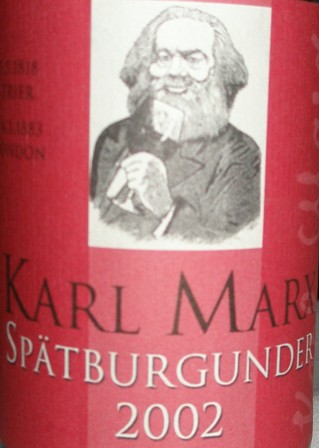
When I visited my hometown Trier recently, I also went to the place where Karl Marx, the most famous of our citizens, was born in 1818 (the Karl Marx Haus). What I did not know about him was his relationship to wine and the Mosel wine industry. From a leaflet collected at the tourist paraphernalia shop I learned that the parents of Karl Marx were vineyard owners along the Ruwer in Mertesdorf where they owned several parcels. It was quite common for bourgeois families of the times to acquire vineyards either for their own wine consumption and/or for investment and old age security reasons. The Marx family vineyard was found in the location “Viertelsberg” a medium quality terroir near the castle ‘Gruenhaus’. Today, the ‘Weingut Erben von Beulwitz’ produces a 2002 Spaetburgunder (Pinot Noir) wine with a Karl Marx label to commemorate this famous “son” of Trier. The wine is not exactly from the old Marx family vineyard but derived from vineyards nearby. Some time ago I had tasted this wine with some delicious venison (big horn sheep) which my mother had prepared for me.

karlmarxweb.jpg

The label with Karl Marx

Marx himself was fond of drinking wine and appreciated the value of it. More interesting is the fact that among others the misery of the Mosel wine producers inspired Marx to study and research economic issues in general. In various newspapers Marx reported about the problems of the Mosel vintners. He criticized the Prussian government for its lack of support which in the end brought him into conflict with the authorities in the 1840ies which in the end led to his exile first in Paris, later in Brussels and finally in London.

After Napoleon lost the war and with it the once occupied lands west of the Rhine river, these territories were given to the Kingdom of Prussia after the peace congress of Vienna in 1815 and administered as the Prussian Province of the Lower Rhine. This marked the beginning of a golden age for Mosel wine producers since they benefited from tax-free export of their wines to Prussia. Unfortunately, the phenomenon was short lived when, with the introduction of the German Customs Union (Zollverein) in 1834, vintners from the southern German states were in the position to successfully displace their competitors from the Mosel. This in turn brought wine prices down. An unfavourable Prussian tax policy coupled with bad harvests led to the pauperization of many vintners at the Mosel. Marx was appalled by their suffering, criticized the government, violated press censorship requirement and in the end had to leave into exile.

In 1857 the Marx family sold its vineyards in Mertesdorf. But due to the efforts of the Weiss family (the owners of the Weingut Erben von Beulwitz, www.hotel-weiss.de), we can enjoy today a Pinot Noir depicting the face of Karl Marx on the label. These bottles can also be bought at the aforementioned shop (7.5 €/0.75 l bottle).

mertesdorf-ruwer.jpg

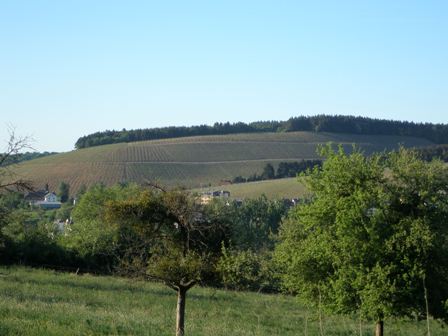
Ruwer vineyards near Mertesdorf in spring

PS: I personally think that it is a pity that the wide adoption of his ideas in Eastern Europe, Vietnam and China for instance brought so much misery to mankind. Less emphasis on the collective and more on individual freedom would have gone a fair bit. Marx should have stayed with drinking and enjoying wine and give up writing in the first place, one is tempted to argue.

In a letter to the father-in-law of his daughter he mentioned that “a man who does not love wine will never achieve anything good for mankind”. Unfortunately, wine drinking is not a guaranty for such deeds as his own life showed.


Along the Mosel River

September 12, 2007

I have often traveled along the Mosel River by train. Last weekend I decided to abolish the train and drive by car from Kobern-Gondorf to Trier. Unfortunately, the sun did not shine. But despite this handicap it was one of the most marvelous trips I have recently made.

The Mosel River valley was buzzing with visitors and tourists. Groups of cyclists, tour buses, camper vans as well as people on foot, motorcyclists and others were cruising along the river and swarming the small towns and villages. Almost every settlement advertised its ongoing or imminent wine festival and vintners’ fair. Everywhere one could buy wines, have a meal or stay overnight. Vintage was in full swing in many places and the young fermented grape juice, in German called “Federweisser” was everywhere on offer.

rivermosel.jpg

Barges and a ferry on the river and a castle in the background

moselriver2.jpg

Steep slopes and a narrow valley, vines on “Graywacke” slate plates

The appelation of the wine region “Mosel-Saar-Ruwer” is the result of the Wine Act of 1909. From 1936 onwards wine labels could show this designation. In 2006 the German Parliament passed a new law abolishing “Mosel-Saar-Ruwer” and simply replacing it with “Mosel” and since August 1st, 2007 the region is officially called “Mosel” only.

The region consists of six sub-regions with 19 locations (Grosslagen) and 524 individual locations (Einzellagen). 5,500 wineries and vineyards are spread over 125 settlements, villages and towns. The total area under vines is about 9,000 ha, which produce annually about 850,000 hectoliters of wine (including 75,000 hectoliters of red wine). The largest wine producing acreages can be found in the settlements of Piesport, Zell (Mosel), Leiwen, Konz, Neumagen-Drohn, Mehring, Bernkastel-Kues and Trittenheim. I passed through some very famous vineyard locations such as “Bremmer Calmont”, “Wehlener Sonnenuhr”, “Erdener Treppchen”, “Ürziger Würzgarten”, “Piesporter Goldtröpfchen”, “Bernkasteler Doctor” and many others.

steepslopes1.jpg

The elevator “sledge”

steepslopes2.jpg

The “rail” for the “elevator”

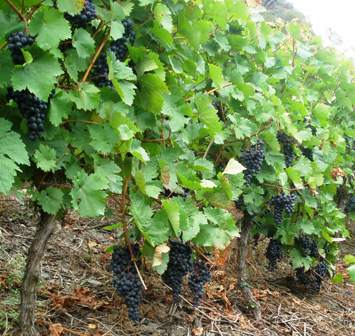
The region has the largest extent of vineyards on steep slopes (inclinations range from 30% till 60%) in Germany. The Mosel region is also the biggest Riesling producer in the world (with about 5.000 ha acreage). Recently some of the more extreme locations have fallen fallow. Traditionally vines were planted on the steep slopes using single posts. In recent times they have been gradually replaced by modern trellis systems. For transport purposes, elevator systems were installed in some locations, as shown on the photos below. I was very surprised to find a lot of red grapes planted in the flat lands near the river. Most of them are Pinot Noir and Dornfelder grapes. There is an increasing trend to extend the acreage for red varieties and the Mosel has once again become a superb producer of red wines, especially Pinot Noir.

redgrapes1.jpg


The “wine map” of Trier

June 6, 2007

My friend Elisabeth from Berlin sent me an interesting article the other day. It was from the Brigitte magazine (www.brigitte.de/trier) and showed a map depicting some recommended wine bars, bistros, restaurants and country inns where fine wines and good food could be enjoyed in my home town Trier (Augusta Treverorum) at the Mosel river.

I must admit that I grew up as a beer drinker, from time to time also enjoying the local cider called “Viez” (very dry) and maybe a Schnaps called “Trester” and made from distilled pressed grapes. My maternal grandfather (Hans-Heinrich Schuessler), however, came from a small hamlet (Reichenberg) near Wuerzburg at the Main river, and was an enthusiastic wine connoisseur. In fact, it was he who introduced me at the tender age of 15-16 to the world of fine wines, mostly dry Silvaner (Bocksbeutel) from the Main region. But because he lived in Martinstein at the Nahe river, we also drank wines from this terroir. He did not like the Mosel wines much.

As you probably know, I usually patronize “Weinstube Kesselstatt” (a wine bistro) near the cathedral. During my recent visit to Trier, I found some of the wine drinking places described in the Brigitte magazine. Due to the shortage of time, however, I could not try them out. I found for instance the wine-restaurant “CUMVINO” which belongs to the diocese of Trier. The catholic church, monasteries and the clergy, were traditionally always lovers of fine wines and developers, promoters and masters of vineyards and wine production.

Other places mentioned in the magazine, I have never heard of, for instance the restaurant “Beckers” in the valley of Olewig at the outskirts of Trier in the middle of steep vineyards. I have to try some of these places. My plan for September and October, when I will be visiting Germany and Trier again, is getting fuller and fuller.

p5030692web.jpg


Single Malt

June 1, 2007

What happened, you might ask yourself? Single malt, that’s not wine! Has Rainer finally left the so much loved and appreciated result of grape fermentation behind and turned to harder drinks? Well, on a recent trip to Bangkok, my old friend Rainer Heufers, who has earlier introduced me to the amazingly complex and enjoyable world of whiskies, gave me a copy of one of the bibles for whisky connoisseurs, “Michael Jackson’s Malt Whisky Companion”, 4th edition.

What a marvellous book this is. Michael Jackson must be to the whisky world what James Halliday and Hugh Johnson are to the wine drinkers. Wine and whisky do have commonalities. For both wood is important. Vintages are clearly identified. The rating system consists of a 100 points scheme. And finally, the verbal description of the liquid as provided by the tasters show similarities with wine too. I give you some examples:

Colour: very full gold with orange tinge
Nose: fresh, soft, very aromatic, with rich malt dryness
Body: light to medium, creamy
Palate: clean, grassy, fruity, becoming cookie-like and nutty
Finish: long, firm dry, malty, restrained, dessert apple

malt-whiskey-small.jpg

The book cover: Michael Jackson’s Malt Whisky Companion

Hundreds of different whisky brands are listed and described in this beautiful book. Of some of the distilleries, photos are added. Short histories provide the readers with another kind of “bait” to explore the world of whisky on their own. Maps and detailed descriptions of the various locations, products, vintages and the distillery process invite the reader to engage and appreciate the world of single malts. Because water is so important for whisky production, many distilleries are located in glens, valleys with streams. My home in Australia is located in Glenburn, family and friends live in Yarra Glen, both places have their water and clear mountain streams.

But the whisky world is full of “Glens”. Names such as Glen Albyn, Glenallachie, Glenburgie, Glendronach, Glendullan, Glenfarclas, Glenfiddich, Glenmorangie, and Glenugie sound exotic to my ear. I decided on the spot that our next trip to Europe would include a visit to Scotland and some distilleries there, probably in the highlands or on the Spyside.

Being of Celtic extraction myself (remember the Treverer! Of the Mosel river valley), I have a soft spot for everything Celtic, as you probably know. I could combine the whisky exploration with some sightseeing. I always wanted to see Edinburgh. Among others I could fulfil one of my dreams: buy a Scottish kilt, probably a young designer item by Howie Nicholsby. They are really cool. Ever since I saw some examples of his art in an airline magazine, I hedged this idea of acquiring a kilt for myself. Tonight there is another Scottish highlight waiting for me. On the eve of the Jakarta Highland Gathering, the Java St. Andrew Society (www.javastandrewsociety.com) is organising Scotland in Concert, a splendid presentation of Scottish music. They will certainly also offer whisky, maybe even a single malt. See you there.


Mama’s kitchen: tender bighorn fillet with mushrooms

May 11, 2007

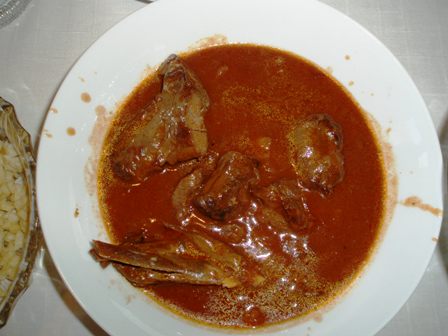
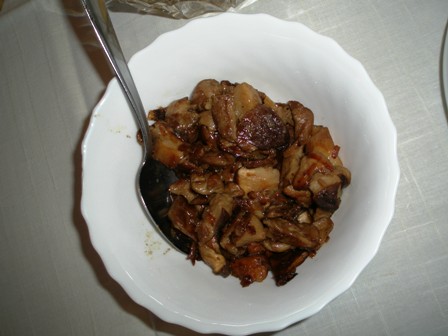
Because I am from a hunter’s family, we have from time to time dished with meat from wild animals at home. During my recent visit to Trier, my mother prepared a tender fillet of a young bighorn sheep (Mufflon in German). The young Mufflon was shot in Schoden at the Saar river by my friend Heinz. She served it with freshly collected wild mushrooms (Steinpilze also from Schoden), a cabbage salad and spaetzle (literally translated: little sparrow), a kind of tiny noodles or dumplings made with flour, eggs, water or milk, salt and sometimes nutmeg mainly used in the South German (my mother comes from Franconia), Austrian, Alsace and Swiss cuisine. I took some photos of the delicacies so that one gets a better idea. It was such a wonderful meal.

p5020662web.jpg

The bighorn fillet

p5020661web.jpg

The mushrooms

p5020664web.jpg

The old folks

When I raided my mother’s wine cellar, I found a bottle with the picture of Karl Marx, one of the most famous sons of my home town Trier. Agreed, the application (or the interpretation hereof) of his ideas has brought much misery to the world. However, now mankind knows for sure that planning economies do not work, but that market based economic co-ordination systems are much better for us all.

p5020656web.jpg

This bottle was given to me for my 50th birthday a couple of years ago. It contained a 2002 Eitelsbacher Marienholz Pinot Noir (Spaetburgunder) from the von Beulwitz Estate (www.von-Beulwitz.de), now owned by the Weis family in Mertesdorf, one of the villages at the Ruwer river, a small tributary to the Mosel (and part of the Mosel-Saar-Ruwer denomination). The Ruwer terroir has about 300 ha under vines in various locations (Ruwer/Eitelsbach, Mertesdorf, Kasel, among others). Some of the best German Riesling is grow here since Roma time. In fact the earliest findings of vine cultivation date back to the 2nd century. A stone relief called “The vintner in his wokshop” is the one of the oldest historical relicts (the other one is the wine ship of Neumagen).

p5010602web.jpg

Ruwer vineyards

The von Beulwitz estate goes back about 140 years and produces mainly Riesling wines, many of which have won international awards and trophies. The most recent one is the “Trophée d’excellence” “Riesling du monde”/Strassbourg for it’s 2003er Kasler Nies’chen, Riesling Auslese, “Alte Reben” (old vines). The 2005 Riesling Spaetlese from this location gained 97 points.

The estate grows vines on about 5 ha, mainly in steep locations in Kasel and Eitelsbach. Yields are kept low in order to produce wines of great elegance and finesse. Unfortunately, the Pinot Noir of 2002 did not fall into this superb category, it was a rather ordinary wine. But despite this, we enjoyed the meal and the wine and had a good time at home. I promised myself to try some of the award wines next time.


My hometown: Augusta Treverorum – a short visit to Trier

May 5, 2007

It was four busy days in Trier, running from appointment to appointment. Spring this year in Germany is most beautiful. Temperatures almost like in summer, sunshine, blue skies and very dry, no rains (bad for all the farmers and vintners). The four days included among others a family gathering with brother Wolf and my old folks, visits of old friends, meals in country pubs and at home, long walks in Trier, barbecues, afternoon coffee and cake, a Riesling wine tasting with the winemaker, a hunting trip in the forests of the Saar river, and a birthday party of my niece Adriane who turned 24!. When I finally had my train ticket to Frankfurt in my hands, I knew the time had come to say good bye. I payed a short visit to my favourite wine bar, Kesselstatt, opposite the cathedral (Trierer Dom) and had a last drink, a fine and dry 2005 Wiltinger Riesling. Then I went to an internet cafe near the train station but could not enter this text into my blog so I had to defer it to later. “Good byes” as always in the hope that you meet again and off I went on the train to catch my plane in Frankfurt for Jakarta.

Weinstube Kesselstatt

Weinstube Kesselstatt in Trier

The train trip makes the farewell easier. Along the Mosel river to Koblenz I could enjoy the beautiful Mosel valley with its steep vineyards, old castles, small settlements, and lovely countryside. After a change of trains follows the middle Rhine river valley with magnificent castles, stepp slopes covered in vines, the narrow valley, and the beautiful and winding river. When I had passed Bingen and entered Mainz, the long farewell had almost come to an end. From the familiar to the unfamiliar, the known to the unknown; the ancient, rural, pituresque and wine producing land gave way to industrial landscapes, big cities and finally the airport. My time in Germany had come to an end. So long, farewell, Auf Wiedersehen, good bye and the promise to return in September with more time on my hands for family and friends and the tasting of fine wines from the Mosel-Saar-Ruwer.

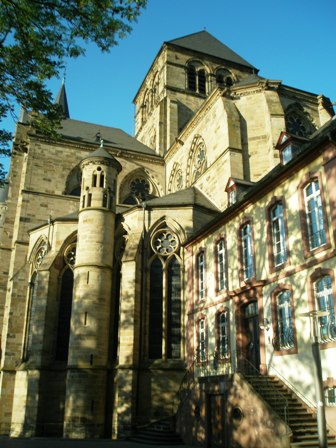
Trierer Dom

Trierer Dom and Liebfrauenkirche


Up North

April 8, 2007

I travelled north, from Jakarta to Taoyuan, Taiwan where I am going to teach for a week at the International Center for Land Policy Studies and Training (ICLPST). The flight was very comfortable in the business class of China Airlines. The menu I chose was all seafood. Boiled baby prawns with tomato and lettuce leaves as entrée and fish and prawn satay in ginger light soya sauce with Shanghai noodles as main course. On top of the wine list I found to my surprise a German Riesling from the Mosel-Saar-Ruwer, my home region in Germany where also Trier, my hometown, is located (www.trier.de). Home sweet home, and out of this melancholy, I asked for it.

menu-taiwan-small.jpg

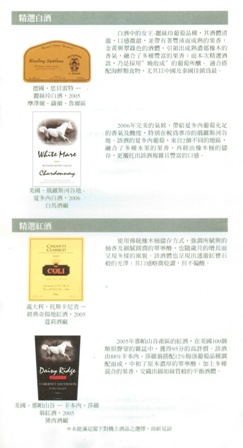
It said: 2005 Spaetlese, but I could not resist! The description claimed the wine is “rich, buttery layered with flavours of orange zest, Asian pears and golden delicious apples, with a subtle, smoky back note”. I could not taste any of this. For me it was “sugary” and the steward was so kind to let me have the second white wine on the menue: a Chardonnay from the US. 2006 White Mare Russian River Valley (Sonoma County), depicting a white horse on the label, not my type of label but what could I do. I did not know the winery. There was also a red (Cabernet Sauvignon), 2005 Daisy Ridge with the same white horse label.

The second red wine was from Italy, a Chianti Classico 2005 from Coli in Tuscany. After a couple of glasses of the Chardonnay, which I quite liked, I moved on to the Italian wine and stayed with it for the rest of the flight. By the way, the service was great at this flight, so many nice stewards and stewardesses, unbelievable. I can only recommend China Airlines. The wine list, though, could be changed. OK, I did not try the champagne, a Drappier Brut which got 89 point from the wine spectator. There are much better Rieslings from the Mosel or the Saar to choose from. I would also replace one of the US wines with an Australian Shiraz maybe or a Merlot.

I watched a movie, read in my Tim Winton book (The Turning) and arrived in Taoyuan in no time, well rested, fed and happy.

temple-small.jpg


A philosopher’s lunch

March 30, 2007

What a beautiful lunch we had the other day. I have to give away the secret of the most delicious dishes we enjoyed last Sunday. In fact it is not a secret at all because the recipe is from a very well known and very beautiful cookbook, the Philosopher’s Kitchen by Francine Segan.

This cookbook’s subtitle reads, “Recipes from Ancient Greece and Rome for the Modern Cook”. Nothing sounds better to the ear of a Celtic Treverer who had enjoyed Roman cuisine for a couple of centuries. We had a fish dish and afterwards a salad, that’s all, but what most delectable food this was. I would have loved to have Sucellus, Epicurus and Lucretius over for lunch that day. Only on the wine side I would have made concessions to modernity. A Sauvignon Blanc from the new world vineyards I find much more appealing than a wine of Roman times which would have needed mixing with water and honey to be drinkable at all.

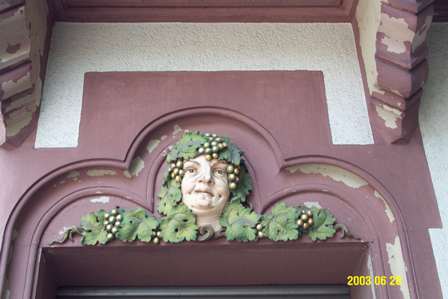
Wine god

On a portal in Trier: Bacchus and vine leafs

And here is the recipe: red snapper in parchment. The ingredients are as follows:

– juice of freshly pressed lemons
– 2 garlic gloves, minced
– ¼ cup of extra virgin olive oil
– 4 bay leaves crushed
– 1 ½ teaspoons whole pink peppercorns
– 2 table spoons of capers, rinsed
– 15 oil-cured black olives, pitted and halved
– 2 red snapper fillets, without skin
– Salt and freshly milled pepper
– Lemon wedges

Mix and combine the lemon juice, garlic, bay leaves, peppercorns, capers and olives in a large bowl and soak the red snapper(in Bahasa Indonesia: Kakap Merah) in this marinade for about two hours in a cool spot. Then put the fish into the oven (up to about 200°). We put it into aluminium foil and topped it with the marinade; then closed the foil and baked it for about 10 to 13 minutes. We served the fish on a plate. We had just plain baguette with it but you can add all kinds of things, eat it with rice, potatoes, and with various vegetables. It was such a wonderful dish, mouth watering. The capers in the marinade give it a spicy edge, and this complements the white flesh of the fish. The olives and the capers take you to the Mediterranean. I could see the ocean, the sand, the beach…and taste the salt, the smells of the water….

After the main course we had a warm spinach salad. The recipe is also in the above cookbook and is called, “Baby Greens with Caper Vinaigrette”. The caper vinaigrette is similar to the marinade, just that no olives and no garlic is added. It goes as follows:

– 2 tablespoons of freshly squeezed lemon juice
– 2 tablespoons wine vinegar
– ¾ cup of extra virgin olive oil
– 3 tablespoons of capers
– Salt and freshly milled pepper
– 3 cups of assorted green vegetables

As I said, we used spinach (Bahasa Indonesia: Bayam Hijau) which we blanched before adding the vinaigrette and the warm salad did in fact complement the first dish and harmoniously end this philosopher’s meal. I highly recommend the cookbook. It makes a wonderful gift. If you love the classics and you want to delve in the past of these two great Mediterranean cultures, you should get it (www.atrandom.com).

You will have noticed that I did not yet mention any wine so far. Well, the wine I chose was a disappointment. I though a Sauvignon Blanc would go well with it, and this is certainly so. I chose a 2006 Sauvignon Blanc from Giessen of Marlborough, New Zealand, of which I had fond memories. But what a surprise. It was stale, oily and did not display any of the varietals’ characteristics of a cool climate Sauvignon Blanc. With sadness and melancholy I thought of times gone by and our own 2002 Two Hills Vineyard Sauvignon Blanc and it’s brilliant taste. Unfortunately, we were down on white wine and we just ended the meal with a port and an Italian coffee. I might have to consider buying a special wine fridge so that this cannot happen again.