Venison from a roe deer for Sunday lunch in Trier

August 24, 2010

My stories from July and August do not come in any particular order. When arrived in early July in Trier at my mother’s place we were greated by a feats, as always. And beecause her partner Heinz is a hunter we often eat game. This time it was venison from a German roe deer (in German: Reh) he had just shot. Needless to say that my mothers cooking is just delicious as you can see from the pcitures below.

Tender venison, a meal in the making

With noodles of course

2008 Saar Riesling Van Volxem Estate

The wine I choose for this meal was a Riesling from Van Volxem Estate in Wiltingen, near Schoden (where the venison was from), one of my favourite producers from the Saar. Tough this is just a “simple” wine, it deplays all the character of a Saar Riesling, fine and delicate which machted the tender venison just perfectly.

Address
Weinmanufaktur Van Volxem
Roman Niewodniczanski
Dehnstrasse 2
54459 Wiltingen, Saar
Ph.: +49-6501-16510
e-mail: vanvolxem@t-online.de


Flammkuchen everywhere

August 14, 2010

Flammkuchen

Everywhere we went in Germany (except Bavaria) during our holidays, “Flammkuchen” was on the menu. Flammkuchen is the German name for an Alsacian dish called ‘flammekueche’ or ‘tarte flambée’ in French. The dish is in fact of ‘alemannic’ origin. The Alamanni , an alliance of different Germanic tribes settled in what is today south-west Germany, eastern France and northern Switzerland (the area south of lake Bodensee); composed today roughly of the regions of Alsace, Baden and the Palatinate.

The thin, bread-like dough comes often in a round shape and is, in its traditional form, covered with crème fraîche, onions, and lardons. However, there are many variations of this old recipe. Similar to pizza all kinds of toppings have found their way onto Flammkuchen. I found different styles as far north as Muenster.

In my home town Trier at the river Mosel, we had the delicious dish from time to time and just loved it. Usually I had a Bitburger Beer with it, preferably in a mug. But the local wines make also a good drink, for instance an Elbling or a local Riesling wine are perfect for the enjoyment of a Flammkuchen. Try it.

Flammkuchen and a Bitburger Beer


Elbling wine in Echternach, Luxembourg

July 8, 2010

We went on a drive along the Mosel river to make good use of our limited time in Germany. It was a beautiful summers day with blue sky and temperatures in the low 30ies. We drove upriver to Wasserbilligerbrueck and north along the Sauer, a tributary of the Mosel.

The two towers of the main church of the abbey

Echternach on the Luxembourg side was our aim, a beautiful medieval town in eastern part of the Grand Duchess at the border to Germany. Echternach is famous for the rhythm of its annual procession, the “Echternacher Springprozession”: two steps forward, one step backward, the rhythm of many political reforms.

The orangery

Elbling is an old grape variety with an obscure origin but it has been widely planted in the Mosel wine region for many centuries. From medieval times until the 20th century Elbling was the most planted variety in this part of Germany. Nowadays it is a variety in decline. Not much is left of it, though, maybe only about 600 ha in Germany and about 150 ha in Luxembourg.

Elbling grapes make a rather neutral white wine with high acidity. It is the wine for every day in the southern part of the Mosel wine region. More often than not it is used for sparkling. In wine tastings Elbing does usually not feature at all.

There is even a revitalized Elbling wine route along the Upper Mosel at the right side of the river from Thorn, Palzem, Wincheringen, Nittel, Wellen, Temmels, Oberbillig until Wasserliesch and at the left side of the river from Igel to Langsur and along the Sauer river, a tributary of the Mosel from Mesenich to Metzdorf.

Local Elbling

We explored the town, the cathedral, the abbey and many of its public places which were filled with locals and some foreign tourists. When we finally settled in a small cafe, it was clear what we were going to order, the house-wine of the place. While the children enjoyed an ice cream, we indulged in a local Elbling. It was dry, clean and crisp with fine acidity; a great drop for a hot summers day. Come and visit this part at the heart of Europe. It’s worth it.


Winery Review: Vereinigte Hospitien, Trier, Mosel

June 2, 2010

vereinigtehospitien1

The St Jacob of United Hospices wine label

I grew up just next to the convent of St. Irminen at Irminenfreihof No. 5 in Trier, Mosel. The convent belongs to Vereinigte Hopitien, a foundation which also ownes a well known winery with the same name. Their English name is “United Hopices Wine Cellars“. The patron saint of United Hospices is St Jacob, an image of which is also used on the wineries labels.

As a kid I played in the cellars and warehouses of the convent. I also remember them sending their vats and barrels for controlling purposes to the Eichamt, the local Weights and Measures Office, which my father was heading. We played around the barrels and I vividly remember the smell emitted by the oak and the moist wood.

vereinigtehospitien3

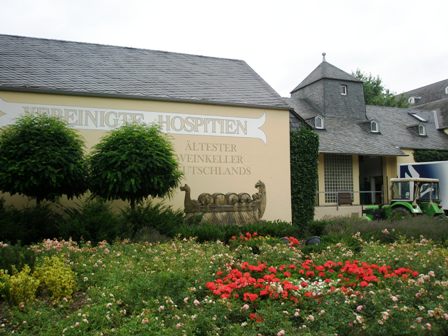
The winery

United Hospices owns vineyards along the Mosel (locations: Piesporter Goldtroepfchen and Triere Augenscheiner) and the Saar (locations in Wiltingen, for instance Hoelle, Scharzhofberg and Kupp, Kanzem and Serrig). Most of the vineyard originally belonged to monastries and convents. Today about 25 ha are under vines, 90% of which are planted with Riesling grapes (my favourite grape variety), the rest consists of Pinot Gris, Blanc and Noir.

As many of the wineries in Trier, also United Hospices has a large traditional wine cellar (some parts of it dating from the 3. century) which you should have a look at. Wine tasting in ths historic atmoshere are unforgettable events. United Hospices top wines are the dry and sweet (Trockenbeerenauslese) Scharzhofberger Riesling wines from the Saar some of which sell for up to 100 Euro/bottle. The ordinary Riesling wines cost about 6.20 Euro/1 l. bottle.

I hope you are going to visit Trier this summer and drop in for a wine tasting. Cheers

vereinigtehospitien4

The main hospice building along the Mosel

vereinigtehospitien2

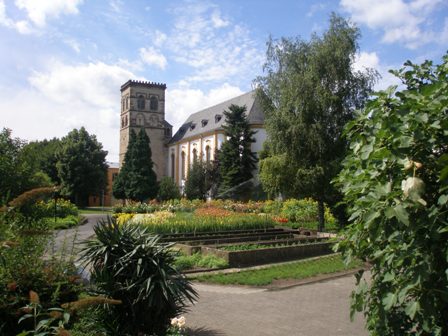
Church St Irminen

Address:
Vereinigte Hospitien
Krahnenufer 19
54290 Trier
Tel.: +49-651/945-1210 o. 0651/945-1211
Fax: +49-651/945-2060
Opening hours: Mo. – Thu. 08-12:30 and 13:30 to 17h; Friday closing at 16h, Saturday 10-14h


Restaurant review: Gasthaus Bidinger, Schoden

May 5, 2010

Bidinger00

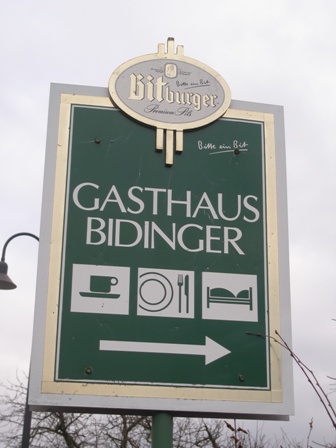
Show me the way

It’s a public holiday in Thailand today (coronation day), and this might be the reason why I am in a reminiscing mood, the dominant “mood of old people”. But Gasthaus Bidinger (Gasthaus/Gasthof = inn) in the hamlet of Schoden, Saar would be a nice place to visit today. Lunch at Bidinger is one of my favourites when with my mother in Trier, Mosel. The food is traditional German country tucker, solid and substantial, and very enjoyable.

Bidinger0

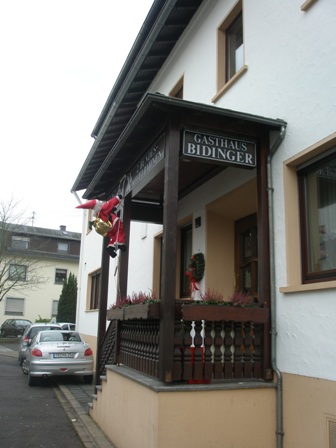
Gasthaus Bidinger, front entrance

Apart from rustique rural food, Gashof Bidinger offers also a nice selection of traditional drinks, for instance Bitburger Pils beer and the local apple-pear cider, called “Viez”. Viez is usually a quite sour, low alcohol drink widely consumed by the local peasantry. Mixed together with some sparkling water it is very refreshing in summer. Moreover, Bidinger also bottles his own local wines. The Saar produces some of the best Riesling wines in Germany, and is one of my favourite wine regions.

Bidinger2

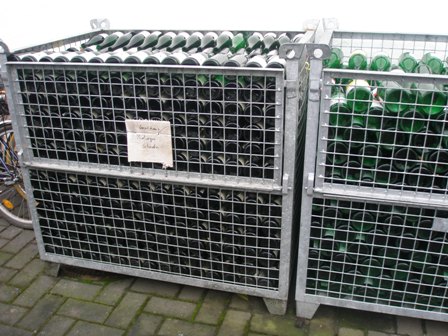
Many empty bottles

Bidinger3

“Moselaner” apple cider, locally called: Viez

Bidinger1

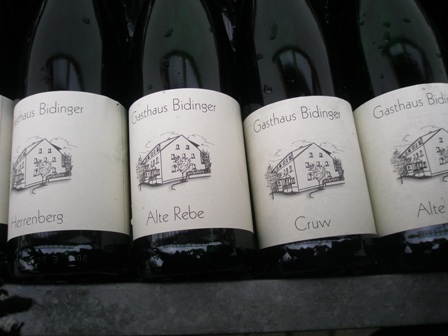
Wines from the Saar

I would love to be at the Saar today. If you have the chance to visit, do so. It’s a jewel, hidden away somewhat but still easily accessible. A visit to the Saar can be combined with a trip to see Trier, the oldest German city and Luxembourg, just next door.

Address:
Gasthaus Bidinger,
Klosterstr. 30,
54441 Schoden
Tel: +49-(0)-6581/99260
Fax: 06581/99261
e-mail: Gasthaus-Bidinger@t-online.de
www.gasthaus-bidinger.de


The Old Man with the Beard

February 9, 2010

Famous last words

As a native of Trier, I treasure the most famous son of our city, Karl Marx, though he left rather early and spent most of his time in exile in London. He used to love wine, especially Riesling from the Ruwer where the Marx family used to own a vineyard and of course my beloved Mosel.

I like the poster above (this is why I took a shot through the window to get a glimpse of it), but unfortunately these were not his last words. he did not say: “Sorry folks, it was just an idea.” Only later generations could come to that conclusion. As family gathered around the dying Marx awaiting his final utterance. It is reported that he barked at them and said: “Go on, get out! Last words are for fools.”


Wine from Slovenia

December 15, 2009

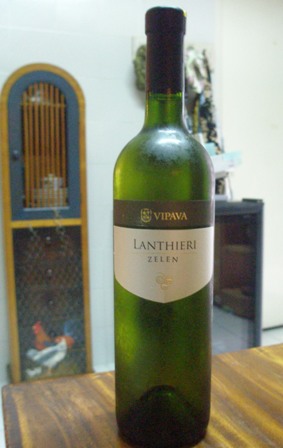
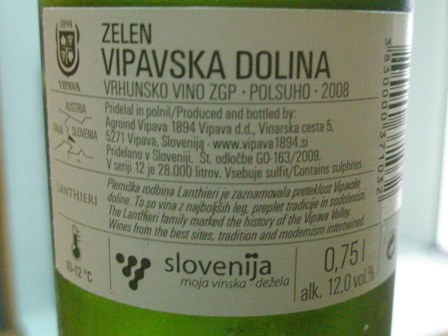
The 2008 Lanthieri Zelen

It’s already some time ago that our firneds Lucia and Giuseppe brought us the above bottle of Slovenian wine. They said, “put it back fro a special occasion”, which we did. But this splendid Sunday warranted a special treat.

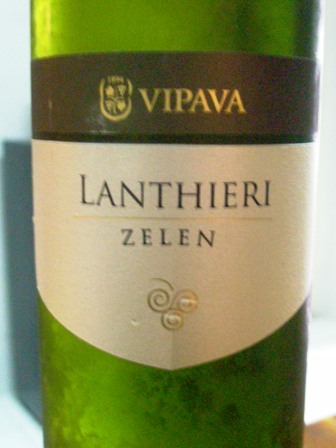
To say it from the outset, the ‘2008 Lanthieri Zelen’ by Agroind Vipava 1894, a wine co-operative in the Vipava valley, is a wonderful wine. It was our first wine from Slovenia ever, a complete novelty to us.

Zelen is an autochthonous grape variety from the Upper Vipava Valley in Slovenia. The Lanthieri brand is reminiscent of the Lanthieri family, noblemen in the region, valley and town of Vipava, also called the Slovene Venice.

The Vipava wine road is going through the valley where viticulture is the main rural business. About 3,000 acres are under vines. The region is home to some very old, indigenous varieties which cannot be found elsewhere, for instance Zelen, Pinela, Klarnica and Pikolit.

The history of wine-making in the Vipava valley is interesting. It reminds me a bit of our own history in my home town Trier. Also in the Vipava valley, the Celts and Illyrian tribes cultivated grapes long before the Romans arrived. This is also true for my own tribe, the Treverer, in the Mosel river valley.

The back label in Slovenian

The wine has a light-yellow colour and seems to be an aromatic type of wine. Floral notes of mediterranean herbs such as lavender and rosemary can be detected. Very dominant, however, is the dried-apricot taste, very lovely and very unusual, I found. The wine has structure and is well balanced, fresh and zippy.

Spicy clam pasta

We enjoyed it with a spicy, clam pasta. The wine was “strong” enough to not “go down” with the red peppers, but, instead, held itself very well. I am sure we will not find any wine from Slovenia in Bangkok wine shops. I guess we have to visit Slovenia and detect its treasures during our next trip to Europe.

Thank you Lucia and Giuseppe for giving us this wonderful gift. We apprecite your generosity and we know how heavy wine bottles are.

I think Slovenia might have the potential to become the “wine Mekka” of tomorrow.


Moufflon leg and Loch Riesling

October 15, 2009

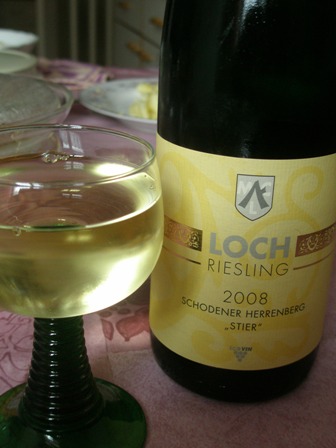
Loch1

When I am at home in Trier, Mosel my mother cooks for me. This time Heinz had shot a young moufflon (a kind of wild sheep) in Schoden. He prepared a leg of the lamb and we had it the traditional way. It was simmering on low heat for ages. The meat was tender and had a fine gamy taste.

This feast was accompanied by a wine from the same place, a ‘2008 Schodener Herrenberg “Stier” by Weinhof Herrenberg and the Loch family in Schoden. This Riesling shows that it was made by hand. It has a fine character, is minerally and fruity with good acidity and length, a perfect Saar wine to be enjoyed right away or cellared for a couple of years.

Nothing could be more perfect, I thought. The moufflons might have roamed the very location of the Herrenberg, the vineyard where the Loch Riesling was produced. I consumed the fruits of the land, the forests of Schoden and the dedicated vintners from the Saar. I am glad my mum is such a good cook. Cheers

Loch2

It’s vintage time at the Saar right now. Why not go on an outing and drive along the romantic Saar river, visit wineries and enjoy rustic German food?

Address:
Claudia and Manfred Loch
Weinhof Herrenberg
D-54441 Schoden/Saar
Tel.: +49-6581-1258
Fax: +49-6581-995438
info@lochriesling.de
www.lochriesling.de


Weinhof Herrenberg – Loch Riesling, Schoden, Saar

October 8, 2009

My friend Heinz was kind enough to help me out. He dropped by the Weinhof Herrenberg in Schoden, Saar, on his way back from the hunt and bought three bottles of Loch Riesling. I had planned to visit the Loch family winery for some time but never managed to get there. There was always something else when visiting Trier, my hometown nearby, a birthday, a visit, a train to catch etc.

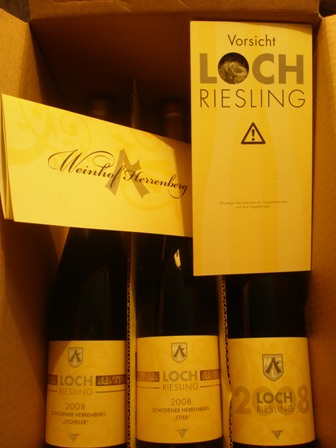
Heinz brought back the box shown below and three different Loch Riesling wines, all of the 2008 vintage. Regular visitors of my blog know that I am a Riesling lover, especially if they were grown along the Saar, my favorite provenance of German Riesling wines.
LochRiesling2

The treasures from Weinhof Herrenberg and the two brochures

The three wines were a ‘2008 LochRiesling’ (8.90 Euro/bottle), a blend of Riesling grapes from various vineyards, a ‘2008 Schodener Herrenberg “Stier”‘ (12.90) and a ‘2008 Schodener Herrenberg “Stoveler”‘ (13.90), both wines from my favorite ‘terroir’, a very steep vineyard called “Herrenberg” bordering a forest and enticing large groups of wild pigs and deer to visit and taste the sweet grapes during vintage time. I had walked the vineyard and heard about the Loch wines but never tried a single drop. It was high time to change that.

LochRiesling3

2008 Loch Riesling wines from Schoden, Saar

I also love the brochure with the “whole” (the “Loch” in German) explaining the philosophy of Claudia and Manfred Loch, the proprietors and vintners of the boutique winery “Weinhof Herrenberg”, which is the basis for their wine-making. In short, the Loch’s aim for authenticity, uniqueness, they reject designer wines but quest for a unique character and truthfulness.

The brochure is a very unusual one, telling people why to keep their hands off LochRiesling wines and what the weaknesses of the wines are: for instance that their wines are unknown, consumer hostile, old fashioned, egoistic, lawless, dangerous and limited (in numbers of bottles!). I like this brochure.

LochRiesling5

The “Loch” brochure with a whole in it

The wine list also includes wines from locations in Ockfen and Wiltingen, two famous Saar wine villages. The “Beerenauslese” wines are not available any longer. The Loch’s also produce a dry, sparkling wine. All wines are reasonably priced.

LochRiesling4

The current wine list

You might wonder what they taste like? Well, I will tell you more about this at a later blog entry. But if you are near Schoden or in the vicinity of the Saar, please visit the Loch family vineyard at Weinhof Herrenberg. If you cannot visit in person, visit the website which is very informative.

Address:
Claudia and Manfred Loch
Weinhof Herrenberg
D-54441 Schoden/Saar
Tel.: +49-6581-1258
Fax: +49-6581-995438
info@lochriesling.de
www.lochriesling.de

Vintage time: Schodener Herrenberg

October 6, 2009

Schoden1

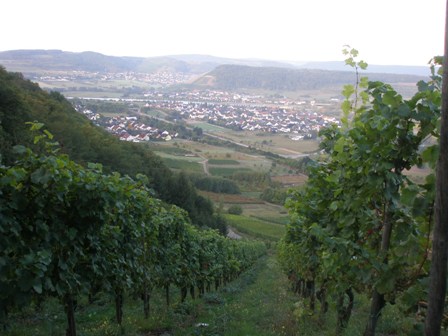
Schodener Herrenberg, in the background the village of Schioden with the Saar

One of my favourite places along the Saar river is Schoden, a small hamlet about 30 minutes southwest of Trier, my hometown. I visit regularly, because my friend Heinz together with some friends has rented the local hunting territory and when I visit Trier, we often go together on the hunt.

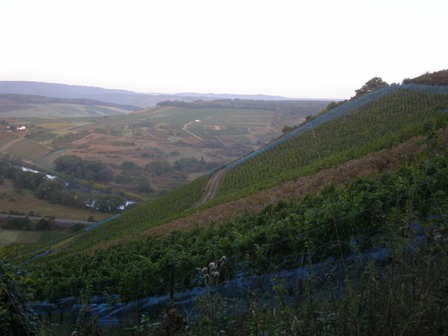
Schoden has also some vineyards and wineries. The location (terroir) “Herrenberg” is one of them. The vineyards are quite steep, which is difficult to depict in a photograph as you can see from the comparison of the two pictures above and below. It is realy a steep site, and the best location for producing Saar Riesling wines of superior quality.

Schoden2

Schodener Herrenberg: vineyards from the South

Schoden3

Schodener Herrenberg: the vineyards from below

Schoden4

A promising vintage?

Schoden5

Beautiful Riesling fruit

The fruit on the vines looked very healthy. In a couple of days or weeks, depending on the weather, the pickers will come to harvest. Needless to say that no machinery can be used, all the work will be done by hand. The vineyards workers will have to navigate the steep hills and balance on the slate pebbels which can be tricky when they are wet.

Needless to say that Schodener Herrenberg produces outstanding Riesling wines. Learn more about these Saar wines on my blog soon. Cheers