Beautiful Bavaria

June 14, 2008

I had the great chance to spend a weekend in Munich, the capital city of the state of Bavaria. The weather was splendid; it was the first weekend of June. Of course I had some to work but fortunately there were a couple of hours which I used to explore the surroundings. I just walked through the city and enjoyed the cheerful atmosphere. Of course I had also food and drinks in mind.

People over people in the English garden in Munich

I ended up in the “English garden”, as it is called, a large park in the heart of the city where everybody seemed to converge on a Sunday afternoon. I asked two nice ladies for the way to the next beer garden (show me the way to the next whiskey bar) and they pointed me to the beer garden at the Chinese pagoda.
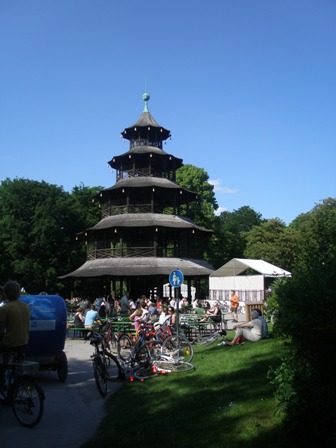
The Chinese pagoda beer garden

Unfortunately my small camera could not capture the atmosphere there. There were lots of people as well. Numerous stalls sold all kinds of Bavarian food and drinks, mostly beer in big and super big mugs or beer based mixed drinks. For instance one could order a “Russian” which is a mix of wheat beer with white lemonade, a nice drink to quench your thirst and thats what I did. There were horse carts, people on bicycles, and children on skate boards. There were street musicians along the wayside, larger and smaller groups of tourist and day visitors from all over the world. Here and there one could spot the odd local Bavarian, men dressed in the traditional ‘Lederhosen’ (leather pants) and women were dressed in elaborate ‘Dirndl’ outfits.

Bavarian folk music presented by a brass band in traditional leather pants

Munich is not exactly known as a wine growing region. Helas, there was also a part of the garden where a vintner from Franconia offered his wares, in this case delicious wines from this northerly part of Bavaria. “My heart jumped in my chest”, as we Germans say. here I had the opportunity to be regaled by the very wine of my mothers homeland.
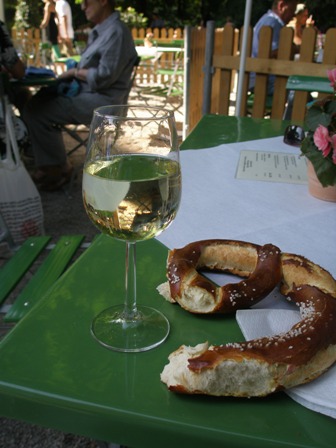
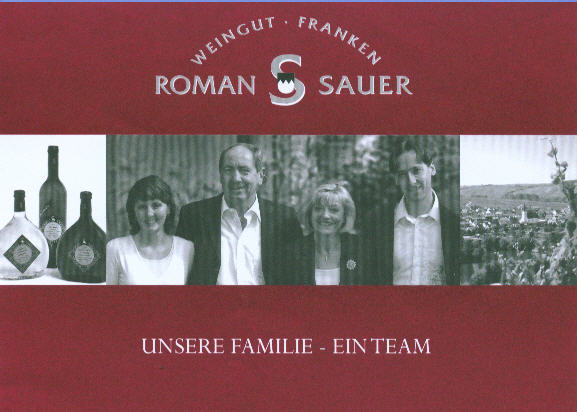
The vintner was Roman Sauer and his family from Nordheim in Franconia. They were very friendly and cheerful. For my next visit to Franconia I should schedule a tasting!

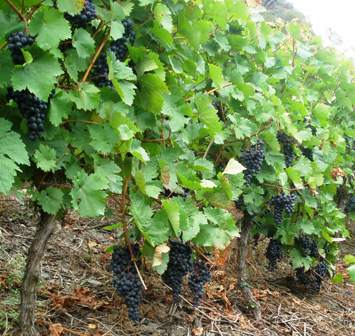
I first tried a Sylvaner (fresh and dry), then I moved on to a Riesling (crisp, citrus and apple aromas) and the last wine I tasted was a red wine (see the picture). Well, and now I face a memory lapse. Moreover, I cannot find my notes. I do not remember what it was. The colour is a deep and beautiful red. It should be a Pinot Noir but it could have been something more “exotic”. Needless to say the wines were all well made and delicious.
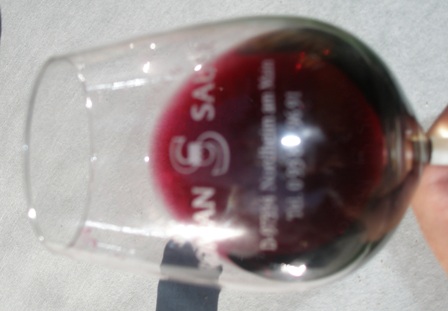
I would have tasted the rest of Roman Sauer’s wines on offer but that was just too difficult in the heat. The sun was shining on me and the three large glasses of wine had their own effect. The Bavarian music was entertaining, the beer garden visitors were loud and cheerful, and somehow I made my way back to the small hotel in Munich-Riem.

Below the flyer I collected which depicts Roman Sauer and his family. There was not much opportunity for a chat because the garden was so buy, guests coming and going. Unfortunately, I could not find a webpage of the Sauer Estate and learn more about his vineyard, wine making, etc.
Address:
Weingut Roman Sauer
Raiffeisenstrasse 11
D-97334 Nordheim
Tel.: +49-9381-9691


Mother’s day – lunch at home

May 12, 2008

Normally we go out for lunch at Mother’s day. But on Sunday we stayed home. Margit cooked a beautiful meal. We had prawns and a risotto “arrabiata”, nice and spicy and a fresh green salad.

It was a beautiful tropical day, the beginning of the dry season in Jakarta. Our garden is lush and green, some of my orchids are still in bloom. In short it was wonderful at home, not disturbed by anybody.

The prawns

The risotto “arrabiata”

A bottle of Mosel Riesling from Trier

Well and what did we drink with the food? I raided my little wine cellar and dug our one of my last bottles of Mosel Riesling. This time a wine from Staatliche Weinbaudomäne Trier, a ‘2005 Avelsbacher Hammerstein Riesling Kabinett’.

It was, I would say, a semi-dry Riesling, maybe a bit on the sweet side. Anyway, it was too sweet for me, but matched the spicy risotto perfectly. The wine has only 8.5 % alcohol; it is fruity, spicy and aromatic, with a good body, structure and length. It was awarded a gold medal by the state of Rheinland-Pfalz’ wine show.

A firework for the nose

The Staatliche Weinbaudomäne (it means ‘estate’ or ‘domain’) is owned by the state of Rheinland-Pfalz. Today, it cultivates about 31 ha of vines at various locations near Trier along the Avelsbach stream, a brook of 4.6 km length which flows into the Mosel river.

In 1996 the estate celebrated its 100 anniversary. It was founded in 1896 by the then Prussian State government and covered about 200 ha under vines consisting of three separate estates, Avelsbach, Ockfen and Serrig, two of which were located at the Saar, another tributary of the Mosel.

The Avelsbach is divided into five ‘terroirs’ (locations), Altenberg, Herrenberg, Kupp, Hammerstein and Rotlay (the last of which is not in production any more).

Interesting is that this wine must appeal to Japanese consumers because of the dozen wine sites a search leads you to, at least 50% were in Japanese characters.

Address
Staatliche Weinbaudomäne Trier
Deworastrasse 3
54290 Trier


Dr. Loosen, I presume

May 11, 2008

Last night we went to dinner with our dear old friends Liz and Walter. After nibblies (as we say in Australia) at their home we proceeded to Cork and Screw, the very hip and extremely trendy restaurant in Jakarta.

The food was excellent as always. We had an Australian Shiraz with the meals and moved on to dessert. Three of us had crème brûlé; Liz had some kind of chocolate dessert. There were only three wines to choose from, two “half bottles” and a Riesling Spätlese and can you imagine from where? The Mosel!.

And what was it? I could not believe my eyes, a ‘2006 Dr. Loosen Wehlener Sonnenuhr Riesling Spätlese’ for only about 33 €. We needed to have this wine. What a bargain. Usually one cannot get any Mosel wine here in Jakarta. I could have kissed the people from Cork and Screw and Vin +, the wine shop associated to the restaurant.

The empty bottle ‘2006 Wehlener Sonnenuhr Riesling Spätlese’, Dr. Loosen, Bernkastel, Mosel

I must admit that though I come from the Mosel, I have never had a bottle of Dr. Loosen’s wine (www.drloosen.com). He is such a famous vintner, sitting on all kinds of wine juries, all over the world. It had to come to that. I tasted his wine in Jakarta, a couple of thousand miles from home. The major German Riesling portal (www.riesling.de) lists him as the top vintner of their top 10 wineries.

“Wehlener Sonnenuhr” is one of the prime terroirs (about 65 ha) on the Mosel, all on steep slopes. A sundial is to be found right among the vines and that gave the location its name.

Wehlener Sonnenuhr (source: www.drloosen.com)

The wine has only 8% alcohol and was the perfect match with our dessert. Of course we drank it too young, but we had no choice, waiting was just not feasible. The wine displays and expressive nose, shows apple, lemon, almonds and nuts. The acids were well balanced and the full sweetness gives it a round and lingering finish. We all loved the wine.

When the waiter wanted to clear the table I told him my story: that I was from Trier, Mosel , not far away from where this wine came from and that I wanted to take the empty bottle home. “Tidak apa apa”, the kind man said, meaning “no worries” in Australian, and he gave me a Cork and Screw bag to carry the bottle.

How wonderful. If you happen to be in Jakarta one of these days, have a meal there; it’s certainly worth it: great place, great service, great food, great wines.


Country Inns in Germany – Klostermühle, Ockfen, Saar

May 5, 2008

When I am visiting my hometown Trier I always try to arrange an outing to the Saar, my most favourite tributary of the Mosel (the other one I love very much, is the river Ruwer).
One day in March my mother, my friend Heinz and I, we went for lunch in the countryside. It was March. Spring was waiting in the wings, but could not get through as yet. However, it was a beautiful day. We choose the Klostermühle in Ockfen, Saar, as our destination, a winery cum hotel and restaurant (www.bockstein.de).

Winery-Hotel-Restaurat Klostermühle in Ockfen, Saar

Pork tenderloin with Spaetzle, a German type of noodle dumplings

The food was delicious, typical country inn style, rustique, big portions, in short: value for money type of food. I had one of their Rieslings with my food. Ockfener Bockstein is the name of the most famous location (terroir) in this neck of the wood. It was a very typical Saar Riesling, low in alcohol but zippy and fruity, with complex acids, a good structure and a long and intense finish.

After lunch we drove though the vineyards of Ockfen. On our way to Schoden where Heinz together with some friends is renting a hunting ground, we passed by the “Bockstein” which you can see in the picture below (where the tree line on the hill in the background is ending).

Ockfener Bockstein, one of the most famous “terroirs” of the Saar

The Saar is a very picturesque wine region and tourist destination in southwestern Germany and certainly worth a visit. Do it regularly as I do. The Riesling wines are among the best of Germany.

Address
Weingut – Hotel – Restaurant Klostermühle
Fam. Minn
54441 Ockfen, Saar
+49-6581-9293-0


“Ze Lawen – Zur Lauben – At the arbour” – Trier at its best

April 18, 2008

In the dialect of Trier “Ze Lawen” translates into high German as “Zu den Lauben” which can be transcribed into “At the arbour” in English.

What is it, you might ask.

Well, it is a part of the city of Trier. In the 18th century it was a small fishing village at the outskirts of the city just beyond the ancient city walls. Later it was transformed into garden arbours used by city folk to spend their Sundays where they relaxed in the shade of their small garden houses.

Today, “Ze Lawen”, located directly north of the Kaiser-Wilhelm bridge, consists of a small stretch of beautiful historic buildings along a very picturesque strip of the Mosel river. Over the years many of the fishermen’s houses were turned into small country inns, eateries, bars and restaurants with a great variety of local foods and drinks on offer. Actually if you look for a culinary delight in Trier you have to visit this part of the city. Needless to say that you can enjoy all the many famous Riesling wines produced along the Mosel and the surroundings valleys of Saar and Ruwer.

I will take you on a quick walk around this part of town (only a 200 meters stretch). Below, thats what it may look like in summer, in the background the Mosel and the red sandstone cliffs.

With friends eating out in “Ze Lawen”

During my recent visit to Trier I took some more photos. One can, for instance, find some stone mason work depicting scenes from Roman times, usually the delivery of rental payments as below.

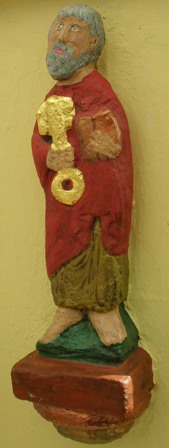
The patron saint of Trier is St. Peter. He is usually depicted holding the city keys and the bible as below.

Now we enter from the north. The first “Wirtshaus” cum restaurant is the “Schwarzbierhaus” to the left. Further on is another well known restaurant: “Pfeffermuehle”.

Other must visit places are “En de Lauben”, “Alt Zalawen”, “Mosellied” and “Bagatelle” (bistro/cafe), a restaurant where we had the most amazing food and wine degustation last year (a summary you will find in this blog).

The entry to the “Schwarzbierhaus”

The old lintels of the door frames shown belwo, usually also in stone, demonstrate that it was fishermen who once lived in these old houses. The most popular motives are fish or gear from fishing boats.

I hope this enticed you to put the city on you map. See you again in “Ze Lawen” one of these days. Its always worth a visit.


Wiltingen Saar – the best of Riesling wines in Germany

March 31, 2008

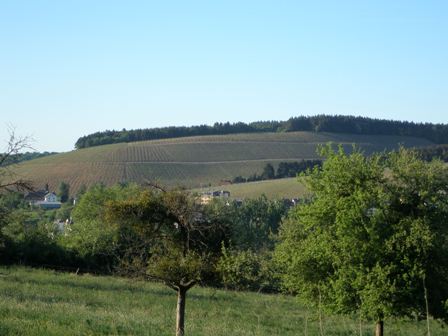
The little village of Wiltingen, Saar , about 9 km southwest of Trier, is one of the most famous “terroirs” for Saar Wine. It has about 1400 inhabitants and is the heart of Riesling production. The area under vines is 160 ha only and rather small one might say but these vineyards produce excellent wines.

The location (terroir) ‘Scharzhofberg’, for instance, produces outstanding Rieslings which are world renown and regularly win international awards as best wines.

Wiltingen is home to many famous wineries. I cannot name them all. There is for instance the “Riesling pope” Egon Müller who has his family business there, so has Roman Niewodniczanski’s winery Van Volxem, and many others.

wiltingen2.jpg

Wiltingen at the Saar river in March, photo taken from the Schoden side
wiltingenschild.jpg

Wiltingen is a jewel also for tourism

It was a rainy day when we visited Wiltingen. However, we wanted to pay a visit to Van Volxem and maybe purchase a couple of bottles of the finest Saar Riesling. Well, we met the winemaker, a very friendly young man from Franconia, as I could identify from his accent, and he invited us in, mentioning in passing that if we came to buy wines, we would have to come again, because they sold out completely. Nonetheless, he made us sit down, served us a very good cup of coffee and told us the story of the Van Volxem wines.

Spring is a busy time in the vineyards. We were told that Van Volxem has about 30 ha under vines and that they are in the process of planting another 6 ha in prime locations, usually on very steep slopes along the Saar river.

Also Ms. Niewodniczanski showed up and took her time fro a friendly chat; she urged us to come again later in the year when they new vintage would be released. She promised she would show us around, not only to the cellars but also the vineyards could be part of our visiting program. We left our addresses and promised to come again. Who could resist such friendliness, a treatment so warm, only expected to be extended to family members.

vanvolxem.jpg

Van Volxem, entry to the cellar door

vanvolxem2.jpg

In the historic tasting room

Postscript: A couple of days later, I sat in the Weinhaus, one of my favorite wine bars in Trier, and witnessed the sale and hand over of two 6-bottle boxes of Van Volxem Riesling wines to customers.

Well, I thought, I cannot complain since I still have some bottles in my “cellar” in Jakarta, and the next vintage will certainly make a wonderful buy.

Address
Weingut Van Volxem
Roman Niewodniczanski
Dehnstrasse 2
54459 Wiltingen, Saar
Ph.: +49-6501-16510
e-mail: vanvolxem@t-online.de

The estate is member of the VDP (Verband deutscher Praedikats- und Qualitaetsweingueter), the association of German prime wine estates (www.vdp.de). Today the Association has 200 members and covers about 3% of the German viticultural area.


Habel Wine Culture

March 20, 2008

The other day in Berlin a shower drove me into the next available shelter and fortunately it was a wine bar: ‘Habel Weinkultur’, where I always wanted to visit (www.wein-habel.de).

habel1.jpg

The place is huge with various rooms and bars. It is also a place with tradition. Habel attempts to revive the old tradition of Prussia’s wine tasting. Originally it was located at Unter den Linden 30 were it was opened in 1779!

habel2.jpg

The elegant dining and tasting rooms of Habel Weinkultur

habel3.jpg

I was the only customer at 15:00 h in the afternoon but I was lucky again, they served customers.

The wine list was beautiful, however, a single person can only drink wine ‘glass wise’ and not by the bottle. I have to come again, I thought, with a friend to sample some of these wines. The food menu looked also very inviting. A good place to visit in Berlin.

I settled for a Riesling of course, this time I choose a Riesling from the Rheingau, one of the best German wine regions, a ‘2005 Riesling Schloss Vollrads’ (4.70 €/0.2 ltr.), a dry wine with a lush bouquet of apples (not a citrus bomb), fruity, well balanced acids, fresh with a nice finish.

habel5.jpg

When I studied the wine list I found that it contained many wines from Germany, France, Italy, Austria, Spain, Chile, Argentina and South Africa but only one single wine from Australia (a Penfolds BIN 2 Shiraz Mourvédre).

Of course with a wine from Penfolds you cannot go wrong but apart from the corporates there are zillions of excellent wines from small wineries and vineyards which would deserve to be sampled by the German wine lovers.

Address:
Habel Weinkultur
Luisenstrasse 19
10117 Berlin
Ph.: +49-30-28098484


German Vineyards in March

March 18, 2008

March is a great time of the year in the Northern hemisphere. Nature is ready to go, buds are almost bursting, waiting for the right temperature, the hours of sunshine which make the difference, warm the soil and the plants. As every year another miracle is in the making.

The vineyards are neatly pruned and ready to go shortly before the new growing season begins. The following pictures from the Saar Wine Region might give you an idea.

vineyardin-march.jpg

The colour scheme is still dominated by greys and dark winter colours but here and there we can see greenish spots, and soon spring will have driven winter away.

The slopes are steep and every vine has its own post. This one is very well tended, not a single stem or blade of grass can be detected.

pruned3.jpg

The pruning is of a special kind too. In Australia we hardly see this kind of binding the canes.

pruned1.jpg

It is not easy to spread organic manure in the vineyards at these steep slopes.

menure1.jpg

A metal sledge is used to bring the manure to the vines.

pruned2.jpg

Apart from the well tended vineyards (as above in Ockfen, Saar) we also find here and there a neglected one or one in a rather ‘chaotic stage’ but they are the exception rather than the rule.

chaoticvineyard.jpg

The neglected vine garden


Karl Marx and Mosel wine

September 26, 2007

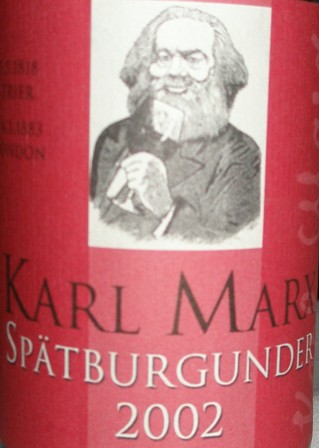
When I visited my hometown Trier recently, I also went to the place where Karl Marx, the most famous of our citizens, was born in 1818 (the Karl Marx Haus). What I did not know about him was his relationship to wine and the Mosel wine industry. From a leaflet collected at the tourist paraphernalia shop I learned that the parents of Karl Marx were vineyard owners along the Ruwer in Mertesdorf where they owned several parcels. It was quite common for bourgeois families of the times to acquire vineyards either for their own wine consumption and/or for investment and old age security reasons. The Marx family vineyard was found in the location “Viertelsberg” a medium quality terroir near the castle ‘Gruenhaus’. Today, the ‘Weingut Erben von Beulwitz’ produces a 2002 Spaetburgunder (Pinot Noir) wine with a Karl Marx label to commemorate this famous “son” of Trier. The wine is not exactly from the old Marx family vineyard but derived from vineyards nearby. Some time ago I had tasted this wine with some delicious venison (big horn sheep) which my mother had prepared for me.

karlmarxweb.jpg

The label with Karl Marx

Marx himself was fond of drinking wine and appreciated the value of it. More interesting is the fact that among others the misery of the Mosel wine producers inspired Marx to study and research economic issues in general. In various newspapers Marx reported about the problems of the Mosel vintners. He criticized the Prussian government for its lack of support which in the end brought him into conflict with the authorities in the 1840ies which in the end led to his exile first in Paris, later in Brussels and finally in London.

After Napoleon lost the war and with it the once occupied lands west of the Rhine river, these territories were given to the Kingdom of Prussia after the peace congress of Vienna in 1815 and administered as the Prussian Province of the Lower Rhine. This marked the beginning of a golden age for Mosel wine producers since they benefited from tax-free export of their wines to Prussia. Unfortunately, the phenomenon was short lived when, with the introduction of the German Customs Union (Zollverein) in 1834, vintners from the southern German states were in the position to successfully displace their competitors from the Mosel. This in turn brought wine prices down. An unfavourable Prussian tax policy coupled with bad harvests led to the pauperization of many vintners at the Mosel. Marx was appalled by their suffering, criticized the government, violated press censorship requirement and in the end had to leave into exile.

In 1857 the Marx family sold its vineyards in Mertesdorf. But due to the efforts of the Weiss family (the owners of the Weingut Erben von Beulwitz, www.hotel-weiss.de), we can enjoy today a Pinot Noir depicting the face of Karl Marx on the label. These bottles can also be bought at the aforementioned shop (7.5 €/0.75 l bottle).

mertesdorf-ruwer.jpg

Ruwer vineyards near Mertesdorf in spring

PS: I personally think that it is a pity that the wide adoption of his ideas in Eastern Europe, Vietnam and China for instance brought so much misery to mankind. Less emphasis on the collective and more on individual freedom would have gone a fair bit. Marx should have stayed with drinking and enjoying wine and give up writing in the first place, one is tempted to argue.

In a letter to the father-in-law of his daughter he mentioned that “a man who does not love wine will never achieve anything good for mankind”. Unfortunately, wine drinking is not a guaranty for such deeds as his own life showed.


Along the Mosel River

September 12, 2007

I have often traveled along the Mosel River by train. Last weekend I decided to abolish the train and drive by car from Kobern-Gondorf to Trier. Unfortunately, the sun did not shine. But despite this handicap it was one of the most marvelous trips I have recently made.

The Mosel River valley was buzzing with visitors and tourists. Groups of cyclists, tour buses, camper vans as well as people on foot, motorcyclists and others were cruising along the river and swarming the small towns and villages. Almost every settlement advertised its ongoing or imminent wine festival and vintners’ fair. Everywhere one could buy wines, have a meal or stay overnight. Vintage was in full swing in many places and the young fermented grape juice, in German called “Federweisser” was everywhere on offer.

rivermosel.jpg

Barges and a ferry on the river and a castle in the background

moselriver2.jpg

Steep slopes and a narrow valley, vines on “Graywacke” slate plates

The appelation of the wine region “Mosel-Saar-Ruwer” is the result of the Wine Act of 1909. From 1936 onwards wine labels could show this designation. In 2006 the German Parliament passed a new law abolishing “Mosel-Saar-Ruwer” and simply replacing it with “Mosel” and since August 1st, 2007 the region is officially called “Mosel” only.

The region consists of six sub-regions with 19 locations (Grosslagen) and 524 individual locations (Einzellagen). 5,500 wineries and vineyards are spread over 125 settlements, villages and towns. The total area under vines is about 9,000 ha, which produce annually about 850,000 hectoliters of wine (including 75,000 hectoliters of red wine). The largest wine producing acreages can be found in the settlements of Piesport, Zell (Mosel), Leiwen, Konz, Neumagen-Drohn, Mehring, Bernkastel-Kues and Trittenheim. I passed through some very famous vineyard locations such as “Bremmer Calmont”, “Wehlener Sonnenuhr”, “Erdener Treppchen”, “Ürziger Würzgarten”, “Piesporter Goldtröpfchen”, “Bernkasteler Doctor” and many others.

steepslopes1.jpg

The elevator “sledge”

steepslopes2.jpg

The “rail” for the “elevator”

The region has the largest extent of vineyards on steep slopes (inclinations range from 30% till 60%) in Germany. The Mosel region is also the biggest Riesling producer in the world (with about 5.000 ha acreage). Recently some of the more extreme locations have fallen fallow. Traditionally vines were planted on the steep slopes using single posts. In recent times they have been gradually replaced by modern trellis systems. For transport purposes, elevator systems were installed in some locations, as shown on the photos below. I was very surprised to find a lot of red grapes planted in the flat lands near the river. Most of them are Pinot Noir and Dornfelder grapes. There is an increasing trend to extend the acreage for red varieties and the Mosel has once again become a superb producer of red wines, especially Pinot Noir.

redgrapes1.jpg