Trier, Mosel: Wine Auction 2008

October 4, 2008

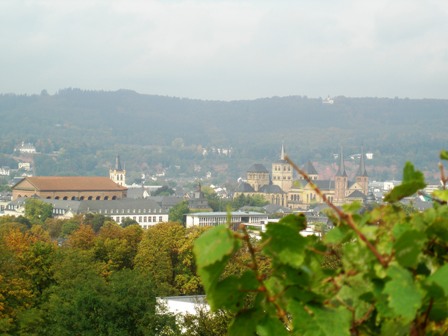
The wine city of Trier (from the Petrisberg side)

According to the website www.riesling.de the annual wine auction of the “grosser Ring” (freely translated as ‘big ring’) a subdivision of the regional section of the Association of German Prädikat Wine Estates (that is how on the website of the association, the German title: “Verband der Deutschen Prädikatsweingüter” is translated) was a full success. The association has about 200 members German wide. About 13,000 bottles of wine were auctioned off. The sale brought in an amount of € 1.3 million.

The top prices were earned by wines from Weingut Egon Müller (Saar), Weingut Joh. Jos. Prüm, and Weingut Dr. Loosen, all top producers of the Mosel wine region.

The most expensive wine of the auction was a single bottle of a ‘1959 Wehlener Sonnenuhr Riesling Trockenbeerenauslese’ by Weingut Joh. Jos. Prüm which was sold for € 5.097.96. Wow, isn’t that amazing.

But also prices for recent vintages were quite high. A ‘2007 Scharzhofberger Auslese Goldkapsel’ by Weingut Egon Müller sold for € 582.62 , a ‘2007 Graacher Himmelreich Auslese Lange Goldkapsel’ by Weingut Jo. Jos. Prüm for € 485.52 and a ‘2007 Erdener Prälat Auslese Lange Goldkapsel’ by Weingut Dr. Loosen for € 449.11

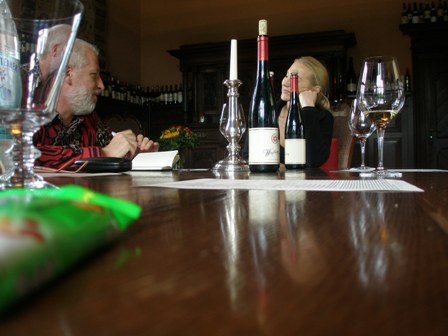
Wine bar Kesselstadt in Trier just opposite the church of Liebfrauen

The auction lasted for more than 5 hours much longer than a marathon run. The general trend as far as bottle size is concerned seems to be heading towards magnum bottles. For wines filled in such size bottles premiums were paid.

The tasting prior to the auction revealed the very high quality standard of the 2007 vintage Rieling wines. On www.riesling.de you can find the detallied rating of the individual wines and the prices paid for the various lots sold.

Even for ordinary mortals like me, the auction is good news. The superior quality of the 2007 Mosel Riesling vintage will also apply for more everyday wines which I can afford. Next time in Trier I will indulge myself again. Why don’t you come with me.


Wine tasting at Van Volxem Estate in Wiltingen, Saar

September 8, 2008

In April this year, my friend Heinz and I, we had visited the Van Volxem Winery (www.vanvolxem.de) in Wiltingen, Saar for the first time. Unfortunately, all wines were sold out then. Dominik Völk, the wine maker, served us a delicious coffee instead and we were invited to visit again in the month of July when part of the new vintage would be released.

Steep slopes for maximum exposure to the sun at the Saar

And that’s what we did. This time I brought my whole family (mother, wife, children). Our appointment was at 14 h in the afternoon on a rainy summers day. Ms. Niewodniczanski, the wife of the owner Roman Niewodniczanski, served us six newly released wines, all of which were excellent representatives of the Saar region. Van Volxem calls these wines ‘classic dry wines’, though residual sugar in Van Volxem Riesling wines may go up to 9 g./l.. For Franconian vintners, for instance, 7.5 g./l. is the agreed maximum. Van Volxem, however, believes that the higher residual sugar content contributes to the overall harmony of its wines. The only exception to the dry wines we tasted was a semi-dry ‘2007 Rotschiefer Riesling Kabinett’.

Contemplating about Riesling wines with Ms. Niewodniczanski

Five of the six were Riesling wines, one was a Pinot Blanc. The following list shows the six wines:

– ‘2007 Weissburgunder’ (Pinot Blanc), 9.90 Euro/0.75 l
– ‘2007 Schiefer Riesling’ (“slate” Riesling), 8.60 Euro/0.75 l
– ‘2007 Saar Riesling’, 9.80 Euro/0.75 l
– ‘2007 Wiltinger Braunefels Riesling’ (a single location/vineyard wine), 12.50 Euro/0.75 l
– ‘2007 Alte Reben Riesling’ (from old vines), 13.80 Euro/0.75 l
– ‘2007 Rotschiefer Riesling Kabinett (red slate), semi-dry, 9.90 Euro/0.75 l

We liked all of them but some more than others. Heinz bought some bottles of Saar Riesling and the semi-dry Rotschieder Riesling Kabinett. Apart from Saar Riesling I bought some bottles of ‘Alte Reben’ (old vines).

The Van Volxem tasting room is a wonderful place, with old wooden furniture and beautiful old maps on the walls.

The estate will release the Grand Cru wines later this summer. We were to early to taste them.

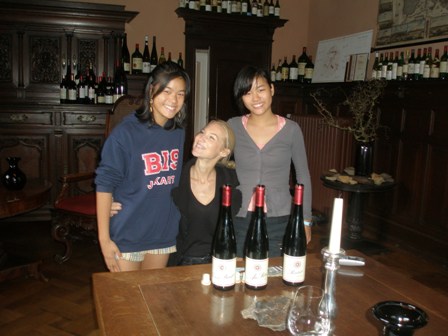
Farewell, but we will come back (my daughters Lucy and Charlotte with the vintner’s wife).

If you are interested in German Riesling, you have to visit the Saar region. Wiltingen is a must, so is Van Volxem Estate. Have fun tasting the best German Riesling has to offer.

Address:
Van Volxem Estate
Dehenstr. 2
54459 Wiltingen, Saar
Te.: +49-6501-16510
e-mail: vanvolxem@t-online.de
www.vanvolxem.de


Germany’s Best Riesling Wines 2007

August 30, 2008

Riesling vineyards in Olewig, Trier

The wine magazine – Weinwelt (Aug./Sept. edition) – I picked up at Frankfurt Airport when leaving Germany in August carried an article on the best Riesling wines in 2007.

About 1.500 wines were entered into this tasting and the overall winner (with 93 points) was

● Weingut Geheimer Rat Dr. von Bassermann-Jordan, Pfalz wine region with a
‘2007 Auf der Mauer Riesling QbA, dry’

Among the top seven wines were 4 from Pfalz, one from Austria, one from Rheinhessen and one from Franconia. For someone like me, a native of the Mosel, it is devastating that no wine from my home region was among the best seven.

Another Riesling competition in Bingen/Rhein in July had a record entry of almost 2,000 wines (1,937 to be exact) from 754 producers from almost all wine producing regions in Germany and from Austria, Canada, Australia, Luxembourg, France, USA, and New Zealand. Most of the non-European Riesling wines came (surprise), of course, from Australia.

The show is conducted every two years and 160 judges of an international jury assesses wines according to the international wine bureau (OIV) standards. The full report of this tasting can be found on www.riesling.de under the rubric “best of Riesling 2008”. In the category “dry Riesling wines”, the winner came from the Rheingau wine region:

● Weingut W.J. Schaefer in Hochheim for the
‘2007 Hochheimer Kirchenstueck Spaetlese’.

Number 2 came from the Mosel:

● Weingut Frank Brohl, Puenderich for the
‘2007 Puendericher Nonnengarten Spaetlese’

and from Pfalz,

● Weingut Emil Zimmermann in Wachenheim for the
‘2007 Wachenheimer Koenigswingert Spaetlese’.

In the “semi-dry Riesling category” wines from Rheinhessen, Mosel and Nahe could be found among the three top wines. However, the “sweet wine category” was dominated by Mosel wines.

There will be many more shows and wine tastings in the coming months. In July this year, when we tasted the 2007 vintage at Van Volxem Winery (Wiltingen, Saar), the “grand cru” wines were not yet presented because their release was scheduled for fall.

Given the fact that most wineries have not yet officially released their “gand cru” or, as the Germans say, “grosse Gewaechse”-wines, we will witness great quality Riesling wines of the 2007 vintage hitting the market later this year. That’s what I call wonderful prospects for us wine lovers.

My favorite Riesling from the Saar

PS: From October 14-18, 2008 the 2008 Canberra International Riesling Challenge will be conducted. For the first time in the history of the event, the number of entries has surpassed 500 wines (506 total entries), with a record number from Germany (99 entries). Let us see what the outcome may be.


Another year gone bye

August 23, 2008

Because of our move to Bangkok, Friday was a busy day. Packers everywhere, the house is like a nest of wasps, it seemed. Not easy under such conditions to find some peace of mind, but I did.

Another year had gone bye. My daughters had woken me early in the morning to wish me happy birthday. More well-wishers would come to join them over the day. My birthday dinner consisted of a ‘Risotto ai Funghi Porcini’, hm, that was beautiful as we say in Australia. I have loved risotto ever since we lived in Rome, Italy. And ‘funghi porcini’ is just the best “profumo” you can imagine.

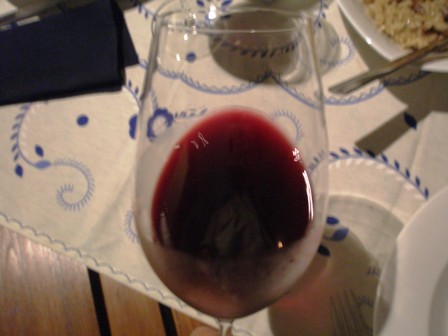
What a wonderful ruby red colour the Shiraz from Hanging Rock has.
Risotto ai Funghi Porcini

Unfortunately, we did not have an Italian wine to go with it. Since my wine cellar is almost empty, I had not much choice. There were only three bottles of Australian wine, all red, left,

a ‘2004 Two Hills Merlot’ (reserved for the last evening in our house),

a ‘2001 D’Arenberg Coppermine Road Cabernet Sauvignon’ from McLaren Vale (I had paid US$ 40 for this bottle) and

a ‘2004 Hanging Rock Cambrian Rise Shiraz’ from Heathcote.

The two whites I have reserved are for lunch on Saturday and Sunday:

a ‘2005 Kitzinger Hofrat, Silvaner dry’ from Bernhard Voelker, Kitzingen in Franconia

and

a ‘2003 Saar Riesling’ from Van Volxem Estate in Wiltingen, Saar.

The tasting room of Van Volxem Estate in Wiltingen, Saar (picture taken in July this year)

I chose the ‘2004 Hanging Rock Shiraz’. The bottle was given to me by Andrew at the cellar door when we went on a wine tasting in August last year. If you visit the region of the Macedon Ranges in Victoria, you have to see this vineyard and taste its award-winning wines (see also my blog entry from 09. September 2007).

Hanging Rock has also a vineyard in the Heathcote wine region, Central Victoria where its award-winning Shiraz wines are grown which enjoy an enormous demand from consumers in China.

The Hanging Rock winery in the Macedon Ranges. In the back you can see the rock. The photo was taken in August 2007.

The wine is a blend from several vineyards near the Mt. Carmel range. It is beautiful, has a ruby red colour, and very intense plum and cherry aromas; it is very fruity, has immense depth, a good structure and actually everything you want from a Shiraz from the Heathcote wine region with its hot summers. The Cambrian soils of the Heathcote region are the key to the fame of its Shiraz wines.

Isn’t the ruby red colour of the Shiraz of Hanging Rock wonderful?

Pity the wine did not match the food (my mistake). The ‘funghi porcini’ were too delicate and subtle and the wine just overpowered the fragrance of the earthy mushrooms. We did not care this time, enjoyed the tropical garden view and the sweet heat of a dry-season evening. One last time. I wonder where I will celebrate my next birthday. Over these thoughts I blew the smoke of a Partagas cigar which was given to me by my friends Liz and Walter in Jakarta. Delicious!


Asian Food and Riesling Wines

August 17, 2008

The Riesling wines I selected for Sunday lunch were just the right complement to the Asian food we were having for the last joint family lunch in our Jakarta home. Tomorrow our girls will be laving for Bangkok to attend the opening of the new school year at their new school.

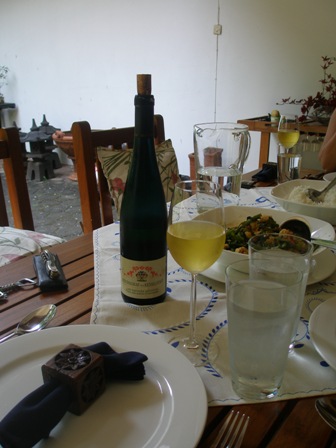
The lunch consisted of a typical Indonesian composition of Kankung (a green water vegetable) with prawns. We ate it with rice using spoons and forks only as it is the custom in Indonesia. The wine we had with the meal was of course not an Asian invention but a Celtic one.

The semi-dry Riesling (“Feinherb” as the Germans say) from the Saar was a perfect match for the food. We had the last bottle of ‘2003 Wiltinger Gottesfuss Riesling Kabinett Feinherb’ , (alc. 11% vol.) from Reichsgraf von Kesselstatt in Trier (www.kesselstatt.com). The spicy food was just the right dish to have with this Riesling wine from my home region.

The sun was shining, my garden green and lush despite the dry season, and so 10 years came to a beautiful end for the four of us.

PS: As “dessert” we had a second bottle of German wine (which was also the last one in my possession), one coming from the Nahe wine region where my grandfather used to live, ‘2003 Sitzius Kreuznacher Rosenberg Spaetlese, Scheurebe’ (with only 9.5 alc./vol.) from Weingut Alfred Sitzius in Kreuznach-Bosenheim (www.weingut-sitzius.de). The variety is mainly found in Germany and Austria and produces highly aromatic wines often made into sweet wines but also available in its dry incarnation. It shows honey, blackcurrant and grapefruit flavors but retains also some of the Riesling character, though it is less acidic, in short beautiful wine can be produced from this grape variety.


Augusta Treverorum – home at last

July 24, 2008

My hometown of Trier (lat.: Augusta Treverorum) from the ‘Kockelsberg’

Alas, we made it. Grandparents were very happy to see us. Blue sky and summer sunshine greeted us. A splendid holiday awaited us. In short, Germany at its best. We are so lucky.

The Mosel river

Margit and I, we went to check out our favourite “watering whole”: the wine bar of Reichsgraf von Kesselstatt opposite the cathedral and the church of “Liebfrauen”.

The ‘garden’ of the wine bar

Riesling was our choice. We had a ‘2007 Kaseler Riesling dry’ (subregion: Ruwer) and a ‘2007 Wiltinger Riesling dry’ (subregion: Saar). Both wines were young and fresh, which make them a delicious drink in a hot summers day. We both preferred the wine from Wiltingen, Saar.

Cheers, and “zum Wohl” as the Germans say.

PS: I am loading this up from a small flat in Madrid which we rented. The internet connection is weak and blogging difficult. Please bear with me.


Family meals and the emptying of my wine “cellar”

July 4, 2008

Our last 60 days in Jakarta have started. Soon we will be moving to Bangkok. We try to enjoy every day. Apart from sorting out things, we are spending our time at home with family meals and drinks.

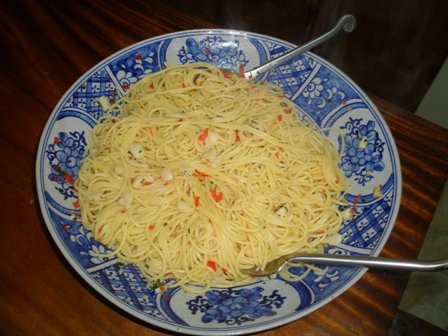
A delicious seafood pasta

I do not have a large supply of fine wines left but some of the bottles I have kept for special occasions. So what did we drink over the last couple of days? Here is a quick run-down:

‘2002 Léon Baur Gewürztraminer Grand Cru Pfersigberg’, alc. 13.5 % Vol.
We drank it before lunch as an aperitif. This is an aromatic wine, very generous in its flavours. It comes from a limestone “terroir” and is the gem of the Léon Baur collection. Low yields make great wines. It’s rather high in alcohol and has 15.2 g/l in sugar. A very enjoyable Gewürztraminer typical for this grape variety (www.leon-baur.com)

‘2003 Wiltinger Gottesfuss, Riesling Kabinett Feinherb, Reichsgraf von Kesselstatt’ , alc. 11 % Vol.
As you know, I love wine from the Saar River, and Wiltingen is one of the major location to produce first class Riesling wines. “Feinherb” is the German word for semi-dry. “Gottesfuss” is one of the best locations in Wiltingen, a very steep, stony slate ground which produces a fine, acidic, and balanced wine. Normally I prefer dry Rieslings but with a spicy Asian meal, the semi-dry version does very well. (www.kesselstatt.com)


‘2005 Hollick Coonawarra Reserve Chardonnay’,
alc. 13.5% Vol.
We had it with a seafood pasta. What a delicious Chardy this was. Although cellaring for up to 7 years is recommended, the bottle did not last that long. It displayed aromas of white peach, had crisp acidity and balanced creamy overtones. Though the wine was matured in French oak for 10 month, it was not “over-wooded”. Beautiful (www.hollick.com).

‘1999 Mildara Coonawarra Cabernet Sauvignon’, alc. 13.5% Vol.
The Mildara brand belongs to the Fosters Group (www.fosters.com). Liz and Walter brought it with them and we had it with all kinds of cheeses, salamis, coleslaw, salads and all kinds of “nibblies”. Despite its age, it displayed all the freshness of a typical Coonawarra wine. The colour was a deep purple. The intense aromas ranged from cassis, to dark berries and plum with hints of mint and herbs. The 18 months in oak have given the wine great depth and bony tannins, mellowed by age. The wine had an excellent structure. It was well aged.

‘2004 Knappstein Clare Valley Enterprise Vineyard Cabernet Sauvignon’, alc. 14.5% Vol.
The bottle retailed for US$ 26.50 at the Jakarta duty free store in Jalan Fatmawati. I had it reserved for a special evening. the wines is Clare Valley Cabernet Sauvignon at its best. Wonderful creamy, cassis, blackberry and mulberry flavours. A big Australian wine, full and complex but heavy which lingers on long after you swallowed the last drop. The fruit is grown on the “terra rossa” soils. Low yields guarantee the quality of the fruit. 2005 was an excellent year with a long ripening season. We had it after a meal just for enjoyment. This is a great wine indeed. (www.knappsteinwines.com.au)

The farewell dinner with our Australian friends (Brett, Janie, John and Dhanya) last night was a delight. We drank some very good wines. I only mention them in passing. Hope you don’t mind. We started with a pre-dinner drink, a ‘2006 Vasse Felix, classic dry white’ from Margaret River, Western Australia. The entreés we washed down with a ‘2007 Yarra Burn Sauvignon Blanc Semillon’ from the Yarra Valley, Victoria. We switched to red before the main course (a pasta bolognese), first to a ‘2004 Cape Mentelle Cabernet Merlot’ and then a ‘2003 Vasse Felix, classic dry red’. Three Margaret River wines stood against the cool climate SB form the Yarra Valley. It was a wonderful evening. No sadness was to find only the joy of being together and having a good time. I love this Australian attitude to life.


German Wine Regions: The Saar

June 28, 2008

One of the premium Riesling producing wine regions in Germany is the Saar, which is part of the Mosel region (the English usually call it Moselle, using the French word for the river). In fact the Mosel Wine Region used to be called (until 2007) “Mosel-Saar-Ruwer”, the latter two being small tributaries to the larger Mosel river. Along the three rivers about 13,400 ha are under vines these days, most of the vineyards are to be found on steep slopes, offering breathtaking views.

The village of Wiltingen, home to many famous wine producers along the Saar

Along the river Saar vine cultivation goes back a long long time, roughly 2,000 years only. Until Napoleon conquered this part of the various German lands, most wineries were in possession of the catholic church, monasteries, and other clerical institutions. Napoleon secularized the administration and with it most vineyards and wineries came into private hands.

The area between Serrig and Konz is the main production base of the Saar. Further upriver only small and singular plots are planted with vines. The most renown wine producing villages along the Saar are
Serrig, Saarburg, Irsch, Ockfen, Ayl, Schoden, Wiltingen, Kanzem, and Wawern. Moreover we find vineyards along one of the smaller side valley’s Filzen, Koehnen, Nieder- and Obermennig, Krettnach and Oberemmel.

Ayler Kupp, one of the prime ‘terroirs’ of the Saar

The dominant variety is, of course, Riesling. The total area under vines is about 1,500 ha, mostly on steep slopes with gradients of up to 55 per cent. Other but minor varieties are Pinot Noir, Dornfelder, Pinot Gris, Rivaner, Kerner and Pinot Blanc. The soil consist mainly of blue Devon slate soils. The alcohol content of the wines is usually low (between 8 and 12 %), but the acidity of the wines shows excellent structures and compositions and this is why the wines can be cellared for long periods of time.

Steep vineyards in Ockfen
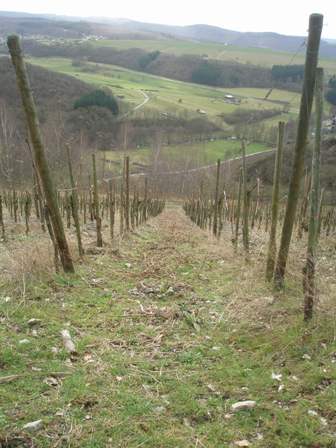
The vineyards are ready for spring to come

The two photos above were taken in Ockfen, showing vineyards in the location ‘Ockfener Bockstein’, one of the prime ‘terroirs’ in that village.

Springtime and lots of work to do to make the season a success. Lime is distributed by hand in the vineyards, here in Schoden.

There are many prime wine producers along the Saar. The top estate is probably Weingut Egon Mueller (also called the godfather of Saar Riesling) – Scharzhof in Wiltingen. Among the highest rated Riesling wines in Germany (on www.riesling.de) Egon Mueller has three of the top eight wines.

But there are many other prime producers. I can only mention a few. For instance Weingut Fortsmeister Geltz-Zilliken in Saarburg, or Schloss Saarstein in Serrig. Then there is the rising star, Roman Niewodniczanski and his team at Van Volxem in Wiltingen. His wine maker, Dominik Voelk, is young and ambitious, and by the way is a native of Franconia, a wine region with long traditions in excellence. When I visited the estate in March, he had completely sold out all his wines. I am now waiting for the release of the newest vintage in September (grand cru only). Then there is Weingut Dr. Siemens in Serrig and Weingut Peter Lauer in Ayl.

Also other producers are worth mentioning. Weingut Reichsgraf von Kesselstatt, which operates a wine bar just across the cathedral in Trier (Trierer Dom), possess vineyards in Wiltingen. Four star ratings were awarded to Weingut von Orthegraven in Kanzem and Weingut von Hoevel in Konz-Oberemmel but there are many others who produce excellent Saar wines.

I love the Saar Rieslings with their well balanced, “filigree like” acid compositions. I love them for their explosiveness, zest, intensive aromas; they have structure and balance, are low in alcohol and usually impress with a long finish, lingering on your tongue’s taste buds like ballerinas which you can still see before your inner eye long after they left the stage.

I encourage you to visit the Saar and sample as many wines as you can, it’s worth it, definitely. This time of the year should be perfect, as the pictures below demonstrate. I hope they can entice you to give it a go and lure you to the Saar.

Explore the beauty of my home region, do not forget to visit Trier, its just around the corner.

Vineyards in Schoden
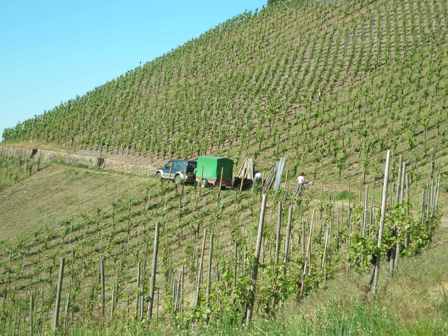
The ‘terroir’/location ‘Herrenberg’ in Schoden

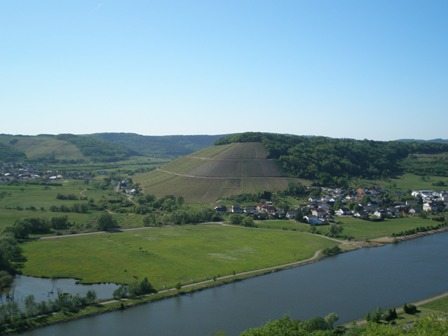
Near Schoden the Saar is most picturesque. The hills, the forests, the river and the small villages offering local food and wines make the Saar a prime destination for tourism.

Restaurants in Germany – Hotel Prinzregent, Munich-Riem

June 25, 2008

Bavaria is just such a beautiful place. I just cannot get enough of it. Especially at this time of the year travelling around Upper Bavaria is truly enjoyable. Even sub-urban places such as Riem have their charm. I stayed in a small hotel at the outskirts of Munich to attend a conference at the Messe Zentrum (the fair).

The very first evening, I asked the receptionist where one could have a decent bite of food, preferable Bavarian style and I was pointed into the direction of the Hotel Prinzregent (www.prinzregent.de), in fact a country inn style place along the main street in Riem. The ‘guest room’ of the public bar part was fairly busy at a Friday evening.

The Bavarian country inn – Hotel Prinzregent

As it was my first evening back in Germany I could not resist ordering a pork roast Bavarian style with ‘Semmelknoedeln’, a kind of cooked carbohydrates made from leftover bread crumbs. It was so delicious I completely forgot to take pictures for my blog. I drank wheat beer with the meal though the Prinzregent has a nice wine list available. For dessert, which I usually do not have, I had ‘Apfelkuechle’, a kind of apple backed in a doe and seasoned with raisin. After that mighty meal I was exhausted and went to bed early.

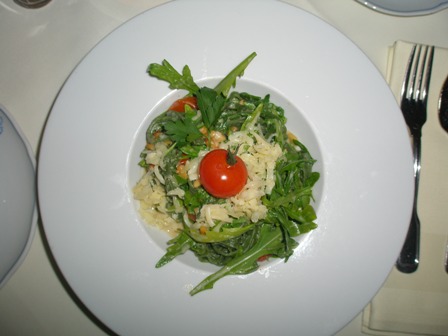
The pasta

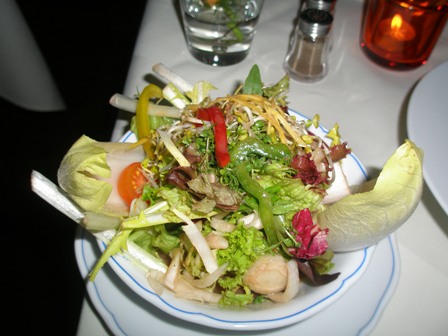
The very next day I came back to enjoy some more of the delicious food at the Prinzregent. Unfortunately, I did not order the roasted pork again (I should have) but went for a vegetarian pasta dish. It was ok but could not match the pork. The side salad was fresh and tasty.

The salad

This time I tried some of the white wines with my food. First I ordered a Riesling from, of course, the Mosel. A ‘2006 Weingut Schmitges dry Riesling from grey slates’ was my choice. It is a young but very enjoyable wine, typical for the region, elegant, displaying aromas of citrus and green apples, a fruity, minerally kind of wine.

For my second glass I choose a Sylvaner from the native lands of my mother, Franconia (the most northerly part of Bavaria). Horst Sauer is one of the icons of the vintners and winemakers from Franconia. His ‘2006 Eschendorfer Lump’ is just divine. The Germans like to describe a wine as “filigran”, which my dictionary says means “lacy” or “filigree”. I do not know if that makes sense to you. Anyway, the wine shows the typical Franconian character, is complex and fine, well balanced, has a good structure and a lingering finish. The prices for the wines were not on the cheap. The fellow at the next table turfed the idea of having a glass of wine after he saw the prices. Well, I was in a festive mood that day and did not bother.

White sausages Bavarian style, isn’t this beautiful?

My last meal at this wonderful place I enjoyed sitting in the large beer garden under very old chestnut trees reminiscing about the wonderful time I had in Bavaria. It was rather a late breakfast than lunch and therefore I ordered the typical Bavarian “white sausages” which is eaten with sweat mustard. A wheat beer matches that perfectly. Sorry you wine folks.

Address:
Hotel Prinzregent an der Messe
Riemer Strasse 350
81829 Munich
Te.: +49-89-94539-0
http://www.prinzregent.de


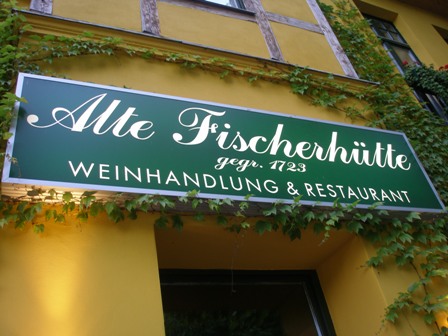
Restaurants in Germany – “Alte Fischerhütte” at Schlachtensee, Berlin

June 17, 2008

During my time in Berlin I had the opportunity to dine at “Alte Fischerhütte” at Schlachtensee in Berlin, a beautiful located restaurant at the shores of a small lake very popular with citizen for all kinds of leisure activities.

The restaurant is under the management of Lutter and Wegner, formerly the oldest wine merchant house in Berlin and today a chain restaurant owned by a corporation (http://berlineating.blogspot.com/2008/04/lutter-wegner.html).

Lutter and Wegner possesses various restaurants and wine shops around the city of Berlin but also outlets in Munich for example.

The “Alte Fischerhütte” offers many facilities. It is great to sit on mild spring and/or summer evenings on the beautiful outside terrace and enjoy the gorgeous surroundings.

The elegant dining facilities are magnificient, so is the wine list and the food.

Because of the rather formal character of the occasion, I could not take photographs of the food on offer.

We (a group of about 50 persons) were served a set dinner consisting of a three course meal: an entrée – green asparagus soup with scrimps – a main course – veal steak with asparagus, sauce Hollandaise and potatoes – and a dessert – fresh strawberries with vanilla ice cream. The quality of the food was excellent, and the month of May is asparagus season, nothing better on offer than this delicious vegetable.

As an aperitif we had a ‘Lutter and Wegner Riesling sparkling wine, extra dry’. Two wines, a white and a red, were on offer with the meal. The white consisted of a ‘2006 Schloss Vollrads dry Riesling’ from the Rheingau and the red was a ‘2006 Jean Stodden, Pinot Noir’ from the Ahr. Both producers have a long tradition in producing excellent wines, Schloss Vollrads for its Rieslings (www.schloss-vollrads.de) and Jean Stodden for its Pinot Noir (www.stodden.de). The wines matched the food extremely well. I loved the crispness of the Riesling, its intensive citrus notes, the well balanced acids and the beautiful finish. The Pinot Noir (13% vol, residual sugar 2.3 g/l) was also an excellent wine with an aroma of cherries and red berries, great structure and a long finish. I stayed with this wines longer than I should have, I guess. What a great selection that was.

The dinner was utterly enjoyable. I was able to take a quick shot of the Riesling in my glass. Isn’t it beautiful, this fresh, light colour promises just the best German Riesling has to offer. I let any other Riesling wine “get warm along the roadside”, as we say, for the German stuff (ok, its exaggerated, I know. I might make an exception for some Alsation and some Austrian Rieslings). It was a splendid evening and I highly recommend a visit to “Alte Fischerhütte”.

Address:
Alte Fischerhütte am Schlachtensee
Fischerhüttenstrasse 136
D-14136 Berlin
Te.: +49-30-80498310