Wine of the day: The Wanderer, Yarra Valley

May 16, 2010

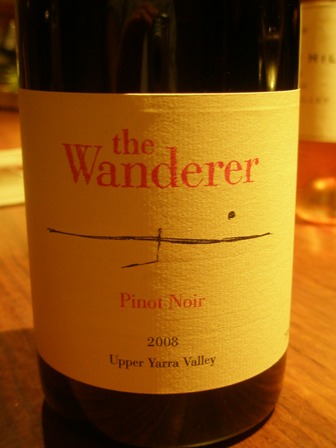
2008 Pinot Noir The Wanderer, Yarra Valley

My wine tip of the day is the Pinot Noir made by wine maker Andrew Marks of Gembrook Hills in the Yarra Valley. The wine is very light in colour with 13% alcohol and has a lot of cherries on the nose. It has some oak and is made from grapes grown from a single vineyard near Tarrawarra in the Yarra Valley.

I know that you have to be in Australia to get hold of this wine. But never mind, visiting Victoria is a bonus anyway. Have a nice Sunday, wherever you are.


Backyard vintner

April 20, 2010

Pips Paddock, Springvale, Yarra Glen

The current overproduction of wine grapes is a great worry for many of the small, medium as well as large producers. Especially for fruit growers the outlook is bleak. Nobody wants to buy your grapes if the slightest deviation from “perfect” is detectable. They just walk away from you and let you sit on the fruit. It’s a buyers market.

However, there are options. One is to make your own wine. Not much equipment is required and space is usually available, even if it is on the back porch of the house.

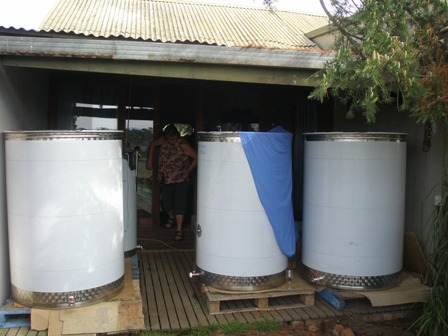
The new stainless steel tanks on the back porch

My friend Gayle Jewson from Springvale, Yarra Glen did exactly that. The grapes were hand picked and sorted, pressed, destemmed and dumped in new stainless steel vats for fermentation.

When we arrived I tasted the “brew” for the first time. Two weeks later I had a second tasting opportunity. What a difference two weeks can make? Amazing. I think Gayle’s Pinot Noir is on the right track and her Chardonnay is just lovely. Lock out for Pips Paddock Pinot and Chardonnay this year. There is only very limited supply. Visit Gayle on her farm and/or order by phone.

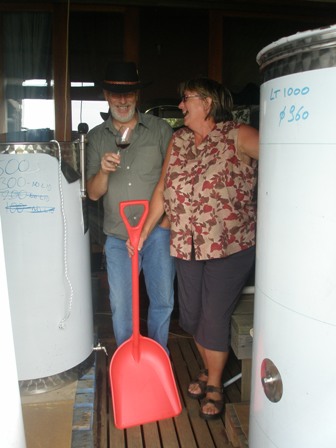
Tasting if fun

The backyard vintner in action


Getting ready for the 2010 vintage

February 22, 2010

Two Hills Pinot Noir shortly before the nets went on

The nets are on now, and we are expecting a good harvest at Two Hills Vineyard for 2010. After the total loss of last year the prospects are not too bad.

Estimates are:

– Sauvignon Blanc: about 8 tonnes of fruit, and already sold
– Pinot Noir: about 5 tonnes of fruit and still looking for a home

The Merlot grapes look good too, but we are not making any wine this year. This will make the bird in the vicinity very happy, what a feast. That’s the price we have to pay for the grape glut. It’s sad but cannot be helped at this point in time.

Our new tractor will come into action for the vintage. This will make things easier, I hope.
Let us hope no unexpected disaster occurs before the grapes are in safely.

The plan for 2011 is to mothball the vineyard for a couple of years and see if the market recovers.


Australia day 2010

January 26, 2010

I started the day with a lemington, a sponge cake and one of the two Australian national desserts (the other one is Pavlowa). It’s Australia’s national day again.

On 26 January 1788 the so called first fleet landed at Sydney Cove and today Australians are commemorating this event. Also we did celebrate, though muted. It was a normal school day for the children and a normal working day for the parents.

Morton Premium Brut

But we cracked a bottle of sparkling tonight which we had with the celery risotto. The sparkling came from New Zealand, which was given to us by our former neighbors Alain and Keiko. It was a ‘Morton Premium Brut’ (Methode Traditionnelle, no vintage), made of Chardonnay, Pinot Noir and Pinot Meunier, a blend from Hawkes Bay and Marlborough grapes. It’s a very creamy bubbly with buttery yeast aromas, easy to drink (12% Vol.). The wines won a couple of silver medals in 2008, 2007 and 2006. It also gained some recognition in a few wine buyers guides (for instance Michael Coopers Buyers Guide).

Celery risotto

It was an enjoyable family meal, an evening like many others for us here in Bangkok. But we raised the glass and toasted to our beloved “island down under”. Cheers


Climate change and grape varieties

November 2, 2009

RieslingSchoden

Riesling grapes in Schoden, Saar, shortly before vintage 2009

Uff, I am reading in todays “Your Daily Wine News” newsletter that some of Australia’s top wine experts think that over the next 20 years climate change will be responsible for the decline of Shiraz and Chardonnay and the rise of varieties such as Vermentino, Arneis, Nebbiolo, Pinot Grigio and Viognier (some call them “alternative varieties”).

This is bad news for me and my own small vineyard. At Two Hills Vineyard we have concentrated on some of the traditional French varieties: Sauvignon Blanc, Pinot Noir, Merlot and Chardonnay (first vintage in 2011 or 2012). Our fruit ripens usually well (if we do not suffer severe frosts) and shows a superior quality. But will that persist under the conditions of climate change?

I still remember vividly how I pulled out the 2 1/2 acres of Cabernet. it was hard work, wrapping a chain around every single vine and lifting the hydraulic of the tractor. I should have left them in, I guess. If temperatures rise in Glenburn, the drought persits, and/or we’ll have less percipitation in the future, Cabernet could have been the ideal variety for our spot. I ripped the vines out because the grapes would not fully ripen. At the moment we have sufficient water, our two dams are overflowing after years of drought but that might change quickly again.

Another issue is age, my age. At 55 I might still have a chance to enjoy some of the coming Chardonnay vintages but replanting would “cost” me many years of waiting. I could contemplate to plant on our second hill where we still have another 5-6 acres of space. Well, let us see what is going to come.

At least there is no politician who tells me what to do and chances are small that an elector such as Clemens Wenzeslaus of Saxonia, who changed the Mosel by instructing vintners to ripp out their red varieties and replant with Riesling, would appear on the Australian scene. However, danger is looming from the anti-alcohol lobby in Canberra which is working day and night to convince law-makers that the purchase of alcoholic beaverages needs to be made more costly for the consumer and profitable for the taxmen.


Autumn in Berlin – Affentaler Spaetburgunder

September 27, 2009

Abendstimmung

Evening at Griebnitzsee, near Berlin and Potsdam

I am in Germany right now attending meetings and conferences. Ever since I landed in Hamburg, the weather has been fine, with mild and sunny autumn days.

Today is election day and at about 18 h we will know who is going to govern the Germans for the next four years. Last night we were all invited by our boss to dine at his home. He and his wife are known for their hospitality. One of the wines on offer came from Baden, a famous German wine region. I must admit that I am rather ignorant about it’s wines.

Affentaler

2008 Affentaler Spaetburgunder 1.5 liter bottle – look at the colour

I was presented with a glass of ‘2008 Affentaler Spaetburgunder’ (12.5% vol. alc.). Needless to say, that I had never heard of “Affentaler”. And only while writing this blog entry I learned that the producer of this excellent German Pinot Noir is a wine co-operative. “Affental” is located 10 km south of Baden-Baden and belong to the city of Buehl.

This is a very elegant wine, fruity, dry and very harmonious, a thorough enjoyment. The 2007 vintage had earned 87 Parker points. The 1.5 liter bottle lasted a while but it was difficult to drink any other wine after we finished it. All of us wished for more. I will look out for it when shopping for wine next time.


A Sunday at Bloody Hill

September 21, 2009

TimoM0

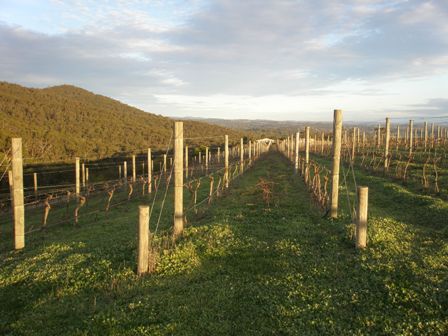
Great Yarra Valley views from the Mayer Vineyard (left to the dam)

On a beautiful Sunday in early August, we were in for a surprise visit to the Mayer’s. We bought some “nibblies” (Australian for cold meats, sausages, cheeses, condiments, etc.) and some wine in Healesville and drove up the steep drive to Bloody Hill on top of which their beautiful house (rammed earth) is situated. Alas, they were in and happy to welcome their unannounced intruders.
TimoM00

The vineyard at the crest of the hill is very neat

TimoM1

Some of the wines on “offer” (f.l.t.r.: a Silvaner from Franconia, Dr. Buerklin-Wolf, a Riesling from the Pfalz and a Dr. Mayer Pinot Noir from the Yarra Valley)

We came at the right time. A shipment of Riesling wine (about 60 cases) which Timo had made on a visit to Germany last year had just arrived and was ready for tasting. Moreover, as a member of the South Pack, Timo was in the preparation of a wine tasting tour to three Australian cities (Melbourne, Sydney and Brisbane). The South Pack is a group of eight innovative young Australian wine-makers who have raised the bar for the selling of premium and super-premium wines in sluggish markets.

TimoM3

The German Brotzeit

A quick “Brotzeit” was thrown up and the wine tasting could start. We did not drink in any kind of order but rather according to gusto and enthusiasm. First cap of the rank was the German Riesling Timo had made, Dr. Mayer Riesling of which I have no picture which speaks for itself. This was not a time for tasting notes but for joy and nourishment of body and soul, for Australian and Swabian story telling and song.

TimoM2

Bloody Hill Pinot Noir

Timo is a native of a small hamlet, called “Grossheppach” (about 4,500 inhabitants), today part of the small town called Weinstadt (translated: wine city) in the Rems valley (the Rems is a small river), Wuerttemberg, about 15 km east of Stuttgart. As everything in Germany, Grossheppach has a long history.

Grossheppach

Coat of arms of Grossheppach showing the river Rems and four grapes on a vine

Furthermore, the village has a long tradition of vine cultivation and wine making. Timo comes from a family of small vintners (and farmers).

In 1279 a historical deed is the earliest written testament of the flourishing wine production in Grossheppach. Magister Rudolf, a local doctor, had bequeathed his house in Esslingen and three vineyards in Grossheppach to the Abbey of Bebenhausen which was witnessed by knight ‘Fridericus miles de Heggebach’.

Timo showed as a historical chronicle of Grossheppach with black and white photos which also depicted his family in the 18th and 19th century. Here we are, thousands of kilometres away from the old land and talking grape production, wine traditions and wine styles. To cut a long story short, Timo had made his first ever Riesling wine in Grossheppach and shipped it for sale to Australia.

It was not the time for tasting notes, I guess. We opened one bottle after the next. First the Riesling wines, then Chardonnay and finally Pinot Noir and Shiraz, all Mayer Vineyard wines and Timo Mayer creations.

TimoM6

Mayer and Dr. Mayer Pinot Noir and a traditional German wine label with the coat of arms of Grossheppach

The Mayer Vineyard is only a small operation (2.5 ha under vines). All wines are hand crafted and from a single vineyard. Timo believes that wine is made in the vineyard, therefore there is minimal interference. The reds are unfined and unfiltered. Timo makes wines with a difference, with great character and individuality. As he says “he wants to bring back the funk”, and funky these drops are. James Halliday, “the wine pope of Australia”, has awarded his highest rating, a 5 stars, to the Mayer Vineyard.

The Dr. Mayer Pinot Noir is one of the newest creations from the masters hands; a great wine, elegant, whole bunch fermented if I am not mistaken. Timo assumed that all of it would be sold during the South Pack promotion tour together with the Riesling. By now there should be nothing left, I guess.

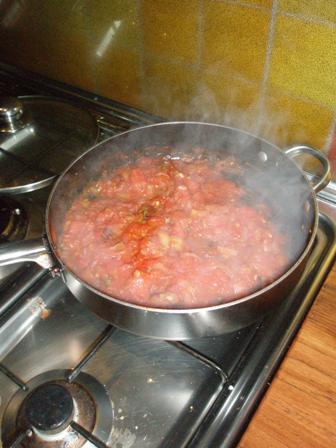
Needless to say that the day extended to the night and ended with a pasta feast for 9 hungry mouths.
TimoM5

The pasta sauce in the making

TimoM4

TimoMM

The magician at work, this time in the kitchen and not in the wine cellar

We had a great time. The children played all afternoon. We walked the vineyard and Timo showed me where he shot a deer. Then we went to get some of that venison for us to take home. The “Brotzeit” led to dinner and then it was time to drive home to our own vineyard in Glenburn. Good news is that Timo is planning to make Riesling again in 2009 and maybe the following years.

For sales and enquiries contact:
timomayer@bigpond.com.au

The following wines are for sale:
Bloody Hill Chardonnay
Bloody Hill Pinot Noir
Big Betty Shiraz
Mayer Close Planted Pinot Noir (also as the Dr. Mayer Pinot Noir)

Restaurant review: Chopin, Berlin

June 8, 2009

chopin1

The Chopin restaurant

Last year I had the chance to dine twice at Chopin restaurant which is located between Wannsee and Griebnitzsee in the South west of Berlin. The cuisine the restaurant specialises in is Silesian food. Today Silesia is a region of Poland smaller parts of which, however, are belonging to the Czech Republic and to Germany.

chopin3

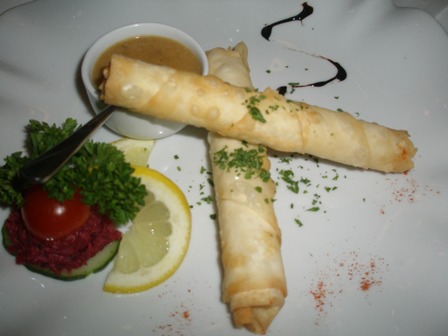
The entrée “Schlesische Zigarren

We had a fixed menu which was ordered for the occasion. The entrée consisted of “Schlesische „Zigarren“, Silesian cigars (price Euro 3,90), a puff pastry filled with sheep feta and a mustard sauce.

chopin2

The beef dish “Schlesischer Sauerbraten”

We could choose between two main dishes: a “Schlesischer Sauerbraten”, a marinated pot roast (price Euro 11,90) with red cabbage and apples, peaches and cranberries served with German dumplings, ….

chopin51

The pike perch (German: Zander)

…and a fish dish, consisting of a pike perch roasted in a sauce of dill and with zucchini (price Euro 13,90). Potatoes and vegetables were also presented.

Since we dined at the restaurant twice within a week, I had the opportunity to taste each of the main dishes.

Needless to say (you can see it from the pictures) the food at Chopin restaurant is delicious; it’s a splendid example of German country cuisine at its best.

chopin4

Pinot Gris

There were two wines served with the food: a white (Grauer Burgunder/Pinot Gris) from Baden, Germany and a red (Nero d’Avola) from Sicily (which is not on the wine list any more).

I had the white, a ‘2004 Oberbergener Bassgeige, Grauer Burgunder, Kabinett, dry’, from the Kaiserstuhl wine region in Baden.

It’s a massive white wine (13% alc.) not something light for the summer. It has substance and structure which make it an ideal partner for pairing with Silesian food.

The producer of the wine is a “wine-co-operative”. The Gault Millau as well as the Eichelmann Wine Guide award the co-operative “one bunch of grapes” (Gault Millau: reliable) respectively “two stars” (Eichelmann: good producer).

I very much like this cosy family restaurant. If you are in Berlin next time, please do not miss to pay it a visit.

Address:
Restaurant Chopin
Wilhelmplatz 4
14109 Berlin, Germany
+49-30-8053033


Francis Coppola

February 24, 2009

Recently, my friend Holger from Berlin had given us a bottle of “Francis Coppola wine”. I had never tasted anything from this producer though I have read a couple of reviews on the net. Therefore, opening this bottle of Pinot Noir and enjoying it with a Sunday roast (chicken this time) promised to be an exciting experience.

The ‘2006 Francis Coppola, Diamond Series, Silver Label Pinot Noir’, originates from Monterey County, a cool climate wine region in central California. During an Agricultural Economist Conference in 1997 I had the opportunity to visit this wine region. It’s a marvellous place and I treasure my memories of tasting various delicious boutique vineyard wines.

coppola11

The ‘2006 Francis Coppola Pinot Noir Diamond Collection Silver Label’

So tasting wine from this part of the world was exciting indeed. We do not drink very many wines from California so this wine extended our experience with USA-wines. Ratings of the 2006 vintage vary (87 or so points), but it is definitely not one of the best Californian Pinot Noirs. However, the price of US$ 20 in the USA indicates that there is quite a market out there for this “very drinkable” drop.

The medium-bodied wine showed plenty of fruit on the nose (cherries, raspberries), it felt silky in the mouth with some forest flavours, and displayed a nice finish. No bitterness could be detected as some tasters have reported earlier. To my taste buds the pairing of lemon chicken with Pinot Noir worked well.

port11

Port wine from Portugal helped us to digest the meal

What a pleasurable tropical afternoon on our terrace we had. The 38 degrees Celsius did not feel that hot but the dry-hot seasons has definitely started. After the meal I had a port wine. I always liked port. Our visit to Porto last summer re-enforced this passion.

With the port (10 years old), I smoked a cigar from Nicaragua, a hand made ‘Casa de CT Torres, Nicaragua, Hecho a mano’. The “smoke” was very pleasant, not to heavy; the tobacco was mild but distinct. I should buy more cigars from Nicaragua.

Cigars relax me and that is what I needed between two very busy work weeks, some relaxation. Also the bad news that we would not have a vintage this year at Two Hills Vineyard needed to be digested. Well, so is nature, unpredictable, unsteady, volatile, but marvellous.


Restaurant Review: Giant Steps in Healesville, Victoria

February 5, 2009

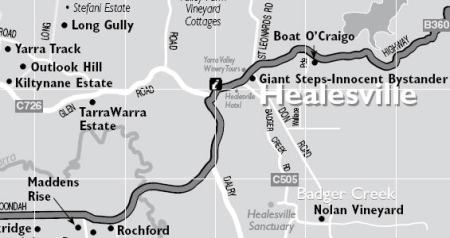
A place which I love to visit whenever I can is Giant Steps/Innocent Bystander, a winery cum restaurant, bakery, cheese maker, coffee and sweats sellers as well as a fun offering place in the heart of Healesville, the picturesque little town in Victoria about an hours drive northeast of Melbourne.

Despite the huge hall with the public dining facilities, the wine tasting and other desks (to sell bread, sweats and so on), the place is quite cosy somehow. It’s a place for large family and other groups as well as for having a coffee or glass of wine by oneself. They have a German “kicker” game and other entertainment facilities. In the mornings you see many young mothers with their kids. Free wireless internet access is another bonus the place has to offer.

giant-steps0

The “hall” with tables and counters

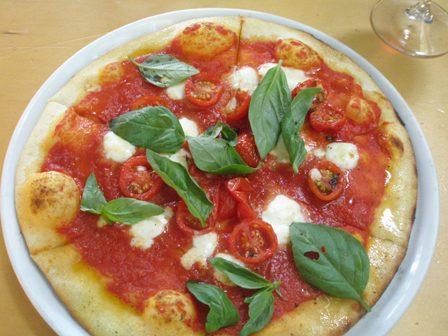
It was of course packed with people in the pre-Christmas period when we came in. We went for lunch before heading home to the vineyard and decided on pizza. Ever since we have lived in Rome, Italy, we love thin pizza of the Roman type. My favourite pizza is the simplest one, a pizza margherita (that is it’s usual name) with just tomatoes and mozarella cheese and basilico.

giant-steps1

Pizza Margerita

The pizza served in Giant Steps/Innocent Bystander is quite nice, though not as thin as a Roman one.

giant-steps4

Tomatoes to be dried

giant-steps3

The pizza oven

Pairing pizza with wine is a tricky thing. The recent controversy of my fellow blogger Do Bianci with Dr. Vino is a case in point. I think Jeremy Parzen is mostly right. When we lived in Rome we had never pizza with wine. Beer was the usual drink. However, as with any food one can have wine with it. That applies also to pizza.

Frankly speaking, I drink whatever wine is offered with the pizza if in a friends home. In a restaurant my choice of wine depends on my mood. My mood told me wine, local wine.

giant-steps2

A sniff and a mouthful

I decided on a ‘2008 Innocent Bystander Pinot Noir’ which is not a complicated wine but rather young and fresh. As regards the pizza margherita there is a lot of cheese on it which might not go well with the high acidity of the Pinot since it destroys the “harmony”. However, the earthy character of the Pinot is what I think makes it somehow acceptable, at least to me.

On www.theworldwidewine.com there is a list which shows which grapes go with which pizza.

pizza-wine-pairings

The pizza-wine pairing suggestions

giant-steps5

Innocent Bystander Pinot Noir

The four of us we had a great time at Giant Steps/Innocent Bystander. I highly recommend to visit the place to any casual tourist. If in Healesville do as the Healesviller do!

Address:
Giant Steps Vignerons – Innocent Bystander Winery
336 Maroondah Hwy.
Healesville, Victoria 3777
Australia
Tel.: +61-(0)3-59626111

healesville-map1

A map