The best 10 German dry Riesling wines

November 25, 2009

It was a bit disappointing for a native from the Mosel River to read through the list of best dry Riesling wines of Gault Millau’s newly released wine guide 2010.

Among the best German dry Riesling wines of 2007 and 2008 there was not a single one from the Mosel, Saar or Ruwer.

I know that my home region is more famous for its semi-dry and sweet Rieslings but…

The good news it that a wine from the Nahe where my materal grandfather had introduced me to dry wines many decades ago was ranked the second highest.

Moreover, the vintner of the year is also from the Nahe. Tim Fröhlich (35) was awarded this prestigious title. The family estate Schäfer-Fröhlich is one of the best wineries in the Nahe Region and produces outstanding dry and sweet wines.

The winner for best dry Riesling (with 96 points) was a wine from the Pfalz, a ‘Forster Kirchenstück GC’ by Dr. Bürklin-Wolf (70 €). Emrich-Schoenleber received 95 point for a ‘Halenberg Grosses Gewächs’ (29 €). Among the top ten five Riesling wines came from Pfalz, two from Rheingau and Rheinhessen each and one wine from the Nahe.

That the Franconian wines were missing from the list was a further disappointment. Also in Franconia the 2007 and 2008 vintages were outstanding (as is the 2009).

Two other wines received 95 points, a ‘Abtserde Grosses Gewächs by Keller Estate, Rheinhessen and a ‘Forster Pechstein GC’ also by Dr. Bürklin-Wolf, Pfalz (35 €). 94 points were awarded to three wines: a ‘Deidesheimer Hohenmorgen GC’ by Dr. Bürklin-Wolf (35 €), a Rüdesheimer Berg Schlossberg by Georg Breuer, Rheingau (40 €) and a ‘G-Max’, also by Keller Estate, Rheinhessen (I found a price of 160 € from an internet sales website). From some chat on the internet I got the impression that you won’t see a bottle on any shelf. This wine is “rationed” and reserved for special customers. Keller estate was “the producer of the year 2006” of Gault Millau.

Two wines were given 93 points: ‘Kastanienbusch Grosses Gewächs’ by Rebholz Estate, Pfalz (32 €), and ‘Rüdesheimer Berg Rottland Alte Reben Goldkapsel’ by Josef Leitz, Rheingau (65 €). Wine number 10 received 92 points and it was a ‘Birkweiler Kastanienbusch Schiefer’ by Siener Estate, Pfalz (16.50 €). This is the only wine in my price-range.

Needless to say that all the wine gurus of the world have written about these wines and these producers, John Gilman, Jancis Robinson, Eric Assimov to name only a few. Some of the wine reviews you can find on the internet, some of them are linked by the specific estate named above. It seems there is lots of research to be done.

Go wine enthusiast. You can, of course, also buy the wine guide, Gault Millau.


German wine regions: the Nahe

September 17, 2009

Nahe2

The Nahe wine region has a great significance for me and my family. It was here that I got first into contact with vine cultivation and wine appreciation at a rather tender age.

Why you might ask? Were you not from Trier, Mosel?
Well, my maternal grandfather, Hans Heinrich Schüssler, a native of Reichenberg, a village near Würzburg, used to live in Martinstein. Being from Franconia, another famous German wine region, he was the only wine drinker in the immediate family (my father preferred beer). He used to be the station master in Martinstein (today 322 inhabitants), a hamlet along the left bank of the Nahe river. The village was founded in the middle ages at a ford crossing the Nahe river. In 1340 it got a castle and even market (city) rights.

My brother and I, we used to spend the long summer holidays (and many other holidays) at my grandparents house in Martinstein. My grandfather used to take us on long walks in the forest and villages nearby. During these walks we always found a country inn where we could refresh ourselves, enjoy a drink or a “Brotzeit” (a typical German snack). He would drink a “Schoppen” (0.25 litre glass) of the local Nahe wine. He loved dry white wines. We would have a lemonade.

He was associated with a “hiking brotherhood” (called “Hunsrückhöhenverein”) whose members would walk in large groups on weekends to various destinations. Usually a country inn was the designated object of the hikers. Here the group converged for a hearty meal and some drinks. Shortly after vintage, “Federweisser” (freshly made but still half-fermented wine) was a popular drink.

But boys being boys, we would sip at his glass from time to time. He being deeply involved in conversation with fellow hikers, did not notice. Neither did we. The sweetness of the fresh wine veiled its dangers. To cut a long story short, we had the experience of a first inebriation of our young lives and could hardly walk strait on our long way home.

After my grandfathers retirement he moved out of the train station into a newly built home right in the middle of vineyards at the outskirts of the village towards the east. Vineyards stretched right to the door. Just a short walk up the hill and endless vineyards lay at your footsteps. Occasionally we would help during vintage time (more play than serious helping). But we would often taste fully ripened grapes and enjoy the fruit. I treasure these wonderful memories of my youth at my grandfathers house in Martinstein.

Map Nahe wine region

The Nahe wine region (photo source: wikipedia)

As you can see from the above map, the Nahe wine region stretches from Martinstein to the West along the river eastward, later north towards the estuary at Bingen where it flows into the Rhine river. The largest city in the region is Bad Kreuznach, a small town of about 45,000 inhabitants.

Nahe1

With about 4,200 ha under vines, the Nahe region is one of the smaller wine growing areas in Germany. It is still larger than, for instance the Yarra Valley in Victoria (with about 3,800 ha, about 2% of Australia’s total). The Nahe region is dominated by white grape varieties (about 74% of the total area under vines). The main variety is Riesling (26%) followed by Mueller-Thurgau (14%) and Dornfelder (13%).

Fifty years ago the variety distribution was very different. Silvaner used to be the most planted variety with about 50% of the total area but has ever since been replaced by the Burgundy varieties (Pinot White, Gris and Noir) as well as by Riesling, Dornfelder, Blauer Portugieser and Müller-Thurgau plantings.

The Nahe is divided into seven collective sites (Grosslagen) and 328 individual sites (Einzellagen). Due to its volcanic origins, the soils of the nahe show a great diversity. The wines reflect this. Only in 1971, the German wine law defined the nahe region. before that time, its wines were sold as “Rhine wines”. However, some of the best Riesling wines of germany originate from the Nahe and today Nahe wine can rival the best from Mosel and Rheingau or any other German wine region.
Nahe3

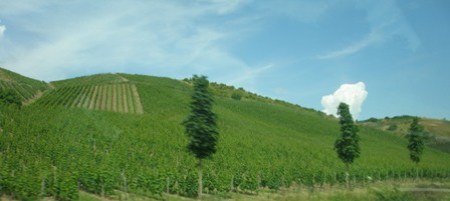
The Nahe can be divided into the upper (west) and lower (north-east) Nahe and the region around Bad Kreuznach. In Martinstein and the neighbouring village of Monzingen (first mentioned in 778) the oldest vineyards of the Upper Nahe are to be found. The soils of the Nahe range from sandstone to quartzite and slate. The region shows a temperate climate and some of the southern slopes enjoy a micro climate comparable to the Mediterranean. Elevations range from 100 to 300 meters altitude.

Nahe4

Who are the top producers of the Nahe wine region?

Well, the name Herrmann Doenhoff comes to mind. He is the leading vintner of the Nahe and his wines are ranked among the top Rieslings in Germany. Herrmann Dönnhoff has about 20 ha under vines and produces about 140,000 bottles a year. His winery is located in Oberhausen/Nahe. The 2007 vintage produced outstanding wines; the 2008 Riesling wines did not quite reach that quality level during recent tastings. But his ‘2008 Niederhäuser Hermannshöhle Riesling Gran Cru’ earned 93 Parker points.

Other top producers are Emrich-Schönleber in Monzingen (about 15 ha under vines, yearly production about 110,000 bottles), Schlossgut Diel (17.5 ha and 120,000 bottles) in Rümmelsheim and Schäfer-Fröhlich (14 ha under vines and 75,000 bottles annually) in Bockenau.

Wines and vintners I like very much are Sascha Montigny in Laubenheim and Weingut Edelberg at Gonratherhof 3 in Weiler just on the other side of Martinstein. The former I like because of the high quality of his red wines, especially the 2006 vintage; the latter produces solid country wines which remind me of my youth in Martinstein and the long hikes with my grandfather. The country inn at Gonratherhof was often our destination when the three of us set out from our little house in the vineyards.


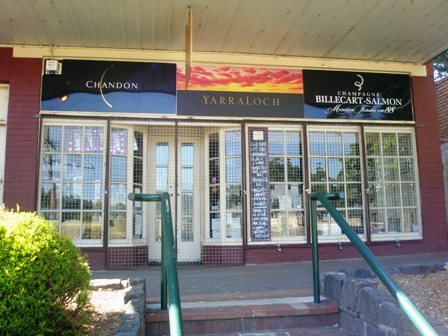
Wine shopping in Healesville, Yarra Valley

August 16, 2009

Barrique

For a long time I wanted to write about my wine shopping experience in Healesville, a charming tourist town in the Yarra Valley, about an hour’s drive from Melbourne. One can find a jewel of a wine store in this rural retreat, called Barrique. I took the photo above Christmas last year.

Barrique2

This is the old shop front

When visiting Healesville again in July 2009, I was shocked to not see the above signpost in the old place. I was afraid that the global financial crises and the bush fires might have let to the closure of this little wine shop. Alas, it had only moved a block further along the main street into the city centre. I was so happy when I found it again.

Barrique3

The “new” Barrique, a block further up the main street

I could not resist the temptation. Previously, I had bought German wines from this shop. I dashed in to see what was on offer. The wines are beautifully displayed. There was so much out there. I could not stop browsing through the shelves.

Barrique5

The inside of Barrique

Barrique4

So many bottles

Barrique6

Wines from all over the world

Barrique7

The “German box” with selected Riesling wines from various German wine regions

The box above announces some of the best German Riesling producers from Mosel, and Nahe. I just love Riesling wines. In the end I picked up four bottles, one from the Pfalz, three from the Mosel. I will not tell you what they were today. More about the tastings of these wines later. Stay tuned to the Man from Mosel River.
Cheers


The best German vintners and wine makers

June 1, 2009

Threewinegods

The wine gods (photo taken from a building in Berlin)

Its certainly a great honour to be called “vintner of the year”. Since 1994 Gault Millau, Germany’s wine guide and major authority regarding wine, wine business and the wine sector, is awarding the “vintner of the year” award.

Today the total number of vintners of the year is 16, seven of which come from the Mosel wine region. The current one, however, comes from the Pfalz (Knipser brothers).

But in the years 2007 (Theo Haart, Mosel), 2005 (Kartaeuserhof, Ruwer), 2001 (Loosen, Mosel), 1998 (Mueller-Scharzhof, Saar), 1996 (Joh. Jos. Pruem, Mosel), 1995 (von Schubert, Ruwer) and 1994 (Fritz Haag, Mosel) the vintner of the year came from my home, the Mosel river and its tributaries.

(Remark: the Mosel wine region was originally called: Mosel-Saar-Ruwer)

No other German wine region has provided that many “champions”. So far the Nahe and Pfalz wine regions had two vintners of the year; and Rheinhessen, Rheingau, Frankonia, Ahr and Baden had one each (for the names of the vintners of the year: Gault Millau).

I came about this fact only by accident while researching a story, I was going to write. I have to find more Mosel wines here in Bangkok, I guess. Wish me luck.


Bleak arrival

March 15, 2009

I arrived from Bangkok on a bleak and cold morning in the middle of March. Three degrees Celsius but dry conditions, is what the pilot predicted. Well, what a chilly morning here in Frankfurt. Where was spring, I thought.

nahe0

Nahe vineyards in March

I decided against the train, rented a car and drove off to the West. When passing the city of Mainz, I decided to go along the Nahe river, the birthplace of my father. It’s a lovely place. The Nahe is a little know German wine region. I will write a separate blog entry to tell you more about this jewel of a wine region. The Nahe region is very deer to me.

I passed the town of Bad Kreuznach but stopped in Bad Sobernheim. There a strolled through the small town just to move my legs little. It was 7 h in the morning, people were on their way to work. I was greeted by all the people I walked past. That’s the charm of those little German places.

nahe1

Martinstein, river Nahe and vineyards in the back

I spent almost all my childhood holidays in the house of my grandfather in a small hamlet called Martinstein. Here the last vineyards are to be found. Further West are only rocks and forests. I paused and paid a visit to my grandparents grave. When overlooking the surrounding hills vivid memories of my youth danced before my inner eye. I remembered that my grandmother took me to fetch the milk and that I could never get enough from watching the cows and that I had to be taken by force to come home. I also remember rides on horse carts and later the first tractors.

nahe2

The city of Kirn

My last stop was in Kirn, a small city and the birthplace of my father. This is a beer drinkers place since the famous Kirner Pils is (or was?) brewed here. I went to Dhauner Strasse to see the house were my father was born and where he grew up. From the castle, the Kyrburg, I took a good look around before heading through the mountains (where I found a lot of snow) to the Trier and the Mosel Valley.


As the river….

October 24, 2008

Most German wine regions (not all) take their name from the river which runs through the territory planted with grape vines. This is true for the Mosel, Saar, Ruwer, Rhine, and Nahe to name but a few. Vine growing in my native Germany is intrinsically linked to rivers and river systems which is partly due to the availability of steep slopes catching the last beams of sun.

The village of Schoden at the Saar river, in the background, the location Ayler Kupp (photo taken from the location “Herrenberg”)

Recently my writing style has been characterized as “meandering” (by David Harden, thanks David) and meandering I do. In fact the purpose of my whole blog is meandering. Meandering between the old and the new world and its wines, meandering between my actual live in a big Asian metropolitan city and my desired live in a rural place in Victoria, Australia, meandering between the many identities I have acquired over the years working in Asia and my future as an Australian vintner and wine maker.

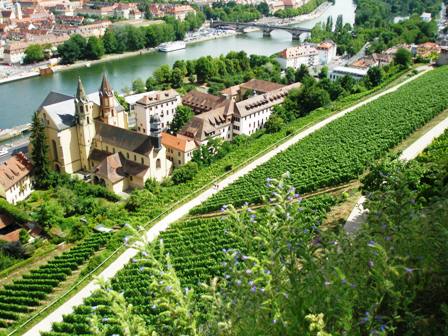
Wuerzburg at the Main river and its vineyards

The second part of the title sentence goes as follows: “…so the wine”. This is certainly true for Germany. I have to find a similar “alliteration” for Glenburn and the Upper Goulburn Wine Region.


Germany’s Best Riesling Wines 2007

August 30, 2008

Riesling vineyards in Olewig, Trier

The wine magazine – Weinwelt (Aug./Sept. edition) – I picked up at Frankfurt Airport when leaving Germany in August carried an article on the best Riesling wines in 2007.

About 1.500 wines were entered into this tasting and the overall winner (with 93 points) was

● Weingut Geheimer Rat Dr. von Bassermann-Jordan, Pfalz wine region with a
‘2007 Auf der Mauer Riesling QbA, dry’

Among the top seven wines were 4 from Pfalz, one from Austria, one from Rheinhessen and one from Franconia. For someone like me, a native of the Mosel, it is devastating that no wine from my home region was among the best seven.

Another Riesling competition in Bingen/Rhein in July had a record entry of almost 2,000 wines (1,937 to be exact) from 754 producers from almost all wine producing regions in Germany and from Austria, Canada, Australia, Luxembourg, France, USA, and New Zealand. Most of the non-European Riesling wines came (surprise), of course, from Australia.

The show is conducted every two years and 160 judges of an international jury assesses wines according to the international wine bureau (OIV) standards. The full report of this tasting can be found on www.riesling.de under the rubric “best of Riesling 2008”. In the category “dry Riesling wines”, the winner came from the Rheingau wine region:

● Weingut W.J. Schaefer in Hochheim for the
‘2007 Hochheimer Kirchenstueck Spaetlese’.

Number 2 came from the Mosel:

● Weingut Frank Brohl, Puenderich for the
‘2007 Puendericher Nonnengarten Spaetlese’

and from Pfalz,

● Weingut Emil Zimmermann in Wachenheim for the
‘2007 Wachenheimer Koenigswingert Spaetlese’.

In the “semi-dry Riesling category” wines from Rheinhessen, Mosel and Nahe could be found among the three top wines. However, the “sweet wine category” was dominated by Mosel wines.

There will be many more shows and wine tastings in the coming months. In July this year, when we tasted the 2007 vintage at Van Volxem Winery (Wiltingen, Saar), the “grand cru” wines were not yet presented because their release was scheduled for fall.

Given the fact that most wineries have not yet officially released their “gand cru” or, as the Germans say, “grosse Gewaechse”-wines, we will witness great quality Riesling wines of the 2007 vintage hitting the market later this year. That’s what I call wonderful prospects for us wine lovers.

My favorite Riesling from the Saar

PS: From October 14-18, 2008 the 2008 Canberra International Riesling Challenge will be conducted. For the first time in the history of the event, the number of entries has surpassed 500 wines (506 total entries), with a record number from Germany (99 entries). Let us see what the outcome may be.


Asian Food and Riesling Wines

August 17, 2008

The Riesling wines I selected for Sunday lunch were just the right complement to the Asian food we were having for the last joint family lunch in our Jakarta home. Tomorrow our girls will be laving for Bangkok to attend the opening of the new school year at their new school.

The lunch consisted of a typical Indonesian composition of Kankung (a green water vegetable) with prawns. We ate it with rice using spoons and forks only as it is the custom in Indonesia. The wine we had with the meal was of course not an Asian invention but a Celtic one.

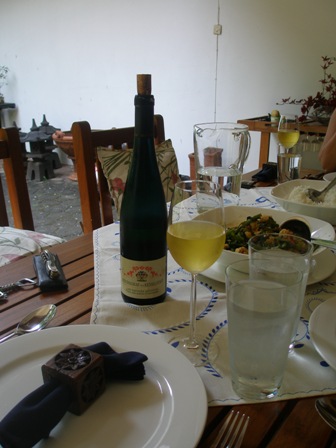
The semi-dry Riesling (“Feinherb” as the Germans say) from the Saar was a perfect match for the food. We had the last bottle of ‘2003 Wiltinger Gottesfuss Riesling Kabinett Feinherb’ , (alc. 11% vol.) from Reichsgraf von Kesselstatt in Trier (www.kesselstatt.com). The spicy food was just the right dish to have with this Riesling wine from my home region.

The sun was shining, my garden green and lush despite the dry season, and so 10 years came to a beautiful end for the four of us.

PS: As “dessert” we had a second bottle of German wine (which was also the last one in my possession), one coming from the Nahe wine region where my grandfather used to live, ‘2003 Sitzius Kreuznacher Rosenberg Spaetlese, Scheurebe’ (with only 9.5 alc./vol.) from Weingut Alfred Sitzius in Kreuznach-Bosenheim (www.weingut-sitzius.de). The variety is mainly found in Germany and Austria and produces highly aromatic wines often made into sweet wines but also available in its dry incarnation. It shows honey, blackcurrant and grapefruit flavors but retains also some of the Riesling character, though it is less acidic, in short beautiful wine can be produced from this grape variety.