Australia: WFA Vintage Report 2010

May 17, 2010

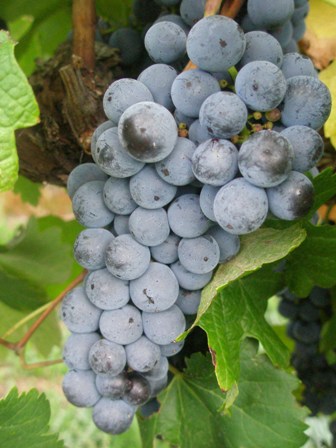
Two Hills Vineyard Merlot grapes 2010

The new figures are out. Today the Daily Wine News presented the Winemakers Federation of Australia (WFA) vintage report 2010. About 360 wineries participated in the survey, representing about 89% of total production.

The basic findings are well known to grape growers, vintners and wine makers. 2010 was a dreadful year especially for grape growers. The 2010 vintage of about 1.53 million tonnes (did they count my grapes as well?) was lower than 2009 (-12%) and 2008 (-5%).

The decline in white wine grapes was sharper (-14%) than the red ones (-8%), but I sold my white though almost nobody bought my Merlot and the Pinot Noir). My own experiences do not conform to the trend, I guess. Especially regarding my Pinot I must have missed something (+26% increase to 35,ooo tonnes). Or was it the other way round: because of the increased intake I could not sell my Pinot Noir?

Well the real reason is that my buyer walked out on me after a perfectly beautiful fruit which my buyer wanted to have some more days of sun was subsequently hit by rain and with it the destruction rain might bring at this time of the year.

Australia’s Sauvignon Blanc crush increased by 15%. OK, I sold all of mine. SB is still Australia’s third most important white variety after Chardonnay and Semillon.

Good that I ripped out my Cabernet (total production 213,000 tonnes), it further decreased in intake (by 14%) as did Merlot (total tonnage 109,000 tonnes), The big winner seems to be Shiraz which we unfortunately do not produce at Two Hills Vineyard. I love Australian Shiraz wines.

What does the enthusiastic Riesling drinker from the Mosel think of the Australia’s Riesling vintage: incredible, there is a 11% decrease in the crush of Riesling. Can you believe this? My most favoured wine available in much less quantity? I hope the quality shows just the opposite trend.


Les Ormes de Cambras – Merlot from France

May 9, 2010

I grabbed the bottle from the supermarket shelve. Just like that. Again, I liked the label. This time a traditional one, with some trees, an alley. Later I learned that they were elm trees. I also liked the price, below 450 Bath (about 11 EURO) which is cheap for Thai conditions. That of course also meant that this wine was a “cheap” one, considered the many import duties and the exorbitantly high Thai alcohol taxes.

‘Les Ormes de Cambras Merlot’, the wine is called (2008 vintage). It’s alcohol content is quite low (12.5%), the colour is a beautiful dark red. Since we produce Merlot ourselves, I am often intrigued to buy other peoples Merlot to see what it is like.

The website of Les Ormes de Cambras told me that the Merlot could be had for 2.30 EURO/bottle in France if you also buy the three other wines produced by this enterprise (a Cabernet Sauvignon, a Sauvignon Blanc and a Cinsault).

2.3 versus 11 EURO for the bottle. I wonder how much the producer of the wine gets from this? What is his profit? 20 cents? 30 cents?

Since the website does not say anything about a vineyard, I assume this is a mass wine of industrial dimensions. But it tasted much nicer than expected. I might consider to get some more bottles.

‘2008 Les Ormes de Cambras Merlot’, Vin de pays d’Oc, France

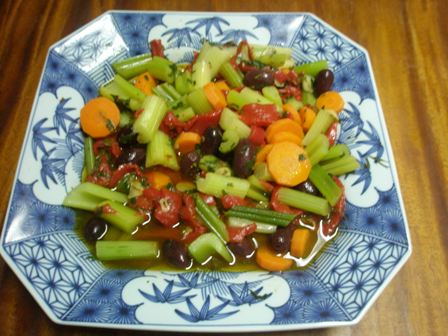
We always have food with our wine. It was a light dinner, just the celery salad with olives, carrots, peppers and garlic and some self-baked white bread. Delicious, and so healthy.

The Merlot was sufficiently well balanced, not heavy, a fruity almost elegant wine which went well with the salad.

A salad for dinner

The celery salad

By the way, Les Ormes de Cambras is located near the city of Béziers in Languedoc in the South-west of France.


Down under: Autumn time – harvest time

April 23, 2010

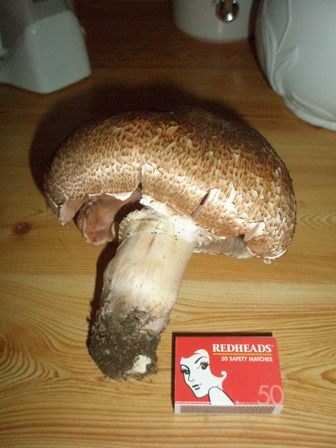
During long walks in the vineyard and around the paddocks we collected quite a few delicious mushrooms. The specimen above was particularly significant. Together with some other mushrooms it made a great pasta ai funghi porcini.

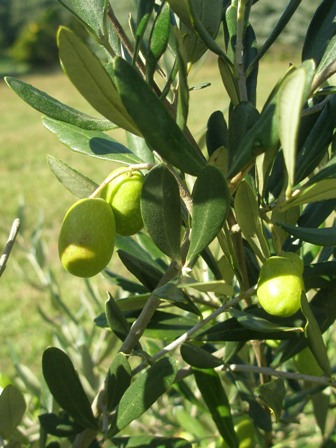
My olive grove was bady damaged during the bushfires last year. Only about 30 of my 100 olive trees escaped unharmed. Although there is lots of new growth from below, it will take years before the olive grove will take shape. However, there were still some beautiful olives to be harvested.

And of course, there were grapes, lots of them. Below a ripe Merlot bunch. It’s a pity that we could not sell all of our vintage this year. The grapes were very sweet and full of juice.

Autumn is a wonderful time in the cyle of the year. It was only the second time that we had the chance to experience it on our farm first hand. Happy days.


Vintage time at Two Hills Vineyard

April 13, 2010

Two Hills Merlot grapes 2010

This vintage is one to forget quickly. The few sales of grapes we had are not worth mentioning. The Merlot grapes looked good though (so did the SB and the Pinot Noir). We have to rethink our business model. But we are in good spirits and optimistic about the future of our undertaking.

Margit and the grapes


Getting ready for the 2010 vintage

February 22, 2010

Two Hills Pinot Noir shortly before the nets went on

The nets are on now, and we are expecting a good harvest at Two Hills Vineyard for 2010. After the total loss of last year the prospects are not too bad.

Estimates are:

– Sauvignon Blanc: about 8 tonnes of fruit, and already sold
– Pinot Noir: about 5 tonnes of fruit and still looking for a home

The Merlot grapes look good too, but we are not making any wine this year. This will make the bird in the vicinity very happy, what a feast. That’s the price we have to pay for the grape glut. It’s sad but cannot be helped at this point in time.

Our new tractor will come into action for the vintage. This will make things easier, I hope.
Let us hope no unexpected disaster occurs before the grapes are in safely.

The plan for 2011 is to mothball the vineyard for a couple of years and see if the market recovers.


Wine of the day: Climbing Merlot by Cumulus Wines

February 20, 2010

Cumulus Climbing Merlot

I do not drink much wine from New South Wales, except maybe Semillon wines from the Hunter Valley. The other day some wines from Cumulus Wines, the largest producer (about 500 ha under vines, not a boutique producer), located in the Orange Region, appeared in our supermarket in Thonglor, Bangkok.

I bought a couple of bottles from the Climbing Series (Shiraz and Merlot). My children liked the label. The ‘2007 Climbing Merlot’ won gold, silver and plenty of bronze medals. It’s a cool climate (grown above 600 m), fruity wine, elegant with a good structure, a delight of a wine, even if one has to fork out about 20 Euro/30 A$ for the bottle here in Bangkok.


Bordeaux wines: Château La Gravière and pasta for dinner

December 13, 2009

The amatriciana pasta

There are just too many châteaux out there. I confess that I do not know much about the wines from Bordeaux. This wine region produces between 700 and 900 million bottles of wine every year. It is divided into 57 appellations. About 10,000 producers call themselves ‘châteaux’, the number of grape growers is about 13,000.

Fortunately, Haut-Médoc, just north of the city of Bordeaux, at the left of the river Gironde covering about 4,600 ha of vines, is smaller but still carries lots of different châteaux. The area used to be marshland until Dutch merchants began to drain it in the 17th century. From grazing land to vineyards (reminds me of my own story and Two Hills Vineyard in Glenburn which is largely grazing land, but in the hills, no marshes to be seen), what a great success story.

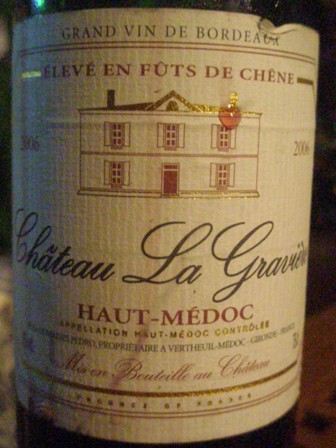
2006 Château La Gravière

Our friend Emmie had given us this bottle (above), a ‘2006 Château La Gravière’ from Haut-Médoc, after her return from Europe. The Château La Gravière is actually situated on the right bank of the river, in Lalande-de-Pomerol AOC. It’s a small producer with only 2.3 ha under vines whose flagship wines are Château La Gravière, a typical blend of Merlot (80%) and Cabernet Franc (20%) and Moulin de Gravière, its second wine.

The label is owned by the Rougefort Group. Total production from the Lalande-de-Pomerol AOC is about 500 cases per year. The Haut-Médoc wines (left bank of the river) are an addition to the portfolio. The character of the wines is quite different from the Lalande-de- Pomerol wines which is partly due to the blending formula, partly due to the different terroir.

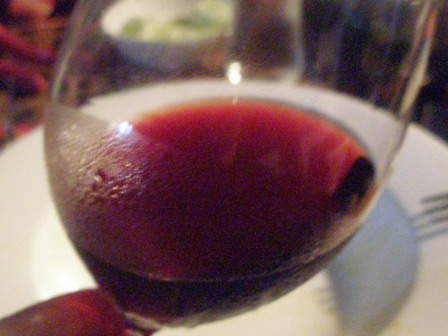
The colour of the wine

The wine was very pleasant, full of vanilla and berry flavours. We just loved it. It could cope well with the strong flavours of the amatriciana pasta and the bacon in it. My prejudices against Bordeaux wines (which are partly the results of my ignorance) were utterly refuted.


Climate change and grape varieties

November 2, 2009

RieslingSchoden

Riesling grapes in Schoden, Saar, shortly before vintage 2009

Uff, I am reading in todays “Your Daily Wine News” newsletter that some of Australia’s top wine experts think that over the next 20 years climate change will be responsible for the decline of Shiraz and Chardonnay and the rise of varieties such as Vermentino, Arneis, Nebbiolo, Pinot Grigio and Viognier (some call them “alternative varieties”).

This is bad news for me and my own small vineyard. At Two Hills Vineyard we have concentrated on some of the traditional French varieties: Sauvignon Blanc, Pinot Noir, Merlot and Chardonnay (first vintage in 2011 or 2012). Our fruit ripens usually well (if we do not suffer severe frosts) and shows a superior quality. But will that persist under the conditions of climate change?

I still remember vividly how I pulled out the 2 1/2 acres of Cabernet. it was hard work, wrapping a chain around every single vine and lifting the hydraulic of the tractor. I should have left them in, I guess. If temperatures rise in Glenburn, the drought persits, and/or we’ll have less percipitation in the future, Cabernet could have been the ideal variety for our spot. I ripped the vines out because the grapes would not fully ripen. At the moment we have sufficient water, our two dams are overflowing after years of drought but that might change quickly again.

Another issue is age, my age. At 55 I might still have a chance to enjoy some of the coming Chardonnay vintages but replanting would “cost” me many years of waiting. I could contemplate to plant on our second hill where we still have another 5-6 acres of space. Well, let us see what is going to come.

At least there is no politician who tells me what to do and chances are small that an elector such as Clemens Wenzeslaus of Saxonia, who changed the Mosel by instructing vintners to ripp out their red varieties and replant with Riesling, would appear on the Australian scene. However, danger is looming from the anti-alcohol lobby in Canberra which is working day and night to convince law-makers that the purchase of alcoholic beaverages needs to be made more costly for the consumer and profitable for the taxmen.


Greetings from Down Under: Two Hills Vineyard in Glenburn, Victoria

July 15, 2009

Down Under

Greetings from down under

Finally, I am on leave and I will enjoy a month long break at the family vineyard in Glenburn, Victoria. It is winter in the southern hemisphere but after many months in the tropics the cool temperatures of a Victorian winter do not scare me. After the devastating bush fires in February, a lot of cleaning up work awaits us.

Glen1

Lucy and Charlotte collecting debris from the fires

Every meal is accompanied by Two Hills wines. There are just a few bottles of the 2001 and 2004 vintages left which we consume with our meals. The ‘2006 Two Hills Merlot’ is very fruity, the intense cherry taste knocks you over. We have to organise the new labels for the 2006 vintage before going back to Bangkok.

But we drank also a lot of local wines, for instance from Giant Steps Vignerons in Healesville (2006 Harry’s Monster) in the Yarra Valley or from Rees Miller Estate (2004 Cotton’s Pinch Merlot) and Kinloch Wines (2003 Pinot Meunier) in the Upper Goulburn. Both Merlot wines went well with a Spanish omelette with mushrooms collected from our paddocks. Winter in Glenburn is just wonderful. The Pinot Meunier we had with a pasta.

Glen3

The mushroom omelette

Glen2

Lashings of Merlot from Rees Miller and Two Hills

Glen4

The lucky vintner


German wines: delight in red and white

July 4, 2009

Traveling in Germany I had the opportunity to taste some marvelous wines with some of my friends. Two of these I would like to briefly present to you, one red, one white wine, one from the Pfalz and one from my native land, the Mosel or to be precise the Saar.

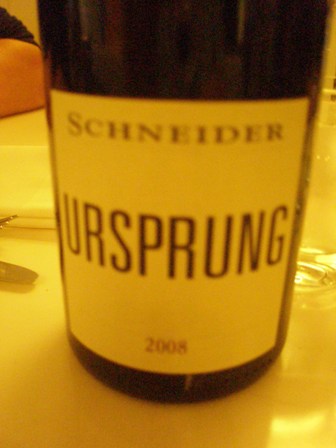
Over a dinner at “Schneeweiss”, a fashionable restaurant in the eastern part of Berlin offering “cuisine from the Alp mountain lands”, we had a bottle of ‘2008 Schneider Ursprung’, a cuveé made of Cabernet Sauvignon, Merlot and Portugieser by Markus Schneider.

Markus Schneider is one of the young but accomplished vintners who earned the highest praise from wine critics and experts from the wine and hospitality industry. This cuveé is made from grapes grown on a rather warm location at the “Feuerberg”, a terroir known for its capacity of heat retention by the local gravel stones which allows the grapes to fully ripen.

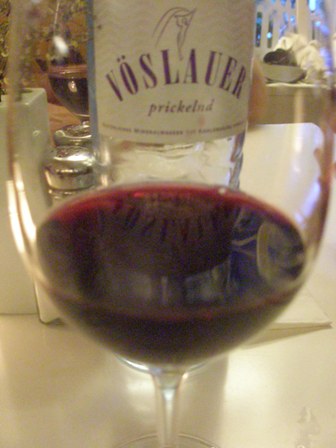
The wine is of a deep purple colour. It displays flavours of a lot of fruit, plum, some mint, chocolate and shows some peppery notes. The wine is very round and extremely smooth, for me just a bit too perfect in the mouth, I must say. It went extremely well with the food that I had ordered (Italian pasta filled with mushrooms). The wine is perfect and was a good choice. It retails for about 8 to 11 EURO but is worth the money.

Schneider Ursprung

A very simple label on the bottle: “Schneider Ursprung”

Schneider ursprung2

What a beautiful deep purple colour

Later the same evening, we tasted a dessert wine from my native lands, the Mosel, actually from the Saar river. It was a ‘1992 Ockfener Bockstein Riesling Spaetlese’ from “Staatliche Weinbaudomaene Trier”.

OckBockRiesAus

What a delight this wine was, a drop from heaven. It had aged well, was fresh and round. Although low in alcohol (only 8%), the acids were vibrant so that the wine was extremely well balanced, honey sweet, just wonderful. Only my friend Gerhard can wait for a wine like this to ripen in the cellar and patiently await the right moment to open a treasure like this.

I know the terroir quite well, Ockfener Bockstein, just a couple of meters away from the boundaries of the hunting grounds of my friend Heinz in Schoden, Saar which borders on Ockfen. The vineyards here are extremely steep and all work in manual. The 1992 vintage of this Riesling Auslese is just wonderful. I have no words to describe this nectar and do justice to the wine.

Address:
Schneeweiss
Kern Ranogajec GbR
Simplonstraße 16
10245 Berlin
Proprietors: Denis Ranogajec and Ralf Kern
Tel.: +49-30/29 04 97 04
Fax: +49-30/29 04 97 05

Weingut Markus Schneider
Am Hohen Weg 1
67158 Ellerstadt
(near Wachenheim, Pfalz)
Tel.: +49 (0)62…
Fax.: +49 (0)6237 – 977230

Administration:
Georg-Fitz-Straße 12
67158 Ellerstadt
info@black-print.net
http://www.black-print.net

Staatliche Weinbaudomänen Trier
Deworastr. 3
54290 Trier, Germany
+49 651 97598-0
www.staats
weingueter.rlp.de