Sunday treat – dry Riesling from Weingut Schäfer-Fröhlich, Bockenau, Nahe

September 30, 2012

Mother’s roe deer dish

Reminiscing about the past is one of the privileges of the not so young. A Sunday lends itself to such action, especially when considering the traditional German Sunday lunch.

Roe deer on noddles

While in my mothers house a few weeks back during our summer vacation, we were treated to roe deer goulash with noddles and salad. My friend Heinz, a passionate hunter, had reserved this particular piece of meat for me. He knows that I love game, especially meat of young animals.

Needless to say that this piece of roe deer was super delicious. When asked how they cook it, I can never quite figure out the recipe. Just simmering for a long time in a pot with some onions, is all what I could extract from the uttering of my mum. Well, I will have to prepare such a dish myself, one day and see.

The choice of wine was a foregone conclusion. Just a couple of days earlier we had visited the winery of the Schäfer-Fröhlich family in the village of Bockenau, Nahe.

In 1995 Tim Fröhlich took over the management of the vineyards and winery from his father. Today the estate has 16 ha under vines, some in the best locations in the vicinity (for instance Monzinger Halenberg, Monzinger Fruehlingsplaetzchen and Bockenauer Felseneck). His fine Riesling wines have won wide acclaim in the world of German wine. In 2010 Gault&Millau selected Tim for its “vintner-of-the-year award”.

The ‘2011 Bockenauer Riesling dry’ is a young wine. It comes from the hill just behind the winery. On the label it says “Schiefergestein” which means the the vines grow on blue and grey slate. I loved the lime and citrus aromas. The wine has great character, is fresh and exuberant. Its fine acidity shows great balance. This elegant Riesling has a long finish and might gain even more complexity when aged. No chance to age for this bottle, though. We needed it with the deer dish on that Sunday to bring absolute enjoyment to the Adam family.

PS: If you want to know where the grapes for this were grown, please visit Weinlagen-Info.de. My wine blogger friend, the winegetter, made me aware of this handy tool to find the vineyards and places where the grapes come from.


Summer wine – Merlot Rosé from the Mosel River

August 31, 2012

The sun in a glass of rosé

When we arrived in germany the temperatures were not excactly summer like. However, that changed over the course of the four weeks. Luckily there is plenty of “summer wine” available, young wines with low alcohol levels which excite the palate also of the non-wine drinker.

Nothing is better fitting a barbecue than a nice and clean rosé wine. My friend Josef’s main house wine producer is the winery of Rudolf Hoffmann in Detzem, Mosel. This is partly because vintner Hoffmann has leased some of his vineyards from the Arnoldi family, and my friend Josef is married to an Arnoldi girl. Both love to drink wines made from the vineyards which were once cultived by the parents and grand-parents.

Lovely Merlot Rosé by Rudolf Hoffmann, Detzem

And here we are with a ‘2010 Esprit Merlot Rosé’ by Rudolf Hoffmann from Detzem, Mosel. This is exactly how you want a rosé to be. The Merlot’s fruitiness is here a bonus as well as the alcohol of only 11%. I suggest: drink more of this type of Mosel wine.

If German summers would just be a bit warmer…..

Address:
Weingut Rudolf Hoffmann
Neustraße 19
54340 Detzem, Germany
Tel.: +49-173 3573982
www.weingut-hoffmann.de


Assmannshausen Hoellenberg Spaetlese – Best Pinot Noir of my summer holidays

August 28, 2012

View of the Rhine from Bingen looking downstream

Well, if you could just see around the bend in the river, you could see Assmannshausen and its steep vineyards. The vineyards you see in the distance on the other side of the Rhine river here in the photo above are in fact the ones of Ruedesheim. However, you will get a good idea how steep these terroirs are and what a hell of a lot of work it is to cultivate the grapes on these steep slopes.

‘Hoellenberg’is the name of the location (terroir) which means in English (freely translated) ‘mountain of hell’, a quite common name for steep slopes in the Rheingau wine region.

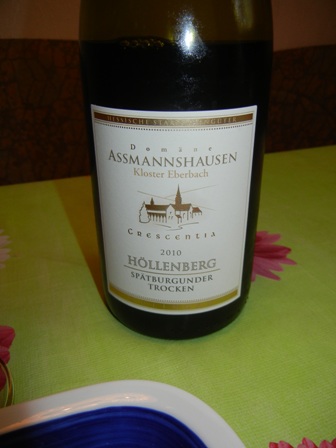
In short, the best Pinot Noir (spaetlese, late harvest) I tasted during my five weeks in Germany was a ‘2010 Hoellenberg Pinot Noir Spaetlese’ from Assmannshausen produced by Kloster Eberbach in the Rheingau.

2010 Assmannshausen Hoellenberg Spaetlese – Pinot Noir

I bought the bottle in the wine shop at Kloster Eberbach for about 17-18 Euro, I think and it turned out to be a treasure. Pinot Noir of the finest kind. Pinot Noir the way I like it, full of flavours but well balanced, earthy with a vibrant acidity, a good body, structure and a long finish. A wine with character.

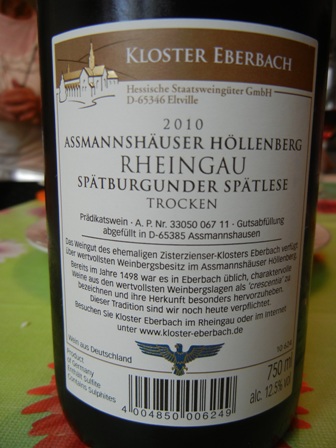
At 12.5. % alcohol, this wine is not overpowering but elegant, regal I would even say. I immediately regretted that I had not bought more bottles. I was to fast, as always, impatient. At the time I did not want to stand in line for the tasting on this busy Sunday afternoon when we had dropped in the cellar door at the monastery in Eberbach.

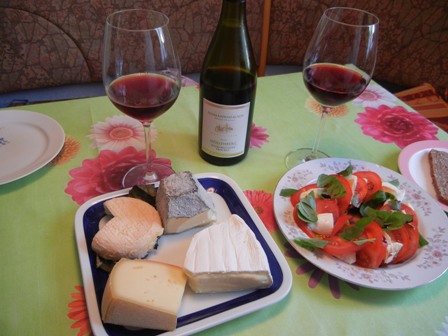
A selection of cheeses and salads

We had the wine in a very casual way with some summer dishes, salads and typical German dinner cold cuts and an insalata caprese. The wine would have matched almost any food except some spicy Asian dishes. but it is worth being enjoyed as stand alone drink.

My rating: four and a half out of five stars, 19 of 20 points, 90 Parker points. I could not be more subjective, I guess. In hindsight and given my memory lapses, I consider this the best wine I drank during my summer vacation.

The only one exception maybe was the wine tasting at Karthaeuserhof in Eitelsbach which I attended at the last day of the holiday, but then we merely tasted (small amounts of excellent wines in big glasses and without food) and did not drink a bottle of wine.

More about this event, another time. Stay tuned to the Man from Mosel River.


Roman Villa Urbana in Longuich, Mosel

August 27, 2012

Vineyards near Longuich – Opposite the steep slopes of the Mosel

The cultivation of grapes along the Mosel river and its tributaries Saar and Ruwer is more than 2,000 years old. For the Romans wine was an important commodity. All along the Mosel river one can find traces of the Roman wine industry, among them wine presses and fermentation tanks, vineyard implements, residues of grapes, statues of gods and godesses etc.
Among the treasures are the ruins and foundations of many Roman rural villas. One of them can be found in Longuich-Kirsch, just a few kilometers downstream from my hometown Trier. Various types of these villas can be distinguished. Some of them contain large mosaics as the villa in Nennig.

The villa in Longuich is a “villa urbana”, the seat of a retired high official. It is very large (110 x 28 meters). It was built in the 2nd century after Christ and includes an extensive Roman bath consisting of a Caldarium (hot bath), Tepidarium (warm bath), Sudatorium (sauna), Frigidarium (cold bath) and Praefurnium (fire and heating system).

The foundations of the villa were accidentally discovered during land consolidation and reconstruction work in 1984. Next to the villa some agricultural buildings we found as well.

The villa urbana was restored and is today open to the public. Various billboards inform the casual visitor about various aspects of roman life including the two thousand years of grape and wine production.
Imagine that so long ago people were working in vineyards and wineries in the very same places where also todays wine is produced. Amazing. The work was even harder than today, I guess.

The production techniques of the Romans are well researched. The billbords explain todays challenges and how they were mastered recently. I loved the way ancient history was linked to contemporary modern life. I highly recommend visiting these villas. The view over the valley and its vineyards is another great experience.

Fortunately, the vineyards in the vicinity of the villa are still productive, and many wineries and vintners are happy to welcome visitors and introduce them to their excellent Riesling wines.


Weinhaus Gut Suelz revisited

August 22, 2012

Weinhaus Gut Suelz

When I was a student at Bonn Univerity and I lived at the right hand side of the Rhein river (they call it the “schael Sick”, the shoddy side of the river), I visited this place in Oberdollendorf regularly.

The building

Sometime we would just walk from Niederdollendorf through the forest to get there, sometimes we would cycle along the Rhain river. It was one of our preferred destinations. We would relax in the garden and enjoy some bottles of local wine.

The garden with the vineyards on the hillside

We came there recently to end our visit to Koeln and Bonn (including a visit to the house of german history). It was the highlight of the day so to speak because my wife and the children had never been there before. I wanted to share with them some of my past.

The weather was a bit cloudy, and it was a Thursday, consequently only young and not so young lovers and retirees where there when we arrived.

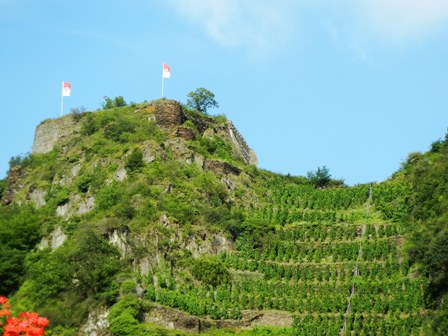
The vineyards in a theater facing the South

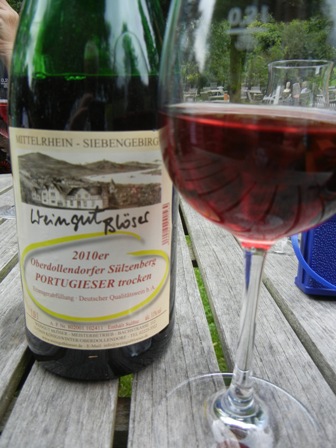
The Weinhaus Gut Suelz is located at the bottom of a kind of natural theater, sourrounded by vineyards with the forests on top of the hills, at the edge of the village. The vineyards, however, do not belong to the ‘Weinhaus’, Suelz does not have it’s own production. But I knew one of the vinteners of these vineyards, the Bloeser family. Indeed I have written about them years ago on the Man from Mosel River.

Blauer/Blue Portugieser by the Bloeser winery

I did not fancy a Riesling but instead wanted something special, something local. The Blauer Portugieser (in France known as Portugais bleu), a traditional grape variety from Austria (yes, Austria and not Portugal) wine seemed just the right stuff.

It is a light, but dark red wine, with a medium to light body, soft tannins and low acidity, an uncomplicated wine one could say. very good for a sensitive stomach. It meant home to me somehow, or as we Germans call it “Heimat”.

Apple juice from ‘Streuobstwiesen’, a traditional biotop under threat

The service was very good. We ordered “Flammkuchen” (a traditional dish from the German Southwest and the French East -Alsace) which seems to have gained the upper hand when it comes to dishes one orders together with wine these days.

Flammkuchen

You can see from the photo above that this was truly worth it.
My tip: if you are in the vicinity, drop in. There is a great choice of wines, not only local ones but many more from around Europe. And enjoy.

Address:
Weinhaus Gut Sülz GmbH.
Bachstraße 157
53639 Königswinter – Oberdollendorf.
Tel.: +49-22 23 – 30 10.


Restaurant review: Gasthof zur Saffenburg, Mayschoss, Ahr

August 20, 2012

Castle Saffenburg in Mayschoss, Ahr

All good things come to an end. That applied also to our family vacation. From the Ruhr we made our way back to the Mosel region. Since we had some spare time on our hands, we decided that a short visit to the Ahr wine region would just be the right distraction.

The Ahr wine region is one of the smaller wine region in Germany (about 600 ha under vines). Despite its northern location the Ahr wine region is dominated by red wine production (about 80%),and is most famous for its outstanding Pinot Noir wines.

Country Inn zur Saffenburg in Mayschoss, Ahr

Since we were also hungry we dropped in at a counrty inn called Saffenburg in Mayschoss at the banks of the Ahr river.

The courtyard of the inn

Mayschoss, a small settlement with about 1,000 inhabitants, is also home to the oldest wine co-operative in Germany (founded in 1868).

Today the Mayschoss-Altenahr Wine Co-operative as it is called, has about 400 members and covers 140 ha under vines. It’s cellar door is located opposite the country inn.

Gasthof zur Saffenburg

The first thing I did was oder a glass of Pinot Noir made by one of the famous Ahr producers: Jean Stodden.

Jean Stodden Pinot Noir

This is the “ordinary” Pinot Noir produced by Stodden but a good specimen of what the Ahr has to offer in Pinot Noir. Unfortunately, we had no time for a tasting at Jean Stodden. Instead we planned to pay a short visit to the wine co-operative across the street after our meal.

Nuernberger sausages with Kraut

German cuisine has a lot of very tasty dishes to offer. We went for Nuernberger sausages (photo above) and beef stew (photo below).

Beef stew

I love German cake

Irresistable were the cakes on offer, together with a coffee, they concluded our meal. Needless to say that the food was delicious. We sat on the terrace in the yard. The service at the country inn is exceptionally good. Five out of five, I would say. We had a jolly good time on our last day of our excusion in Germany.

The steep vineyards behind the inn on the other side of the Ahr river

I plan to also inform you about our visit to the wine co-operative in Mayschoss. Stay tuned.

The Ahr wine region is a very popular destination for day travellers but also suitable for longer excursions. I highly recommend the “Rotwein-Wanderweg”, the red wine hicking path crisscrossing the region with breathtaking views of the vineyards and the small settlements. Ideal is to explore the valley on a push bike.

Please also visit my blog entries from November 2007 regarding DAGERNOVA, another wine co-operative and vintage time along the Ahr.

Address:
Gasthof zur Saffenburg
Rotweinstrasse 43
53508 Mayschoss
Tel.: + 49 (0) 2643-8392
Handy + 49 (0) 171–9369257
Fax: + 49 (0) 2643-8100
E-Mail: info@gasthof-saffenburg.de
http://www.gasthof-saffenburg.de


Kloster Eberbach, Rheingau

August 7, 2012

The Rheingau wine region

Because of a flight delay we had a couple of hours on our hands with nothing to do. This provided us with an unexpected but welcome opportunity to visit the Rheingau wine region. So where to go and what to do?

Some years ago I had been to Eltville, one of the many small and pretty settlements with extensive wine culture and history. Last year in November I met a couple of professors from the famous wine institute in Geisenheim, Rheingau at the 3rd International Symposium on Tropical Wine in Chiang Mai, which further nurtured my curiosity in the Rheingau wine region.

So I typed “Kloster Eberbach” into the navigation system of the hired car and off we went to this place near Eltville which I had always wanted to visit. We were looking for some mix of culture and wine. In no time we were cruising the country roads of the Rheingau.

Vineyards and farm buildings

The region on the right side of the Rhein river between Wiesbaden and Assmannshausen is like a Garden Eden of the modern world. The slopes of prime vineyard land descend gently towards the Rhein river. The land is very fertile and the climate very suitable for the production of first class wines, mainly Riesling.

The top of the mountain ridges of the southern Taunus are crowned with deep forests. Many of the villages and settlements are very beautiful. Every year millions of tourist flock to places like Ruedesheim, Geisenheim, Erbach and Eltville.

The Eberbach monastery

Our destination, the Eberbach Monastery, formerly a Cistercian Abbey, is a kind of museum today. We had a look at the old church, the cloister and the various rooms used by its monks from the 12th century until the French revolution and the secularization of church property under Napoleon.

Fortunately, the grape-growing and wine-making tradition of the monks has been preserved. Today the state of Hessia is the owner of the vineyards and winery “Kloster Eberbach”. The monastery offers a range of programs related to wine, special tastings for instance in the historic wine cellar, and has a “vinothek”, a kind of cellar door or wine shop.

The wine shop of Kloster Eberbach

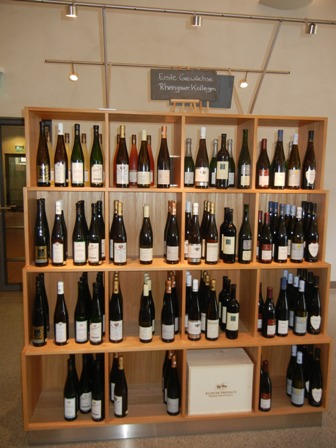
The “vinothek” wine shop does not only offer the wines of Kloster Eberbach but also of vintners and wineries of the surrounding villages and terroirs. The shop was packed with buyers on this Sunday afternoon. I browsed through the various shelves with wines from different locations and of different quality categories. I tried to stick to a certain budget which did not allow for grand cru wines.

My selection

In the end I settled for three wines only, one Riesling and two Pinot Noir wines. The Riesling came from the most famous and oldest terroir called “Steinberg” (stone mountain) right behind the monastery. The Pinot Noir Spaetlese from Assmannshausen was a bit pricier (17.40 EURO). It should turn out to be the best Pinot Noir I drank while holidaying in good old Germany.

Address:
Kloster Eberbach Winery
65346 Eltville am Rhein
Tel.: +49-6723-6046-0
www.kloster-eberbach.de

PS: When I studied agricultural economics at Bonn University, my master thesis was (among others) also dealing with the farming activities of the Cistercian monasteries and how they influenced land markets. I had visited Himmerod Abbey, a Cistercian monastery near Trier, but had never visited the equally famous Eberbach Abbey.


“Weinsinnig” – wine bar in Trier

August 4, 2012

One of my favourite wine bars in my home town Trier is “Weinsinnig”, located right in the center of town.

The name of the bar is a kind of word play on “Wahnsinnig” (in English “mad” or “crazy”), and composed of two parts, a nomen, “Wahn” or “mania” (in English) and an adjective “sinnig” which can be translated as “plausible”, “make sense”, “evident”, “sensible” or “witted”. In the combination with “Wein”/”wine” it becomes something new, a compound with a new meaning which could be translated as “in the mood to enjoy wine”, “wine is sensible” or “crazy for wine”.

Weinsinnig is also a kind of cellar door for wineries from the Mosel. Moreover, it offers selected culinary delights, for instance “Flammkuchen”, a tarte flambe. And last but not least, Weinsinnig offers various activities related to wine and the people making it.

In front of the ‘walk along wine list’

It was a rainy summer’s evening when we visited and therefore we sat inside. Weinsinnig offers also a couple of chairs and tables outside. One sits on the pavement on a narrow street. Fortunately, warm blankets are on offer.

My choice: a dry Riesling from the Ruwer

I love their selection of local wines, many of them produced by young and innovative vintners. I chose a ‘2011 Maximin Gruenhaeuser dry Riesling’ by one of the top producers from the Ruwer valley, von Schubert’sche Gutsverwaltung. I also bought some more of this wine and will only say that this is a Riesling to die for.

2011 Maximin Gruenhaeuser dry Riesling

Inside

By the way TripAdvisor rated it 4 of 5 on 16 Jun 2012 and ranked Weinsinnig as 69 out of 182 restaurants in Trier. In my view Weinsinnig belongs to the “must visit” category in Trier. Check it out.

Address:
Weinsinnig
Palaststraße 12
54290 Trier, Germany
Tel.: +49-651 9790156


Restaurant review: Brasserie, Gendarmenmarkt, Berlin

July 30, 2012

The other day in Berlin I had a hearty meal at Brasserie Gendarmenmarkt, one of the most lovely public squares in the German capital.

The weather was very nice so we sat outside on the pavement but the inside of the restaurant is worth having a look at.

The salmon with the cream cheese was a wonderful starter. Since it was an unusual hot day, a light meal was just the right choice.

The main course was a pasta. Is the photo of the pasta with the red pepper and the greens not nice?

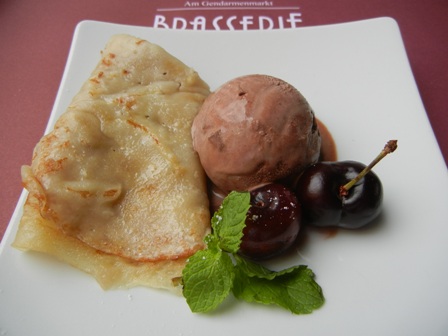
And I could not resist the dessert, some ice cream with a pancake. All very delicious.

I had a glass of white wine with the meal. I selected the dry Riesling from the Rheingau. It was a ‘2009 Riesling QbA dry’ by the Debus Winery in Gau-Odernheim, Rheingau.

This Riesling wine is for easy drinking, ideal on a hot summer’s day. I decided to visit the Rheingau wine region and learn more about the wines produced in this very famous part of Germany.


The art of blogging and wine from Caves Alianca Dao, Portugal

July 11, 2012

No blog entry for two weeks, goodness me. Why I am so busy? It seems this is a terible time. No time for my blog. Moroever, I am going on an extended trip to my hometown Trier, Germany (this time on vacation), where I have very ittle access to the internet. Therefore the prospects are grim. Please bear with me. I plan to continue my blog despite the odds.

Today I have a last entry before the blog-free seasons starts. The good news is that I will be visiting the Mosel and its tributaries. This also means that I will probably visit some wineries and taste some delicious wines. I should come back to Bangkok with many more stories to tell and share.

A beautiful dark red colour

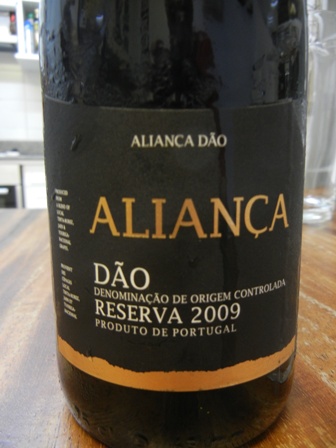
Last night, we had with our meal a beautiful red. It was a ‘2009 Caves Alianca Dao Reserva’, a blend of various Portuguese grape varieties (the label says: Tinta Roriz, Alfrocheiro, Jaén, Touriga Nacional).

The Dao wine region is consistently producing outstanding wines. Ever since our holiday along the Douro river, I am a big fan of Portuguese wines.

Caves Alianca Dao Reserva

With 14% alcohol this wine is big and mighty. It is also very smooth with lots of forest fruit. There is some hint of vanilla (from the oak). The wine has a good mid-pallet weight and a long finish.

The back label of the Alianca Dao

In Europe the wine retails for about 7 Pounds.

We had this beautiful and delectable wine with very spicy green beans and a beef fillet. Woh, that meal was super delicious and the wine was just a perfect match. I wish we had more of it. Well.

Soon we will be at the shores of the Mosel river and ive into the tasting of Riesling. What a consolation.